


Kotak's integrated report is short, tidy and Board-approved, with one of the clearest value creation spreads in Indian banking. But its MD & CEO's letter, dated nine days after he said he would not seek a second term, never mentions it, and its customer chapter claims faster complaint handling while the RBI table shows complaints pending beyond 30 days rising almost tenfold.
In this article
 In short
Key takeaways
- Ashok Vaswani's MD & CEO letter is dated 6 July 2026 and ends 'Let's keep going!'. Nine days earlier the Bank had told the stock exchanges he would not seek re-appointment when his term ends on 31 December 2026. The report records this only in the Directors' Report (p. 231) and the corporate governance report (p. 325). There is no Chairman's message.
- The KPI page (p. 18) gives every headline number with a five-year CAGR and no prior-year figure. The five-year table (p. 50) shows consolidated RoE at 11.28%, the lowest of the five years, against 13.12% in FY 2024-25, and reported consolidated profit down from ₹22,126 crore to ₹19,288 crore.
- The customer chapter (p. 32) reports a 33% cut in complaint resolution time. The RBI-format table (p. 184) shows complaints received up 7% to 2,24,585, complaints pending at year-end up from 5,325 to 10,226, and those pending beyond 30 days up from 434 to 4,190.
- On the double materiality matrix (p. 43), 'Climate and ESG risks' and 'Sustainable Finance' are plotted at the lowest financial materiality of all 15 topics. The report discloses no financed emissions and no emissions target; the Bank's renewable electricity share is 5.2% (p. 40).
- Subsidiaries delivered 27% of consolidated profit (p. 11). Kotak Mahindra Capital's profit after tax rose from ₹361 crore to ₹1,444 crore (p. 52), while BSS Sonata Microcredit lost ₹73 crore for a second year.
- Seven product advertisements appear in the narrative section, four of them inside the strategy chapter (pp. 12-14), plus a half-page credit card advertisement in the customer chapter (p. 32).
Official report: Get the Kotak Mahindra Bank Integrated Annual Report 2025-26 from the company's website. This page is The Footnotes' independent review of it.
Verdict: Kotak has written one of the tighter integrated reports in Indian banking, and then left the year's two most uncomfortable facts for readers to find in the back half. Its MD & CEO is leaving at the end of 2026, and its complaint backlog grew. The narrative section mentions neither. Score: 21 of 35.
This is the Bank's 41st annual report and its sixth integrated one. Everything is in one 447-page PDF: a narrative of about 45 pages ("Kotak at a Glance" and "Building for the Long Term"), financial highlights, the consolidated and standalone accounts, the Directors' Report, the Management Discussion and Analysis, the corporate governance report and the BRSR. Page numbers below are the printed ones. Screenshots are small excerpts reproduced for review and remain the copyright of Kotak Mahindra Bank Limited; the full report is on the Bank's investor relations pages.
The letter that doesn't say goodbye
Ashok Vaswani's letter to shareholders (pp. 8-11) is headed "Let's keep going!" and ends the same way. It is a confident document. He says the first two years of his tenure were spent working through the RBI's technology embargo, stress in unsecured retail loans and senior leadership changes, and that "the best is genuinely ahead of us".
It is dated 6 July 2026. On 27 June, the Bank had told the stock exchanges that Mr Vaswani would not seek re-appointment when his term ends on 31 December 2026. The report does record this, in one paragraph of the Directors' Report (p. 231) and a note in the corporate governance report (p. 325): the Board "has respected his decision and has initiated the process for the appointment of a new Managing Director & CEO".
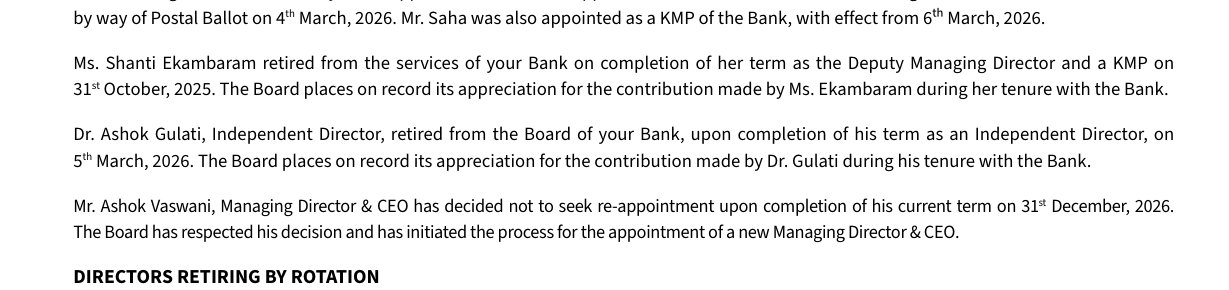
A reader of the narrative section would not know. The letter sets out a multi-year strategy, three pillars and a "next phase", and gives no hint that the person signing it will not lead that phase. The governance chapter (pp. 22-25) says succession planning "is supported by a structured framework" without mentioning the one succession under way.
Nor is there anyone else to say it. The report has no Chairman's message. C. S. Rajan, the independent part-time Chairman, was re-appointed to October 2027 (p. 325), and appears only in the Board photograph (pp. 6-7). The year also saw the Deputy MD retire, two whole-time directors appointed and an independent director retire (p. 231). That is a lot of change at the top of a bank to leave entirely to the statutory pages.
A KPI page that only looks back five years
The KPI page (p. 18) shows the year's headline numbers. Every growth figure is a five-year CAGR: total assets 16%, net profit 14%, book value per share 16%. None has a prior-year comparison. The ratios beside them (RoA 2.06%, RoE 11.28%, NIM 4.60%) stand alone.
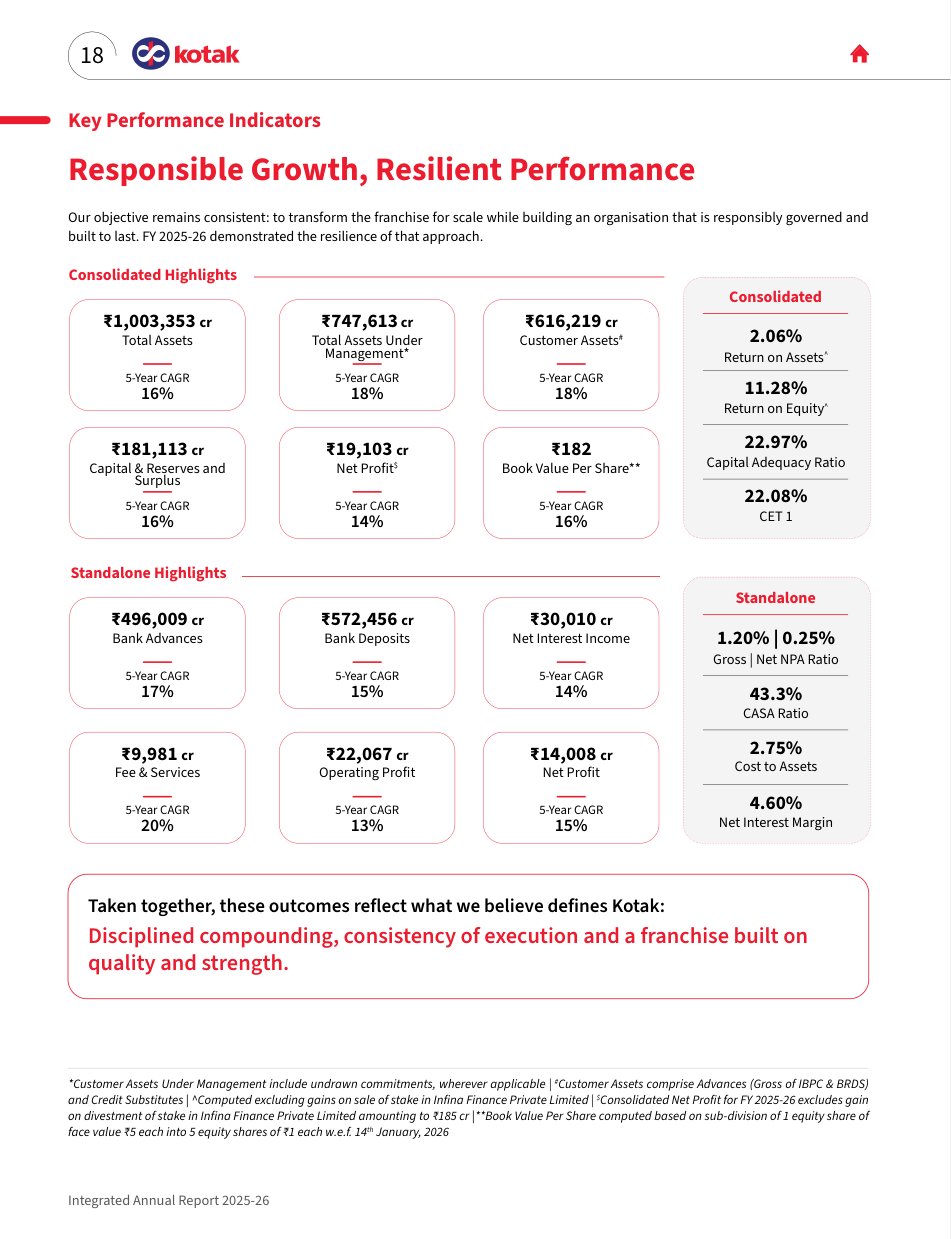
Five-year rates are a fair way to show a franchise. They also smooth over a weaker year. Turn to the five-year tables (pp. 50-51) and the year is plain:
- Returns fell. Consolidated RoE was 11.28%, the lowest in the table, against 13.12% in FY 2024-25 and 15.08% in FY 2023-24. Consolidated RoA fell from 2.36% to 2.06%.
- Profit fell on a reported basis. Consolidated profit was ₹19,288 crore against ₹22,126 crore, and standalone profit ₹14,008 crore against ₹16,450 crore. Both prior years included a gain from selling 70% of the general insurance business to Zurich. Excluding it, standalone profit rose 2.1% (p. 226). That is a reasonable explanation, and the Directors' Report gives it. The KPI page doesn't.
- Margins narrowed. Standalone NIM fell to 4.60% from 4.96% and 5.33% two years earlier, which the Directors' Report attributes to rate cuts and a book that is 63% repo-linked (p. 226).
- The market noticed. Market capitalisation fell from ₹4.32 lakh crore to ₹3.52 lakh crore, and price-to-book from 2.74 to 1.94 (p. 50).
One number on the standalone table (p. 51) also doesn't match. It shows FY 2024-25 RoA as 2.65%, beside a net profit row that excludes the Zurich gain. The MD&A (p. 281) puts the like-for-like figure at 2.21%. The 2.65% appears to include the gain, which makes this year's fall to 1.97% look steeper than it was.
Similarly, the CEO's letter says profit growth was "supported by moderation in credit costs", citing a fourth-quarter exit rate of 39 basis points. For the full year, credit cost rose to 65 basis points from 60 (p. 283).
Complaints: faster, and also more of them
Complaints pending at year-end
Of those, pending beyond 30 days
The older backlog grew to 9.65 times its previous level. Average speed and unresolved cases measure different parts of the experience.
Source of figures — Kotak Mahindra Bank Integrated Annual Report 2025–26, pp. 32 and 184–185, as cited in this review. Bars share a zero baseline.
The customer chapter (p. 32) says the Bank "reduced average complaint resolution time by 33%", and the value creation model repeats the figure as a headline customer outcome. The RBI-format complaints table in the notes to the accounts tells a different story.
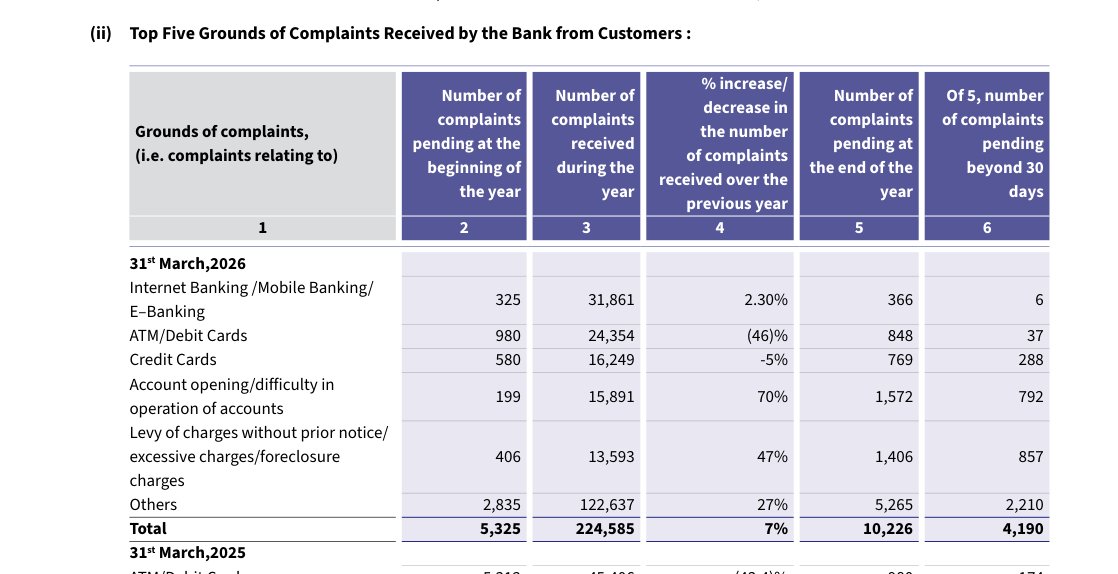
The Bank received 2,24,585 complaints, 7% more than the year before. Complaints pending at year-end almost doubled, from 5,325 to 10,226. Those pending beyond 30 days rose from 434 (p. 185) to 4,190. Complaints about account opening rose 70%, and about charges levied without notice 47%. Of 2,19,684 complaints disposed of, the Bank rejected 1,07,345 (p. 184). Complaints escalated to the RBI Ombudsman rose to 6,233 from 5,173.
Both things can be true. Average resolution time can fall while the tail of unresolved cases grows. But an integrated report is supposed to connect them, and this one presents the improvement on page 32 and leaves the backlog to a regulatory schedule 150 pages later.
One spread from capitals to outcomes
- 01Six capitals
Resources allocated
- 02Four businesses
Banking and lending, capital markets, asset management, protection
- 03Three pillars
Strategy executed
- 044C outcomes
Customer, company, colleague, community
Simplified from the model on pp. 16–17. Governance and materiality frame the flow. The review also asks for clearer trade-offs between capitals.
The report's best page is its value creation model (pp. 16-17). It reads left to right in four columns: how capital is allocated (six capitals, each with two or three numbers), how value is created (the four businesses: banking and lending, capital markets, asset management, protection), how strategy is executed (three pillars) and how outcomes are measured (the "4C" framework of customer, company, colleague and community). Governance and materiality run along the bottom as the frame for all of it.
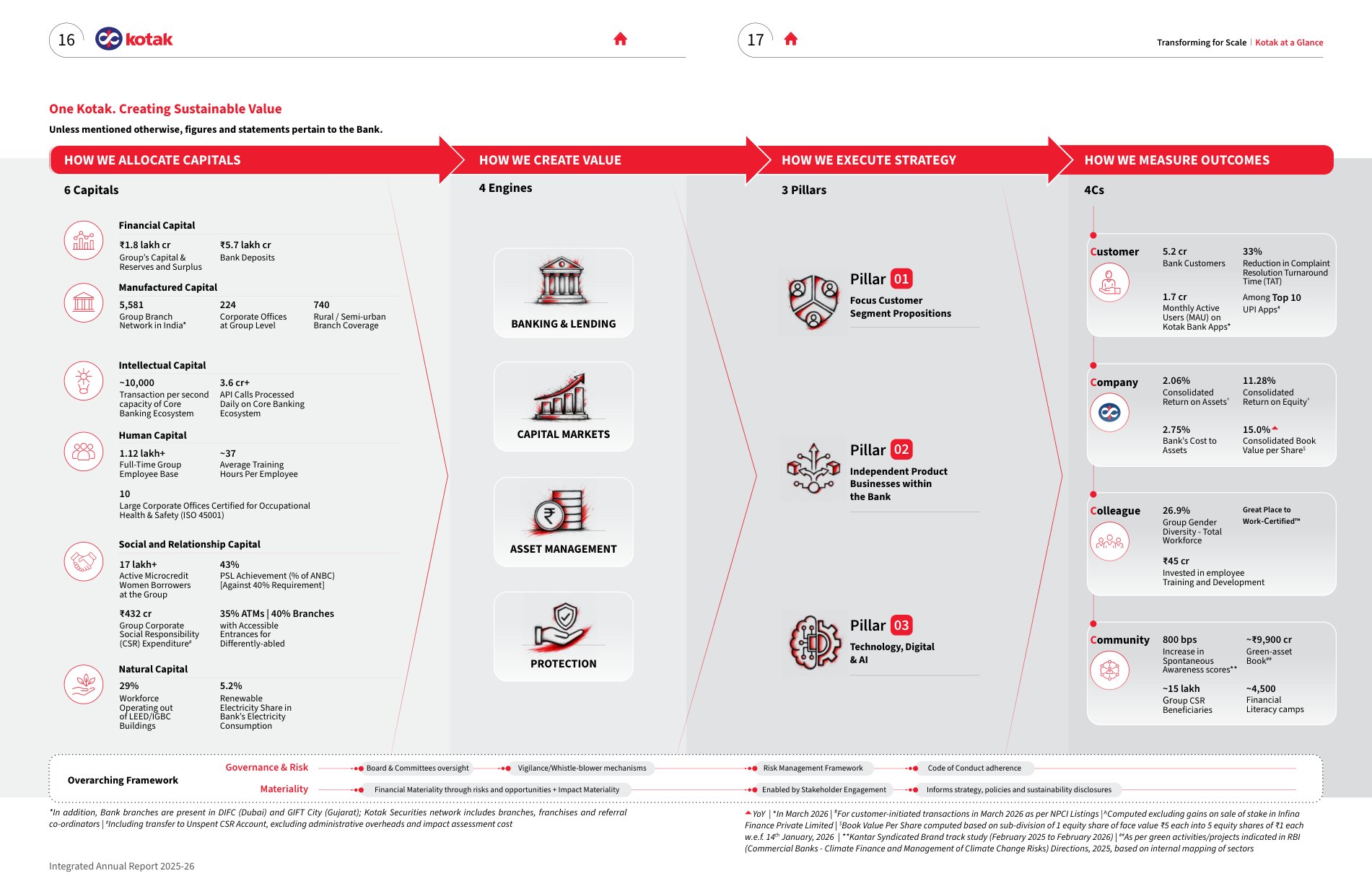
This is the flow from inputs through activities to outcomes that HDFC Bank's model, a table spread across two places 176 pages apart, lacks. Each later chapter opens with a box naming its material topics, capital linkage and SDGs, so the reader can follow the thread. The strategy pages (pp. 12-15) give each business a short role ("the relationship anchor", "the compounding machine") and a few numbers: SME advances up 19.4% to 23.9% of the book, Kotak811 holding 12.2% of the Bank's savings balances.
What the model lacks is trade-offs. The capitals are listed as stocks (₹1.8 lakh crore of capital, 5,581 branches), not as things being consumed or built, and the 4C outcomes celebrate an 800 basis point rise in brand awareness while RoE appears without its prior-year figure. The strategy chapter also says the seven strategic themes of FY 2023-24 are "presented in the Materiality Assessment section". They are not there.
The four-engine story is well supported further back. "Consolidation at a Glance" (p. 52) shows each subsidiary's profit and net worth for two years, which most Indian groups leave to the notes. Subsidiaries contributed 27% of consolidated profit (p. 11). Kotak Mahindra Capital's profit rose from ₹361 crore to ₹1,444 crore in a year of 22 IPOs and seven QIPs (p. 13); the microfinance subsidiary, BSS Sonata, lost ₹73 crore for a second year.
Climate: the lowest-ranked topic on the matrix
The materiality chapter (pp. 43-45) is better than most. It names its method (GRI 3 and the double materiality principle of the European ESRS), plots 15 topics on impact against financial materiality, groups them as value drivers, enablers and protectors, and gives each a description, capital linkage and a KPI. The Board approves the material topics, according to the "About this Report" page.
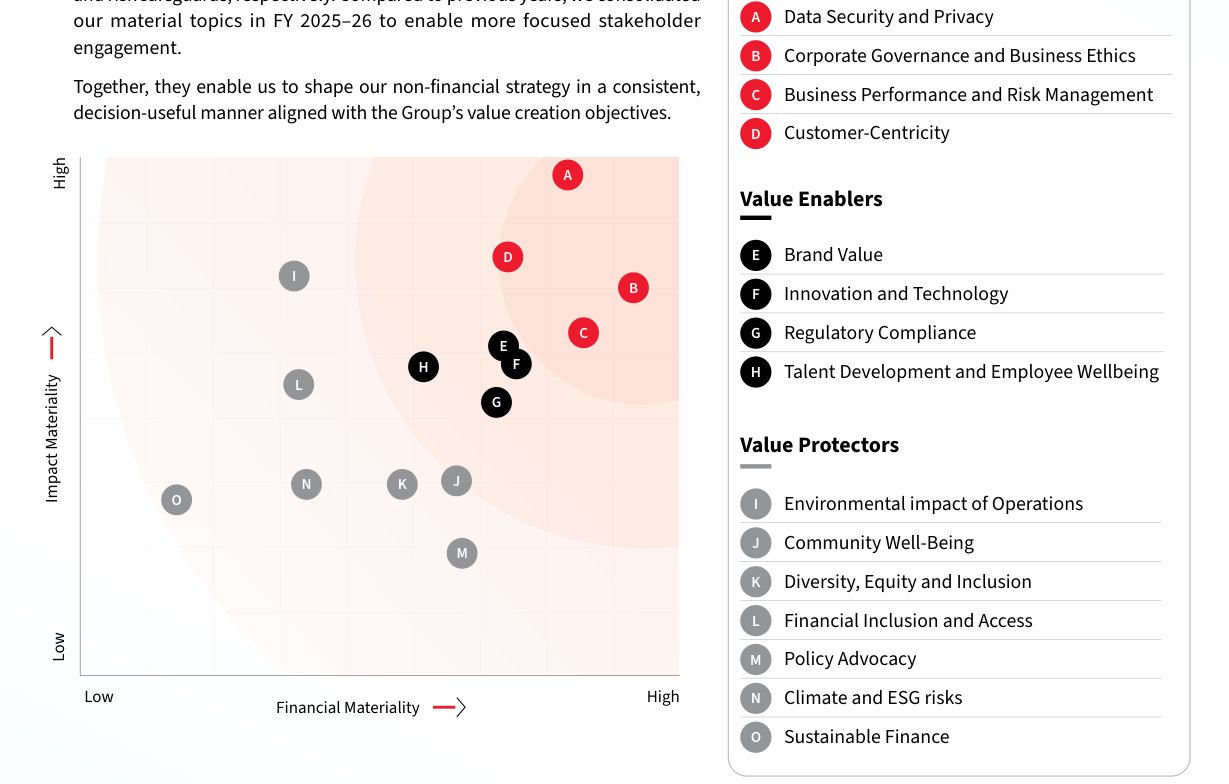
The placements are another matter. "Climate and ESG risks" sits near the bottom left. "Sustainable Finance" is the lowest-ranked topic of all 15 on financial materiality, below "Brand Value" and "Policy Advocacy". The matrix has no scale or threshold, and the last step of the process is a management review.
The rest of the climate disclosure matches that ranking. The report gives Group-level Scope 1 and 2 emissions of 1,12,957 tCO2e, voluntarily extending beyond the BRSR's standalone boundary, and a Bank Scope 3 figure of 78,352 tCO2e built partly from a commuting survey (pp. 40-41). It reports a green asset book of about ₹9,900 crore, up 25% (p. 39). It does not report financed emissions, which for a bank with ₹4.96 lakh crore of advances is the number that matters. The MD&A says the Bank benchmarks sector exposures against weighted average carbon intensity (p. 322), but gives no result. There is no emissions target, and renewables are 5.2% of the Bank's electricity (p. 40). HDFC Bank, by comparison, measures financed emissions under PCAF.
Assurance is at the top of the range. DNV gives reasonable assurance on BRSR Core indicators and limited assurance on other BRSR and GRI disclosures (pp. 432-436 and 444-447). The BRSR is candid in places: three data breaches, one involving customers' personal information (p. 425), RBI penalties of ₹1.23 crore (p. 185), and permanent employee turnover of 32.5% (p. 379), a figure the 6-page "Our People" chapter does not mention.
Seven advertisements
Integrated reports are read by investors, analysts and regulators. Kotak's carries advertising. The strategy chapter has two full advertisements on page 12 (the "Hausla" brand campaign and a business current account), two on page 13 (the Kotak Neo trading app and a multi-asset mutual fund), and a term insurance advertisement, complete with its advertisement reference number, on page 14. The customer chapter gives half of page 32 to a Solitaire credit card. A full-page metal debit card advertisement closes the narrative.
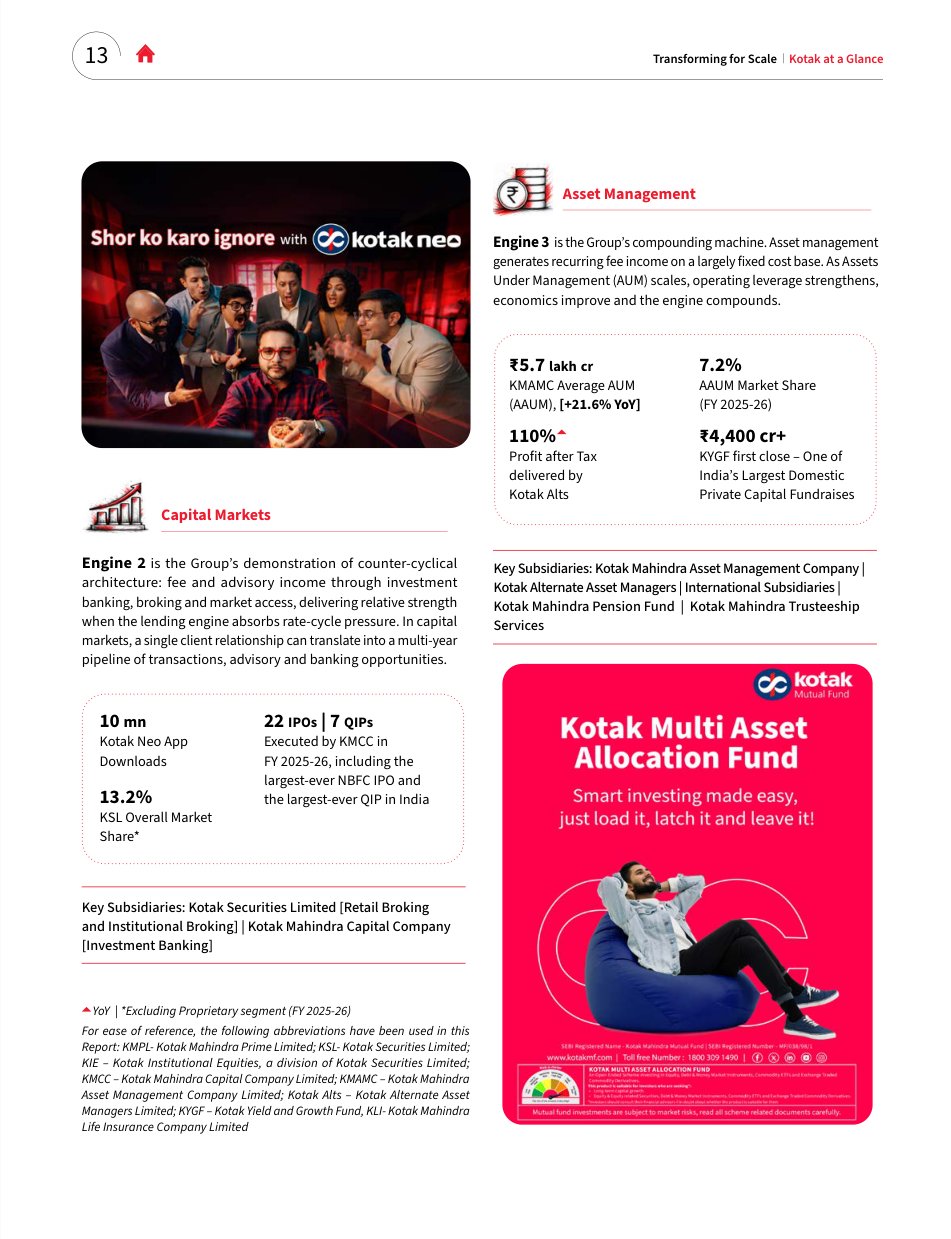
The products are real and the brand campaign is part of the strategy, so there is an argument for showing it once. Seven times, inside the chapter that explains how the Group makes money, makes the report read in places like a brochure.
Otherwise the design is good. A consistent red-and-white system, numbers in large type, and a narrative short enough to read in one sitting. Apart from a few spreads, the PDF is single pages, which suits a phone.
The digital version is weaker. The contents page lists about 25 sections but only one is a clickable link, and the home icon on each page goes nowhere. The PDF's bookmark panel has 151 entries, including bare page numbers and production file names such as "2-01.pdf", and its "Board of Directors" bookmark opens the cover. We found no online edition; the investor site offers the full PDF and section-by-section PDFs.
What other companies can copy
- A value creation model that reads as a flow (pp. 16-17), from capitals to businesses to strategy to outcomes on one spread.
- A "Consolidation at a Glance" table (p. 52) showing each subsidiary's profit and net worth for two years, if you are a group.
- Group-level emissions beyond the BRSR boundary (pp. 40-41), with the boundary for each figure stated.
- A materiality matrix with a page that ties each topic to a capital and a KPI (pp. 43-45).
What not to copy: a CEO letter that is silent on the CEO's own departure, a KPI page with no prior year, a customer claim that the regulatory tables contradict, and advertisements.
The score
- Strategy and narrative3 / 5
- Integrated thinking and capitals4 / 5
- BRSR and ESG integration3 / 5
- Governance disclosure3 / 5
- Financial storytelling3 / 5
- Design and readability3 / 5
- Digital version2 / 5
Seven criteria, each out of five. Scores assess reporting quality. The review’s explanations appear in the table below.
| Criterion | Score (of 5) | Why |
|---|---|---|
| Strategy and narrative | 3 | Clear engines, pillars and 4C framework; the CEO's letter omits his exit, and the KPI page avoids the year-on-year picture |
| Integrated thinking and the capitals | 4 | A true capitals-to-outcomes flow on one spread, linked through every chapter; no trade-offs, and a dead cross-reference |
| BRSR and ESG integration | 3 | Reasonable assurance on Core and Group-level emissions; no financed emissions or targets, and climate ranked least financially material |
| Governance disclosure | 3 | Board-approved report, penalties and breaches disclosed; no Chairman's message, and the CEO succession left to the Directors' Report |
| Financial storytelling | 3 | Five-year tables and an excellent subsidiary table; profit and RoE declines kept off the KPI page, and an inconsistent FY25 RoA |
| Design and readability | 3 | Compact, consistent and mostly single pages; seven product advertisements |
| Digital version | 2 | One working contents link, broken bookmarks, no online edition |
| Total | 21 / 35 |
How it compares
Every review on The Footnotes uses the same seven-point card, so scores can be compared. Scores are editorial opinion of the published document.
| Company | Score (of 35) |
|---|---|
| Hindustan Zinc | 30 |
| HUL | 28 |
| TCS | 28 |
| Bharti Airtel | 27 |
| L&T | 27 |
| Reliance | 27 |
| HDFC Bank | 26 |
| Asian Paints | 25 |
| ICICI Bank | 25 |
| Infosys | 25 |
| LTM | 25 |
| Tata Steel | 25 |
| Mahindra & Mahindra | 24 |
| Titan | 23 |
| Adani Ports | 22 |
| ITC | 21 |
| Kotak Mahindra Bank (this review) | 21 |
| SBI | 21 |
| Sun Pharma | 21 |
| Bajaj Finance | 20 |
| NTPC | 20 |
Frequently asked questions
Does Kotak's annual report say its CEO is stepping down?
Yes. The Directors' Report (p. 231) and the corporate governance report (p. 325) state that Ashok Vaswani, Managing Director & CEO, has decided not to seek re-appointment when his current term ends on 31 December 2026, and that the Board has started the process to appoint a successor. The decision was disclosed to the stock exchanges on 27 June 2026. His letter to shareholders, dated 6 July 2026, does not mention it.
How did Kotak Mahindra Bank perform in FY 2025-26?
On a standalone basis, profit after tax was ₹14,008 crore, against ₹16,450 crore in FY 2024-25, which included a one-time gain of ₹2,730 crore from selling 70% of its general insurance arm to Zurich. Excluding that gain, profit rose 2.1% (p. 226). Consolidated profit was ₹19,288 crore against ₹22,126 crore. Net interest margin fell to 4.60% from 4.96%, and standalone return on assets fell to 1.97% from a like-for-like 2.21% (p. 281).
How many customer complaints did Kotak Mahindra Bank receive?
The table of top complaint grounds (p. 184) shows the Bank received 2,24,585 complaints in FY 2025-26, 7% more than the year before. Pending complaints at year-end rose to 10,226 from 5,325, and those pending beyond 30 days rose to 4,190 from 434 (p. 185). Complaints about account opening rose 70% and about charges 47%. Of 2,19,684 complaints disposed of, 1,07,345 were rejected by the Bank.
What climate data does Kotak Mahindra Bank disclose?
It reports Group Scope 1 and 2 emissions of 1,12,957 tCO2e (p. 41), Bank Scope 3 emissions of 78,352 tCO2e covering commuting, travel, energy and purchases (p. 41), a green asset book of about ₹9,900 crore (p. 39), and says it benchmarks sector exposures against weighted average carbon intensity (p. 322). It does not disclose financed emissions or set an emissions target. DNV provides reasonable assurance on BRSR Core indicators.
How does The Footnotes score annual reports?
Seven criteria, each scored 1 to 5 with a one-line reason: strategy and narrative; integrated thinking and capitals; BRSR and ESG integration; governance disclosure; financial storytelling; design and readability; and the digital version. Scores are editorial opinion based on the published document, and the same card is used for every company so results can be compared.
Sources
- Kotak Mahindra Bank — Annual Reports (Integrated Annual Report 2025-26) — Kotak Mahindra Bank
- Kotak Mahindra Bank — Integrated Annual Report 2025-26 (PDF) — Kotak Mahindra Bank
- Kotak Mahindra Bank CEO Ashok Vaswani to step down in December; board begins succession hunt (28 June 2026) — Business Today
- SEBI circular: BRSR Core — framework for assurance and ESG disclosures for value chain (12 July 2023) — SEBI