

HDFC Bank Integrated Annual Report 2025-26: A Review
HDFC Bank's 617-page report has the most rigorous materiality work we have seen, a PCAF financed-emissions study and reasonable assurance on BRSR Core, but it is far too long, its Chairman's letter buries the year's governance event, and a proofreading slip on page 151 shows the strain.
 In short
Key takeaways
- At 617 printed pages the HDFC Bank report is roughly twice the length of the Reliance integrated report; the non-financial narrative alone runs to page 250 before the Directors' Report begins.
- The Bank refreshed its double materiality assessment in FY 2025-26 under GRI Universal Standards 2021, revisiting 14 topics with weighted stakeholder surveys and plotting them on an impact-versus-financial matrix with quadrant-based response rules; it is the only report in the series so far to show the matrix and date the work.
- Financed emissions are measured under PCAF: ₹2.67 lakh crore of business and project loans to 313 listed borrowers across 39 sectors, estimated at 34.96 million tCO2e, with a stated average data-quality score of 1.11; operational Scope 1 and 2 are 0.33 million tCO2e against a carbon-neutrality target for FY 2031-32.
- SGS India provides reasonable assurance on BRSR Core KPIs and limited assurance on selected indicators under ISAE 3000 (Revised) and ISAE 3410, and the 'About the Report' page describes a CFO-led, Board-approved process for the integrated report itself, which is rare and welcome.
- The Chairman's message is signed by an interim, non-independent Chairman; the resignation of the previous Chairman on 18 March 2026, the external legal review and the Special Committee of independent directors appear under 'Corporate Event' after a page of IMF growth statistics, and the letter does not summarise the review's findings.
- Climate change is plotted in the 'high impact, low financial materiality' quadrant, a placement hard to reconcile with a 34.96 million tCO2e financed-emissions exposure; page 151 repeats an entire paragraph verbatim, a sign of a document that has outgrown its production process.
HDFC Bank's Integrated Annual Report 2025-26 is the longest document in this series and, in places, the most rigorous. It is also the report of a year in which the Bank's Chairman resigned with a statement that, in the interim Chairman's own words, "led to speculation on the Bank's governance standards". How a report handles a year like that tells you more about its integrated thinking than any capitals diagram, so we have read both.
As with every review in this series, we read the published PDF against the <IR> Framework, SEBI's BRSR Core expectations and plain readability, and score it on the same seven-point card. Scores are our opinion. Screenshots are small excerpts reproduced for review and remain the copyright of HDFC Bank Limited; the full report is on the Bank's investor relations pages.
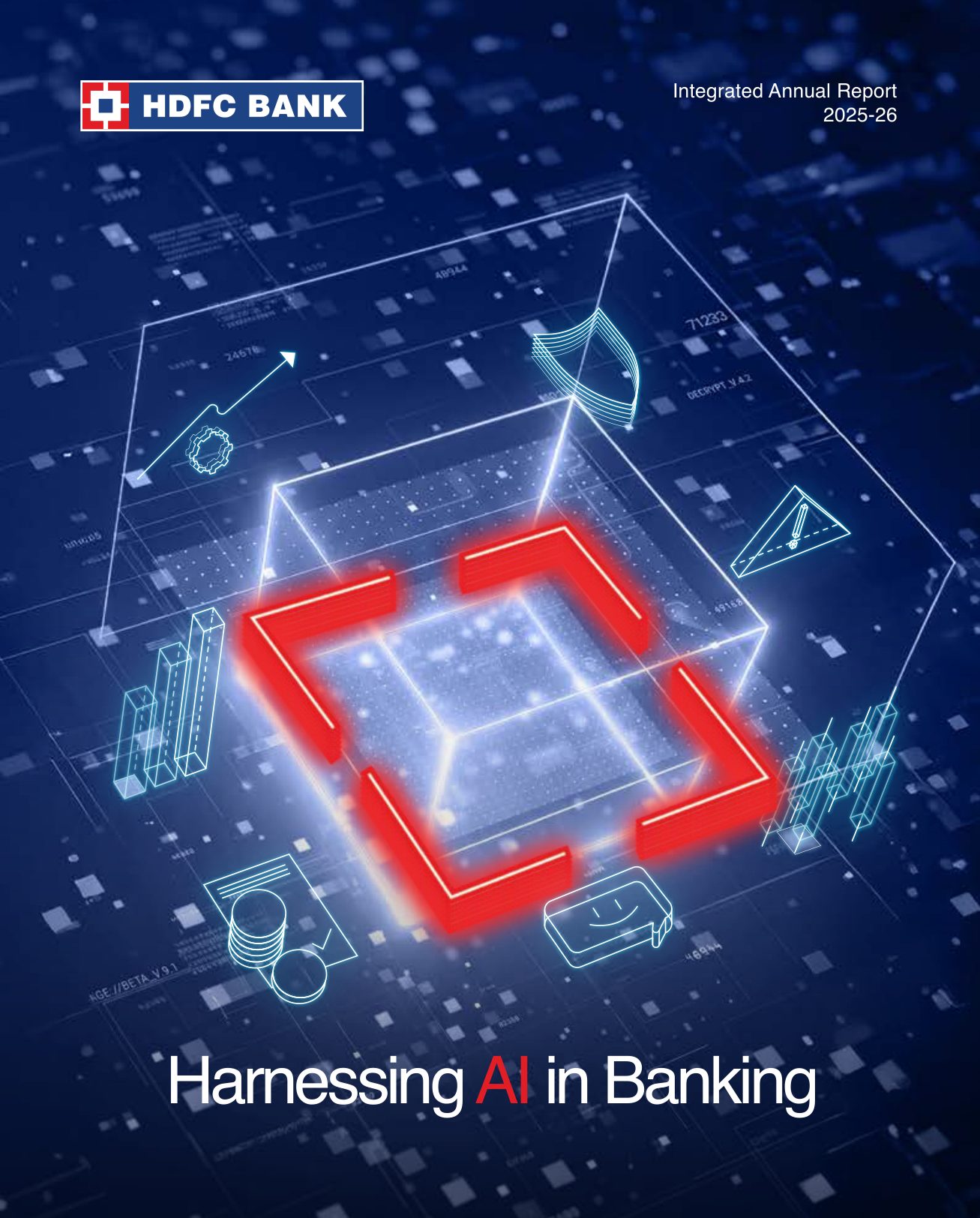
The scorecard
| Criterion | Score (of 5) | In one line |
|---|---|---|
| Strategy and narrative | 3 | Clear CEO priorities and strategic pillars; the Chairman's letter opens with macroeconomics and reaches the year's defining event late |
| Integrated thinking and the capitals | 4 | Value creation model with inputs, outcomes, risks and SDGs per capital; a 'Connecting the Capitals' chapter; no single business-model flow |
| BRSR and ESG integration | 5 | Dated double materiality matrix, PCAF financed emissions, TCFD structure, reasonable assurance on Core |
| Governance disclosure | 3 | Statutory disclosure is complete; the narrative treatment of the Chairman's resignation and the legal review is thin |
| Financial storytelling | 4 | Highlights spread and ten-year table are strong; growth story told plainly |
| Design and readability | 3 | Clean system, but 617 pages, dense spreads and a duplicated paragraph on page 151 |
| Digital version | 4 | Online version linked; interactive value-creation model with clickable elements; PDF is a mix of single pages and spreads |
| Total | 26 / 35 |
What the report is
Everything sits in one PDF: a 250-page integrated narrative (overview, leadership messages, performance, "How We Create Value", strategy, risk, responsible business, "Connecting the Capitals", ten-year highlights, assurance statement and GRI index), followed by the Directors' Report, corporate governance report, standalone and consolidated financial statements, the BRSR at page 560, and shareholder information at 617.
The "About the Report" page is a model of its kind. It names the frameworks (<IR>, GRI 2021, TCFD, BRSR, UN SDGs, plus the Companies Act, Banking Regulation Act and RBI rules for the financials), states the boundary (the Bank on a standalone basis for non-financial data), confirms no restatements of the prior year, names the assurance provider and standards, and, unusually, describes the governance of the report itself: a Group CFO-led process with iterations through business units, review by senior management and formal approval by the Board. That last paragraph is what the Framework means by a "statement of responsibility", and most Indian reports don't include one.
Key number: 617 — printed pages before the shareholder-information section, against roughly 290 for Reliance and 383 for TCS.
Strategy and narrative: 3/5
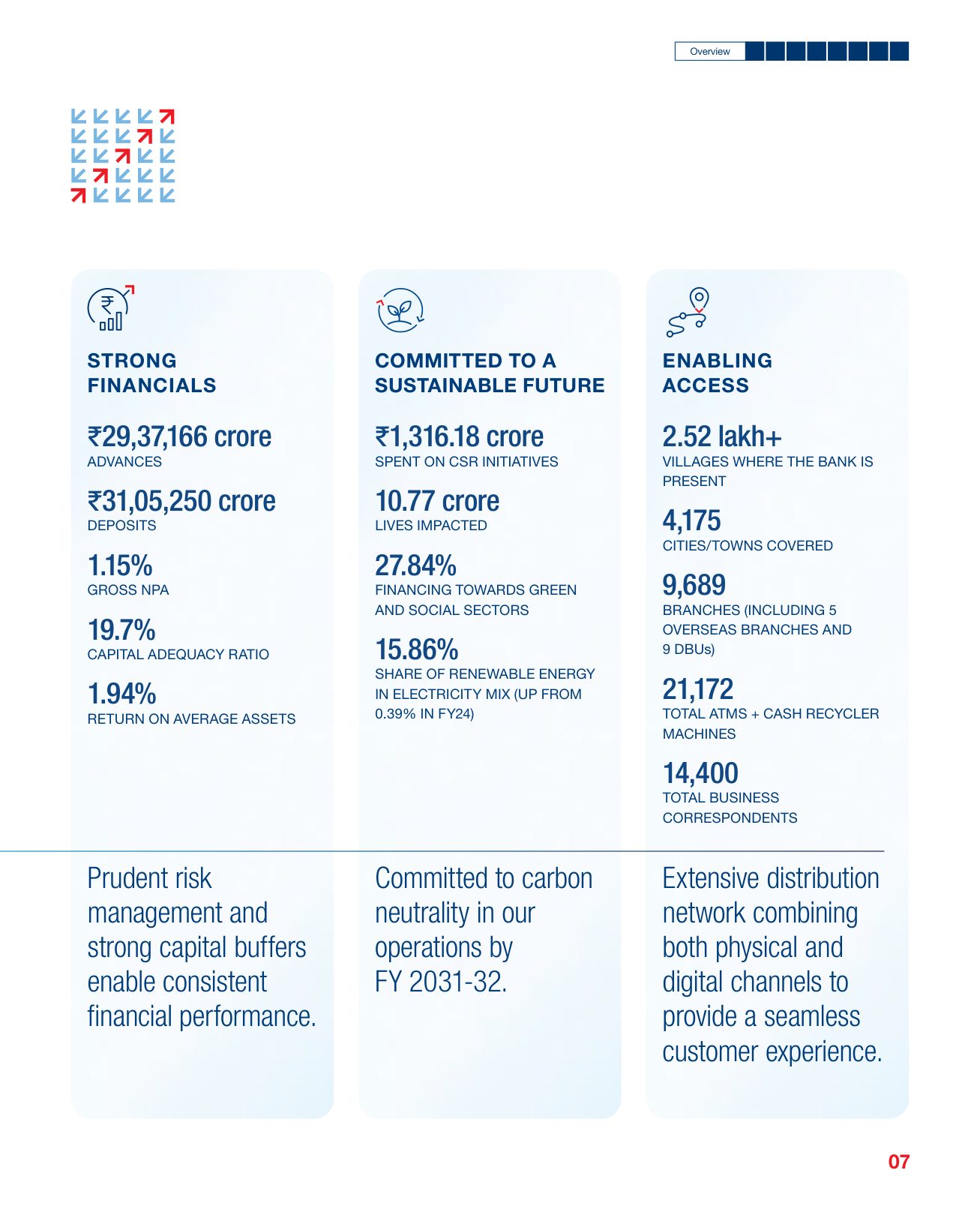
The strategy is legible once you reach it. Five CEO priorities (people and culture, customer centricity, digital and technology leadership, group synergies, and the underlying "serving financial needs of Indians") sit above ten strategic pillars from branch engagement and virtual relationship management to the corporate cluster, and the "Strategy in Action" chapter reports on each. The MD & CEO's message gives the year's numbers cleanly: advances up 12.1% against 5.4% the year before, deposits up 14.4%, profit after tax ₹74,671 crore, return on assets 1.94%, cost-to-income 38.0%, gross NPA 1.15%.
The Chairman's message is where the score is lost. It is signed by Keki M. Mistry as "Interim Part-time Chairman and Non-Executive (Non-Independent) Director". It opens with IMF global growth estimates, inflation averages, the West Asia conflict and India's 7.7% GDP growth, and only under a later heading, "Corporate Event", does it say that Mr Atanu Chakraborty resigned as Part-time Chairman and Independent Director on 18 March 2026, that an interim Chairman was appointed the same day with RBI approval, that the Board engaged domestic and international law firms to review the concerns in the resignation letter, oversaw by a Special Committee of independent directors, and that the findings were received on 26 June 2026 and intimated to the exchanges.
What the letter does not do is say what the findings were, in a sentence. A reader is told the Bank "remains strongly rooted in strong corporate governance principles" and directed, implicitly, to the exchange filing. For a document whose first principle is integrated thinking, the year's most material governance event deserved the first page and a plain summary of the outcome.
Integrated thinking and the capitals: 4/5
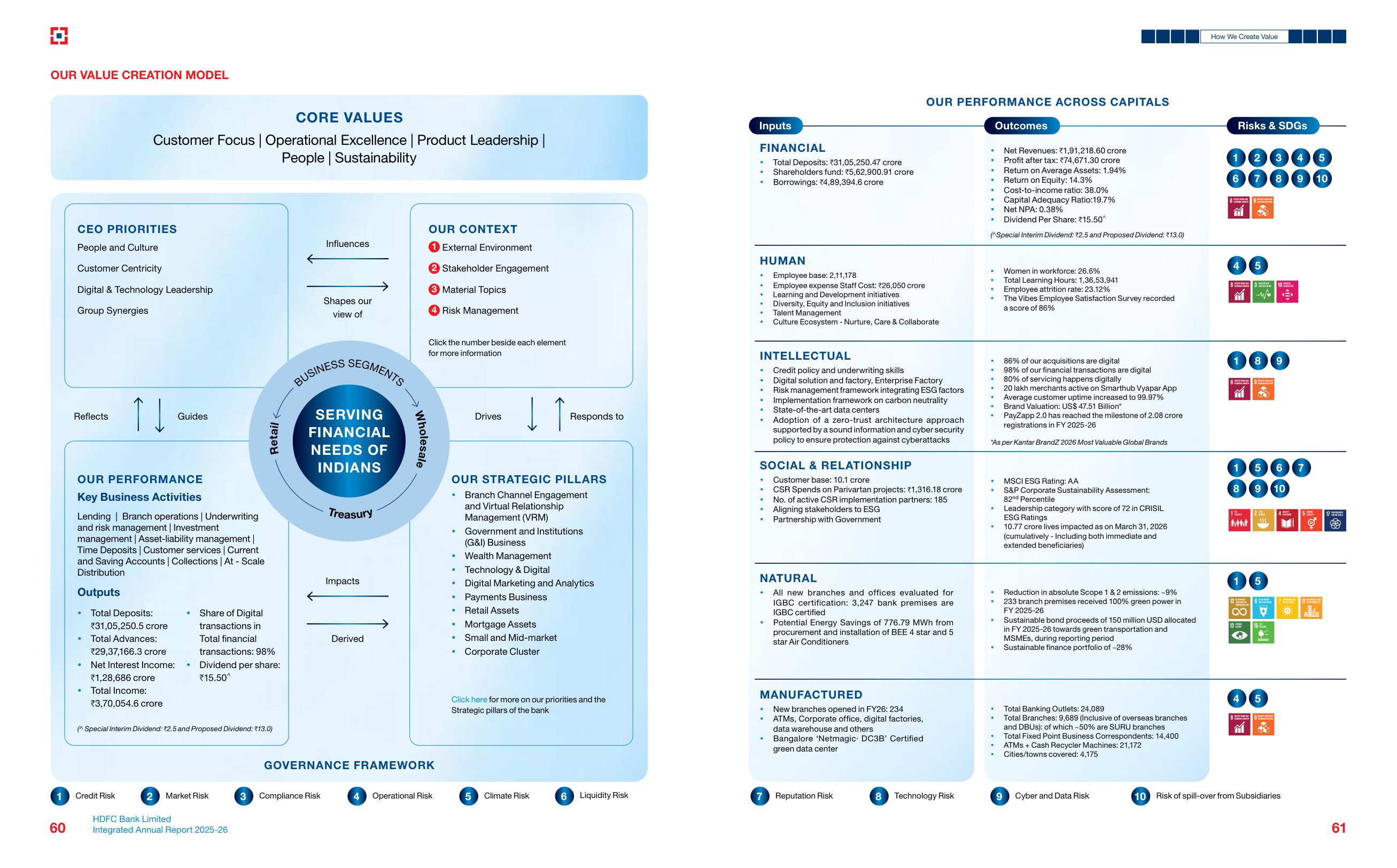
The "Our Value Creation Model" spread is thorough. The left page shows core values, CEO priorities, context (external environment, stakeholder engagement, material topics, risk management), key business activities, outputs and strategic pillars around the three business segments. The right page tabulates, for each of six capitals, inputs, outcomes, and the risk numbers and SDGs that apply, with a ten-item risk key underneath. Every cell has a figure: 2,11,178 employees and 23.12% attrition under human capital; 98% digital transactions and a US$47.51 billion brand valuation under intellectual; ₹1,316 crore of CSR spend and 10.1 crore customers under social; about 9% lower Scope 1 and 2 and a roughly 28% sustainable finance share under natural.
A separate "Connecting the Capitals" chapter near the end (page 236) does something we haven't seen elsewhere: it writes out the trade-offs and dependencies between capitals in prose, finance to manufactured (branches and business correspondents), intellectual to customer (digital journeys, GenAI), and so on. That is the Framework's "connectivity of information" principle, handled explicitly.
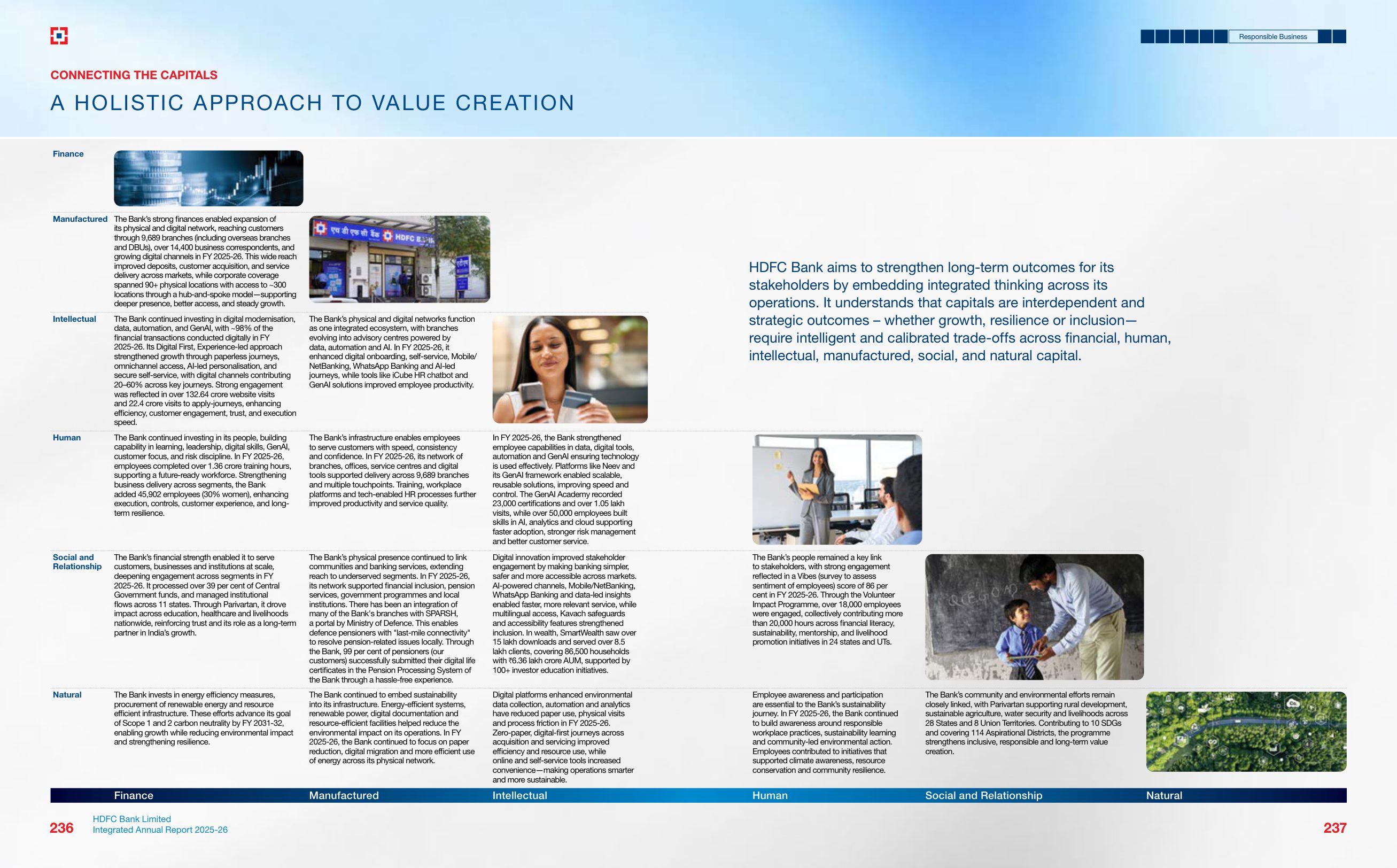
Why not a 5: the model is a table of inputs and outcomes rather than a flow from inputs through activities to outcomes, and the two halves of the story (the model on page 60, the connections on page 236) are 176 pages apart. TCS puts the same content on one spread.
BRSR and ESG integration: 5/5
This is the section that earns the report its place in the series.
Materiality first. The Bank states that it refreshed its double materiality assessment in FY 2025-26 under GRI Universal Standards 2021. The chapter sets out an eight-step method (context, topic identification, stakeholder mapping, impacts-risks-opportunities, scoring criteria, stakeholder consultation, the matrix, governance validation), explains that the 14 topics from the previous cycle were revisited, that stakeholder survey responses were weighted by group, and that scores reflect scale, likelihood and breadth. The result is plotted.
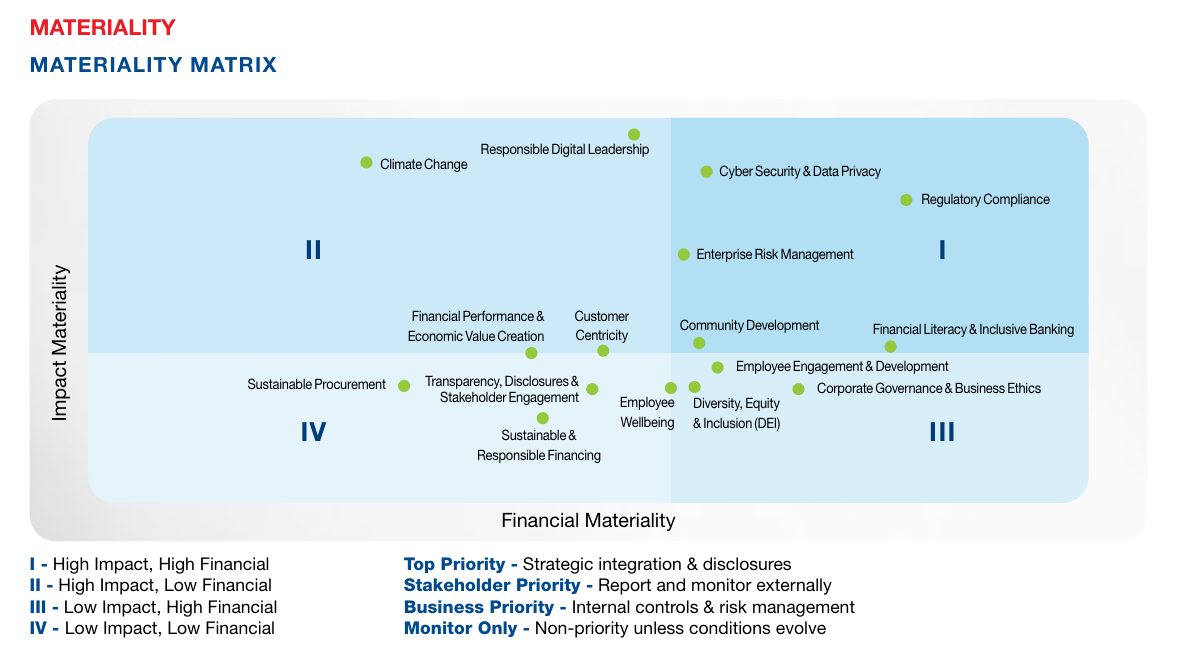
Each topic then gets a page: definition, impact materiality and financial materiality described separately with polarity and nature, the capitals covered, SDGs, and an FY26 performance figure. For "Regulatory Compliance" the figure is "100% BRSR Core KPIs reasonably assured". This is the most complete materiality disclosure we have seen in an Indian report, and it is dated, which is the thing Reliance's is not.
One placement deserves a question. Climate Change sits in Quadrant II: high impact, low financial materiality. Sixty pages later, the Bank reports PCAF financed emissions of 34.96 million tCO2e across ₹2.67 lakh crore of business and project loans to 313 listed borrowers in 39 sectors, including metals, mining, petroleum, automotive and energy supply. For a lender, that is the financial materiality of climate. Either the matrix is scoring operational climate impact only, in which case it should say so, or the financial axis is understating a transition exposure the Bank has itself quantified.
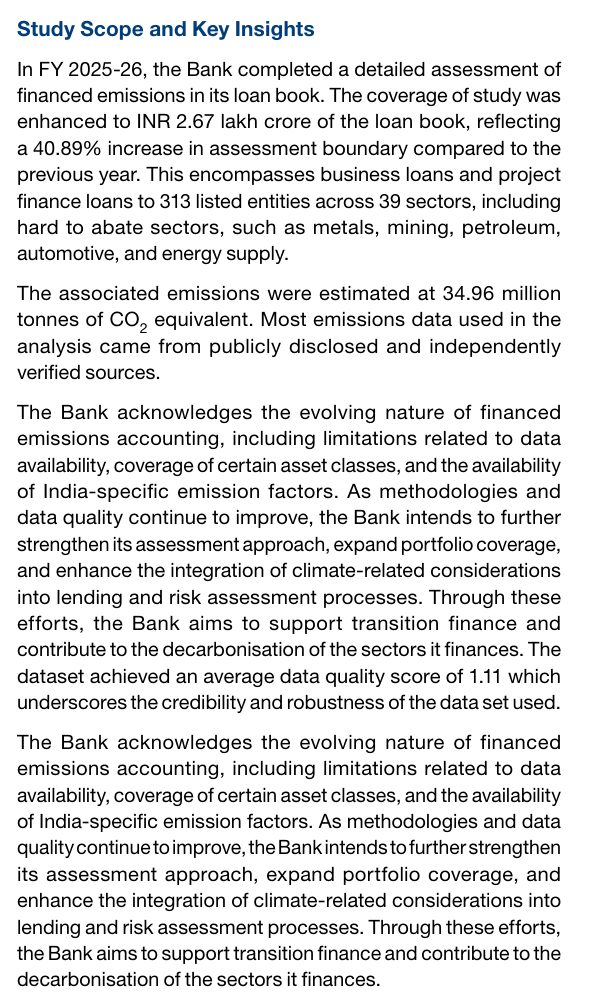
The financed-emissions disclosure is itself strong: the method (PCAF), the coverage and its growth (up 40.89%), the borrower count, the sectors, the estimate, the average data-quality score of 1.11, and an honest paragraph on data limitations and India-specific emission factors. Operational emissions are 0.33 million tCO2e for Scope 1 and 2, with five Scope 3 categories at 0.23 million; the target is carbon neutrality in operations by FY 2031-32. There is no target or pathway for financed emissions, which is the number that matters, and the report should say when one will be set.
Assurance: SGS India provides reasonable assurance on BRSR Core KPIs and limited assurance on selected other indicators under ISAE 3000 (Revised) and ISAE 3410, aligned to SEBI's BRSR Core framework and the GHG Protocol. That puts HDFC Bank level with Reliance and TCS at the top of the assurance range.
Governance disclosure: 3/5
The statutory sections are complete and the corporate governance report is long. The score reflects the narrative. Beyond the Chairman's "Corporate Event" paragraphs, the MD & CEO's message also describes the resignation as "a challenging event" and moves on. The report records that Mr Rajiv Kumar was appointed Part-time Chairman and Independent Director at the Board meeting of 29 June 2026, subject to approvals, which is useful. What is missing is a governance-section account of the legal review, its scope, and its conclusions in the Board's own words. Exchange filings are not a substitute for the annual report saying what happened.
The value creation model's ten-risk key includes "risk of spill-over from subsidiaries", which is a candid inclusion for a group with 15 subsidiaries, and the "Power of the Group" chapter reports on them.
Financial storytelling: 4/5
The performance spread shows balance-sheet size (₹43,64,886 crore), deposits (₹31,05,250 crore), advances (₹29,37,166 crore), PAT, return on equity (14.3%), return on average assets (1.94%), EPS and dividend (₹15.50 including a ₹2.50 special interim), each with the prior year. The ten-year financial highlights table is at page 238. The MD & CEO's message explains why growth accelerated (advances 12.1% versus 5.4%) and why deposit growth outpaced the system, and the "Home Loan Advantage" and "Small and Mid-market" chapters give the two growth engines their own pages.
What we'd add is a short section on the merger's remaining integration effects on the balance sheet and margins, which a reader coming to the Bank fresh still needs.
Design and readability: 3/5
The design system is clean: section colour bars at the top of each page, a consistent capital icon set, and well-labelled highlights. The issue is volume. Two hundred and fifty pages of narrative before the statutory sections, with the ESG strategy, environment, customer, people, community and nation-building chapters each running to dozens of pages, means the reader who wants the value-creation story has to find it. The report would be stronger at half the length with the detail moved to the online version.
Page 151 repeats the paragraph beginning "The Bank acknowledges the evolving nature of financed emissions accounting" in full, twice, one after the other. It is a small error, and in a report this size it is also a diagnosis.
Digital version: 4/5
The contents page links to an online version, and the value-creation model invites the reader to "click the number beside each element for more information", so the interactive edition carries the connectivity the PDF can only gesture at. The PDF mixes single pages with spreads, which works better on phones than the all-spread files from Reliance and TCS.
What reporting teams can take from it
Copy the "About the Report" page, especially the paragraph on how the integrated report is governed and approved. Copy the materiality chapter end to end: method, weighting, a plotted matrix, and a page per topic with impact and financial materiality separated. If you are a lender, copy the financed-emissions disclosure, including the data-quality score and the limitations paragraph.
Don't copy the length. And when the year contains a governance event, lead with it, say what the review concluded, and say it in the Board's own voice.
Series scorecard
Every report in this series is scored on the same seven-point card by the same reader. Scores are editorial opinion of the published document; each review carries the page references behind its findings.
| Company | Score (of 35) |
|---|---|
| Hindustan Zinc | 30 |
| TCS | 29 |
| HUL | 28 |
| Reliance | 27 |
| L&T | 27 |
| Bharti Airtel | 27 |
| HDFC Bank (this review) | 26 |
| ICICI Bank | 25 |
| Infosys | 25 |
| ITC | 21 |
Frequently asked questions
Does HDFC Bank publish a double materiality assessment?
Yes. The 'About the Report' page states that in FY 2025-26 the Bank reviewed its material matters through a double materiality assessment aligned with GRI Universal Standards 2021. The materiality chapter (from page 66) sets out an eight-step method, revisits 14 topics, weights stakeholder groups by influence, and plots each topic on an impact-materiality versus financial-materiality matrix with response rules for each quadrant.
What are HDFC Bank's financed emissions?
For FY 2025-26 the Bank assessed financed emissions using the PCAF standard across ₹2.67 lakh crore of business and project finance loans to 313 listed entities in 39 sectors, including metals, mining, petroleum, automotive and energy supply. The estimate is 34.96 million tonnes CO2 equivalent, with an average PCAF data-quality score of 1.11. Coverage rose 40.89% over the previous year.
What is HDFC Bank's climate target?
Carbon neutrality for its own Scope 1 and Scope 2 operations by FY 2031-32. In FY 2025-26 operational Scope 1 and 2 emissions were 0.33 million tCO2e, absolute Scope 1 and 2 fell about 9%, renewable electricity rose to 15.86% of the mix from 0.39% in FY24, and 3,247 premises are IGBC-certified. There is no target for financed emissions.
Who assures HDFC Bank's BRSR?
SGS India Pvt. Ltd. provides reasonable assurance on BRSR Core KPIs and limited assurance on selected indicators in the BRSR and the integrated report, under ISAE 3000 (Revised) and ISAE 3410. The financial statements are audited separately; the report also states that the integrated report is reviewed by senior management and approved by the Board.
What does the report say about the Chairman's resignation?
The interim Chairman's message notes that Mr Atanu Chakraborty resigned as Part-time Chairman and Independent Director with effect from 18 March 2026, that an interim Chairman was appointed the same day with RBI approval, that the Board engaged domestic and international law firms to review the concerns raised in the resignation letter under a Special Committee of independent directors, and that the findings were received on 26 June 2026 and intimated to the stock exchanges. The letter does not summarise what the findings were.
How does The Footnotes score annual reports?
Seven criteria, each scored 1 to 5 with a one-line reason: strategy and narrative; integrated thinking and capitals; BRSR and ESG integration; governance disclosure; financial storytelling; design and readability; and the digital version. Scores are editorial opinion based on the published document, and the same card is used for every company so results can be compared.
Sources
- HDFC Bank — Integrated Annual Report 2025-26 (PDF) — HDFC Bank
- HDFC Bank Investor Relations — HDFC Bank
- PCAF — The Global GHG Accounting and Reporting Standard for the Financial Industry — Partnership for Carbon Accounting Financials
- SEBI circular: BRSR Core — framework for assurance and ESG disclosures for value chain (12 July 2023) — SEBI