

Bharti Airtel Integrated Annual Report 2025-26: A Review
Airtel's report has SBTi-validated targets, an emissions table that footnotes the effect of the Indus Towers sale on its own reductions, DNV reasonable assurance and a Board accountability statement. It also puts 'Net Profit (before exceptional items)' on the highlights page without a growth arrow, because statutory profit fell 21% on a prior-year tax credit, and keeps the materiality matrix single rather than double.
 In short
Key takeaways
- The report is a 534-page integrated annual report in five parts: Overview and Performance, Strategic Review, Capital-wise Performance, MD&A, and Statutory Reports and Financial Statements, with the BRSR at page 203 and an 'Accountability Statement' in which the Board and management confirm the report presents a balanced overview.
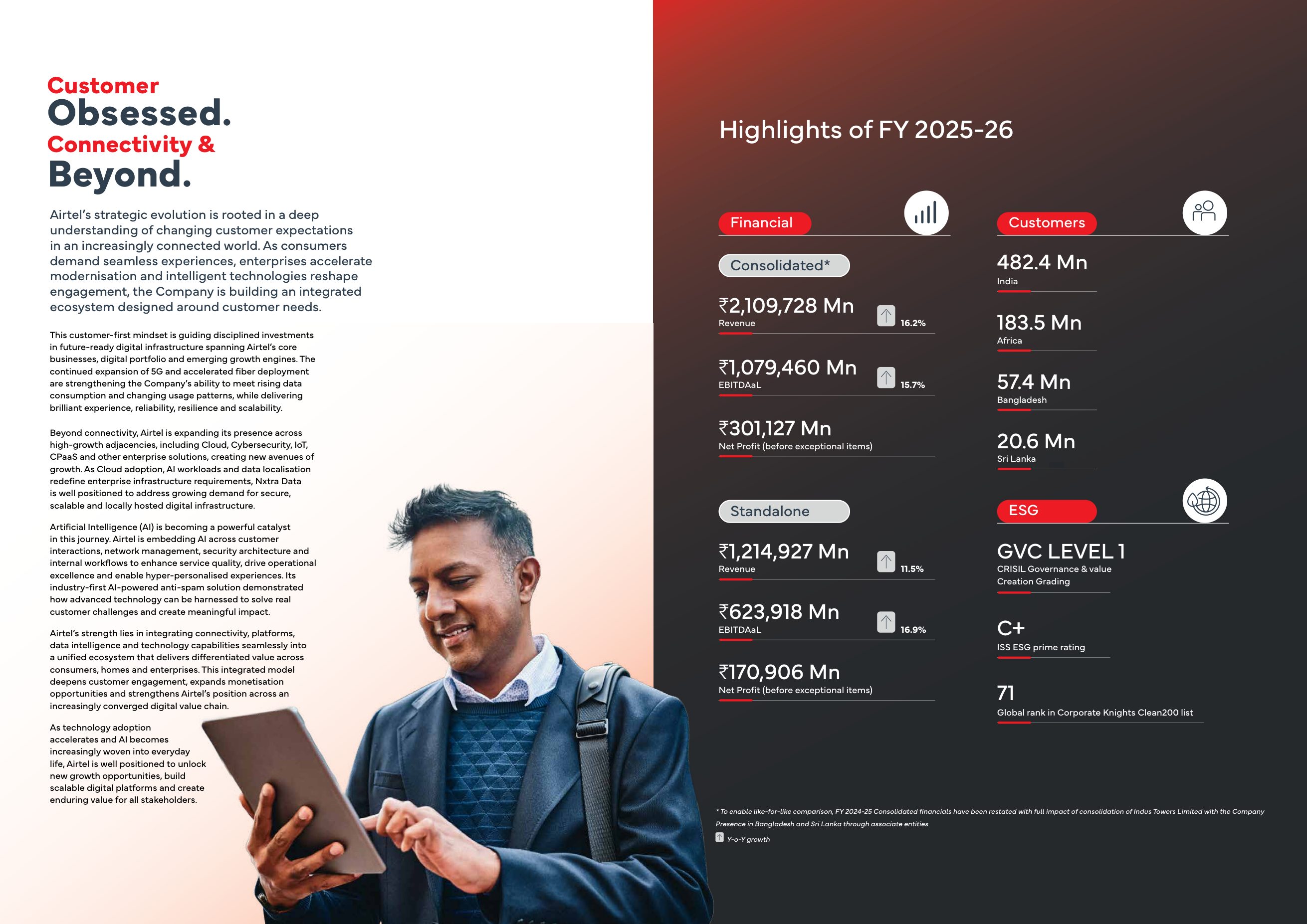
- The highlights page shows consolidated revenue of ₹2,109,728 million (up 16.2%) and EBITDAaL of ₹1,079,460 million (up 15.7%) with growth arrows, and 'Net Profit (before exceptional items)' of ₹301,127 million with no arrow; the financial summary on page 172 shows statutory profit for the year of ₹266,952 million against ₹337,440 million, down 21%, largely because tax expense rose from ₹31,921 million to ₹113,499 million after a prior-year credit.
- Airtel states it was the first Indian telecom company with validated Science Based Targets: absolute Scope 1 and 2 down 50.2% and Scope 3 down 42% by FY 2030-31 from FY 2020-21; FY 2025-26 Scope 1 and 2 were 911,950 tCO2e (from 1,102,249) and Scope 3 6,656,560 tCO2e, of which upstream leased assets, the towers now owned by Indus, are 6,014,858.
- The emissions table carries a footnote that reductions 'should be viewed in conjunction with the sale of towers to Indus Towers Limited in FY 2024-25 and the improvement in India's grid emission factor', which is the kind of honesty most reports omit.
- Materiality is a single matrix (significance to stakeholders against significance to the organisation) with critical, high and moderate tiers, reviewed every three years and last reviewed in FY 2024-25 under GRI, ISO 26000 and AA1000; the report does not claim double materiality.
- DNV Business Assurance India gives reasonable assurance on BRSR Core for standalone operations and limited assurance on other selected disclosures; the report includes the GSMA ESG Metrics for Mobile, a GRI content index and the full DNV statement, and financial figures are presented in ₹ million throughout.
Bharti Airtel's report is titled "Customer Obsessed. Connectivity & Beyond.", and its most useful pages are the ones where it stops being obsessed with anything and simply reports: a value creation model with figures in every box, an emissions table that explains its own good news, and a financial summary that shows what happened to profit. The question the report raises is why its front page chooses a different profit number from its own summary.
As with every review in this series, we read the published PDF against the <IR> Framework, SEBI's BRSR Core expectations and plain readability, and score it on the same seven-point card. Scores are our opinion. Screenshots are small excerpts reproduced for review and remain the copyright of Bharti Airtel Limited; the full report is on the company's investor pages.

The scorecard
| Criterion | Score (of 5) | In one line |
|---|---|---|
| Strategy and narrative | 4 | Strategic pillars, a Chairman's and an Executive Vice Chairman's letter, and a quarterly progress page; the featured stories are marketing |
| Integrated thinking and the capitals | 4 | Numeric inputs and outputs per capital, stakeholder icons used throughout; capital chapters list features rather than trade-offs |
| BRSR and ESG integration | 4 | SBTi targets, full Scope 3, an honest footnote, GSMA metrics, reasonable assurance; single-axis materiality last reviewed a year ago |
| Governance disclosure | 4 | Board accountability statement, materiality approved by the Board ESG Committee; a leadership transition is noted in passing |
| Financial storytelling | 3 | The MD&A summary is complete and clear; the highlights page leads with profit before exceptional items and omits its growth |
| Design and readability | 4 | Consistent five-part structure, icon system, good tables; ₹ million everywhere |
| Digital version | 4 | Bookmarked PDF built as spreads; no online edition referenced |
| Total | 27 / 35 |
What the report is
Five parts across 534 printed pages: Overview and Performance (about the report, at a glance, footprint, segments, strategic pillars, the two letters, Board), Strategic Review (value creation model, stakeholder connect, materiality, ESG approach, risk, KPIs, quarterly progress, CSR, awards), Capital-wise Performance (financial, manufactured, intellectual, human, social and relationship, natural, then GSMA ESG metrics, GRI index and the DNV assurance statement), the MD&A, and Statutory Reports and Financial Statements with the BRSR at page 203.
The "About the Report" page does what the Framework asks: period, boundary (the six capitals cover India operations excluding Indus Towers, Airtel Payments Bank and Beetel; financial capital is standalone), reporting principles (<IR>, GRI 2021, UN SDGs, GSMA ESG Metrics for Mobile, BRSR), regulatory compliance, and an "Accountability Statement" from the Board and management confirming the report "provides a balanced overview". It names Deloitte as auditor and DNV as the sustainability assurance provider, with the scope of each.
Key number: 6,014,858 — tonnes of CO2e in Scope 3 category 8, upstream leased assets, which is the towers Airtel sold to Indus and now leases back. The number is on page 140 and it changes how the Scope 1 and 2 reduction should be read.
Strategy and narrative: 4/5
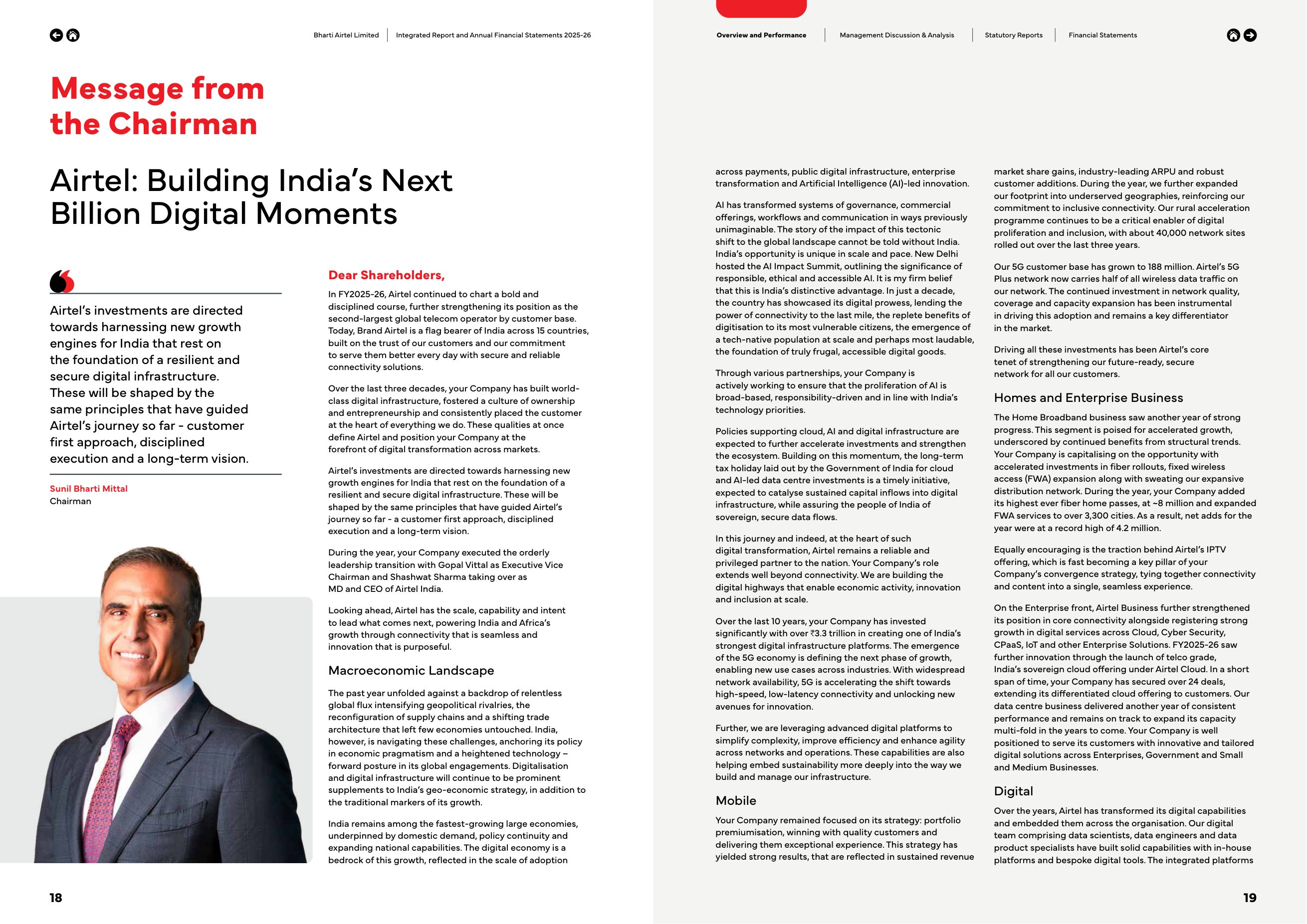
The strategic pillars are stated once and referenced throughout. The Chairman's message ("Building India's Next Billion Digital Moments") and the Executive Vice Chairman's ("Building the Next Phase of Digital Growth") divide the work sensibly: the Chairman on positioning, the leadership transition to Gopal Vittal as Executive Vice Chairman with Shashwat Sharma taking over as CEO, and the long view; the Vice Chairman on the year's execution, digital and AI. A "Quarterly Strategic Progress" page tracks what was announced against what was delivered, which is unusual and good.
The "Featured Stories" that punctuate the report ("Customer First, Always", "Network Intelligence meets Artificial Intelligence") are well produced but read as brand pages; the strategy would survive without them.
Integrated thinking and the capitals: 4/5
The value creation model gives inputs and outputs for all six capitals with numbers: ₹1,605,349 million of equity and ₹1,307,916 million of net debt; 345,912 towers, 1,187,894 base stations including 5G, 532,388 route-km of fibre, eight submarine cable systems and ₹310 billion-plus of capex; 20,116 employees and 80,123 contractual staff; 1,185,186 MWh of grid electricity and 322,119 MWh of renewables; 2,858 suppliers, 4,800-plus distributors and a million-plus retailers. Outputs include standalone revenue of ₹1,214,927 million, a 51.4% EBITDAaL margin, ₹749,310 million of cash from operations, ₹433,566 million to the exchequer, net debt at 1.3 times EBITDAaL, 3.5 billion spam SMSes blocked, 135 million next-best-action decisions, and "30%+ code written by AI".
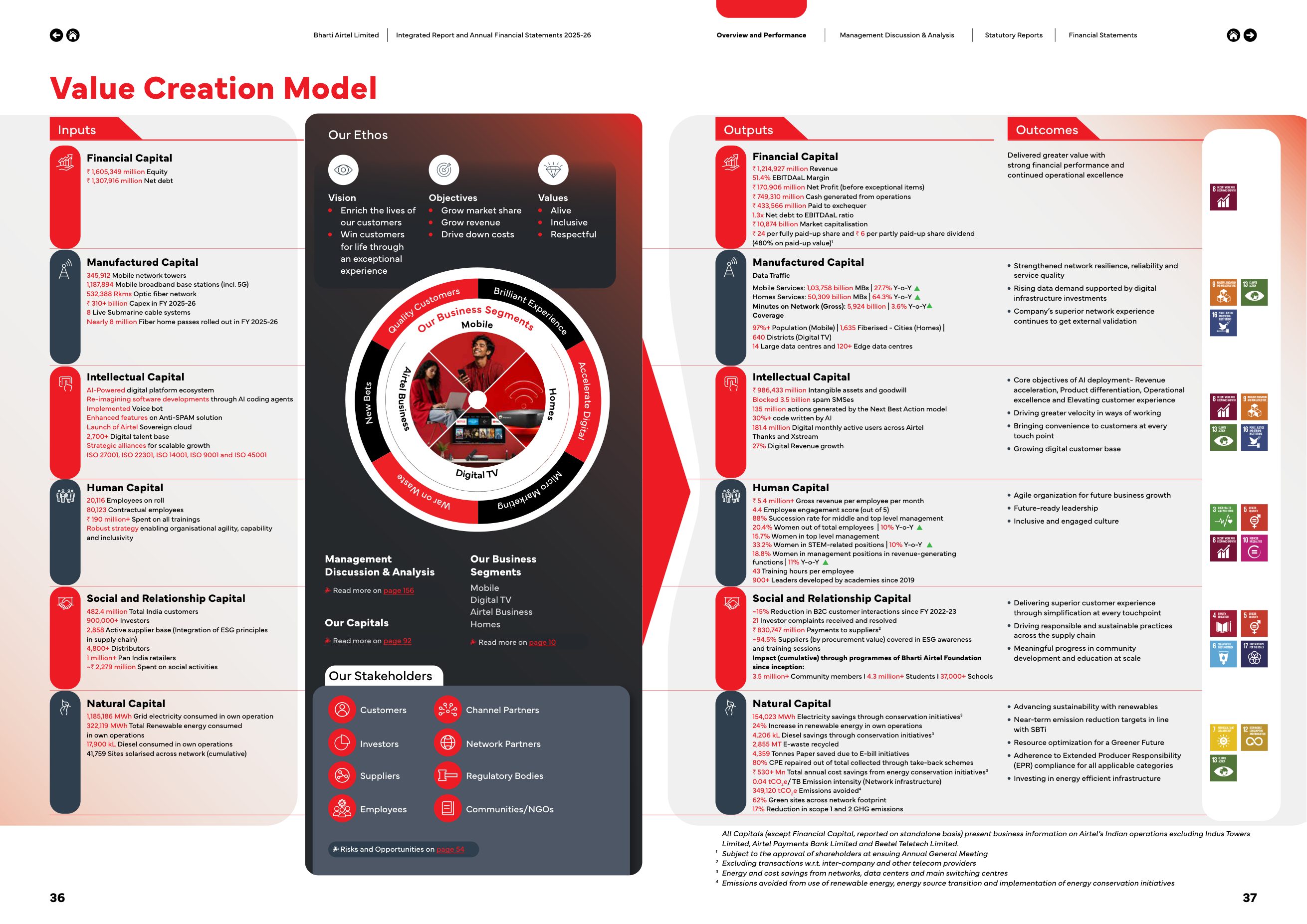
The capital chapters are long and feature-led: each lists initiatives, platforms and programmes with figures. What they don't do is show the connections the model implies. The intellectual capital that blocks spam draws on the human capital of a 2,700-strong digital talent base and on the manufactured capital of the network; the natural capital reduction depends on a manufactured capital decision (selling the towers). The Framework calls this connectivity; the report leaves it to the reader.
BRSR and ESG integration: 4/5
The climate disclosure is among the best in the series. Airtel states that it was the first Indian telecom company to have validated Science Based Targets: absolute Scope 1 and 2 down 50.2% and absolute Scope 3 down 42% by FY 2030-31 from FY 2020-21. The emissions table gives Scope 1 (70,468 tCO2e), Scope 2 (841,482) and their total (911,950 against 1,102,249), then Scope 3 by category with prior-year restated figures, totalling 6,656,560 tCO2e.
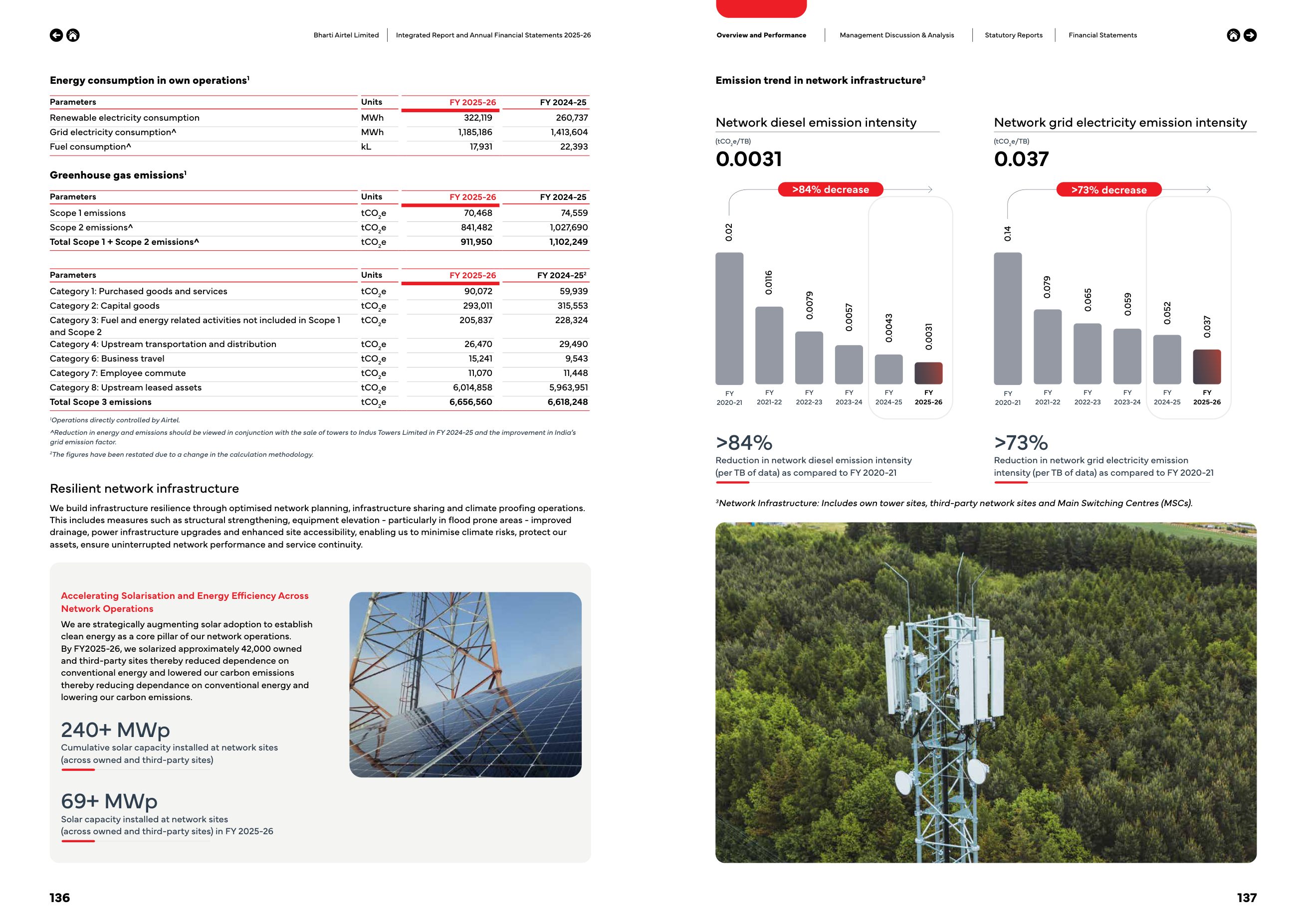
The footnote is the reason to praise it: "Reduction in energy and emissions should be viewed in conjunction with the sale of towers to Indus Towers Limited in FY 2024-25 and the improvement in India's grid emission factor." The 17% fall in Scope 1 and 2 is partly a boundary change, and the report says so in the same table. Upstream leased assets, which is where the towers now sit, are 6.01 million tCO2e, about 90% of Scope 3. That is the number the SBTi Scope 3 target will be judged on, and it rose slightly. A reader can see all of this on one page, which is what disclosure is for.
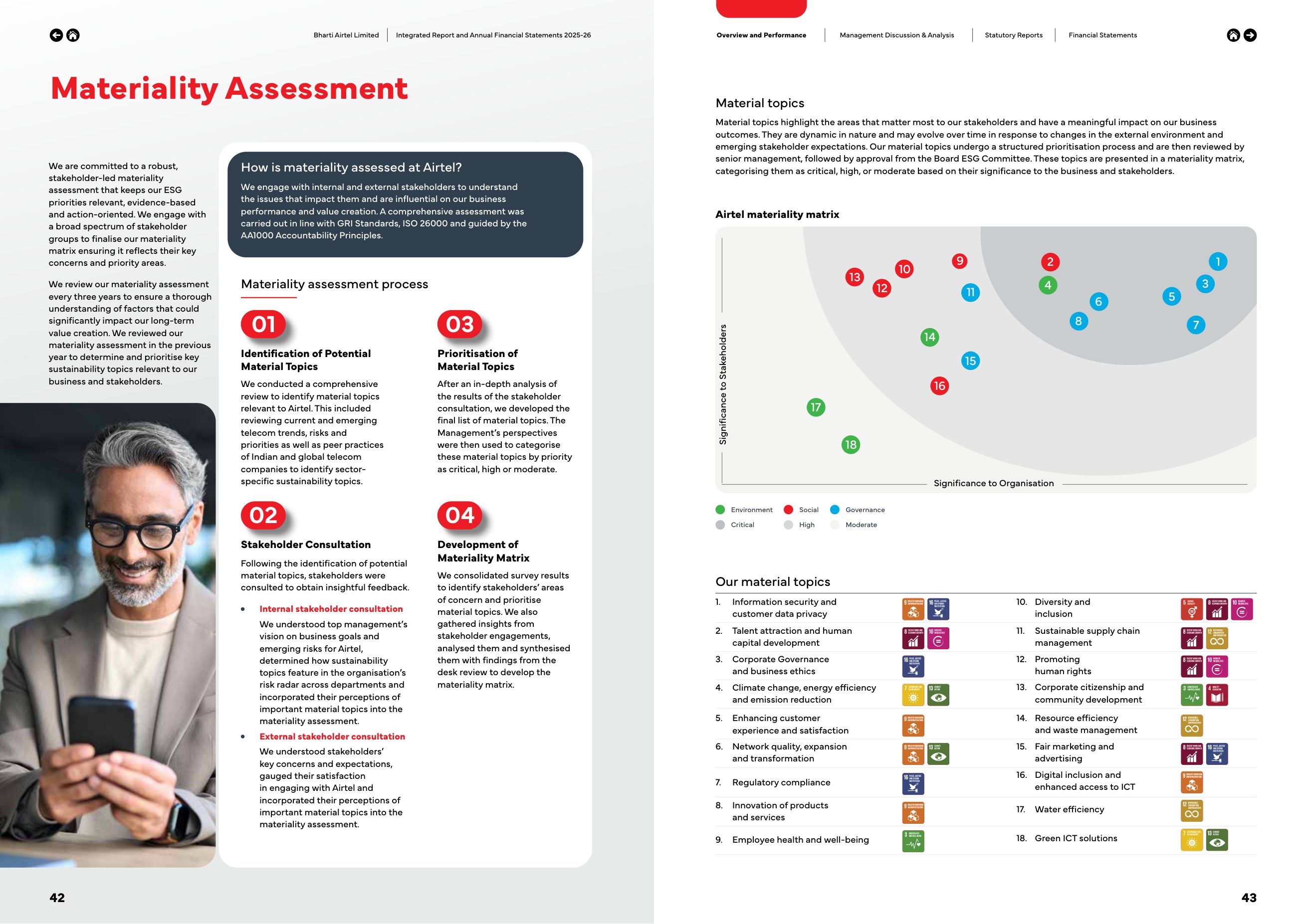
Materiality is the section that holds the score at 4. The process is described in four steps (identification, stakeholder consultation, prioritisation, matrix), follows GRI, ISO 26000 and AA1000, and produces a matrix of significance to stakeholders against significance to the organisation with critical, high and moderate tiers, approved by the Board ESG Committee. It was "reviewed in the previous year" and is refreshed every three years. It is a competent single-materiality exercise; HDFC Bank, L&T and Hindustan Zinc have moved to double materiality, and Hindustan Zinc prints its financial thresholds.
DNV Business Assurance India provides reasonable assurance on BRSR Core for standalone operations and limited assurance on other selected disclosures, and the full statement is printed. The GSMA ESG Metrics for Mobile and a GRI content index sit in the report, so a sector analyst doesn't need a separate document.
Governance disclosure: 4/5
The accountability statement, the Board ESG Committee's role in materiality, and the corporate governance report at page 271 are all in order. The leadership transition, from a Managing Director and CEO structure to an Executive Vice Chairman with a new CEO, is mentioned in the Chairman's message; a governance-section note on how the roles now divide, and why, would help.
Financial storytelling: 3/5
The MD&A financial summary on page 172 is clear and complete: consolidated revenue ₹2,109,728 million, EBITDAaL ₹1,079,460 million, profit before exceptional items and tax ₹485,902 million (from ₹369,712 million, up 31%), profit before tax ₹451,727 million, tax expense ₹113,499 million (from ₹31,921 million), and profit for the year ₹266,952 million (from ₹337,440 million). Standalone EPS is ₹23.65 against ₹40.60. The prior year's low tax charge is what drove the decline; the operating story is strong.
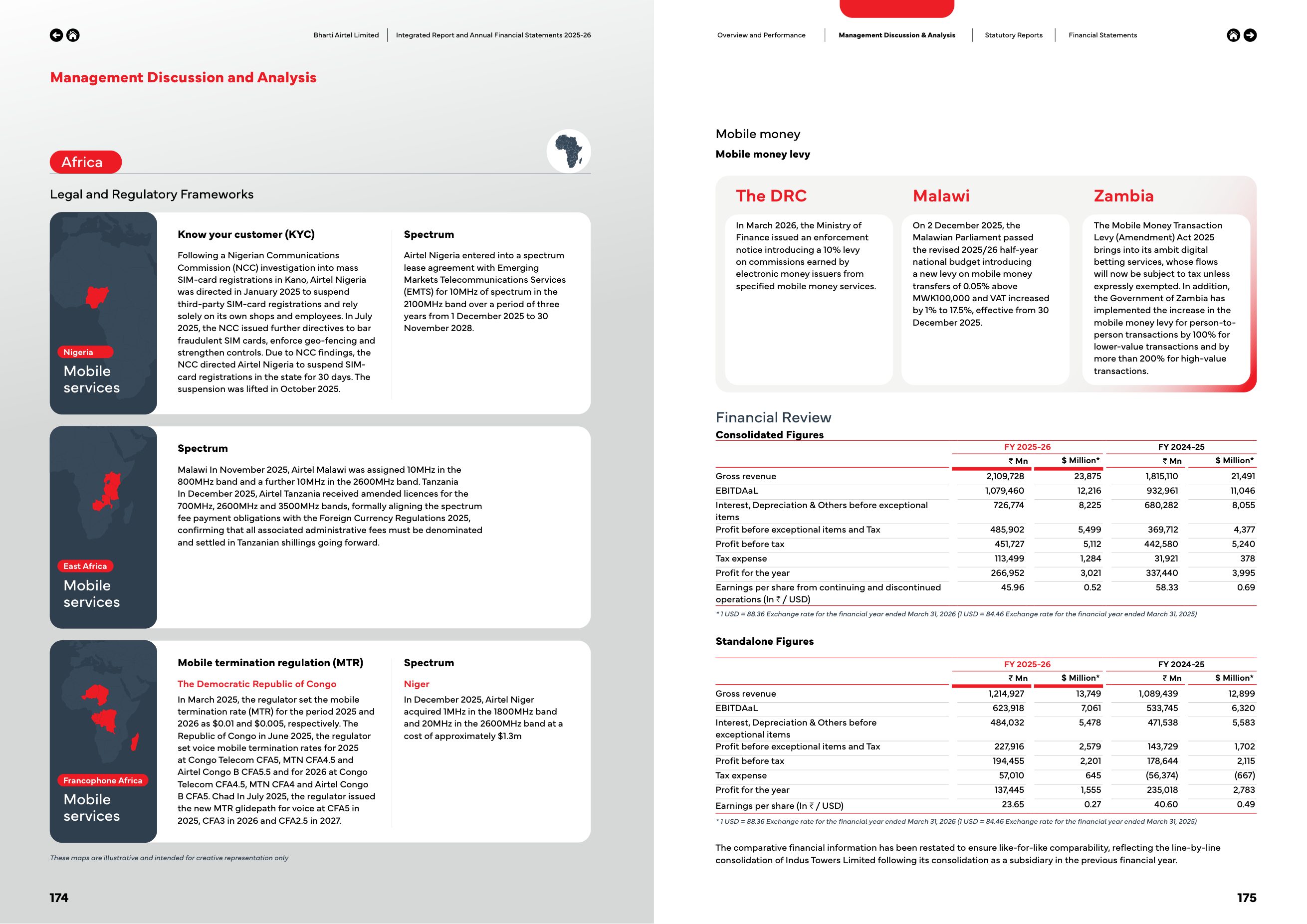
The highlights page tells it differently. Revenue and EBITDAaL carry growth arrows (16.2%, 15.7%); "Net Profit (before exceptional items)" of ₹301,127 million carries none. The label is accurate and the omission of the arrow is, in its way, honest. But a reader who does not turn to page 172 will not learn that profit for the year fell 21%, and the value creation model repeats the before-exceptional figure. Infosys footnotes its adjusted measure where it appears and prints the statutory number in the table; L&T shows recurring, exceptional and overall profit on three lines. Airtel's summary has the information; its front page doesn't.
The restatement of FY 2024-25 consolidated figures for the full consolidation of Indus Towers is disclosed on the highlights page and in the about-the-report boundary note, which is correct.
Design and readability: 4/5
The five-part structure is easy to hold in the head, the capital and stakeholder icons are used consistently from the about-the-report page onward, and the tables are well set. Two habits cost a point: financial figures in ₹ million throughout (₹2,109,728 million rather than ₹2,10,973 crore), which no other company in the series does, and the featured-story spreads, which lengthen the report without adding disclosure.
Digital version: 4/5
The PDF is bookmarked and navigable, and built as spreads. There is no reference to an online edition, and the BRSR, GRI index and assurance statement are all inside the PDF, so it is complete on its own.
What reporting teams can take from it
Copy the emissions footnote: when a reduction reflects a boundary change or a grid factor, say so in the table. Copy the quarterly strategic progress page. Copy putting the GSMA metrics, GRI index and the full assurance statement inside the report.
Then give the front page the same profit number as the summary, or both, with the arrow; move the materiality assessment to a double-materiality basis at the next three-year review; and write one paragraph per capital on what it draws from the others.
Series scorecard
Every report in this series is scored on the same seven-point card by the same reader. Scores are editorial opinion of the published document; each review carries the page references behind its findings.
| Company | Score (of 35) |
|---|---|
| Hindustan Zinc | 30 |
| TCS | 29 |
| HUL | 28 |
| Reliance | 27 |
| L&T | 27 |
| Bharti Airtel (this review) | 27 |
| HDFC Bank | 26 |
| ICICI Bank | 25 |
| Infosys | 25 |
| ITC | 21 |
Frequently asked questions
What are Airtel's climate targets?
Science Based Targets validated by the SBTi: reduce absolute Scope 1 and 2 greenhouse gas emissions by 50.2% and absolute Scope 3 emissions by 42% by FY 2030-31 from a FY 2020-21 base year. In FY 2025-26, Scope 1 was 70,468 tCO2e, Scope 2 841,482 tCO2e (total 911,950, down from 1,102,249), and Scope 3 6,656,560 tCO2e across the reported categories, with 41,759 network sites solarised cumulatively and 322,119 MWh of renewable energy consumed.
Why does Airtel report net profit 'before exceptional items'?
The highlights page and the value creation model use net profit before exceptional items (₹301,127 million consolidated; ₹170,906 million standalone). The MD&A financial summary shows profit before exceptional items and tax up 31% to ₹485,902 million, but profit for the year down to ₹266,952 million from ₹337,440 million because the prior year carried a much lower tax charge (₹31,921 million against ₹113,499 million). Both measures are disclosed; the highlights page chooses the first.
Does Airtel do a double materiality assessment?
No. The report describes a stakeholder-led materiality assessment, reviewed every three years and last reviewed in FY 2024-25, following GRI Standards, ISO 26000 and the AA1000 principles. Topics are plotted on a matrix of significance to stakeholders against significance to the organisation and classified as critical, high or moderate, then approved by the Board ESG Committee.
Who assures Airtel's sustainability disclosures?
DNV Business Assurance India Private Limited provides reasonable assurance on BRSR Core indicators, with a boundary of Airtel's standalone operations under direct operational control, and limited assurance on other selected disclosures. Deloitte Haskins & Sells LLP audits the financial statements. The full DNV statement is printed in the report.
What does Airtel's value creation model show?
Inputs and outputs by capital: ₹1,605,349 million of equity and ₹1,307,916 million of net debt; 345,912 towers, 1,187,894 base stations and 532,388 route-km of fibre; 20,116 employees and 80,123 contractual staff; 1,185,186 MWh of grid electricity and 322,119 MWh of renewables; and outputs including ₹1,214,927 million of standalone revenue, a 51.4% EBITDAaL margin, ₹749,310 million of cash from operations, ₹433,566 million paid to the exchequer, 3.5 billion spam SMSes blocked and 30%-plus of code written by AI.
How does The Footnotes score annual reports?
Seven criteria, each scored 1 to 5 with a one-line reason: strategy and narrative; integrated thinking and capitals; BRSR and ESG integration; governance disclosure; financial storytelling; design and readability; and the digital version. Scores are editorial opinion based on the published document, and the same card is used for every company so results can be compared.
Sources
- Bharti Airtel — Integrated Report and Annual Financial Statements 2025-26 (PDF) — Bharti Airtel Limited
- Bharti Airtel — Investor relations — Bharti Airtel Limited
- Science Based Targets initiative — target dashboard — SBTi
- SEBI circular: BRSR Core — framework for assurance and ESG disclosures for value chain (12 July 2023) — SEBI