

Hindustan Zinc Integrated Annual Report 2025-26: A Review
Hindustan Zinc's seventh integrated report is the most ambitious ESG document in this series: a CSRD-aligned double materiality assessment with rupee thresholds, 2030 goals reported against status, a reporting suite that includes tax transparency, climate action and TNFD reports, and a Board statement of responsibility. It is also 610 pages, leads with its own awards, and reports absolute emissions of 5.02 million tonnes against a 50% reduction target without saying how far along it is.
 In short
Key takeaways
- The report is Hindustan Zinc's seventh integrated report, 610 printed pages in six sections (Know Us, Foundations, Value Creation, ESG, Statutory, Financial), with a Board and management statement of responsibility for its integrity and a reporting suite that includes a Tax Transparency Report, a Climate Action Report and a TNFD Report.
- Materiality: a double materiality assessment conducted in FY2025 with over 400 stakeholders, aligned to the EU CSRD, with financial materiality thresholds stated in rupees (low below ₹10 crore a year, medium ₹10 to 100 crore, high above ₹100 crore), 21 topics finalised from 200-plus, and outcomes approved by the Board's Sustainability & ESG Committee.
- Sustainability Goals 2030 are reported as target and FY2026 status across climate, water, waste, biodiversity, safety, diversity and supply chain: Scope 1 and 2 at 5.02 million tCO2e against a 50% cut by 2030, 13% less freshwater against 50%, 26.4% gender diversity, and two work-related fatalities stated plainly.
- Financials were a record: revenue ₹40,844 crore (up 20%), EBITDA ₹22,162 crore (up 27%), net profit ₹13,832 crore (up 34%) with about 45% from silver, ROCE around 67%, net cash of ₹5,594 crore, and a ₹10 dividend (₹4,225 crore); the five-year KPI charts also show the ₹75.50 dividend of FY2022 and a market capitalisation that peaked near ₹3.1 lakh crore before closing at about ₹2.12 lakh crore.
- S.R. Batliboi & Co. LLP gives reasonable assurance on BRSR Core and limited assurance on the remaining BRSR and GRI indicators; in FY2026 the company became the first Indian company admitted to the International Council on Mining and Metals and ran its first ICMM self-assessment and audit.
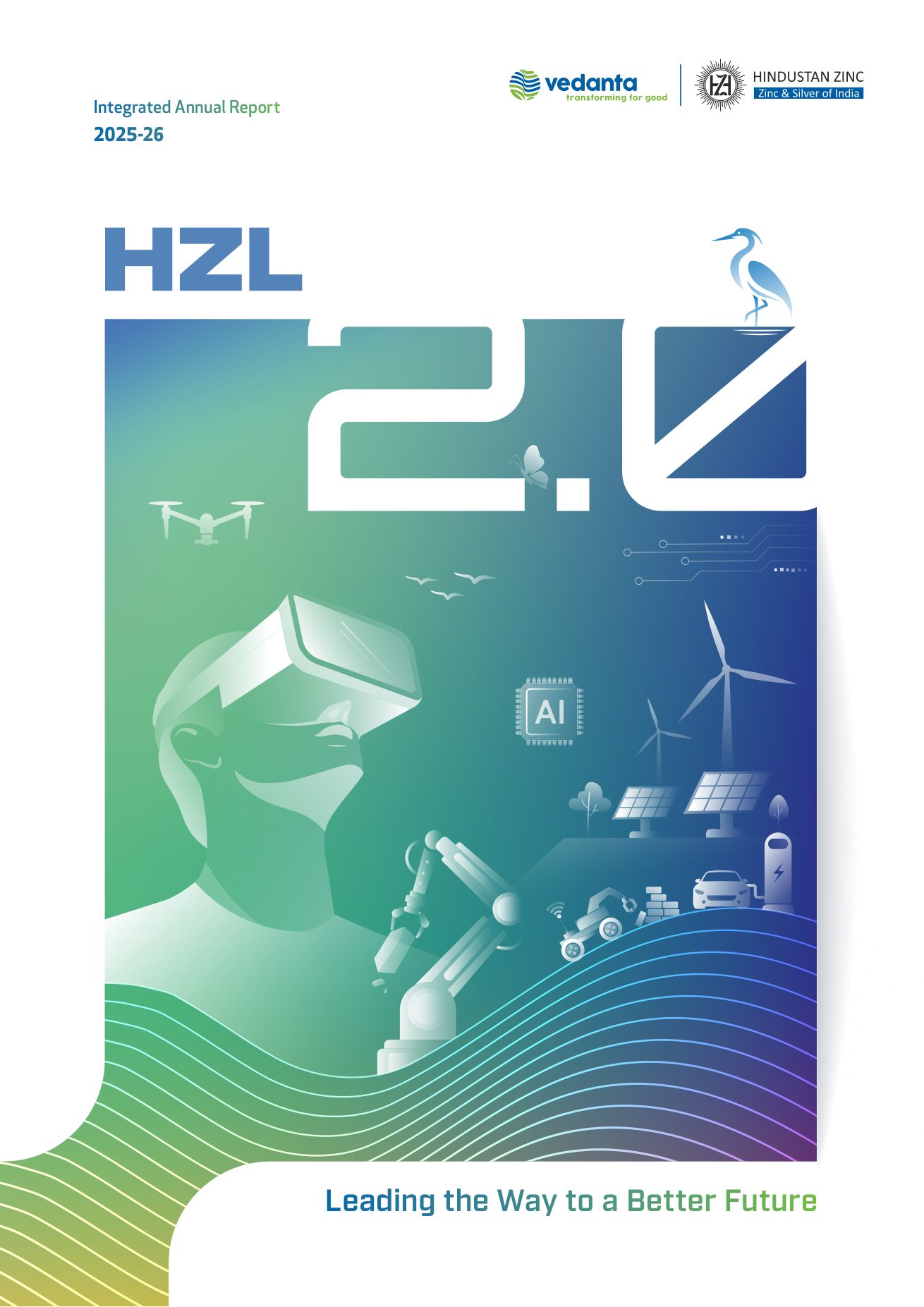
- Production issues: the cover PDF carries the invisible text 'INTEGRATED ANNUAL REPORT 2023-24' in white type from an earlier template, the reporting-suite graphic shows prior-year covers, and two spreads of awards, including the report's own LACP ranking, precede the 'About the Report' page.
Hindustan Zinc is not a Nifty 50 company, but its integrated report belongs in any comparison of India's best, and in FY2026 it had a lot to report: record revenue and profit, the lowest zinc cost of production in five years, admission as the first Indian member of the International Council on Mining and Metals, and a set of 2030 sustainability goals it has chosen to be measured against. The report is the most complete execution of integrated reporting in this series. It is also a reminder that completeness has a page count.
As with every review in this series, we read the published PDF against the <IR> Framework, SEBI's BRSR Core expectations and plain readability, and score it on the same seven-point card. Scores are our opinion. Screenshots are small excerpts reproduced for review and remain the copyright of Hindustan Zinc Limited; the full report is on the company's investor pages and as a digital edition.
The scorecard
| Criterion | Score (of 5) | In one line |
|---|---|---|
| Strategy and narrative | 4 | Investment case, strategic priorities and a CFO's statement alongside the Chairperson and CEO; the report opens with awards |
| Integrated thinking and the capitals | 5 | An integrated-thinking chapter, a business model with inputs and focus areas per capital, and capital chapters that name topics, SDGs, ICMM principles and strategy links |
| BRSR and ESG integration | 5 | CSRD-aligned double materiality with rupee thresholds, goals against status, TNFD and climate reports, reasonable assurance |
| Governance disclosure | 5 | Board and management statement of responsibility for the report; materiality approved by a Board committee; parent relationship and stake sales disclosed |
| Financial storytelling | 4 | Five-year KPI charts and a CFO's statement with cost of production and ROCE; record year told without hedging, market-cap fall included |
| Design and readability | 3 | Strong system and genuinely useful explainers, but 610 pages and an awards section ahead of the report |
| Digital version | 4 | Full digital integrated report by QR and URL, single-page-friendly sections; the PDF carries template leftovers |
| Total | 30 / 35 |
What the report is
Six sections across 610 printed pages: Know Us (performance, highlights, awards, about the report, integrated thinking, leadership messages, investment case), Foundations for Sustainable Growth (business model, stakeholders, materiality, risk, strategic priorities), Our Value Creation (CFO's statement, KPIs, operating environment and operational performance by product, mine and smelter), ESG (sustainability overview and environmental, social and governance chapters), Statutory Reports and Financial Statements. The BRSR is inside the PDF at pages 374 to 443.
The "About the Report" page is one of the two best in the series with HDFC Bank's. It states that this is the seventh integrated report, prepared under the <IR> Framework "now part of the IFRS Foundation" (the correct attribution), gives the period, scope and boundary, explains that five-year trends are provided for KPIs including ESG indicators, names the statutory frameworks, and contains a "Board and Management Assurance" paragraph in which both "acknowledge their shared responsibility for the integrity and completeness of the information" and state their opinion that the report "presents an accurate, fair, and balanced view". That is the Framework's statement of responsibility, in full.
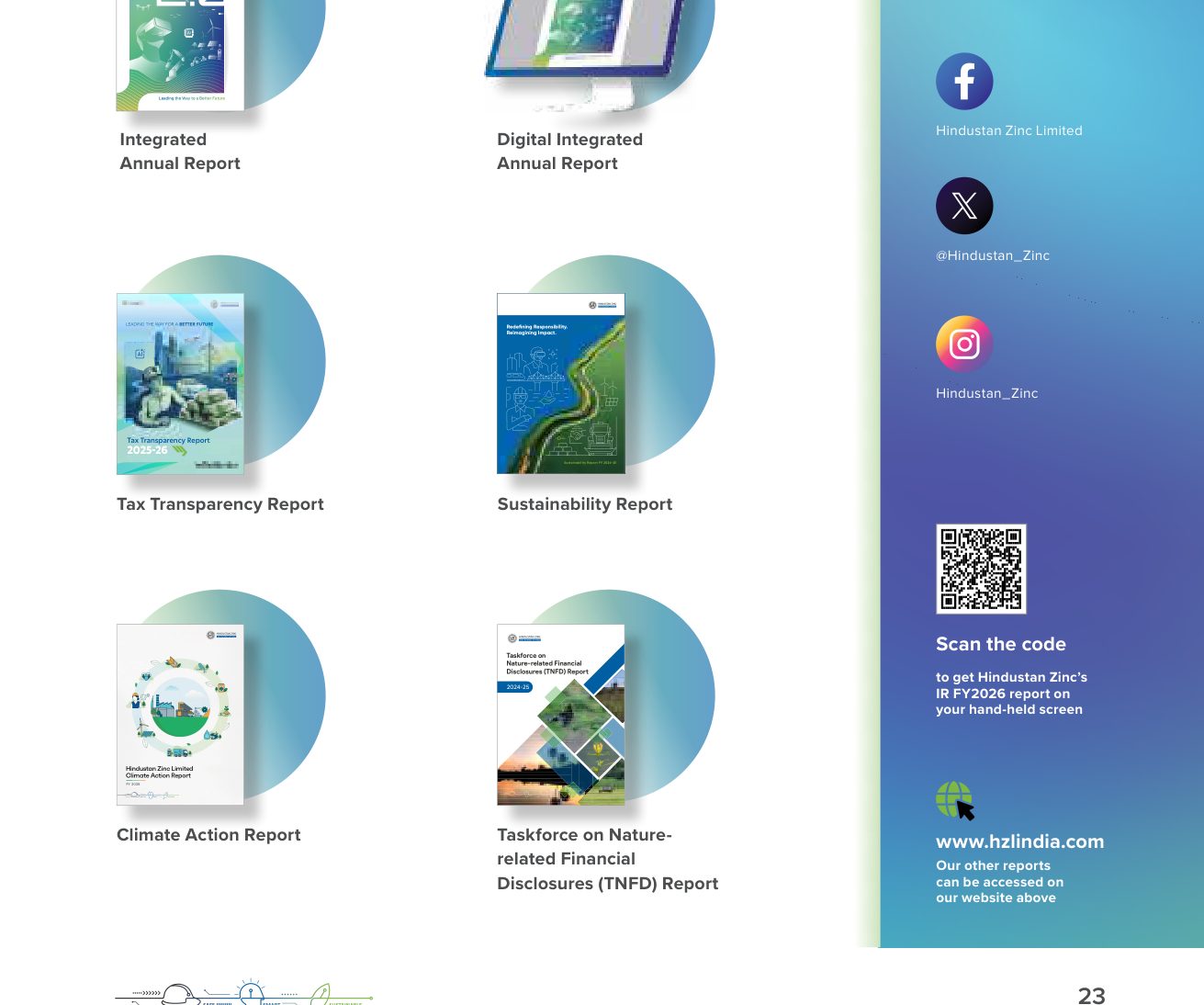
The same spread shows the reporting suite: a Tax Transparency Report, a Sustainability Report, a Climate Action Report and a TNFD Report. No other company in the series publishes a tax transparency report or a nature-related disclosure under TNFD.
Key number: 21 — material topics finalised from more than 200 candidates in the double materiality assessment, each with a stated financial threshold.
Strategy and narrative: 4/5
The narrative apparatus is rich: a Chairperson's message from Priya Agarwal Hebbar, a CEO and Whole-time Director's message, a separate CFO's statement, an investment case, and a strategic priorities chapter. The CEO's message gives the year in numbers (revenue ₹40,844 crore, EBITDA ₹22,162 crore, net profit ₹13,832 crore with about 45% from silver, ROCE around 67%, net cash ₹5,594 crore) and the strategic context: record production of 851 kt of zinc, the Serentica round-the-clock renewable agreement, and the phase of growth the company calls HZL 2.0. The investment case is specific about what shareholders can track, listing the 2030 goals with their baselines.
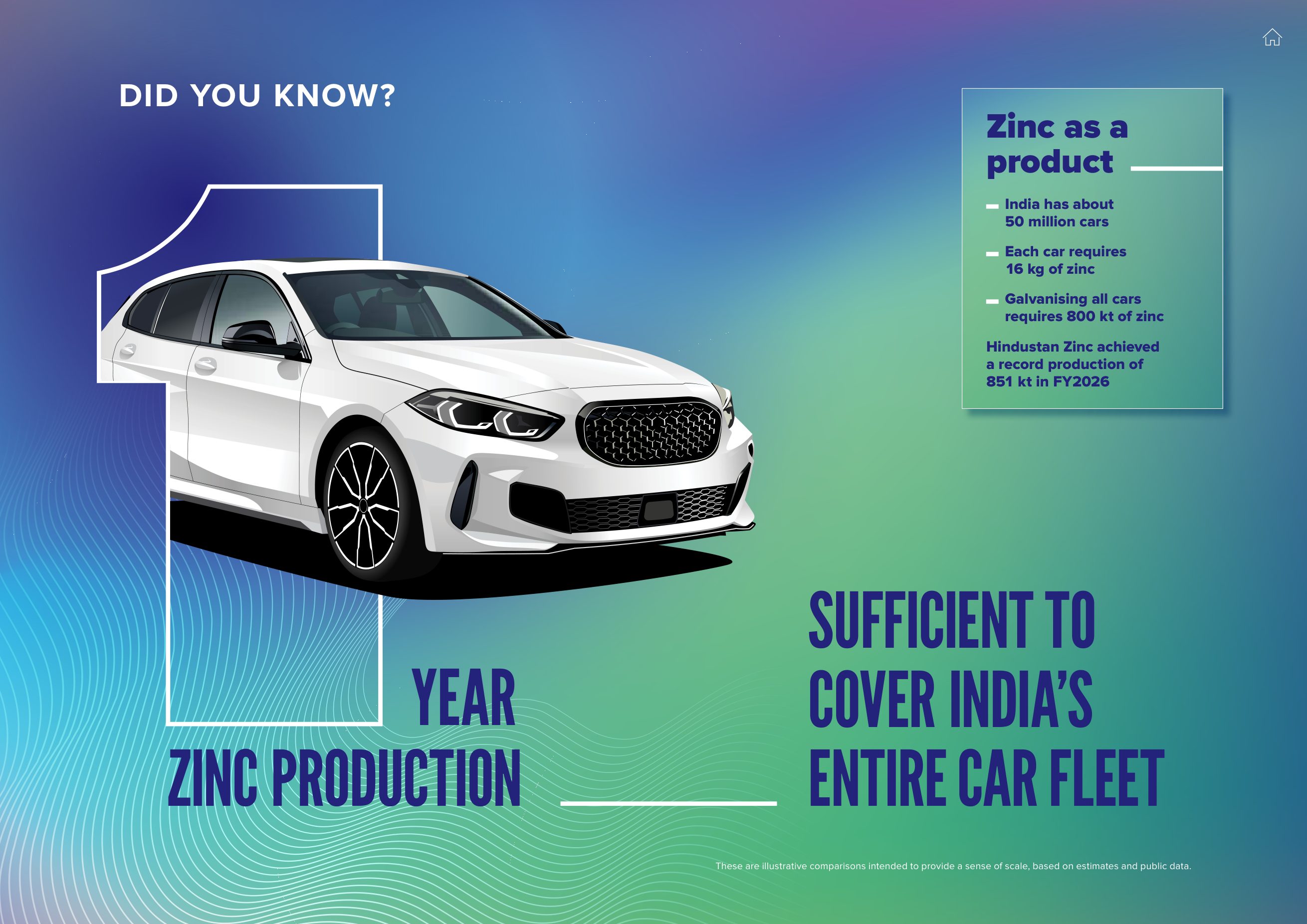
A series of "Did you know?" spreads translates production into scale a lay reader understands (851 kt of zinc is enough to galvanise every car in India), with the honest footnote that these are illustrative comparisons. That is good editorial thinking.
The point dropped is sequencing. The report opens with "Performance that Powers the Next Phase" and "FY2026 Highlights", which is right, and then gives two spreads to awards and recognitions, including its own integrated report's LACP ranking, before the reader reaches "About the Report". Awards belong at the back.
Integrated thinking and the capitals: 5/5
A chapter titled "Integrated Thinking at Hindustan Zinc" explains the model in one paragraph: value emerges from the interplay of six capitals and stakeholder relationships, shaped by the external environment, material issues and chosen priorities, with ESG at the core through Sustainability Goals 2030 and a "zero harm, zero waste, zero discharge" philosophy. The business model spread then lists, for each capital, the inputs deployed and the key focus areas.
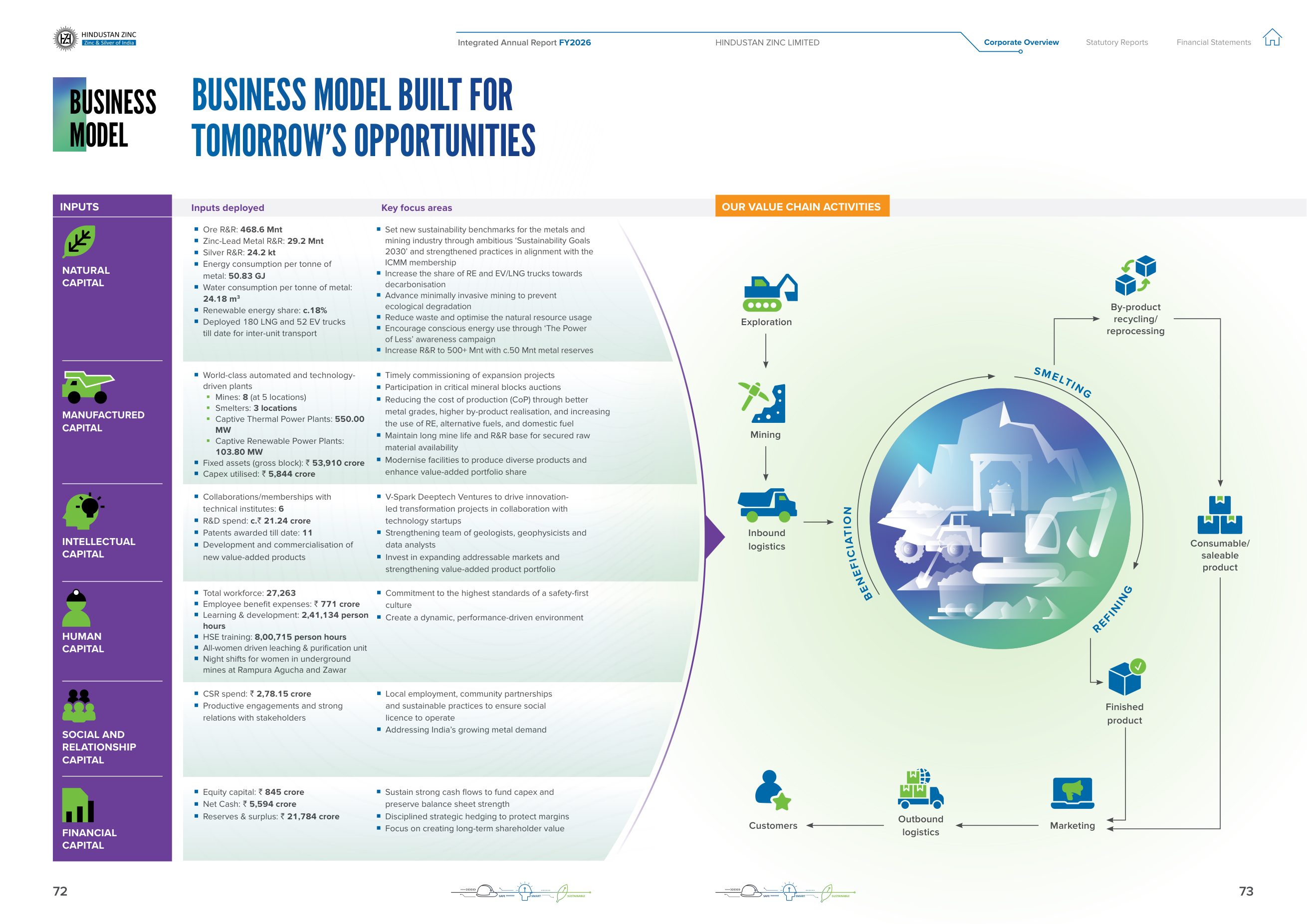
The inputs are specific: eight mines at five locations, three smelter locations, 550 MW of captive thermal and 103.8 MW of captive renewable power, ₹53,910 crore of gross block and ₹5,844 crore of capex; ore reserves and resources of 468.6 million tonnes, 29.2 million tonnes of zinc-lead metal and 24.2 kt of silver; energy of 50.83 GJ and water of 24.18 cubic metres per tonne of metal; a workforce of 27,263 with 2,41,134 person-hours of learning; ₹278 crore of CSR; ₹21.24 crore of R&D and 11 patents. Each ESG chapter then opens with the material topics, capitals impacted, SDGs, policies, ICMM principles, the strategy pillar it links to and the stakeholder affected, and ends with a "key takeaway". It is a lot of scaffolding, and it works.
BRSR and ESG integration: 5/5
Materiality is the reference example. The company runs a full double materiality assessment every three years with annual reviews; the FY2025 assessment followed the EU CSRD's principles, engaged over 400 stakeholders through site visits, focus groups and interviews, scored impact on severity, reach and irreversibility, and set financial materiality thresholds that it prints: low below ₹10 crore a year, medium ₹10 to 100 crore, high above ₹100 crore. Two hundred-plus topics were narrowed to 21, and the outcome was approved by the Board's Sustainability & ESG Committee. Each topic then carries its KPIs and a page reference for progress.
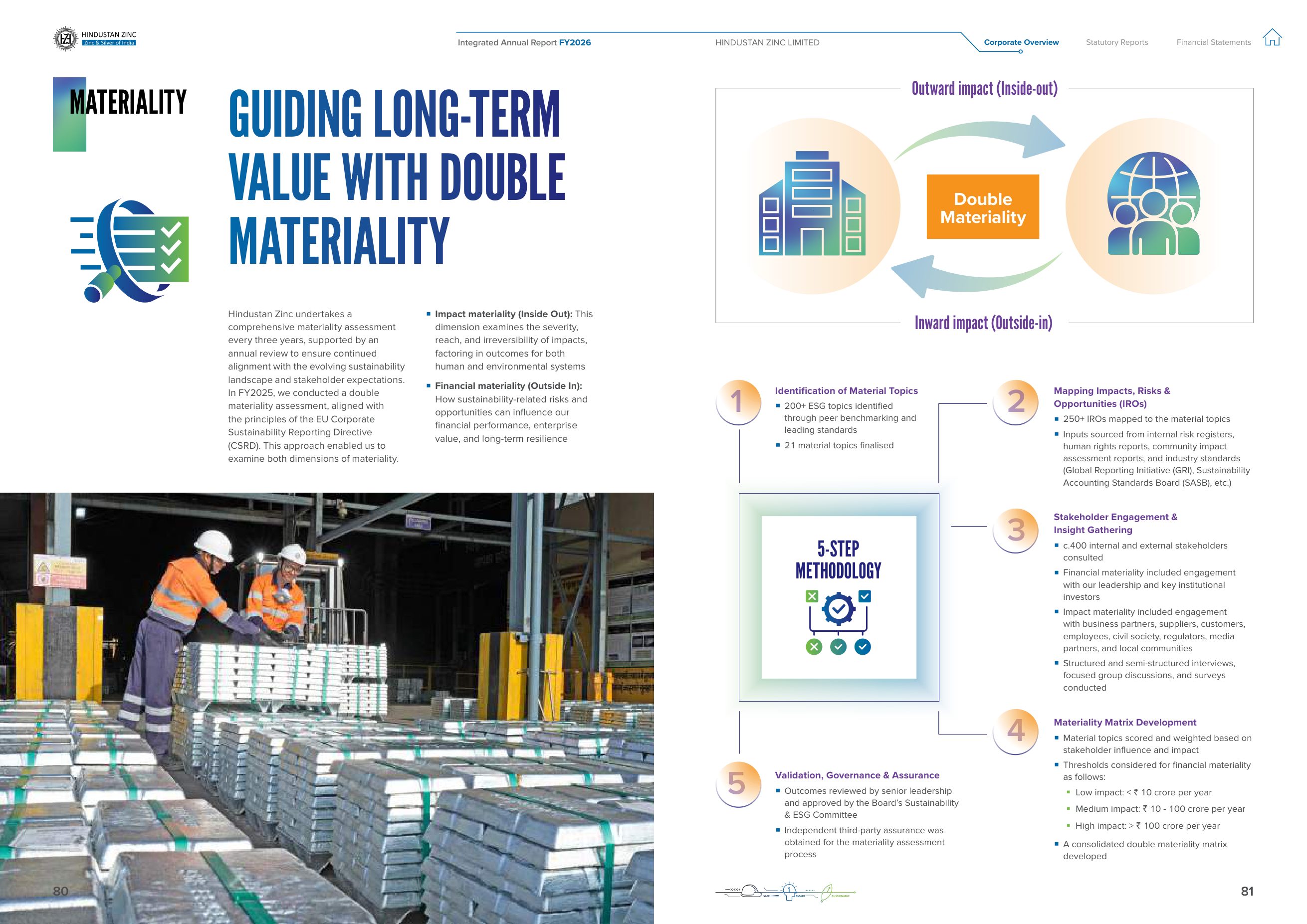
Printing the rupee thresholds is the detail that matters. Most double materiality disclosures say "financial materiality was assessed" and stop; this one tells the reader what "material" means in money, which is what the CSRD and, in time, IFRS S1 are asking for.
The Sustainability Goals 2030 spread reports eight goal areas as target and FY2026 status. Climate: 50% cut in Scope 1 and 2 and 25% in Scope 3 by 2030 from FY2020; status, absolute Scope 1 and 2 of 5.02 million tCO2e and Scope 3 of 1.47 million. Water: 50% less freshwater; status 13% reduction, 47% municipal treated water in smelting. Waste: near-zero to landfill; status 29.43% reused and 104% utilisation of high-volume low-toxicity waste. Safety: zero harm; status "2 fatalities, 1 high consequence injury". Diversity: 26.4%, with 30% in decision-making roles.
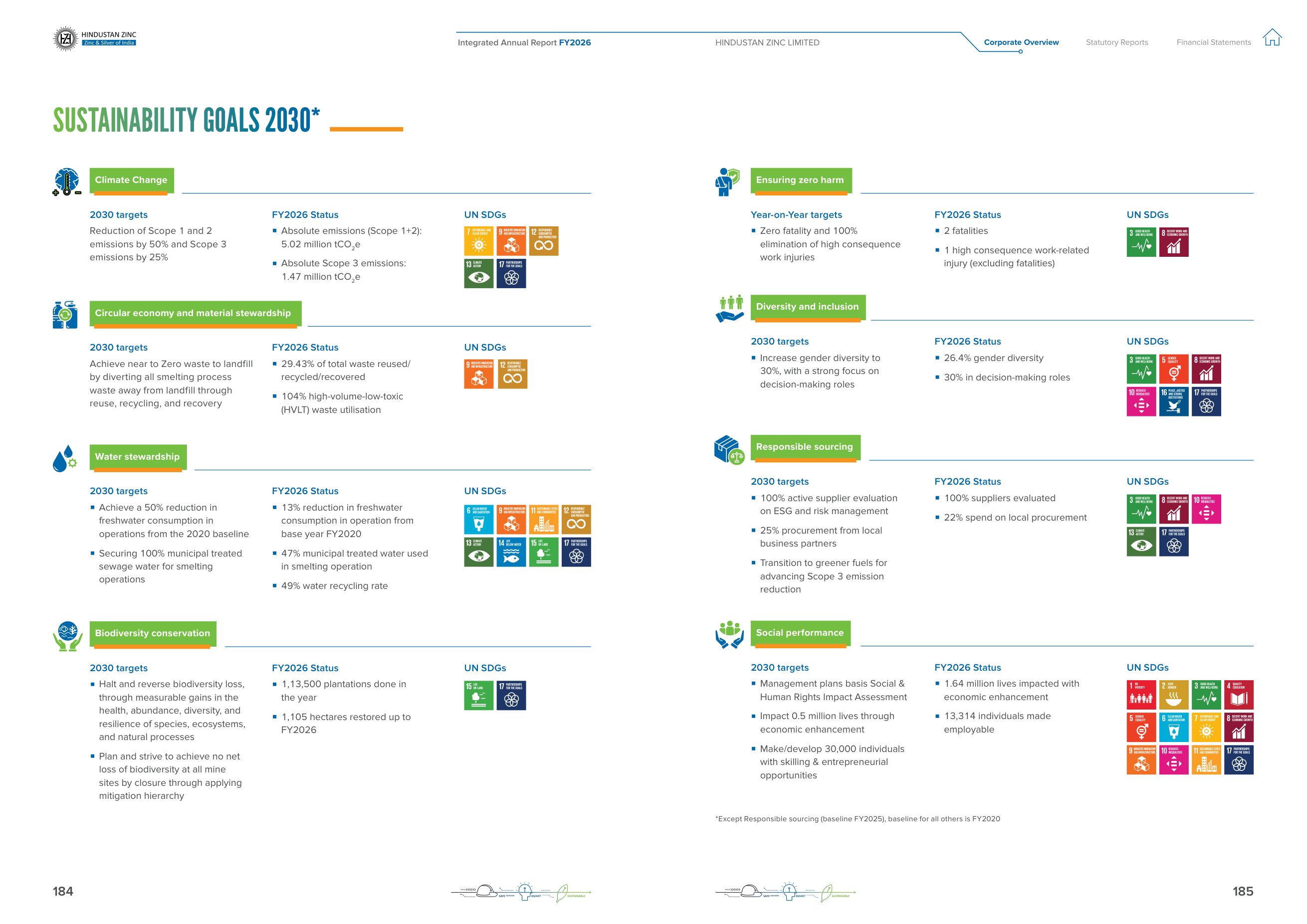
Two observations. First, stating "2 fatalities" on the goals page, against a goal of zero, is the kind of disclosure that earns trust for everything around it. Second, the climate status is the one line on that spread that gives an absolute number without the comparison the goal invites: 5.02 million tCO2e tells the reader where the company is, not how far it has come from FY2020 or how far it has to go, when the water line does exactly that (13% against 50%). With renewable power at about 18% and a 70% target by FY2028, the climate pathway is the report's hardest number, and it should be shown as a percentage of the base.
Assurance: S.R. Batliboi & Co. LLP gives reasonable assurance on BRSR Core and limited assurance on the rest of the BRSR and GRI indicators. The company also completed its first ICMM self-assessment and audit at Rampura Agucha and Chanderiya, which will become an external benchmark in future years.
Governance disclosure: 5/5
The statement of responsibility is the headline, and it is backed up: materiality outcomes are approved by a Board committee, the sustainability governance structure is drawn, and the corporate governance report and Directors' report are complete. The report is also direct about its ownership: it notes the two stake sales by Vedanta Limited that increased the free float, and the dividend history in the KPI charts (₹75.50 per share in FY2022, ₹29 in FY2025, ₹10 in FY2026) tells the parent-company story without commentary. The Chairperson is a member of the promoter family and the report says so in the signature.
Financial storytelling: 4/5
The CFO's statement is a real letter: it explains that the year beat the company's own guidance, gives the cost of production (US$959 per tonne excluding royalty, the lowest in five years), the swing from net debt of ₹1,169 crore to net cash of ₹5,594 crore, ROCE of about 67%, and the market capitalisation, which "reached a peak of around ₹3,10,000 crore during the year and stood at c.₹2,12,000 crore as of March 31, 2026". Putting the fall from the peak in the CFO's own words is the right call.
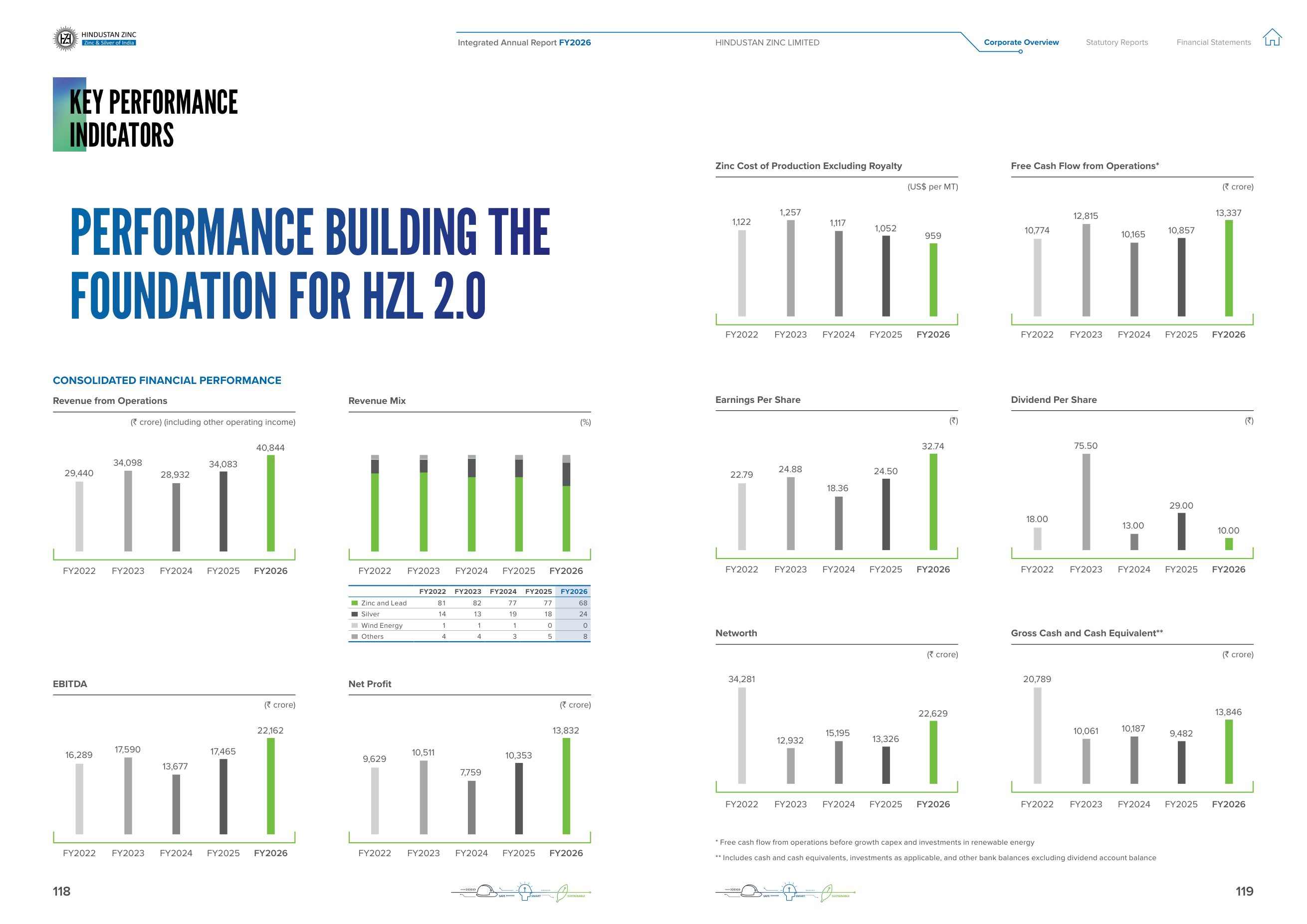
The five-year KPI spread covers EBITDA, net profit, cost of production, net worth, free cash flow, EPS, dividend per share and gross cash, each as a labelled bar chart. Nothing is adjusted and nothing is missing. The point dropped is that the KPI charts sit at page 118, after the investment case, business model, materiality, risk and strategy chapters; the reader who wants the numbers first has a long way to go.
Design and readability: 3/5
The design system is confident and the explanatory devices ("Did you know?", "Here's the scoop" video links, key takeaways per chapter) are genuinely useful. But 610 pages is 610 pages, the operational performance section alone runs to sixty, and the ESG section repeats material that the separate Sustainability Report carries in full. The awards spreads at the front, and the report's habit of citing its own rankings, cost it a point that the content would otherwise have earned.
Digital version: 4/5
The digital integrated report is a real product, reached by QR code from the PDF and by a public URL, and the PDF's section structure maps onto it. Two production leftovers keep the score at 4. The cover PDF contains the text "INTEGRATED ANNUAL REPORT 2023-24" in white type on a white background, invisible to the eye but present to search engines, screen readers and anyone who selects all; it is the template from two years ago. And the reporting-suite graphic shows the prior year's Sustainability, Climate Action and TNFD report covers next to the current integrated report, which a reader will reasonably take to mean the current editions don't exist.
What reporting teams can take from it
Copy the "About the Report" page, including the Board and management statement of responsibility. Copy the materiality chapter, and in particular the printed financial thresholds. Copy the goals-against-status spread, including the willingness to print "2 fatalities". Copy the CFO's statement as a form.
Then move the awards to the back, show climate progress as a percentage of the baseline the way the water goal is shown, run a text-layer check on the cover before release, and consider whether the reader needs the Sustainability Report's content twice.
Series scorecard
Every report in this series is scored on the same seven-point card by the same reader. Scores are editorial opinion of the published document; each review carries the page references behind its findings.
| Company | Score (of 35) |
|---|---|
| Hindustan Zinc (this review) | 30 |
| TCS | 29 |
| HUL | 28 |
| Reliance | 27 |
| L&T | 27 |
| Bharti Airtel | 27 |
| HDFC Bank | 26 |
| ICICI Bank | 25 |
| Infosys | 25 |
| ITC | 21 |
Frequently asked questions
What is in Hindustan Zinc's reporting suite?
The integrated annual report (PDF and a digital edition reached by QR code), a Sustainability Report, a Climate Action Report, a Taskforce on Nature-related Financial Disclosures report, and a Tax Transparency Report. The integrated report states that its non-statutory sections follow the <IR> Framework and that detailed ESG disclosures are in the Sustainability Report on the company's website.
How does Hindustan Zinc assess materiality?
Through a double materiality assessment conducted in FY2025 and reviewed annually, with a full reassessment every three years. It followed the principles of the EU Corporate Sustainability Reporting Directive, engaged over 400 internal and external stakeholders through site visits, focus groups and interviews, scored impact materiality on severity, reach and irreversibility, and set financial materiality thresholds of under ₹10 crore, ₹10 to 100 crore, and over ₹100 crore a year. Twenty-one material topics were finalised and approved by the Board's Sustainability & ESG Committee.
What are Hindustan Zinc's climate targets and emissions?
Sustainability Goals 2030 include a 50% reduction in Scope 1 and 2 emissions and a 25% reduction in Scope 3 from an FY2020 baseline, on a pathway to net zero by 2050 or sooner, and 70% renewable power by FY2028. FY2026 absolute Scope 1 and 2 emissions were 5.02 million tCO2e and Scope 3 1.47 million tCO2e. Renewable power share was about 18%, including 519 million units received under a 530 MW round-the-clock renewable agreement with Serentica.
Who assures Hindustan Zinc's BRSR?
S.R. Batliboi & Co. LLP provides reasonable assurance on BRSR Core indicators and limited assurance on the remaining BRSR and GRI indicators, as stated in Section A of the BRSR. The report also states that the Board and management acknowledge shared responsibility for the integrity and completeness of the integrated report.
What were Hindustan Zinc's FY2026 results?
Revenue of ₹40,844 crore, up 20%; EBITDA of ₹22,162 crore, up 27%; net profit of ₹13,832 crore, up 34%, with about 45% contributed by silver; the lowest zinc cost of production in five years at US$959 per tonne excluding royalty; return on capital employed of about 67%; net cash of ₹5,594 crore; earnings per share of ₹32.74; and a dividend of ₹10 per share totalling ₹4,225 crore.
How does The Footnotes score annual reports?
Seven criteria, each scored 1 to 5 with a one-line reason: strategy and narrative; integrated thinking and capitals; BRSR and ESG integration; governance disclosure; financial storytelling; design and readability; and the digital version. Scores are editorial opinion based on the published document, and the same card is used for every company so results can be compared.
Sources
- Hindustan Zinc — Integrated Annual Report FY 2025-26 (digital edition) — Hindustan Zinc Limited
- Hindustan Zinc — Investors: annual reports — Hindustan Zinc Limited
- International Council on Mining and Metals — Mining Principles — ICMM
- SEBI circular: BRSR Core — framework for assurance and ESG disclosures for value chain (12 July 2023) — SEBI