

Infosys Integrated Annual Report 2025-26: A Review
Infosys keeps its integrated report to 24 pages, labels its adjusted margin on the highlights page and prints a five-year table that includes a 22% fall in market capitalisation. The compression has costs: one page per capital, qualitative outcomes, a strategy diagram still built on the 2018 four-pronged plan, and 'carbon neutral for seven years' resting on offsets.
 In short
Key takeaways
- The integrated report proper is 24 pages (pages 8 to 31 of a 383-page PDF): about-this-report, leadership, highlights, two letters, business context, strategy, a value creation model spread, and one page for each capital; the BRSR sits inside the PDF at pages 140 to 192.
- The highlights page prints 'Adjusted operating margin(3)' with the footnote on the same spread, excluding a ₹1,289 crore Labour Codes charge; net profit in the five-year table (₹29,440 crore, up 10.2%) is the statutory figure. That is the presentation TCS should have used.
- The same table shows market capitalisation falling from ₹6,52,332 crore to ₹5,07,192 crore (US$75.8 billion to US$54.8 billion) in a year; printing that number in a highlights table is rare and creditable.
- The value creation model gives numeric inputs and outputs (3.1% constant-currency growth, 31.6% ROE, 39.5% women in the workforce, 71.22% cut in Scope 1 and 2) but its 'outcomes' column is bullet-point adjectives, and the strategy diamond at its centre still shows the 2018 four-pronged strategy while the letters describe an AI-first pivot.
- 'Carbon neutral for seven years in a row' covers Scope 1, 2 and 3 and is achieved through ten carbon offset projects; Scope 3 is 2,07,374 tCO2e in the BRSR but does not appear in the integrated section, and there is no science-based reduction target for it.
- Deloitte Haskins & Sells LLP gives reasonable assurance on BRSR Core; the report says it was 'reviewed and approved for publication by the Management', not the Board, and cites the framework as the IIRC's, a body that folded into the IFRS Foundation in 2022.
Infosys was publishing GRI-based sustainability performance eighteen years ago and was the first IT company to report to GRI G4 comprehensive criteria in 2014, and the "About this report" page says so. That history shows in the FY 2025-26 report's discipline: the integrated section is 24 pages, the numbers are labelled, and the five-year table includes the one figure most companies would leave out. It also shows in a certain settledness. Some of the furniture hasn't been moved since 2018.
As with every review in this series, we read the published PDF against the <IR> Framework, SEBI's BRSR Core expectations and plain readability, and score it on the same seven-point card. Scores are our opinion. Screenshots are small excerpts reproduced for review and remain the copyright of Infosys Limited; the full report is on the company's investor relations pages.
The scorecard
| Criterion | Score (of 5) | In one line |
|---|---|---|
| Strategy and narrative | 4 | A Chairman's letter with a genuine argument and a six-pillar AI framework; the strategy graphic lags the text |
| Integrated thinking and the capitals | 3 | Numeric inputs and outputs on one spread, but outcomes are adjectives and each capital gets a single page |
| BRSR and ESG integration | 3 | BRSR inside the report, reasonable assurance on Core; materiality undated, carbon neutrality via offsets, Scope 3 absent from the integrated section |
| Governance disclosure | 3 | Complete statutory disclosure; the report is approved by management, not the Board, and the framework citation is out of date |
| Financial storytelling | 5 | Adjusted margin footnoted in place, statutory profit in the table, market capitalisation decline printed |
| Design and readability | 4 | Clean, short, consistent; the value-creation spread is the one crowded page |
| Digital version | 3 | Working bookmarks and a spread-format PDF; the ESG report and SDG mapping live in a separate document |
| Total | 25 / 35 |
What the report is
A 383-page PDF in which the integrated report is a 24-page front section. It covers about-this-report, the Board and leadership, business highlights, the Chairman's message, the CEO's letter to shareholders, awards, business context, strategy, a value creation model and six capital pages. Then come the statutory sections: Board's report, MD&A, corporate governance report, risk management report, Deloitte's BRSR assurance report, the BRSR itself (pages 140 to 192), CEO and CFO certification, and the standalone and consolidated financial statements. UN SDG mapping is delegated to a separate ESG report.
Two lines on the about-this-report page are worth noting. The framework is described as "the International Integrated Reporting Framework, developed by the International Integrated Reporting Council (IIRC)"; the IIRC was consolidated into the IFRS Foundation in 2022 and the Framework is now maintained there, as Reliance's and TCS's reports say. And the report "has been reviewed and approved, for publication, by the Management of the Company", where HDFC Bank's is approved by its Board. Neither is a large matter; both are the kind of detail a report that has been produced the same way for a long time stops checking.
Key number: 24 — pages in the integrated report section, against roughly 100 for Reliance, 64 for TCS and 250 for HDFC Bank.
Strategy and narrative: 4/5
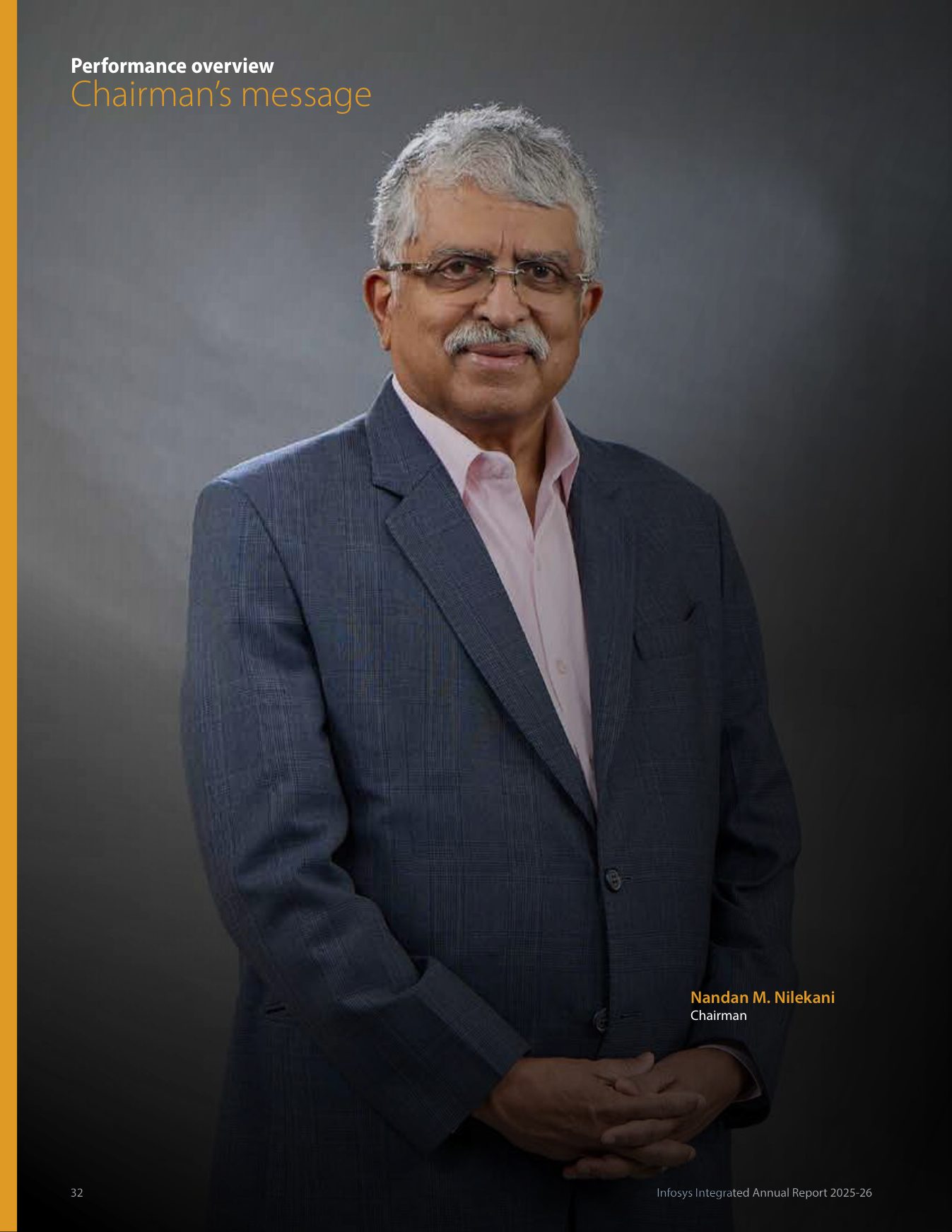
Nandan Nilekani's Chairman's message is the best piece of writing in the series so far because it makes an argument rather than a list. It names the question investors are asking ("if coding becomes automated, then why are we needed at all?"), answers it (testing, validation, architecture, cybersecurity, data governance, the deployment gap in large enterprises), and introduces a framing the rest of the report uses: the shift "from predictable machines to probabilistic ones", technical debt as "a strategic liability", and the "deployment gap" that "requires what we have come to call a root-and-branch surgery". It contains no financial numbers at all, which is right for a Chairman's letter when the CEO's letter that follows has them.
Salil Parekh's letter supplies them: revenue above US$20 billion, adjusted operating margin of 21%, free cash flow of US$3.7 billion, over US$4 billion returned through dividends (US$2.1 billion) and buybacks (US$2 billion), a ₹48 dividend, US$14.9 billion of large deals, 20,000 graduates hired. It also gives the one AI number that matters: revenue from the six AI-first areas was 5.5% of total revenue in the third quarter and growing faster than the company.
The strategy pages set out the AI-First value framework: Orchestrate, Insight, Transform, Modernize, Innovate and Assure, split into "AI First" services to capture new demand and "AI Augmented" services to reinvent existing ones, on a foundation of platforms and IP, ecosystem partnerships, talent and brand.
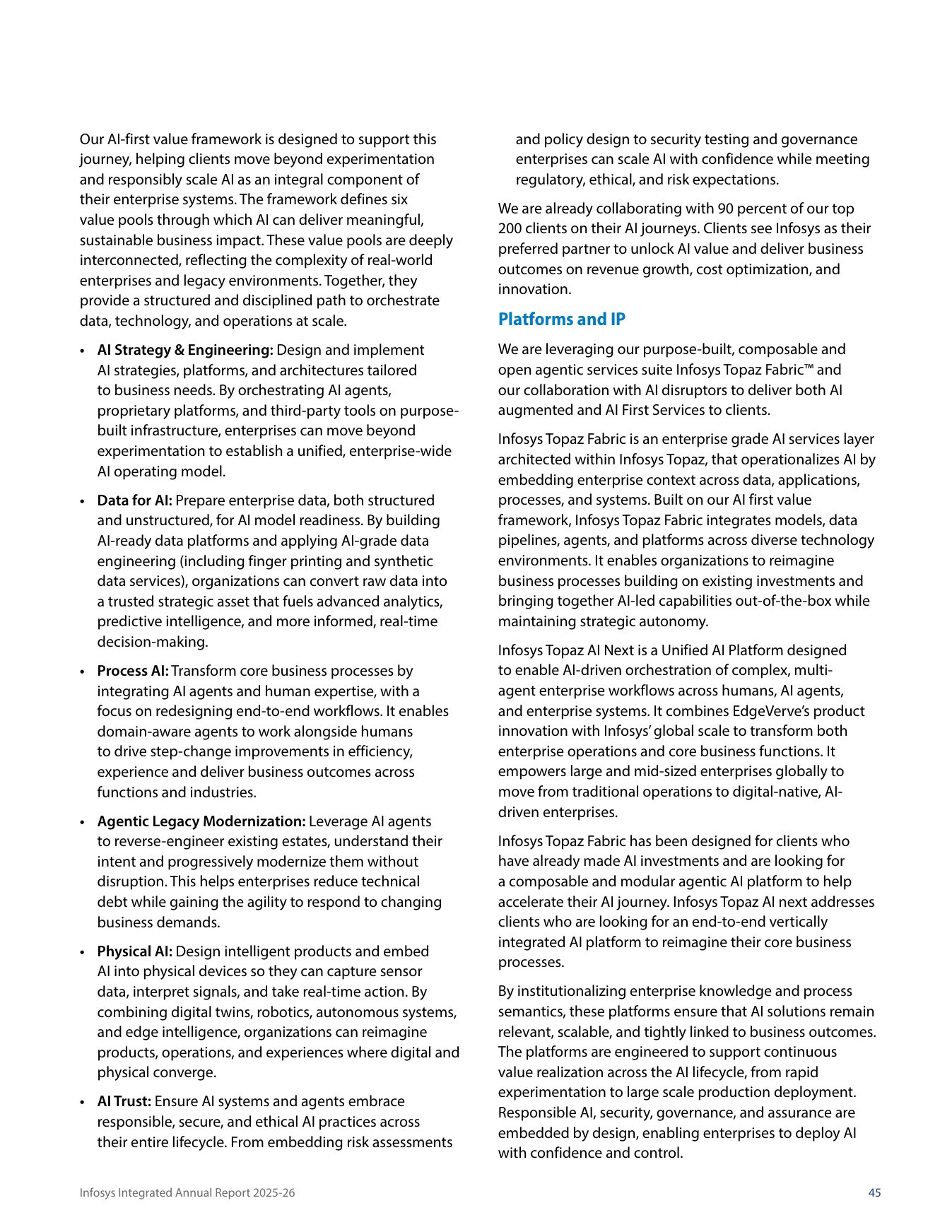
The point dropped: the same section still opens with "In 2018, we embraced a four-pronged strategy" (Scale Agile Digital, Energize the Core, Reskill our People, Expand Localization), and it is that 2018 diamond, not the six AI pillars, that sits at the centre of the value creation model two pages later. The text has moved; the diagram hasn't.
Integrated thinking and the capitals: 3/5
The value creation model is one spread: inputs by capital on the left, process and strategy in the middle, outputs and outcomes by capital on the right, stakeholders down the edge.
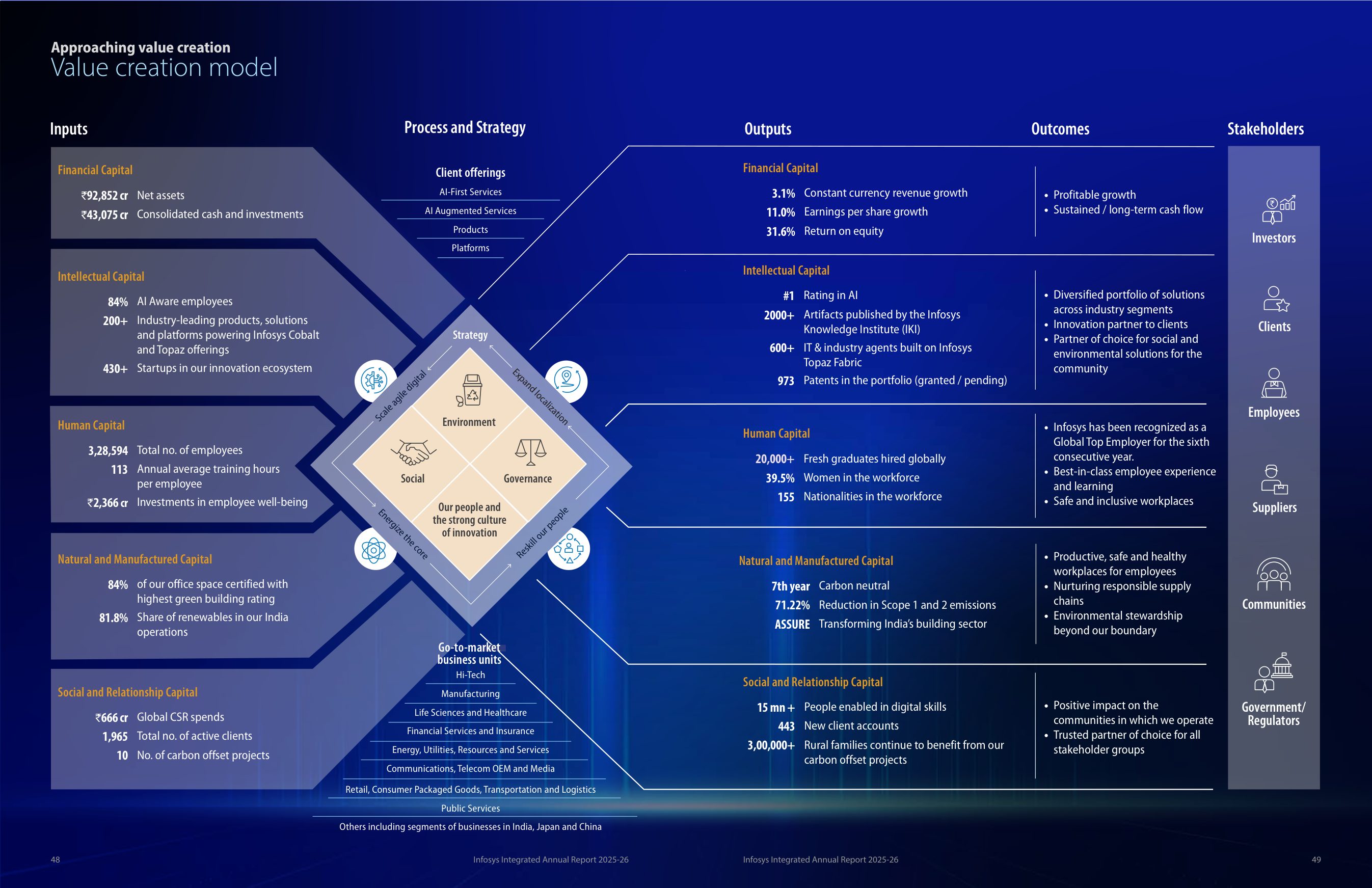
The inputs and outputs are numbers: ₹92,852 crore of net assets and ₹43,075 crore of cash and investments in; 3.1% constant-currency growth, 11.0% EPS growth and 31.6% ROE out. 3,28,594 employees and 113 training hours each in; 20,000-plus graduates, 39.5% women and 155 nationalities out. 84% green-certified office space and 81.8% renewables in; seven years carbon neutral and a 71.22% reduction in Scope 1 and 2 out. So far, so good, and comparable to TCS.
The "Outcomes" column is where it thins. Financial capital's outcomes are "Profitable growth" and "Sustained / long-term cash flow". Human capital's are "Best-in-class employee experience and learning" and "Safe and inclusive workplaces". Social capital's include "Trusted partner of choice for all stakeholder groups". These are aspirations, not outcomes; an outcome is a measured change in a capital, and the numbers that would show it (attrition, client satisfaction, learning-to-deployment, emissions intensity trend) are elsewhere or absent. One output, "#1 Rating in AI", carries no source.
The capital pages that follow are one page each, structured as material topics, SDG mapping, performance highlights and a short narrative. It is a clean template. It is also the reason a reader looking for how human capital investment connects to the AI pivot, or how the intellectual capital of 973 patents connects to Topaz revenue, doesn't find it. Connectivity is asserted by proximity rather than shown.
BRSR and ESG integration: 3/5
The BRSR is inside the PDF and Deloitte Haskins & Sells LLP gives reasonable assurance on BRSR Core, under an engagement dated 16 January 2026, which puts Infosys in the top assurance tier with Reliance, TCS and HDFC Bank.
The environmental story is told as "carbon neutral for seven years in a row", across Scope 1, 2 and 3, on a "Reduce and Restore" strategy that the report describes as advancing towards "climate positivity". The reduce side is real: Scope 1 and 2 down 71.22%, 81.8% renewable electricity in India, 62.42 MWp of installed solar, 84% of office space at the highest green-building rating, 100% wastewater recycled, and a supplier engagement programme with environmental product declarations. The restore side is ten carbon offset projects, with the report emphasising their community benefit to over 3,00,000 rural families and roughly 14 million saplings.
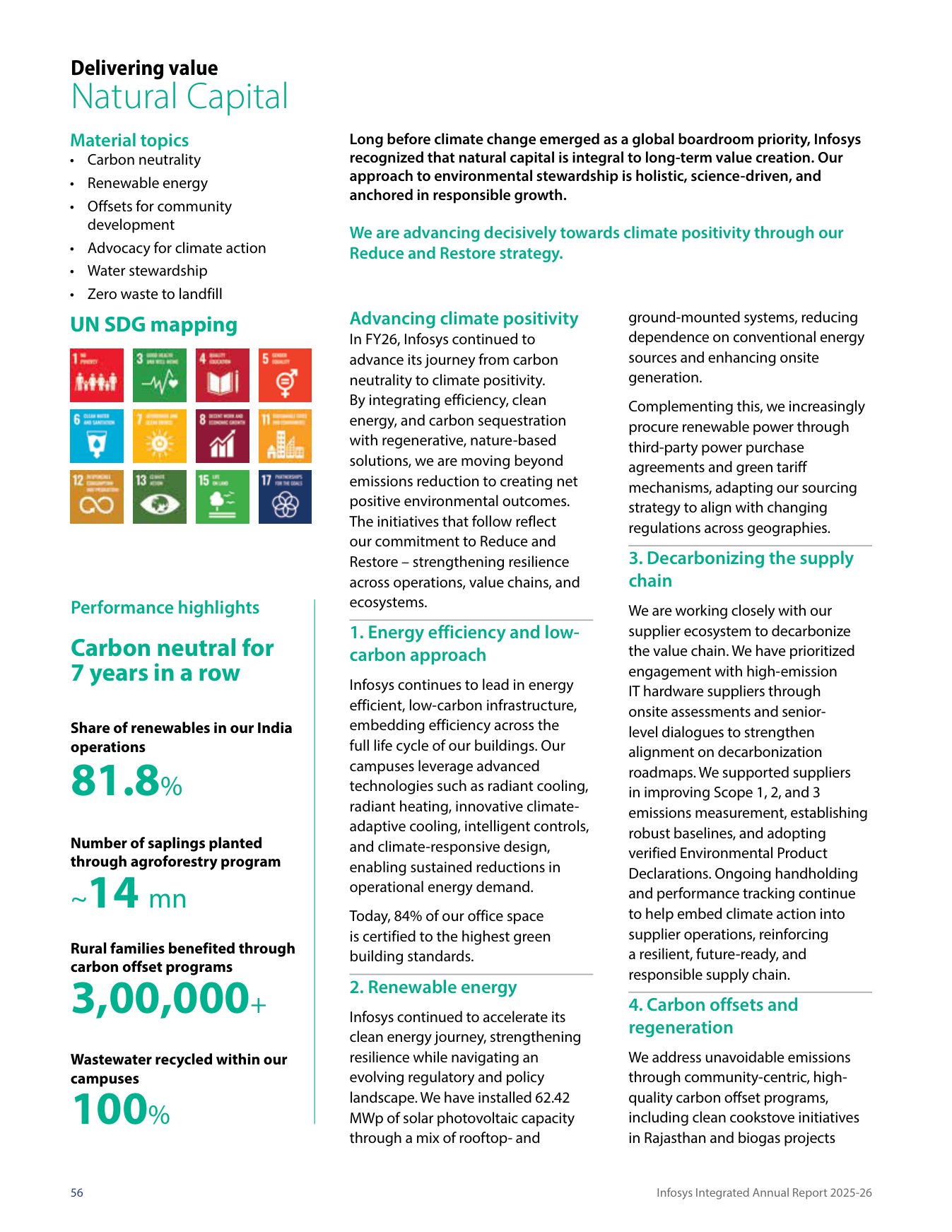
Two things are missing from the integrated section. The first is the Scope 3 number itself; it is in the BRSR at 2,07,374 tCO2e for fiscal 2026 against 2,08,659 the year before, a decline of 0.6%, and a reader of the front section never sees it. The second is a science-based reduction target. TCS reports an SBTi target of 35% absolute Scope 3 reduction by FY 2034 and shows 26% achieved; Infosys reports neutrality, which offsets deliver regardless of the trajectory. "Carbon neutral" and "climate positive" are claims that standard-setters and, increasingly, regulators treat with care; a report that leads with them should show the reduction pathway alongside.
Materiality is described in the BRSR as a GRI-based assessment with six stakeholder groups, with the ESG Committee of the Board approving "the continued relevance of the material topics on an annual basis". Approving continued relevance is not the same as reassessing, and the report does not say when the last full assessment was done or show its result. On this dimension HDFC Bank's dated, plotted matrix remains the standard.
Governance disclosure: 3/5
The corporate governance report and Board's report are complete and the risk management report is a separate, useful section. The reasons for a 3 are the two lines from the about-this-report page. A report approved "by the Management of the Company" is a weaker statement of responsibility than the Framework contemplates, and than HDFC Bank provides; the Board's report and the CEO/CFO certification cover the statutory content, but the integrated narrative is where the Board's ownership matters. And citing the IIRC three years after it ceased to exist suggests the page is carried forward rather than re-read.
Financial storytelling: 5/5
This is the page to hold up against TCS's.
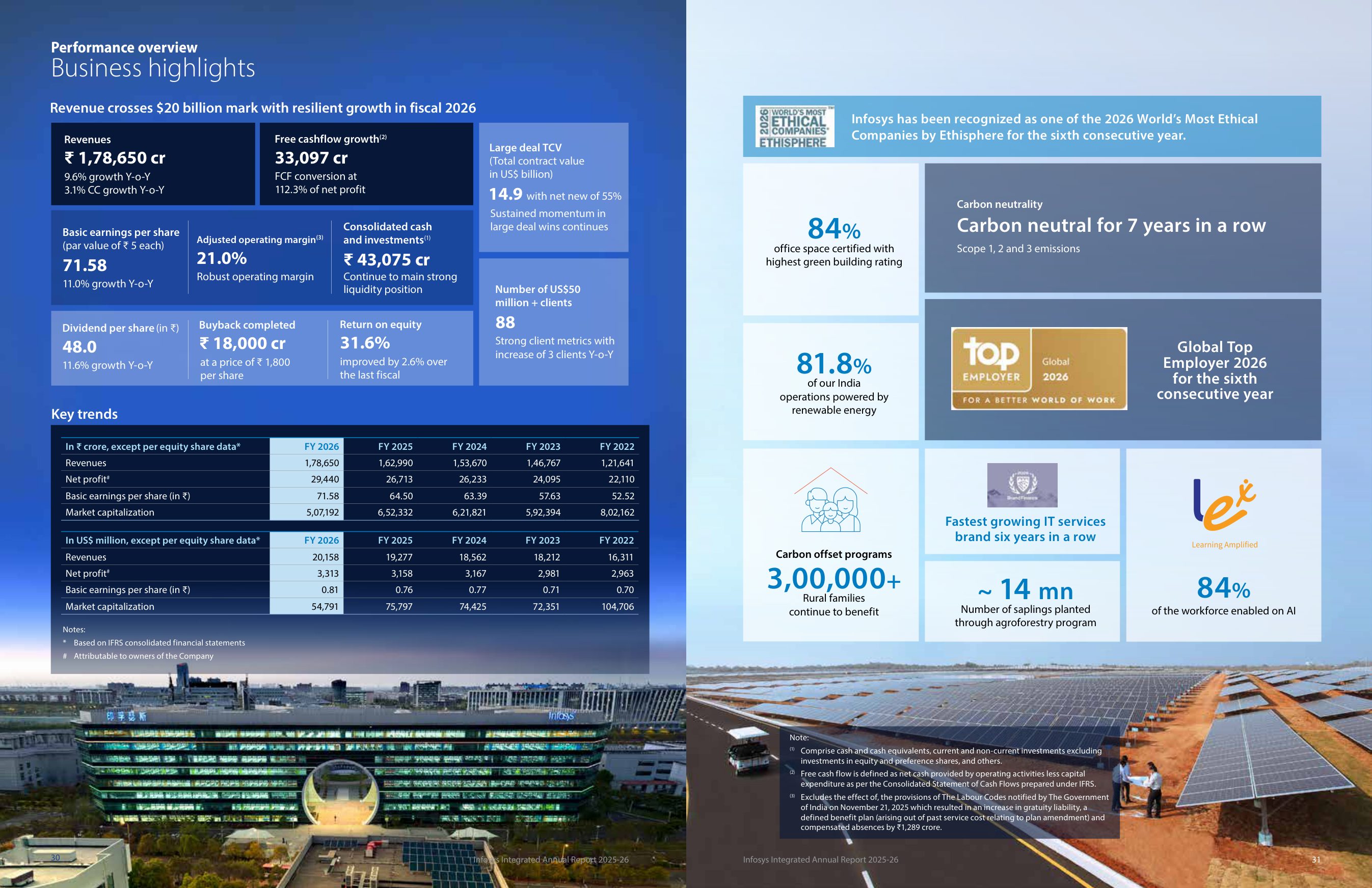
The tile reads "Adjusted operating margin(3) 21.0%", and footnote (3) on the same spread says it excludes the Labour Codes charge of ₹1,289 crore. Net profit in the five-year table, ₹29,440 crore against ₹26,713 crore, is the statutory figure attributable to owners, and is marked as such. Revenue growth is given both ways, 9.6% reported and 3.1% constant currency, side by side on the tile. And the table prints market capitalisation for five years: ₹5,07,192 crore at March 2026, down from ₹6,52,332 crore a year earlier and ₹8,02,162 crore in FY 2022. A company that puts a 22% fall in its own market value in the highlights table is telling the reader it isn't selecting the numbers.
The rest of the page carries free cash flow (₹33,097 crore, 112.3% conversion), cash and investments, large-deal TCV with the net-new share, ROE, dividend, buyback and the US$50 million-plus client count, each with the year-on-year movement. It is dense but every figure earns its place.
Design and readability: 4/5
Short chapters, one visual system, generous photography, restrained colour. The capital pages are the most readable in the series, precisely because there is one of each. The value creation spread is the one page that asks too much: dark ground, small type, a diamond, arrows and five stacked panels. The strategy pages also carry two overlapping diagrams (the six pillars and the two-service model) that could be one.
Digital version: 3/5
Bookmarks work, the PDF is built as spreads (the same phone-reading problem as Reliance and TCS), and the SDG mapping and much of the ESG detail are in a separate ESG report the reader must go and find. There is no QR or in-page navigation to an online integrated report.
What reporting teams can take from it
Copy the highlights page: adjusted measures footnoted where they appear, statutory profit in the table, both revenue growth rates side by side, and market capitalisation printed even when it fell. Copy the Chairman's letter format: an argument, not a list. Copy the length.
Then add what the compression removed: measured outcomes in the outcomes column, a strategy graphic that matches the strategy text, the Scope 3 figure in the front section with a reduction target next to the neutrality claim, a dated materiality assessment, and a Board-level statement of responsibility for the report.
Series scorecard
Every report in this series is scored on the same seven-point card by the same reader. Scores are editorial opinion of the published document; each review carries the page references behind its findings.
| Company | Score (of 35) |
|---|---|
| Hindustan Zinc | 30 |
| TCS | 29 |
| HUL | 28 |
| Reliance | 27 |
| L&T | 27 |
| Bharti Airtel | 27 |
| HDFC Bank | 26 |
| ICICI Bank | 25 |
| Infosys (this review) | 25 |
| ITC | 21 |
Frequently asked questions
How long is Infosys' integrated report?
The full PDF is 383 pages, but the integrated report section runs from page 8 to page 31: about this report, leadership, business highlights, the Chairman's message and CEO's letter, business context, strategy, a value creation model spread and one page for each of the capitals. The Board's report, MD&A, governance report, risk report, BRSR and financial statements follow as statutory sections.
What does 'adjusted operating margin' mean in the Infosys report?
The 21.0% adjusted operating margin excludes the effect of India's Labour Codes, notified on 21 November 2025, which increased gratuity and compensated-absence liabilities by ₹1,289 crore and is presented as an exceptional item. The footnote sits on the highlights page next to the figure, and the net profit shown in the five-year table is the statutory number.
Is Infosys carbon neutral?
The report states Infosys has been carbon neutral for seven consecutive years across Scope 1, 2 and 3, achieved through a 71.22% reduction in Scope 1 and 2 emissions, 81.8% renewable electricity in India operations, and ten carbon offset projects that the company says benefit over 3,00,000 rural families. The BRSR reports Scope 3 emissions of 2,07,374 tCO2e for fiscal 2026. There is no published science-based target for absolute Scope 3 reduction.
Who assures Infosys' BRSR?
Deloitte Haskins & Sells LLP performed a reasonable assurance engagement on the BRSR Core indicators, under an engagement letter dated 16 January 2026; the assurance report is at page 136 of the PDF. Deloitte also audits the financial statements. The report itself is stated to be reviewed and approved for publication by management.
What is Infosys' AI strategy as described in the report?
An 'AI-First value framework' with six pillars: Orchestrate (AI strategy and engineering), Insight (data for AI), Transform (process AI), Modernize (agentic legacy modernisation), Innovate (physical AI) and Assure (AI trust), delivered as 'AI First' services to capture new demand and 'AI Augmented' services to reinvent existing ones. The CEO's letter says AI-led programmes are deployed at 90% of the top 200 clients and that revenue from the six areas was 5.5% of total revenue in the third quarter.
How does The Footnotes score annual reports?
Seven criteria, each scored 1 to 5 with a one-line reason: strategy and narrative; integrated thinking and capitals; BRSR and ESG integration; governance disclosure; financial storytelling; design and readability; and the digital version. Scores are editorial opinion based on the published document, and the same card is used for every company so results can be compared.
Sources
- Infosys — Integrated Annual Report 2025-26 (PDF) — Infosys Limited
- Infosys Investor Relations — Infosys Limited
- Integrated Reporting Framework (IFRS Foundation) — IFRS Foundation
- SEBI circular: BRSR Core — framework for assurance and ESG disclosures for value chain (12 July 2023) — SEBI