

ICICI Bank Annual Report 2025-26: A Review
ICICI Bank's report is the shortest and plainest of the big-bank reports: a 62-page integrated section built around 'Fair to Customer, Fair to Bank', a business model wheel, and financial charts that tell the story without adjectives. The costs are a leadership message with no numbers, a materiality assessment last done in fiscal 2025, a BRSR that lives on the website, and a first PCAF financed-emissions exercise whose result is not disclosed.
 In short
Key takeaways
- ICICI Bank calls the document an 'Annual Report' rather than an integrated annual report, but structures it as Integrated Report (pages 2 to 63), Statutory Reports and Financial Statements; the BRSR and a separate digital ESG report are published on the Bank's website, alongside a full HTML edition of the annual report, none of which the PDF links to.
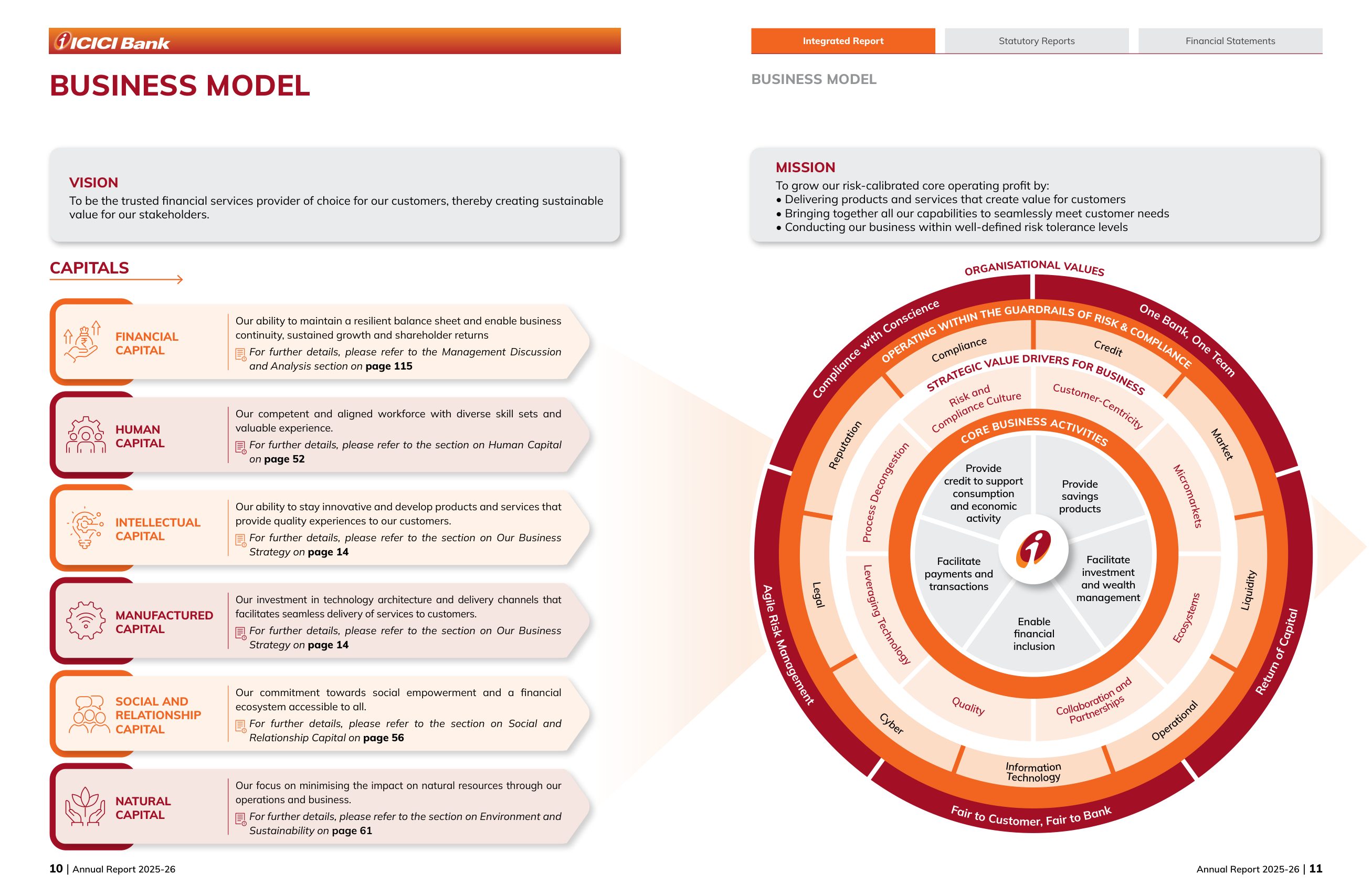
- The business model spread defines six capitals with page pointers and a values wheel ('Fair to Customer, Fair to Bank', 'One Bank, One Team', 'Return of Capital', 'Agile Risk Management', 'Compliance with Conscience'); the following spread lists outcomes per capital, including standalone profit after tax up 6.2%, net NPA down to 0.33%, CET1 of 16.35% and 32% women in the workforce.
- The 'Message from the Wholetime Directors' is four paragraphs from the MD & CEO and three executive directors, none of which contains a financial figure; the Chairman's message carries the year's numbers instead.
- Materiality: the report states the key ESG material topics were re-examined in fiscal 2025 against GRI, SASB and DJSI, and points readers to the ESG report and BRSR on the website for the results; no matrix or topic list appears in the annual report.
- Climate: Scope 1 and 2 emissions fell 9.2% to 132,932 tCO2e, own-operations Scope 3 is 144,861 tCO2e, renewable electricity including I-RECs is 48%, and the target is carbon neutrality for Scope 1 and 2 by fiscal 2032; the Bank ran its first PCAF financed-emissions assessment of listed corporate borrowers but does not disclose the result.
- Sustainable financing outstanding is ₹994 billion, of which 31% is green; the ESG mandate of the CSR Committee was widened during the year to oversee the ESG action plan and disclosures, with climate and ESG risk retained by the Risk Committee.
ICICI Bank's annual report opens with two pages on empathy, "seva bhaav" and the philosophy of being "Fair to Customer, Fair to Bank", and it is fair to say the rest of the document keeps that promise: it is plain, consistent, and it does not oversell. Whether it does enough is the question this review tries to answer.
As with every review in this series, we read the published PDF against the <IR> Framework, SEBI's BRSR Core expectations and plain readability, and score it on the same seven-point card. Scores are our opinion. Screenshots are small excerpts reproduced for review and remain the copyright of ICICI Bank Limited; the full report is on the Bank's investor pages.
The scorecard
| Criterion | Score (of 5) | In one line |
|---|---|---|
| Strategy and narrative | 3 | Strategy pages are clear and micromarket-led; leadership messages carry no numbers and repeat each other |
| Integrated thinking and the capitals | 3 | Six capitals named, an outcome page for each; the model is a values wheel rather than a flow, and the report never states its framework |
| BRSR and ESG integration | 3 | Governance is tidy and emissions are disclosed with prior-year comparatives; materiality dated, BRSR and assurance offsite, financed emissions unquantified |
| Governance disclosure | 4 | Committee composition on one page, risk governance drawn as three lines of defence, ESG oversight reassigned and explained |
| Financial storytelling | 4 | Five-year charts and a ten-year indicator table, no adjusted measures; ₹ billion takes some getting used to |
| Design and readability | 4 | Compact, one visual system, spreads used sparingly |
| Digital version | 4 | A full HTML edition and a separate digital ESG report exist online; the PDF never points to either |
| Total | 25 / 35 |
What the report is
A 349-page PDF in three parts: a 62-page Integrated Report, Statutory Reports (Board's report, governance certificate, MD&A, ten-year key financial indicators), and the standalone and consolidated financial statements with Basel Pillar 3 disclosures. The BRSR and a fuller ESG Report are separate documents on the website, as is, by implication, the BRSR Core assurance statement.
What the report lacks is an "about this report" page. There is no statement of the frameworks applied, the reporting boundary, the assurance obtained, or who approved the integrated narrative. Reliance, TCS, HDFC Bank and Infosys all have one; HDFC Bank's is the best. For a report that labels its first section "Integrated Report", the absence is odd, and it leaves the reader to infer the six-capital structure from the business model page rather than being told.
Key number: 62 — pages in the Integrated Report section, about a quarter of HDFC Bank's narrative and the second shortest in the series after Infosys.
Strategy and narrative: 3/5
The strategy pages themselves are good. "Our Business Strategy" runs from page 14 to page 35 and is organised around ecosystems and micromarkets: retail, business banking, corporate and investment banking coverage, each with the platforms that serve it (iMobile, InstaBIZ, DigiEase, iCRM, iLens) and the risk framing that the Bank repeats like a mantra: risk-calibrated core operating profit, right counterparty, return of capital. A reader understands how the Bank thinks about growth.
The leadership messages are the weak point. The Chairman's message gives the year's numbers, the shift of ESG oversight to an enlarged CSR Committee mandate, ₹9.94 billion of CSR commitment with about half to healthcare, and the fiscal 2032 carbon-neutrality target. Then comes "Message from the Wholetime Directors": four paragraph-length statements from the MD & CEO and three executive directors, stacked on one page.
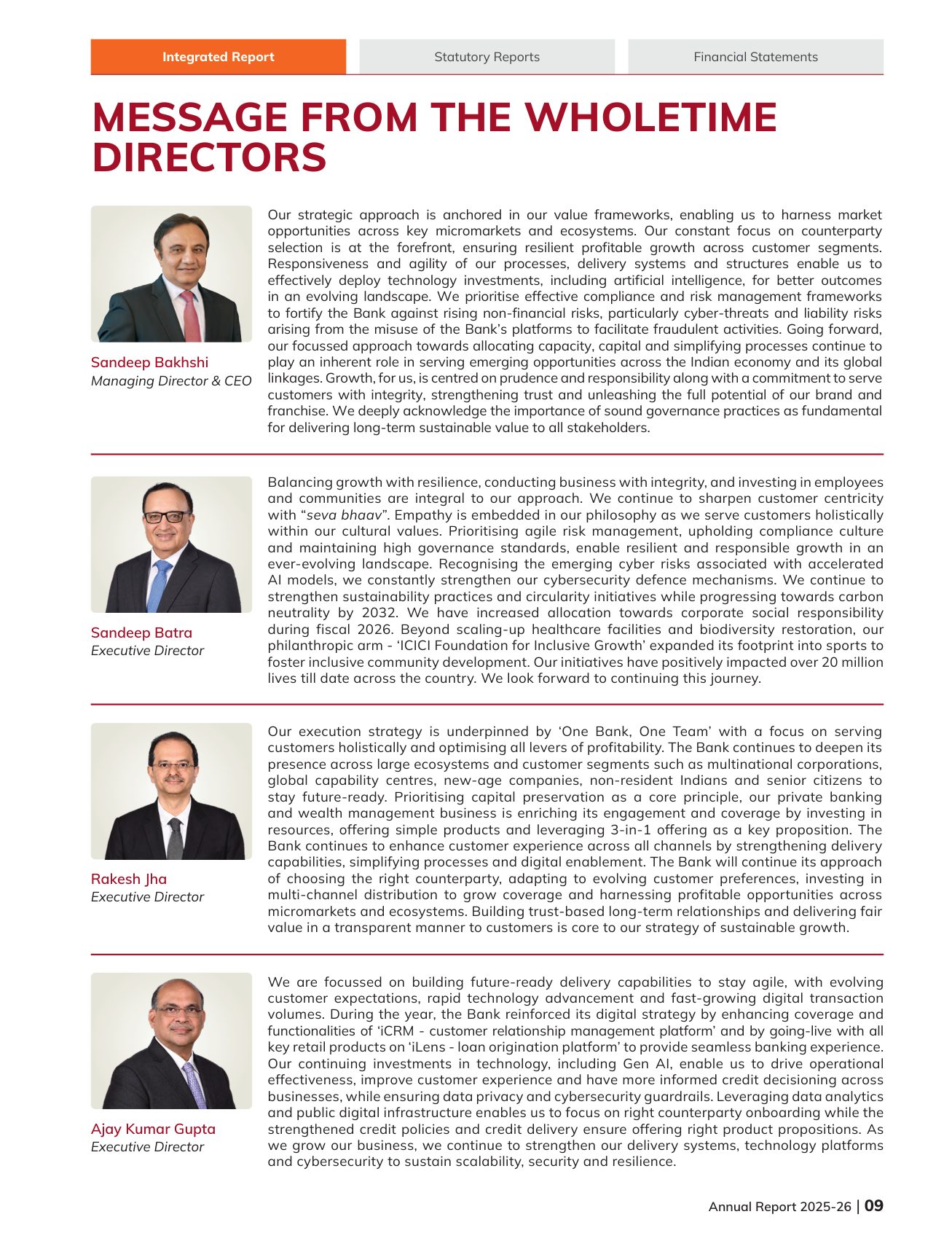
None of the four contains a number. Each restates the values (empathy, One Bank One Team, right counterparty, compliance culture, cybersecurity, carbon neutrality by 2032). The format has a logic, collective leadership and no single hero, but a CEO's letter that says what the year's decisions were and why, in figures, is the one thing readers open an annual report for, and this report doesn't have it.
Integrated thinking and the capitals: 3/5
The business model spread pairs a vision and mission with six capital definitions on the left and a wheel on the right: core business activities at the centre (credit, savings, payments, investment and wealth, inclusion), strategic value drivers around them (customer-centricity, micromarkets, ecosystems, technology, process decongestion, risk culture), the risk guardrails in the next ring, and the organisational values on the outside.
The next spread, "Business Model Outcomes", gives four to five bullets per capital with figures: profit after tax up 6.2% and CET1 of 16.35% for financial; about 40,000 women at 32% of headcount and 10.4 learning days per person for human; iCRM, DigiEase and iLens for intellectual; ₹994 billion of sustainable financing, 31% green, and 48% renewable electricity for natural.
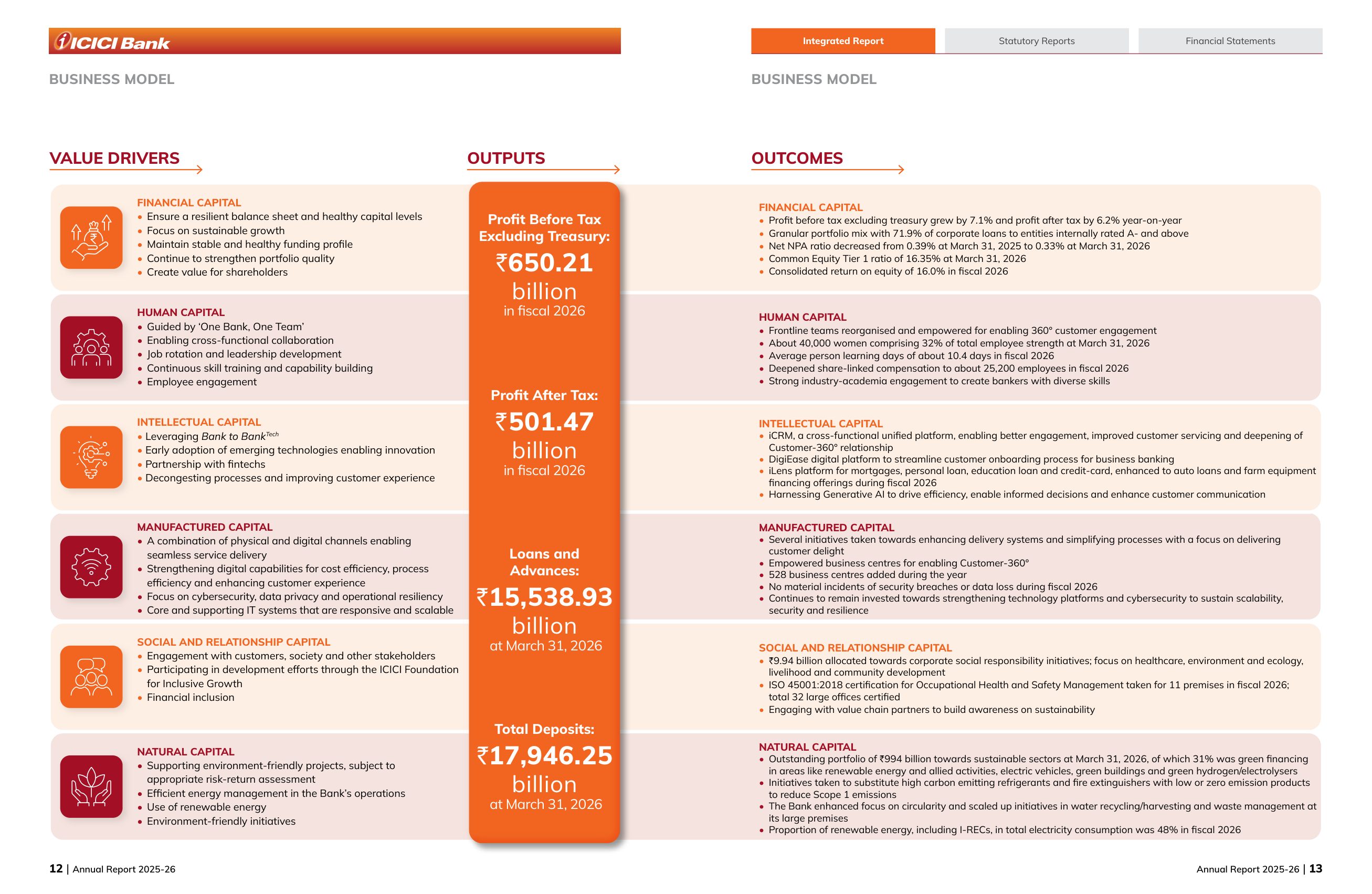
This is competent. What keeps it at a 3 is that the wheel isn't a value-creation model in the Framework's sense; it doesn't show inputs being consumed and transformed, and there is no page on how the capitals trade off. The capital sections that follow are three (human, social and relationship, environment), with financial, manufactured and intellectual capital deferred to the MD&A and strategy chapters by page pointer. And the report never says it is following the <IR> Framework, so it can't be held to it.
BRSR and ESG integration: 3/5
The "ESG Governance and Material Matters" chapter is short and clear on structure: an overarching ESG policy, a dedicated team in the CFO's office, a quarterly ESG Steering Committee, an annual Board update, and, from this year, the CSR Committee's mandate widened to oversee the ESG action plan and disclosures while the Risk Committee keeps climate and ESG risk. The Audit Committee appoints the BRSR Core assurance provider. Value-chain BRSR Core parameters were reviewed for upstream partners in line with SEBI's March 2025 circular.
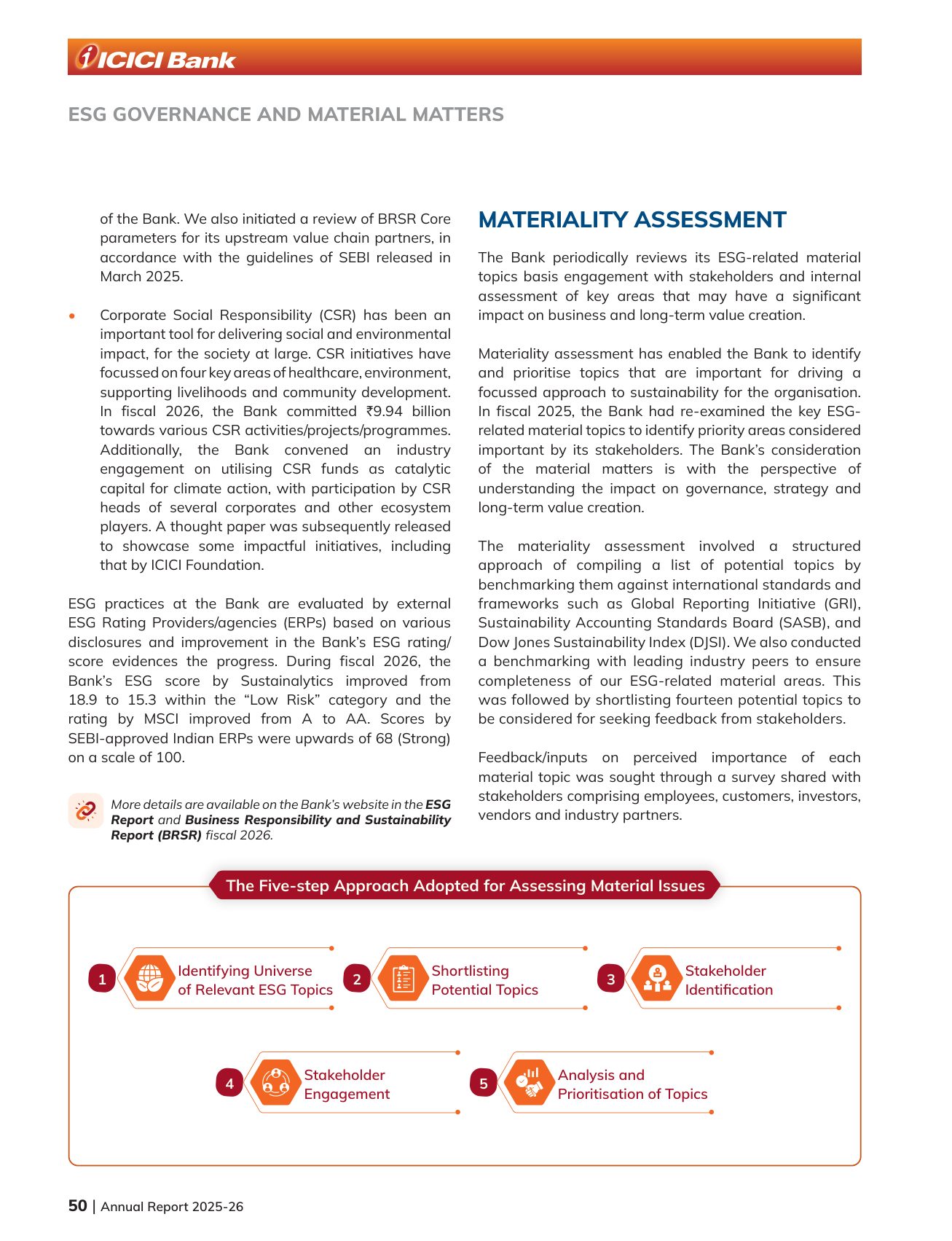
Materiality is dated and offsite. The report says the key ESG material topics were re-examined in fiscal 2025, benchmarked against GRI, SASB and DJSI, and that the outcome is in the ESG Report and BRSR on the website. No list or matrix appears here.
Emissions are disclosed properly: Scope 1 and 2 down 9.2% to 132,932 tCO2e; own-operations Scope 3 of 144,861 tCO2e across seven categories; I-RECs of 35,000 MWh taking renewables to about 48%. The financed-emissions paragraph is the one that disappoints: the Bank "undertook, for the first time, an assessment of emissions of listed corporate borrowers which disclose their Scope 1 and Scope 2 emissions" under PCAF, and is "building capabilities for measuring emissions for other asset classes". No tonnes, no coverage, no data-quality score. HDFC Bank, on the same page count, gave ₹2.67 lakh crore of coverage, 313 borrowers and 34.96 million tCO2e. A first assessment with no number reads as a placeholder.
In practice: if the first financed-emissions run is too rough to publish as a headline, publish it as a range with the coverage and data-quality score. Saying the exercise was done without saying what it found tells the reader the number was unwelcome.
Governance disclosure: 4/5
The "Corporate Information" page lists every committee with its chair and members, which is unusually helpful. The risk governance framework is drawn as three lines of defence with the independent monitoring groups named. The reassignment of ESG oversight to the CSR Committee is explained in the Chairman's message rather than buried. The governance report and Board's report are complete. What would lift it is an "about this report" statement of responsibility, which is a governance disclosure as much as a reporting one.
Financial storytelling: 4/5
The financial highlights are four spreads of five-year charts: loans by segment, deposits by type with CASA mix, net worth, capital adequacy by tier, standalone net profit, NII and margin, profit before tax excluding treasury income, and gross and net NPAs. There are no adjusted measures; the one exclusion, treasury income from PBT, is a standard bank presentation and labelled. A ten-year key financial indicator table sits at page 135.
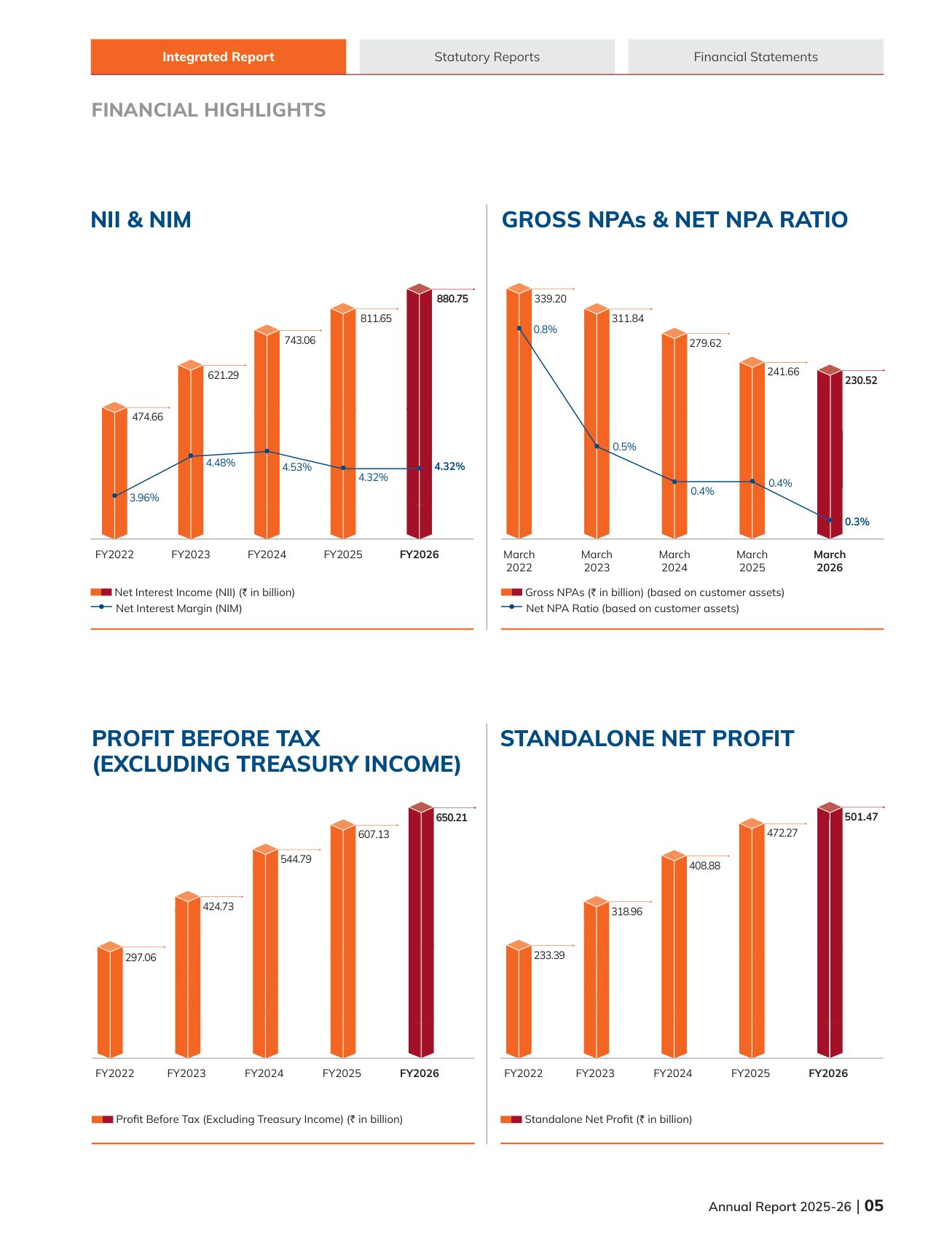
Two quibbles. ICICI reports in ₹ billion (₹501.47 billion of profit) where every other Indian company uses crore, so a reader comparing across reports converts every time. And the charts carry values but no year-on-year percentages, which the outcomes page then supplies; putting them together would save a page-turn.
Design and readability: 4/5
The page furniture (three tabs: Integrated Report, Statutory Reports, Financial Statements) is the cleanest in the series. Type is large, colour is restrained, and spreads are used only where they earn it. The empathy essay at the front is two pages longer than it needs to be.
Digital version: 4/5
The Bank publishes a full HTML edition of the annual report and a separate digital ESG report for FY 2025-26, which is where the materiality result, the BRSR and the assurance statement can be read together. That is a better digital footprint than most in the series. The point dropped is that the PDF never mentions either: no link, no QR code, no line in the contents page. A reader of the printed or downloaded report is not told the ESG report exists, and the PDF on its own is not a complete record of the year's disclosures.
What reporting teams can take from it
Copy the committee-composition page and the three-lines-of-defence diagram. Copy the discipline of five-year charts with no adjusted measures. Copy the length.
Add an "about this report" page, a CEO letter with numbers, the materiality result (dated), and, above all, the financed-emissions figure. If the BRSR and ESG report live online, say so in the PDF with a link, and put the assurance conclusion in the annual report.
Series scorecard
Every report in this series is scored on the same seven-point card by the same reader. Scores are editorial opinion of the published document; each review carries the page references behind its findings.
| Company | Score (of 35) |
|---|---|
| Hindustan Zinc | 30 |
| TCS | 29 |
| HUL | 28 |
| Reliance | 27 |
| L&T | 27 |
| Bharti Airtel | 27 |
| HDFC Bank | 26 |
| ICICI Bank (this review) | 25 |
| Infosys | 25 |
| ITC | 21 |
Frequently asked questions
Is ICICI Bank's annual report an integrated report?
The document is titled 'Annual Report 2025-26' but its first 63 pages are labelled 'Integrated Report' and cover the business model across six capitals, strategy, values, risk governance, ESG governance and material matters, and human, social and relationship, and natural capital. It does not state that it is prepared in accordance with the <IR> Framework, and it does not include an 'about this report' page setting out frameworks, boundary or assurance.
Where is ICICI Bank's BRSR?
Not in the annual report PDF. The report states that the Business Responsibility and Sustainability Report and the ESG Report for fiscal 2026 are available on the Bank's website. The Audit Committee is responsible for appointing the third-party assurance provider for BRSR Core under SEBI's guidelines; the assurance statement is therefore also outside the annual report.
What are ICICI Bank's emissions and climate target?
Aggregate Scope 1 and 2 emissions declined 9.2% from 146,377 tCO2e in fiscal 2025 to 132,932 tCO2e in fiscal 2026. Own-operations Scope 3 across capital goods, commuting, travel, fuel and energy, leased assets, transport and waste was 144,861 tCO2e. Renewable energy including I-RECs (35,000 MWh) was about 48% of electricity. The target is carbon neutrality for Scope 1 and 2 by fiscal 2032.
Does ICICI Bank disclose financed emissions?
The report says the Bank undertook, for the first time, an assessment of the emissions of listed corporate borrowers that disclose their Scope 1 and 2 emissions, using PCAF methodology, and is building capability for other asset classes. It does not disclose the resulting figure, the loan-book coverage or a data-quality score. HDFC Bank's report, by comparison, gives all three.
What are the headline financials in the report?
Standalone net profit of ₹501.47 billion, up 6.2%; profit before tax excluding treasury income up 7.1%; net NPA ratio 0.33% (from 0.39%); Common Equity Tier 1 ratio 16.35%; consolidated return on equity 16.0%; and 71.9% of corporate loans to entities rated A- and above internally. ICICI reports in ₹ billion rather than crore.
How does The Footnotes score annual reports?
Seven criteria, each scored 1 to 5 with a one-line reason: strategy and narrative; integrated thinking and capitals; BRSR and ESG integration; governance disclosure; financial storytelling; design and readability; and the digital version. Scores are editorial opinion based on the published document, and the same card is used for every company so results can be compared.
Sources
- ICICI Bank — Annual Report 2025-26 (PDF) — ICICI Bank
- ICICI Bank — Annual Report 2025-26, HTML edition — ICICI Bank
- ICICI Bank — ESG Report 2025-26, digital edition — ICICI Bank
- SEBI circular: BRSR Core — framework for assurance and ESG disclosures for value chain (12 July 2023) — SEBI
- PCAF — The Global GHG Accounting and Reporting Standard for the Financial Industry — Partnership for Carbon Accounting Financials