

ITC Report and Accounts 2026: A Review
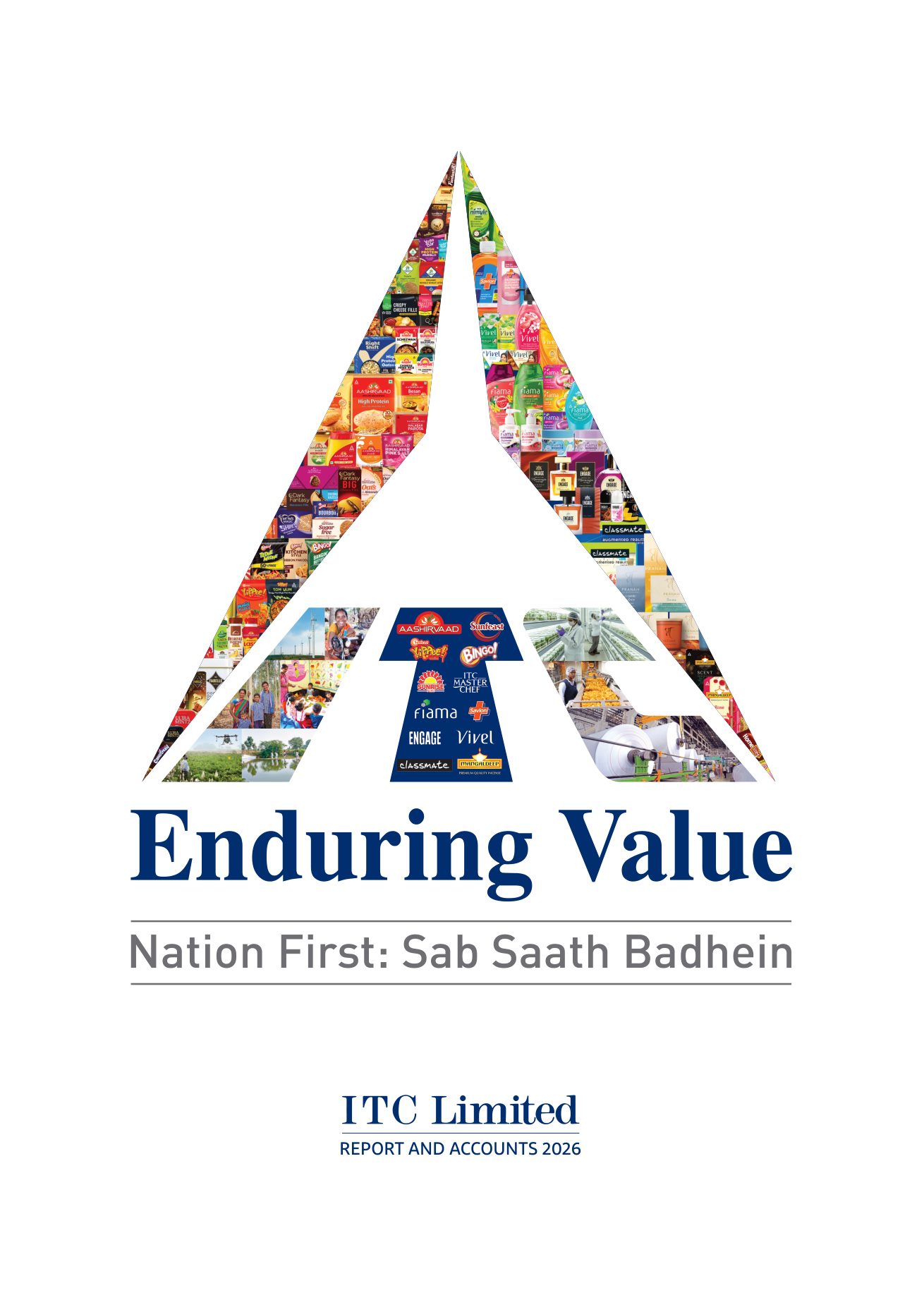
ITC is the one large company in this series that has not adopted integrated reporting for its statutory annual report. The Report and Accounts 2026 is a 24-page corporate showcase, a 90-page Board's report that opens with global GDP, and a 54-page BRSR with KPMG reasonable assurance. It is complete, hyperlinked and old-fashioned, and its highlights page manages to omit profit.
 In short
Key takeaways
- ITC's statutory report is titled 'Report and Accounts', not an integrated annual report; it does not cite the <IR> Framework, has no capitals or value-creation model, and no Chairman's or CEO's letter; ITC's sustainability reporting is done in a separate Sustainability Report approved by a Board committee.
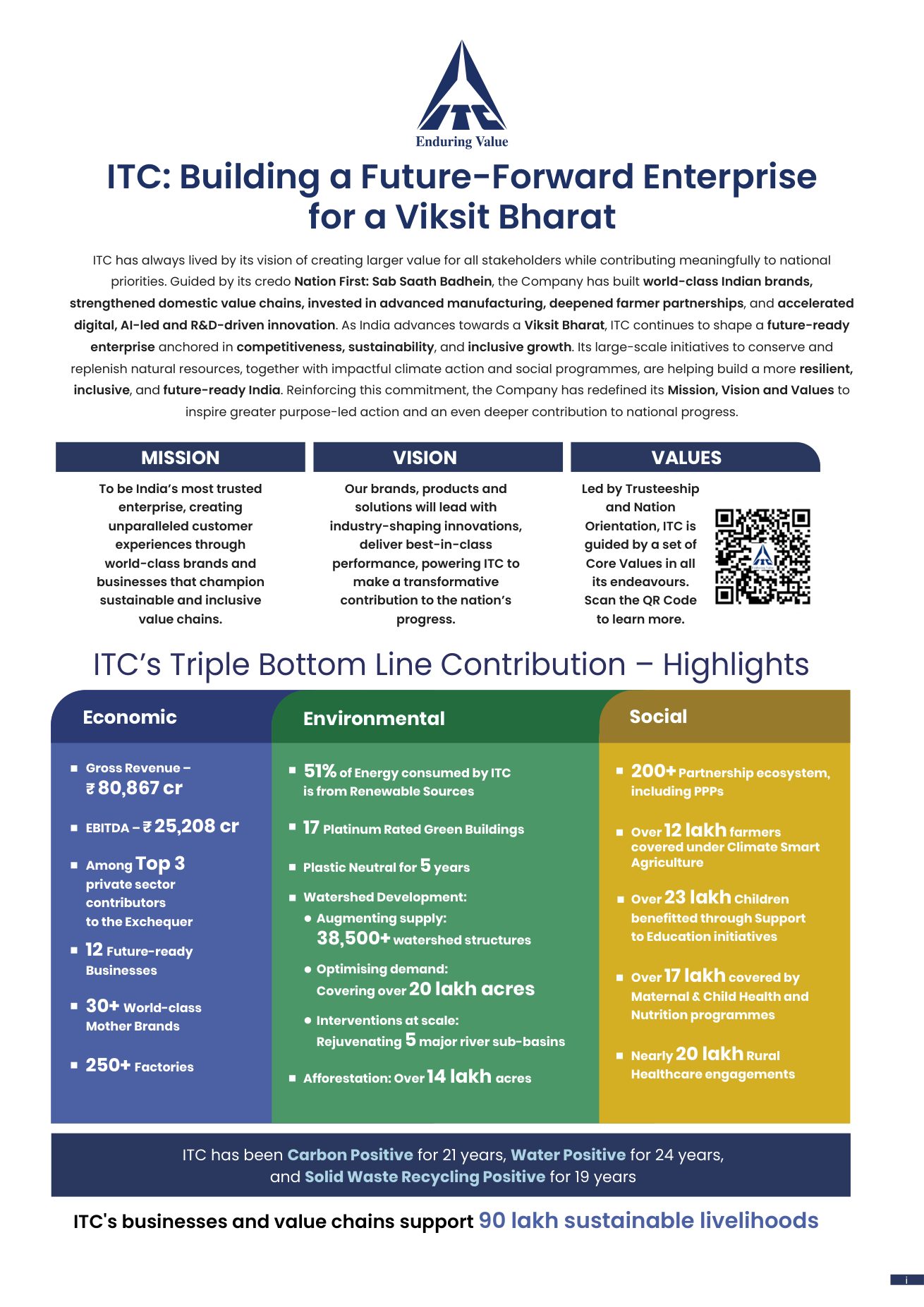
- The front section (pages i to xxiv) is a corporate showcase: mission, vision and values, 'triple bottom line' highlights, the ITC Next strategy, business-by-business pages, climate action and social programmes; the economic highlights list gross revenue (₹80,867 crore) and EBITDA (₹25,208 crore) but not profit after tax or EPS.
- The Board's report and MD&A run to 90 pages and open with global and Indian macroeconomics; the financial results paragraph on page 42 shows gross revenue up 10.1%, EBITDA up 4.9%, profit before exceptional items and tax up 3.7%, and PAT of ₹20,286 crore against ₹20,093 crore, a 1.0% increase, with EPS of ₹16.20.
- The BRSR is inside the report (54 pages) with KPMG Assurance and Consulting Services LLP giving reasonable assurance on BRSR Core; Scope 1 emissions were 1,045 kilotonnes CO2e (from 1,101), Scope 2 151 kilotonnes, and Scope 3 rose to 1,442 kilotonnes from 1,062 after the logistics boundary was expanded.
- ITC describes itself as 'Carbon Positive for 21 years', which rests on farm and social forestry sequestering about 7.6 million tonnes of CO2 in the year; its climate targets are a 50% cut in specific (intensity-based) Scope 1 and 2 emissions by 2030 and 'Net Zero Operations' by 2050, which excludes Scope 3.
- The PDF's contents are hyperlinked and every page header returns to the contents page, which is the best in-document navigation in the series; the report also lists every factory and rural service centre address, which is thoroughness of a different kind.
ITC's annual report is called the Report and Accounts, and the name is accurate. Among the companies reviewed in this series it is the only one that has not adopted integrated reporting for its statutory document; the sustainability narrative lives in a separate Sustainability Report, and what shareholders receive is a corporate showcase, a very long Board's report, the accounts and the BRSR. That is a legitimate choice. It is also, on our card, a costly one.
As with every review in this series, we read the published PDF against the <IR> Framework, SEBI's BRSR Core expectations and plain readability, and score it on the same seven-point card. Where a company does not claim to follow the Framework we still score against it, because the card is about what a reader can learn from the document, not about compliance. Scores are our opinion. Screenshots are small excerpts reproduced for review and remain the copyright of ITC Limited; the full report is on the company's investor pages.
The scorecard
| Criterion | Score (of 5) | In one line |
|---|---|---|
| Strategy and narrative | 2 | ITC Next is laid out clearly, but there is no letter from anyone, and the Board's report opens with the IMF |
| Integrated thinking and the capitals | 1 | No framework, no capitals, no value-creation model; a 'triple bottom line' page stands in |
| BRSR and ESG integration | 3 | BRSR inside, reasonable assurance from KPMG, emissions with comparatives; 'carbon positive' framing and no Scope 3 target |
| Governance disclosure | 4 | Roles of Board, committees, CMC and Chairman-as-CEO spelt out; the governance report is thorough |
| Financial storytelling | 3 | Ten-year table and a full results paragraph; highlights page omits profit and EPS in a flat year |
| Design and readability | 3 | Clean showcase pages; the Board's report is 90 pages of dense two-column text |
| Digital version | 5 | Hyperlinked contents, a return-to-contents link on every page header, single pages |
| Total | 21 / 35 |
What the report is
A 404-page PDF: a 24-page front section numbered i to xxiv ("ITC: Building a Future-Forward Enterprise for a Viksit Bharat"), the Board and committees, the corporate governance report with shareholder information, the Report of the Board of Directors and MD&A (pages 38 to 128), the CEO and CFO certificate, standalone and consolidated financial statements, a guide to subsidiaries, ten years at a glance, financial highlights, and the BRSR (pages I to LIV).
There is no "about this report" page and no framework statement, because there is no integrated report to describe. The BRSR's Section A names KPMG Assurance and Consulting Services LLP as providing reasonable assurance on BRSR Core indicators, and the governance report notes that a Board committee approves the separate Sustainability Report.
Key number: 0 — letters from the Chairman or the executive leadership in the report. Every other company in the series has at least one.
Strategy and narrative: 2/5
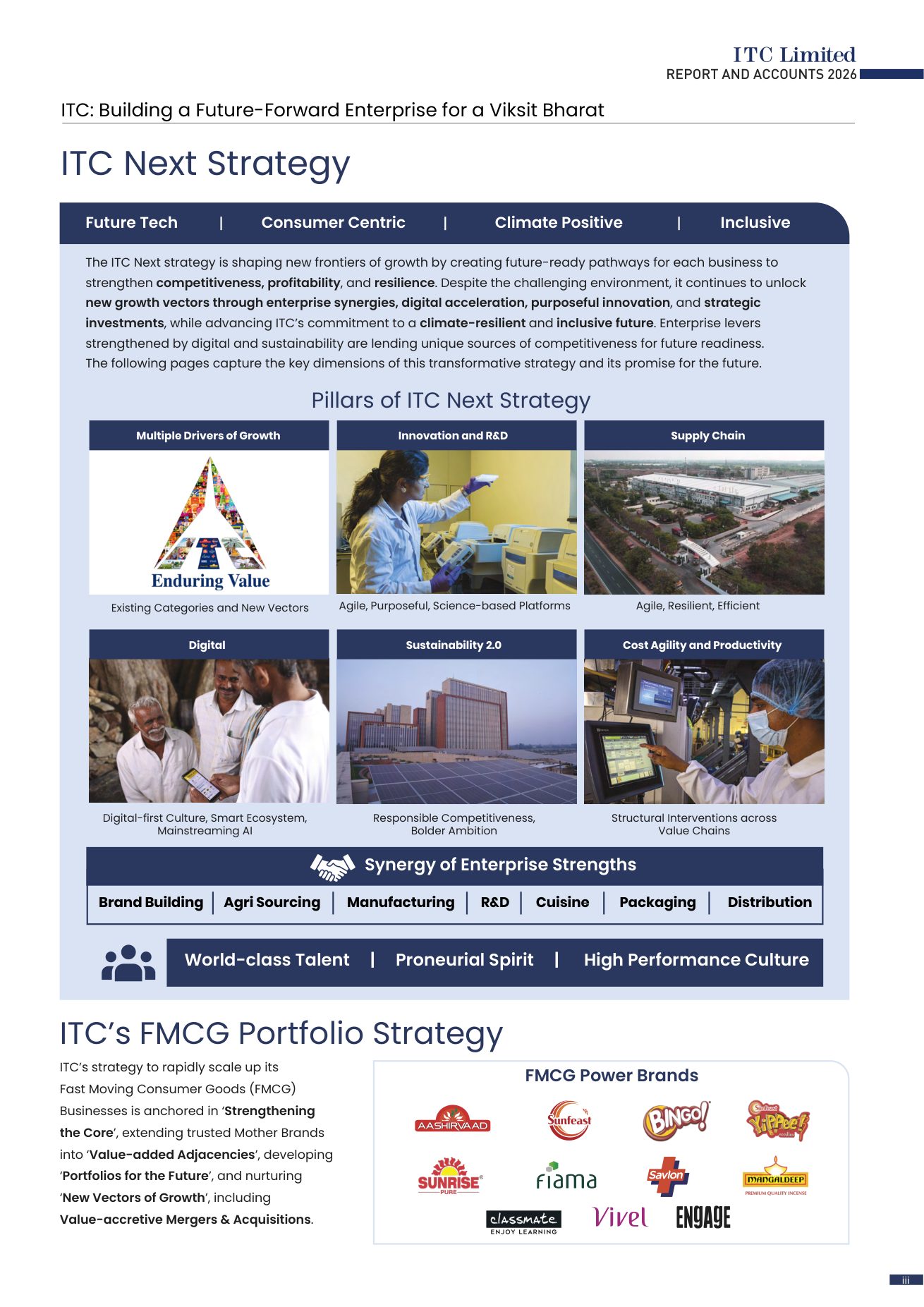
The front section does two things well. It states a refreshed mission, vision and values on page i, and it lays out the ITC Next strategy on page iii: strengthening the core, value-added adjacencies, portfolios for the future and new vectors of growth for FMCG, resting on power brands, innovation and R&D, supply chain, digital, Sustainability 2.0, cost agility and enterprise synergy. The business-by-business pages that follow (FMCG core and adjacencies, agri, paperboards and packaging, ITC Infotech, fresh foods, and ITC Hotels as a listed associate) give each a page with its positioning and figures.
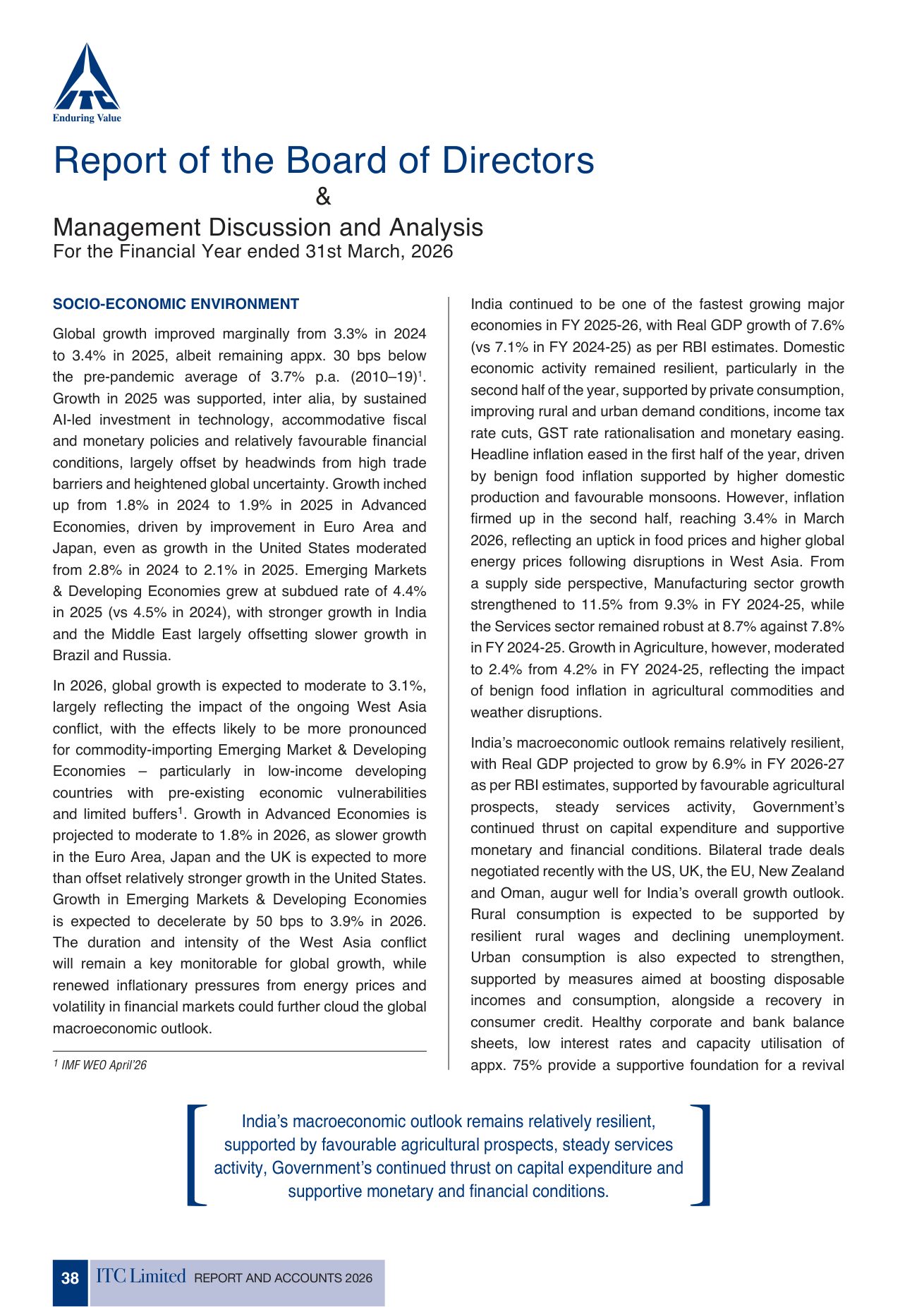
What it lacks is a voice. There is no Chairman's statement (ITC's Chairman addresses shareholders at the AGM, and that speech is published separately), no CEO letter, and no first-person account of the year's decisions. The Board's report, which is where the narrative lives, opens on page 38 with global growth of 3.4% in 2025, advanced-economy growth of 1.9%, emerging-market growth of 4.4% and the outlook for 2026, before reaching India, then ITC. A reader who wants to know what the company thinks it did well and badly this year has to assemble the answer from 90 pages.
Integrated thinking and the capitals: 1/5
The report does not attempt this. The nearest thing is the "Triple Bottom Line Contribution" panel on page i, with economic, environmental and social highlights in three columns, and the claim beneath it that ITC has been "Carbon Positive for 21 years, Water Positive for 24 years, and Solid Waste Recycling Positive for 19 years". There are no capitals, no inputs and outcomes, no statement of how the businesses draw on and affect each other's resources, and no connection drawn between the strategy pages and the financial results.
The score is a 1 rather than a 0 because the showcase does at least present the enterprise as a system of businesses sharing brands, sourcing, distribution and R&D, which is the beginning of integrated thinking even if it isn't integrated reporting. ITC produces a separate Sustainability Report that historically has been the more integrated document; a reader of the statutory report doesn't see it.
BRSR and ESG integration: 3/5
The BRSR is complete and inside the PDF, and KPMG's reasonable assurance on Core indicators places ITC in the top assurance tier alongside Reliance, TCS, HDFC Bank and Infosys. The emissions tables are there with prior-year comparatives: Scope 1 of 1,045 kilotonnes CO2e (1,101), Scope 2 of 151 kilotonnes (153), and Scope 3 of 1,442 kilotonnes (1,062), with a note that the logistics boundary was expanded to all downstream logistics, which explains the rise and is the right thing to say. The BRSR also states that the forestry programmes sequestered about 7.6 million tonnes of CO2 in the year, and that ITC obtains limited assurance on Scope 3 for its Sustainability Report.
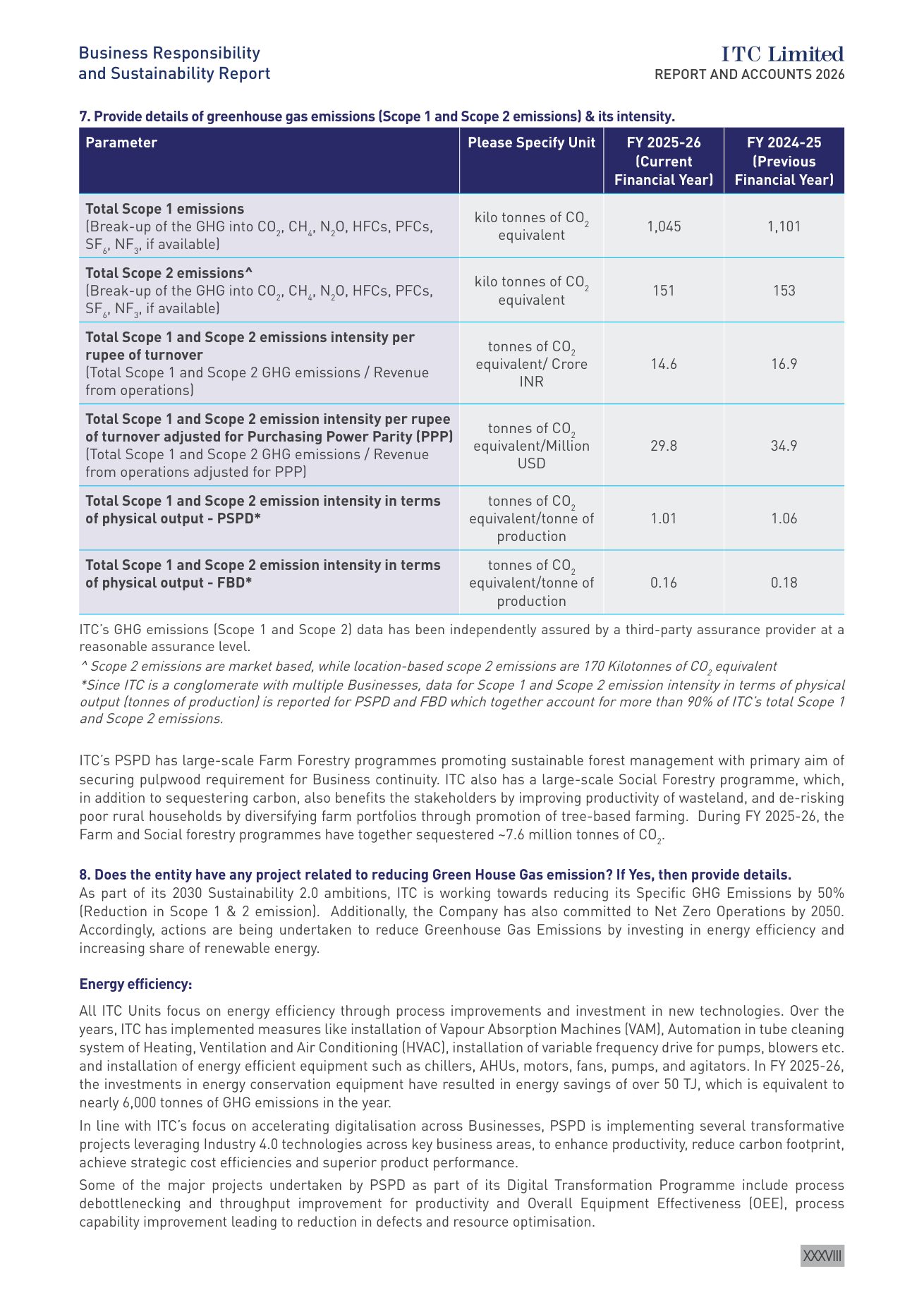
Two things hold the score at 3. The first is the framing. "Carbon positive" means sequestration exceeds emissions, and 7.6 million tonnes against about 1.2 million is a large margin. But a forestry programme that secures pulpwood for the paperboard business is a business activity with a carbon benefit, not a reduction in the company's own emissions, and the two belong in separate sentences. The GHG Protocol and the ISSB standards both keep removals apart from gross emissions for that reason. The front section's climate page does the same thing in reverse, leading with "21 Yrs Carbon Positive" above the decarbonisation content.
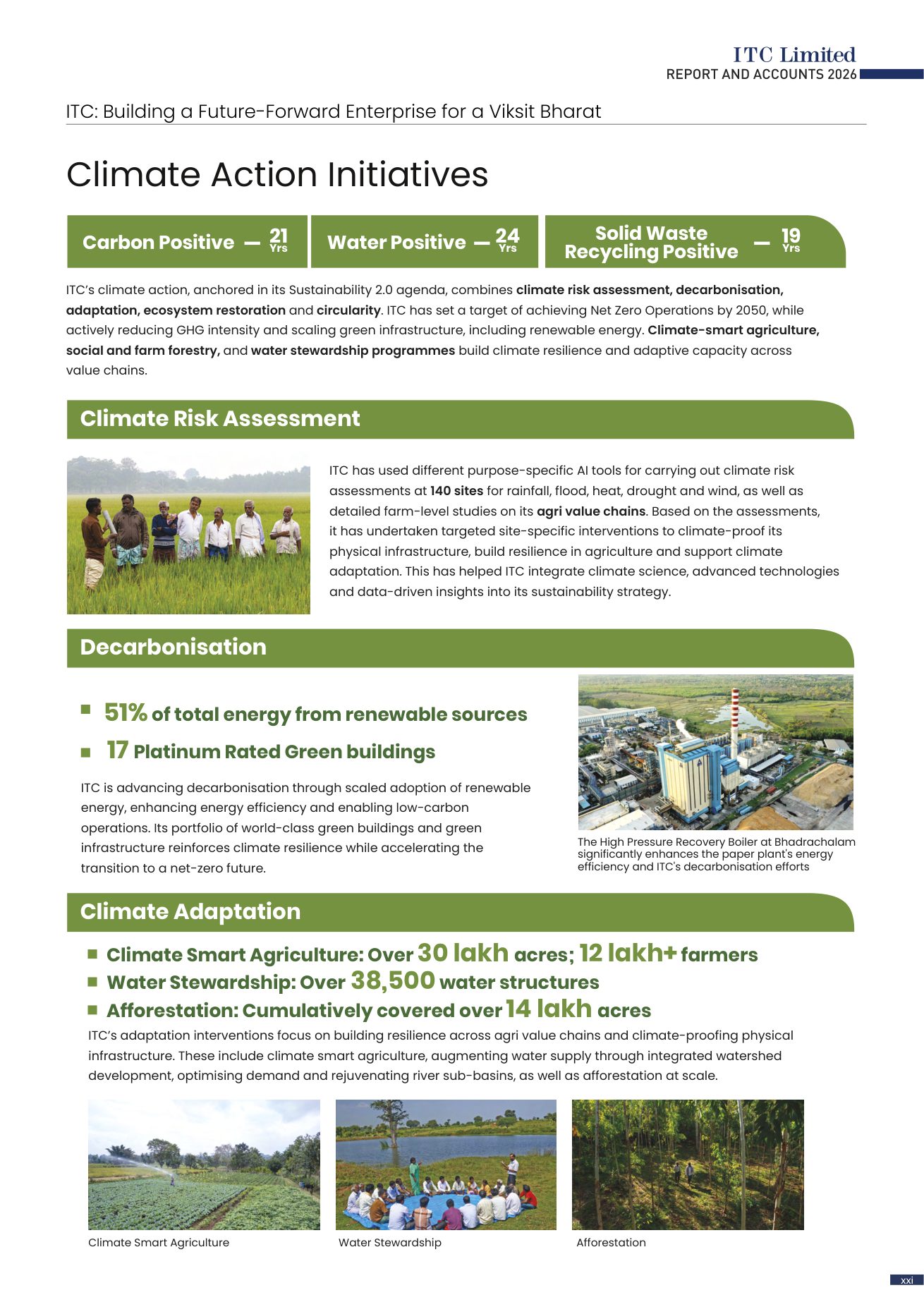
The second is the targets. Sustainability 2.0 commits to a 50% cut in specific (intensity) Scope 1 and 2 emissions by 2030 and "Net Zero Operations" by 2050, which the Board's report defines as decarbonising Scope 1 and 2. Scope 3, at 1,442 kilotonnes the largest number in the table, has a commitment to "deepen collaboration" and "progressively strengthen systems to measure and monitor", and no target. Materiality is described in one sentence as remaining "central to prioritising issues"; there is no dated assessment or topic list in this document.
On the credit side, the climate-risk work is specific: assessments at 140 sites for rainfall, flood, heat, drought and wind, with farm-level studies in the agri value chains, and a refreshed suite of sustainability policies approved by the Board during the year, including a new Responsible Marketing Policy.
Governance disclosure: 4/5
The corporate governance report is the most explicit in the series on who does what. It defines the roles of the Board, Board committees, the Corporate Management Committee, Divisional Management Committees, and the Chairman, who "is the Chief Executive of the Company" and chairs both the Board and the CMC. Stating the combined role that plainly, and describing the Board's role as "trusteeship", is more useful than a paragraph of assurances. Committee terms, remuneration policy (commission caps for the Chairman and executive directors as a percentage of net profit; ₹1 crore to ₹1.3 crore for non-executives) and shareholder information are complete. The score would be higher with a skills matrix and an account of board evaluation outcomes.
Financial storytelling: 3/5
The ten-year table is good: standalone operating results and balance sheet from FY17 to FY26, with segment revenue and EBITDA for FMCG-Others broken out, and charts of EPS, dividend and PAT.
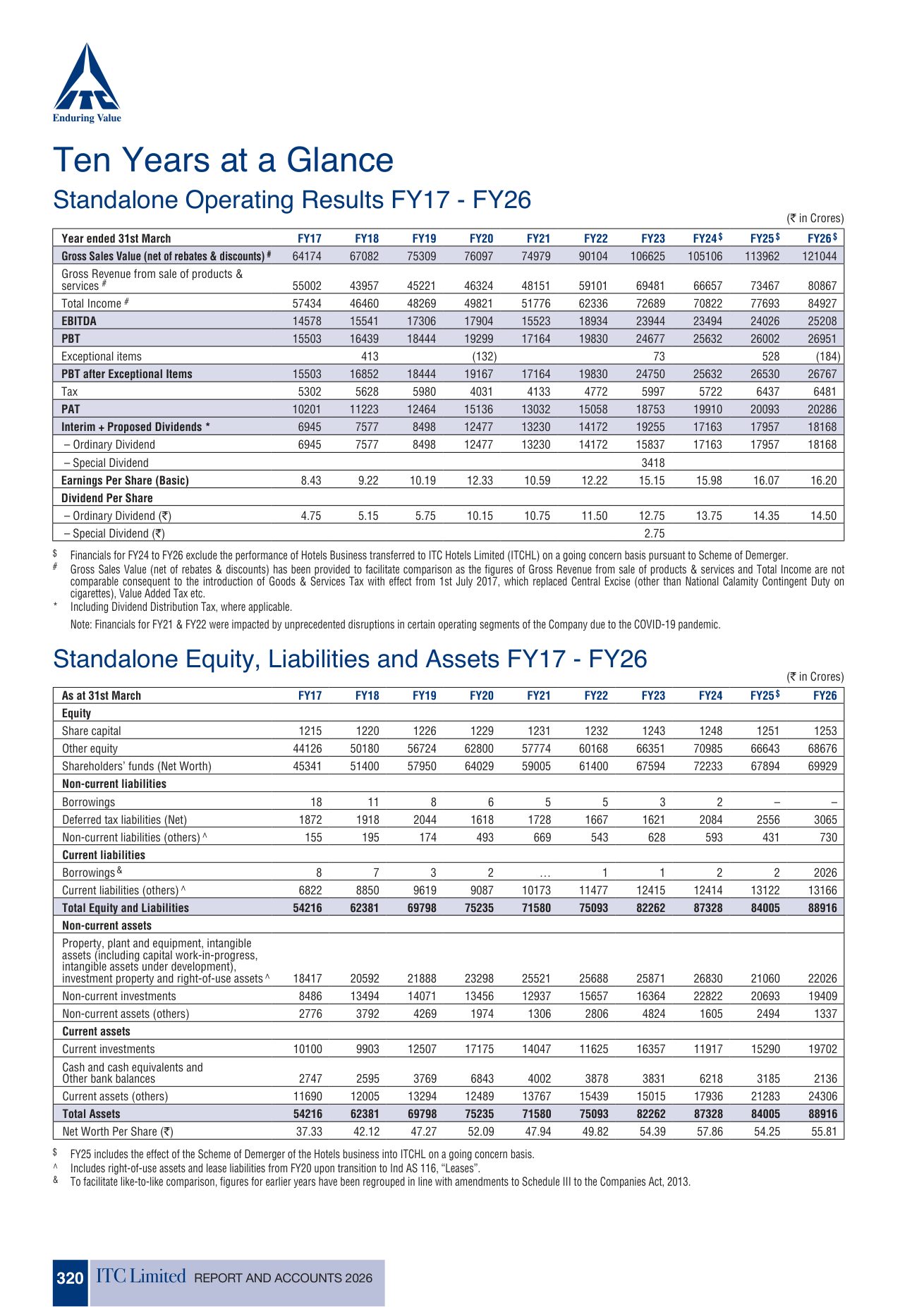
The results paragraph in the Board's report is complete: gross revenue ₹80,867 crore (up 10.1%), EBITDA ₹25,208 crore (up 4.9%), profit before exceptional items and tax ₹26,951 crore (up 3.7%), PAT ₹20,286 crore against ₹20,093 crore, EPS ₹16.20 against ₹16.07, final dividend ₹8.00. It is on page 42.
The highlights page on page i lists gross revenue and EBITDA and stops. In a year when profit grew 1.0% and EPS 0.8%, leaving PAT and EPS off the one page most readers see is the kind of selection that Infosys, with its market capitalisation printed in the five-year table, chose not to make. Segment-by-segment narrative in the MD&A is thorough, particularly on paperboards, where the margin squeeze from wood costs and the second-half recovery on minimum import prices are explained properly.
Design and readability: 3/5
The front section is clean, with bold statistics and a consistent blue. The Board's report and MD&A are 90 pages of two-column text in the Companies Act register ("your Company"), with few charts, and the shareholder-information section lists the postal address of every factory, plant under construction and rural services centre. Completeness is a virtue in a statutory filing; it is not the same as readability.
Digital version: 5/5
The contents page is hyperlinked to every section, and every page header carries a link back to the contents page. The PDF is single pages, not spreads, so it reads on a phone. No other report in the series has both. It is a small piece of engineering that every reporting team should copy this week.
What reporting teams can take from it
Copy the hyperlinked contents and the return-to-contents link on every page. Copy the plain statement of who holds which role, including a combined Chairman-CEO where that is the arrangement. Copy the ten-year table.
Then consider what the statutory report could carry that it doesn't: a letter, a capitals-based account of how the businesses connect, profit on the highlights page, and a climate section that reports emissions and removals separately, with a Scope 3 target.
Series scorecard
Every report in this series is scored on the same seven-point card by the same reader. Scores are editorial opinion of the published document; each review carries the page references behind its findings.
| Company | Score (of 35) |
|---|---|
| Hindustan Zinc | 30 |
| TCS | 29 |
| HUL | 28 |
| Reliance | 27 |
| L&T | 27 |
| Bharti Airtel | 27 |
| HDFC Bank | 26 |
| ICICI Bank | 25 |
| Infosys | 25 |
| ITC (this review) | 21 |
Frequently asked questions
Is ITC's annual report an integrated report?
No. ITC publishes a 'Report and Accounts' with a front showcase section, the Board's report and MD&A, corporate governance report, financial statements and the BRSR. It does not state adherence to the <IR> Framework and has no six-capitals structure. ITC's sustainability disclosure beyond the BRSR is in a separate Sustainability Report, which the report says is approved by a Board committee.
What are ITC's emissions and climate targets?
In the BRSR for FY 2025-26, Scope 1 emissions were 1,045 kilotonnes of CO2e (1,101 in the prior year), Scope 2 were 151 kilotonnes (153), and Scope 3 were 1,442 kilotonnes (1,062), the increase reflecting expanded coverage of downstream logistics. Targets under Sustainability 2.0 are a 50% reduction in specific Scope 1 and 2 emissions by 2030 and 'Net Zero Operations' by 2050. Scope 3 has no quantified target.
What does 'carbon positive' mean in ITC's report?
ITC states it has been carbon positive for 21 years, meaning the carbon sequestered by its farm and social forestry programmes exceeds its own emissions. The BRSR puts the year's sequestration at about 7.6 million tonnes of CO2 against Scope 1 and 2 emissions of about 1.2 million tonnes. Sequestration through forestry is a legitimate activity but it is not a reduction of the company's own emissions, and standard-setters generally require the two to be reported separately.
Who assures ITC's BRSR?
KPMG Assurance and Consulting Services LLP provides reasonable assurance on the BRSR Core indicators, as stated in Section A of the BRSR. ITC separately obtains limited assurance on Scope 3 emissions (GRI 305-3) for its Sustainability Report, which covers subsidiaries, associates and third-party manufacturers.
What were ITC's headline financials for FY 2025-26?
Gross revenue of ₹80,867 crore, up 10.1%; EBITDA of ₹25,208 crore, up 4.9%; profit before exceptional items and tax of ₹26,951 crore, up 3.7%; profit after tax of ₹20,286 crore against ₹20,093 crore; earnings per share of ₹16.20 against ₹16.07; and a recommended final dividend of ₹8.00 per share.
How does The Footnotes score annual reports?
Seven criteria, each scored 1 to 5 with a one-line reason: strategy and narrative; integrated thinking and capitals; BRSR and ESG integration; governance disclosure; financial storytelling; design and readability; and the digital version. Scores are editorial opinion based on the published document, and the same card is used for every company so results can be compared.