

Asian Paints Integrated Annual Report 2025-26: A Review
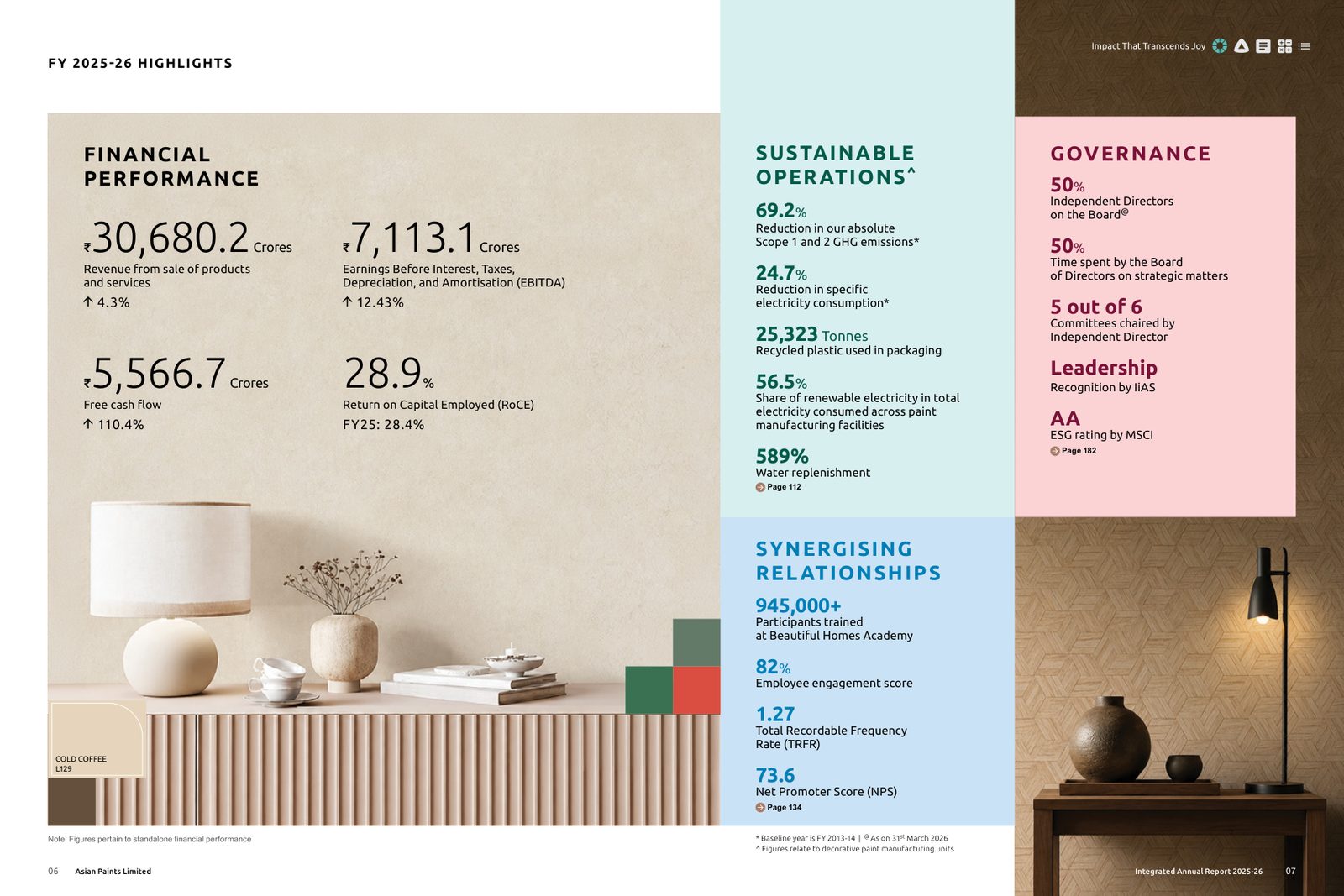
Asian Paints publishes a Board responsibility statement, an ESRS-based double materiality assessment with its scoring thresholds and its own assurance, and a 2030 scorecard with baselines. Its highlights page also reports a 69.2% cut in 'absolute' Scope 1 and 2 emissions that the climate chapter puts at 33%, and its front half never mentions the White Teak impairment.
 In short
Key takeaways
- The report runs to 580 numbered pages: Corporate Overview, Management Discussion and Analysis, Value Proposition, an ESG Performance Review in three parts (Sustainable Operations, Synergising Relationships, Governance), Statutory Reports including the BRSR (pages 311 to 353), Financial Statements, and annexures with GRI and TCFD indices and the assurance report.
- The 'About this report' page includes a Board Responsibility Statement: the Board acknowledges its responsibility for the report's integrity, says it addresses all material issues, and records approval on 29 May 2026.
- Double materiality was assessed in 2026 with reference to ESRS 1 and EFRAG guidance; impact topics are material at 2.3 and above on a 3-point scale and financial topics above 2; Biodiversity and Influencer Management dropped out; and Deloitte Haskins & Sells assured the process and methodology.
- The highlights page reports a '69.2% reduction in our absolute Scope 1 and 2 GHG emissions'. The climate chapter (p. 116) puts the absolute reduction at 33% and the intensity reduction at 69%. Absolute Scope 1 and 2 at decorative plants rose from 42,924 tCO2e in FY24 to 51,876 tCO2e in FY26, and renewable electricity fell from 65.8% to 56.5%.
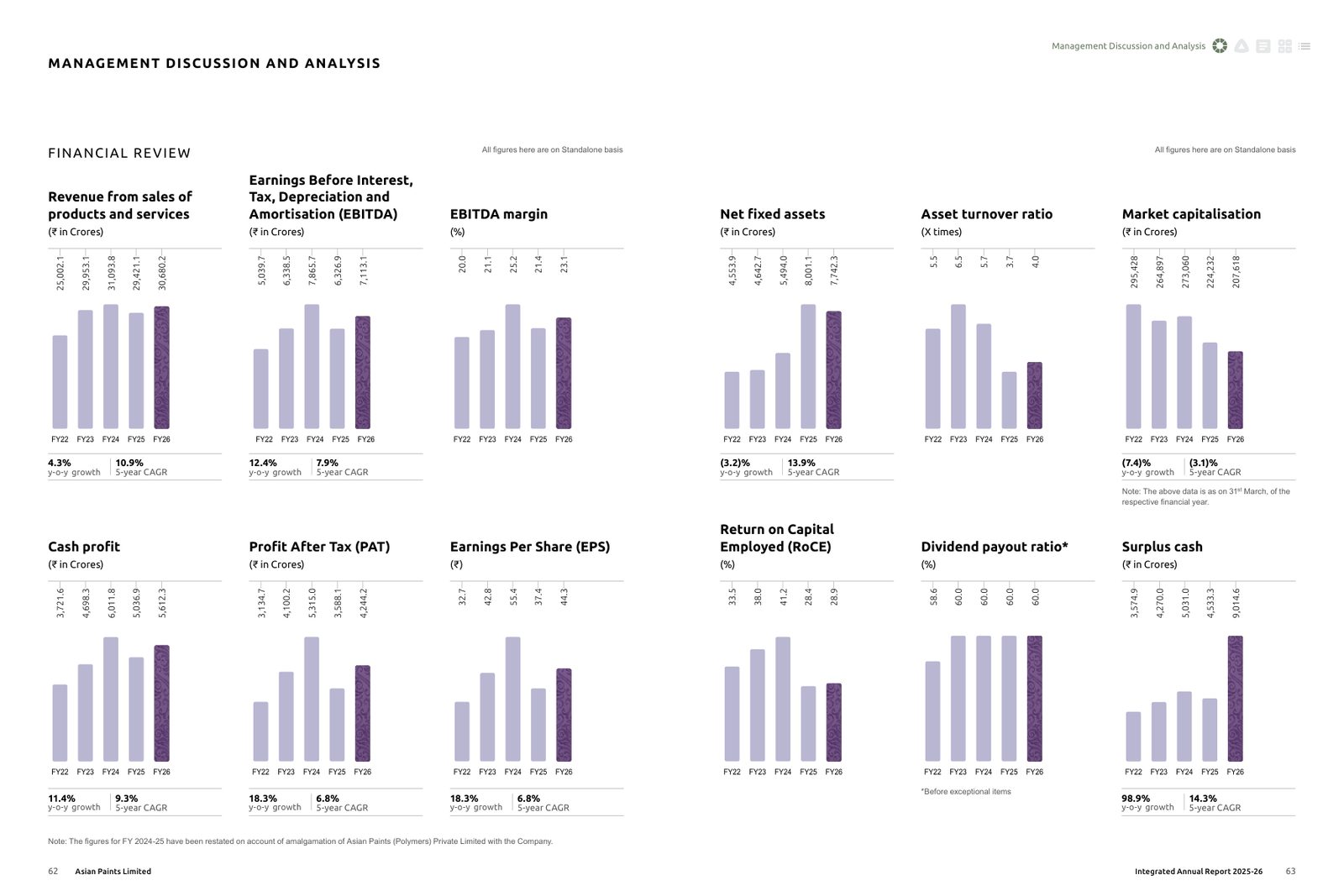
- Standalone revenue from products and services grew 4.3% to ₹30,680.2 crore and profit 18.3% to ₹4,244.2 crore; profit before exceptional items grew 11.7%, because exceptional charges fell from ₹379.6 crore to ₹166.5 crore. The five-year charts show market capitalisation down 7.4% to ₹207,618 crore and profit still below FY24's ₹5,315.0 crore.
- Deloitte Haskins & Sells LLP audits the financial statements and also gives reasonable assurance on BRSR Core and reasonable or limited assurance on other indicators. The PDF has 1,503 internal jump links and a row of link icons on every page, but no bookmarks, and it is built as spreads.
Asian Paints had a year that its own leadership describes in careful terms. Volume in the India decorative business grew 8.7%, but value growth across coatings was 5.3%, standalone revenue rose 4.3%, and the stock market took ₹16,614 crore off the company's value. The Chairman's letter speaks of "unprecedented competitive intensity" without naming a competitor. The Integrated Annual Report 2025-26, themed "Bringing joy to people's lives: Responsible. Resilient. Radiant.", is strongest where it is most technical and weakest where it summarises.
As with every review in this series, we read the published PDF against the <IR> Framework, SEBI's BRSR Core expectations and plain readability, and score it on the same seven-point card. Scores are our opinion. Screenshots are small excerpts reproduced for review and remain the copyright of Asian Paints Limited; the full report is on the company's investor pages and in an online edition. The file we reviewed is the one the company hosts with "rev" in its name; the report itself carries no revision note, so we can't say what changed.

The scorecard
| Criterion | Score (of 5) | In one line |
|---|---|---|
| Strategy and narrative | 3 | Six growth accelerators used consistently; letters open with macroeconomics, avoid numbers and never name the competition |
| Integrated thinking and the capitals | 4 | A value creation model with numeric inputs, stakeholder outcomes, risks and material topics on two spreads; the capitals are renamed and the links are lists |
| BRSR and ESG integration | 4 | Assured, ESRS-based double materiality with printed thresholds and a baseline-to-target scorecard; a mislabelled headline and an intensity-only climate target |
| Governance disclosure | 4 | Board responsibility statement with approval date and full statutory disclosure; the governance chapter is thin and the CCI matter gets one paragraph |
| Financial storytelling | 4 | Five-year charts and a ten-year table that show the bad years; the highlights page omits profit and the narrative omits the impairment |
| Design and readability | 3 | A consistent colour-card system and useful page links, but 580 pages of spreads and a repeated paragraph in the CEO's letter |
| Digital version | 3 | 1,503 internal links and an online portal, but no bookmarks, spread pages, and no pointer from the PDF to the online edition |
| Total | 25 / 35 |
What the report is
The report runs to 580 numbered pages. The integrated section takes the first 190: About this report, highlights and an ESG snapshot, then Corporate Overview (pp. 12 to 39), Management Discussion and Analysis (pp. 40 to 79, ending with a ten-year review), Value Proposition (pp. 80 to 111) and an ESG Performance Review split into Sustainable Operations, Synergising Relationships and Governance (pp. 112 to 190). The statutory reports follow, with the Board's report at page 214, the corporate governance report at 255 and the BRSR from 311 to 353. Standalone and consolidated financial statements take pages 354 to 563, and the annexures carry a GRI index, a TCFD index and the assurance report.
"About this report" (pp. 4 to 5) is one of the better examples in the series. It states that the report is prepared in accordance with the <IR> Framework, gives the reporting boundary (financials standalone and consolidated, non-financial and operational data standalone unless stated), names Deloitte Haskins & Sells LLP as auditor and as assurance provider for selected sustainability indicators and the materiality process, and contains a Board Responsibility Statement. The Board "acknowledges its responsibility to ensure the integrity" of the report, says it addresses all material issues and presents a balanced overview, and records approval on 29 May 2026. Hindustan Zinc and Bharti Airtel carry similar statements; most reports in the series don't.
Key number: 33% — the reduction in absolute Scope 1 and 2 emissions from the FY 2013-14 baseline, as the climate chapter reports it. The highlights page says 69.2%.
Strategy and narrative: 3/5
The strategy is easy to find and used consistently. Six "growth accelerators" (brand building, the innovation quotient, services, regional markets, B2B and backward integration) appear on the at-a-glance spread with page links, structure the MD & CEO's message, and reappear at the centre of the value creation model. The MD & CEO's message takes them one by one and is specific in places: new products at about 16% of revenue, more than 9.45 lakh painters and contractors trained, nearly 6,000 new retail touchpoints, the white cement plant at Fujairah commissioned, the PPG joint venture extended for 15 years.
The weaknesses are in what the letters leave out. The Chairman's letter spends its opening on the global economy and India's GDP before reaching the business, and it cites "industry consolidation" and "unprecedented competitive intensity" without saying who or what. The MD & CEO's "FY 2025-26 performance" paragraph contains no numbers at all: growth was "visible across all key financial parameters", revenue "expanded at a measured pace". The Chairman's letter supplies the volume and value growth (8.7% decorative volume, 9.0% and 5.3% across coatings) and the dividend; the CEO's does not. And the CEO's closing section repeats itself: two consecutive paragraphs both say the company enters the new year "with a broader opportunity set and a clear conviction in the path ahead" and that it "has never been defined only by the markets it serves". That is a proofreading slip in the most-read pages of the report.
Integrated thinking and the capitals: 4/5
The value creation model (pp. 82 to 85) is a two-spread flow that does most of what the Framework asks. Inputs are given numbers under seven headings that stand in for the capitals: shareholders' funds of ₹20,781.6 crore and debt of ₹1,221.3 crore; 11,162 permanent and 22,198 contractual employees with ₹20.6 crore spent on learning; 13 in-house plants and 30 outsourced processing centres; ₹124.9 crore of R&D, 181 patents filed and ₹158.2 crore of IT investment; a supplier base above 30,000; CSR spend of ₹114.6 crore. The middle shows the upstream, own-operations and downstream value chain around the six accelerators. The second spread lists 14 risks marked as risk, opportunity or both against PESTLE factors, and outcomes for each stakeholder group, again with numbers: LTIFR 0.34, NPS 73.6, 91 patents granted, ₹5,067.0 crore of taxes paid, 78.7% local procurement.
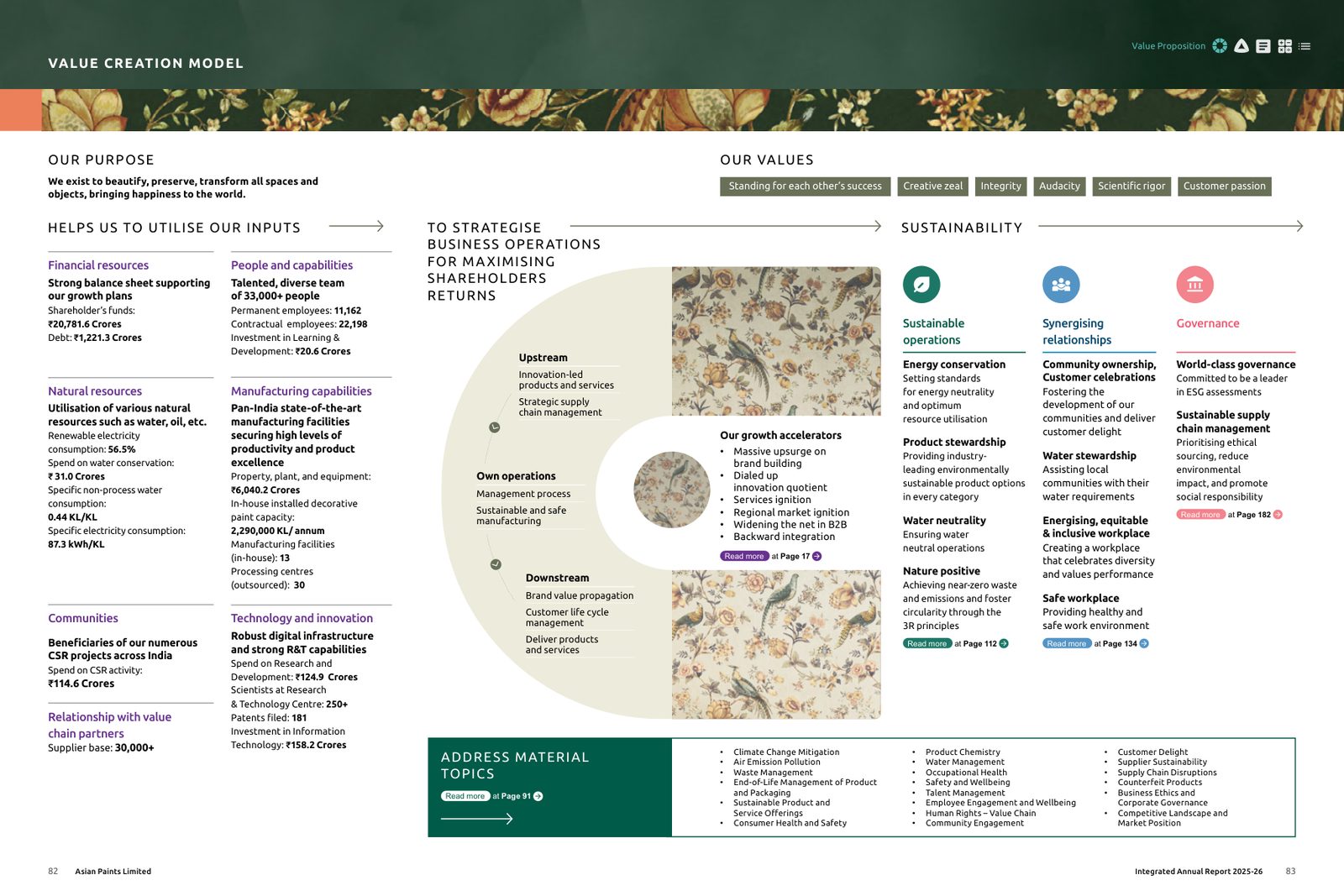
It falls short of a 5 on two counts. The capitals are renamed ("Natural resources", "Manufacturing capabilities", "Relationship with value chain partners") without saying how they map to the Framework's six, so a reader comparing reports has to do the translation. And the connections are lists rather than links: the material topics sit in a box at the foot of the spread, the risks in a column on the next, with no indication of which input, risk or topic drives which outcome. Each ESG chapter opens with its material topics, SDGs and affected stakeholders, which helps, but the trade-offs (capacity growth against energy intensity, for instance) are left to the reader.
BRSR and ESG integration: 4/5
The materiality chapter (pp. 91 to 97) is among the best in the series. The company ran a double materiality assessment in 2026 with reference to ESRS 1 and EFRAG's implementation guidance, mapping impacts, risks and opportunities across the upstream, own-operations and downstream value chain and engaging stakeholders through questionnaires, interviews and discussions. It prints its thresholds: impacts scored on scope, scale, irremediability and likelihood are material at 2.3 or above on a 3-point scale; risks and opportunities scored on magnitude and likelihood are material above 2. Results were discussed with the Board and cross-referenced to the enterprise risk register. It says which topics dropped out (Biodiversity and Influencer Management). And the process itself was assured by Deloitte Haskins & Sells, a step few Indian reports take.
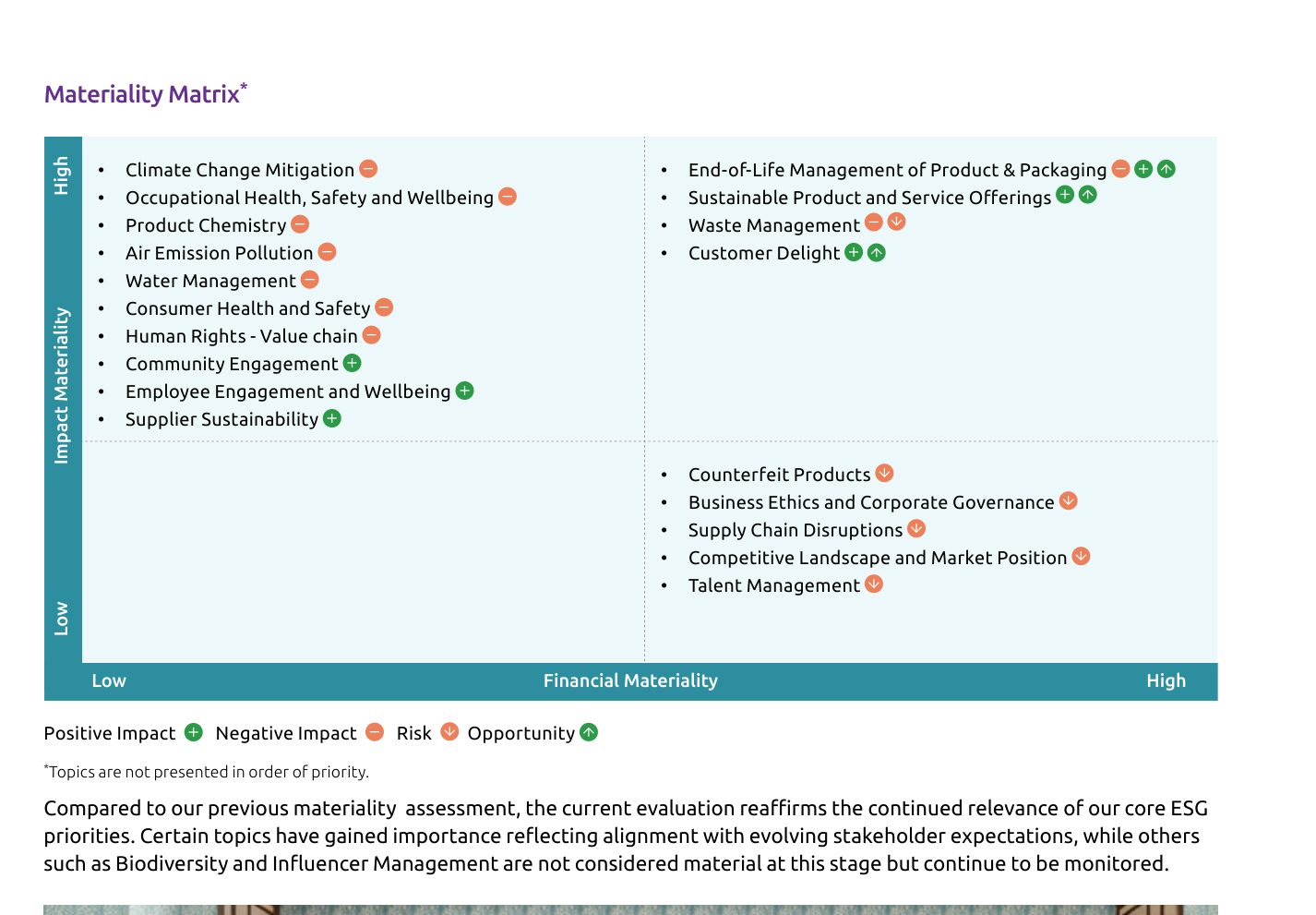
The matrix is a four-box grid rather than a plot, and it produces one result worth a sentence of explanation that the report doesn't give: climate change mitigation and water management are high on impact but low on financial materiality, for a manufacturer with 25 paint plants and a 2030 aspiration to 100% renewable electricity.
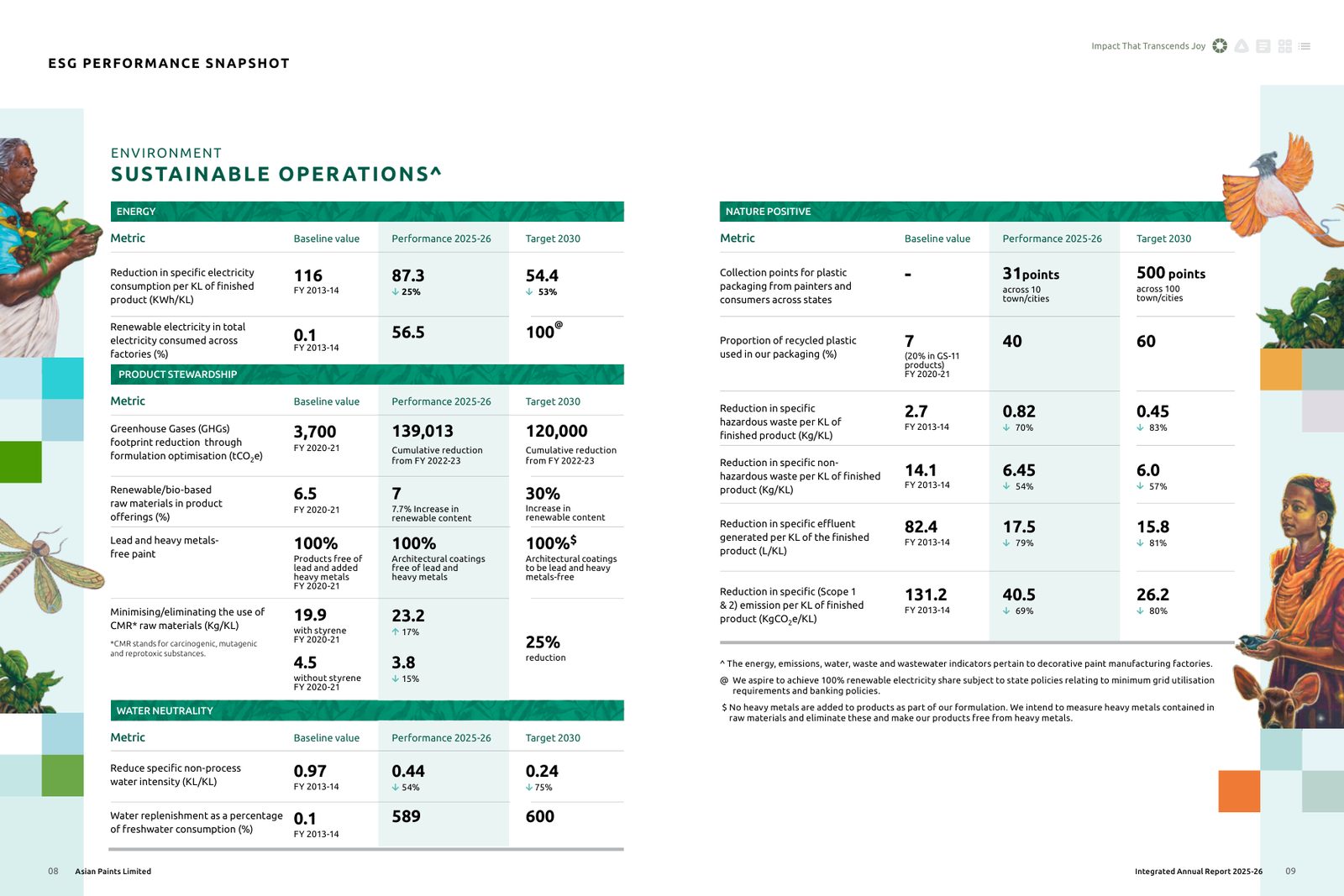
The ESG performance snapshot (pp. 8 to 11) is the other strength: every 2030 target shown with its baseline, baseline year and FY26 performance. Read closely, it also shows where progress has stalled. Specific electricity consumption is 87.3 kWh per kilolitre against 54.4 for 2030, and the climate chapter's chart shows it rising from 74.2 in FY24. Renewable electricity is 56.5% against an aspiration of 100%, down from 65.8% in FY24. The report explains the electricity rise (new capacity stabilising, backward integration moving energy inside the boundary), which is to its credit.
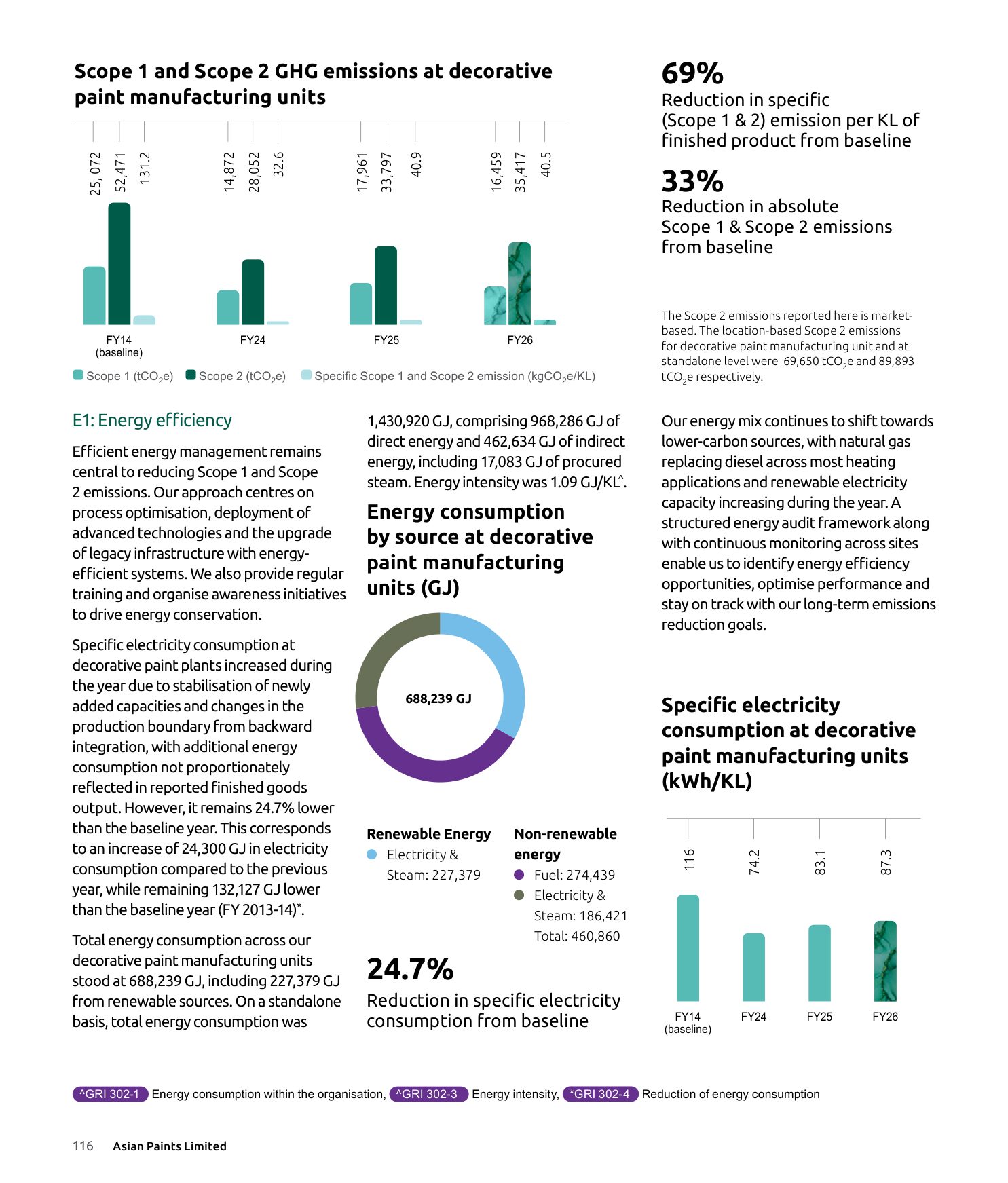
The point dropped is the headline. The FY 2025-26 highlights page reports a "69.2% Reduction in our absolute Scope 1 and 2 GHG emissions". The climate chapter on page 116 prints two separate numbers: a 69% reduction in specific emissions per kilolitre and a 33% reduction in absolute Scope 1 and 2 from the FY 2013-14 baseline. Its own chart shows absolute Scope 1 and 2 at the decorative plants of 42,924 tCO2e in FY24, 51,758 in FY25 and 51,876 in FY26. The highlights page, which most readers will see, describes an intensity figure as an absolute one.
The climate target is intensity-only (an 80% cut in Scope 1 and 2 intensity by 2030, per the TCFD index), Scope 3 is disclosed by category and makes up about 94% of the total but has no reduction target, and the TCFD index dates the climate risk assessment to FY 2022-23. The Chairman refers to "the comprehensive assessment of our 2025 targets"; we couldn't find that assessment published in the report. Assurance is thorough: Deloitte Haskins & Sells gives reasonable assurance on BRSR Core and reasonable or limited assurance on other indicators. It is also the statutory auditor, which the report states plainly. Safety data is complete: no fatalities, but LTIFR up from 0.32 to 0.34 and TRFR of 1.27 against a 2030 target of 0.80 or lower.
Governance disclosure: 4/5
The Board responsibility statement is the anchor, and the statutory disclosure is complete: 12 directors, six independent including the Chairman, 25% women, average independent-director tenure of 3.7 years, attendance for each director on the Board pages, and a new independent director appointed on 29 May 2026. The Board's report lists the year's decisions, including the amalgamation of Asian Paints (Polymers), the renewal of the PPG joint ventures and the divestment of the stake in Akzo Nobel India.
Two things hold it at 4. The governance chapter in the integrated section is short, and its 2030 targets ("committed to be a leader in ESG assessments", "proactive engagement with value chain partners") have no metric, baseline or status, unlike every environmental and social target in the snapshot. And the Competition Commission of India proceedings get one paragraph in the Board's report (p. 228), saying the company is a party to an ongoing investigation and a separate appeal. The integrated section doesn't mention them.
Financial storytelling: 4/5
The financial review (pp. 60 to 63) is honest. Twelve five-year charts show revenue, EBITDA, margin, cash profit, PAT, EPS, RoCE, net fixed assets, asset turnover, payout, surplus cash and market capitalisation, each with its year-on-year change and five-year CAGR. They include the unflattering ones: market capitalisation down 7.4% to ₹207,618 crore, RoCE of 28.9% against 41.2% two years ago, PAT of ₹4,244.2 crore still below FY24's ₹5,315.0 crore. The text says in words that market capitalisation "moderate[d]" amid foreign portfolio outflows. An economic value statement follows, and the ten-year review (pp. 78 to 79) gives standalone and consolidated tables side by side with exceptional items on their own line.
The gaps are at the front. The highlights page gives revenue, EBITDA, free cash flow (up 110.4%) and RoCE, all standalone, but not profit. PAT growth of 18.3% owes something to smaller exceptional charges (₹166.5 crore against ₹379.6 crore); profit before exceptional items grew 11.7%. The exceptional items include a ₹105.4 crore impairment of the investment in White Teak, after an impairment and fair-value loss on the same business the year before. The CEO's message and the MD&A describe White Teak's integration as supporting category expansion and revenue growth; the word "impairment" doesn't appear anywhere in the first 190 pages.
Design and readability: 3/5
The design has a clear idea: every section divider and many pages carry Asian Paints shade cards (Moonlit Silk 7809, the Colour of the Year, among them), and St+art street-art projects mark the ESG chapters. Tables are clean, charts are labelled with values, and a row of link icons sits in every page header. The integrated section is tighter than most, with a ten-year review inside the MD&A where a reader expects it.
But the document is 580 pages, the ESG Performance Review alone runs close to 80, and a two-page awards spread sits inside the MD&A. The repeated paragraph in the CEO's letter and the highlights mislabel are the kind of error a final read should catch. Ranked against Hindustan Zinc and HDFC Bank at similar lengths, it earns the same mark.
Digital version: 3/5
The company's annual reports page links to the PDF and to an online edition, which we confirmed exists. It is a portal with highlights, leadership messages and section PDFs rather than a full HTML report. The PDF doesn't point readers to it: its "Online" icons link to policies, position statements and other pages on the website.
The PDF is well linked inside: we counted 1,503 internal jump links, and the header icons and "Read more" arrows work. It has a proper text layer. But it has no bookmarks at all, so a 580-page file can only be moved around from the contents page, and every page between the covers is a two-page spread, which is awkward on a phone.
What reporting teams can take from it
Copy the Board Responsibility Statement with its approval date. Copy the materiality chapter, especially the printed thresholds, the list of topics that dropped out, and the decision to have the process assured. Copy the ESG snapshot's baseline, performance and target columns, and the five-year charts that show the bad years alongside the good.
Then check every headline number against its chapter before release, give the highlights page a profit line, put the impairment in the narrative where the business it relates to is praised, set an absolute and a Scope 3 target, add bookmarks, and publish single pages.
Series scorecard
Every report in this series is scored on the same seven-point card by the same reader. Scores are editorial opinion of the published document; each review carries the page references behind its findings.
| Company | Score (of 35) |
|---|---|
| Hindustan Zinc | 30 |
| TCS | 29 |
| HUL | 28 |
| Bharti Airtel | 27 |
| L&T | 27 |
| Reliance | 27 |
| HDFC Bank | 26 |
| Asian Paints (this review) | 25 |
| ICICI Bank | 25 |
| Infosys | 25 |
| LTM | 25 |
| Tata Steel | 25 |
| M&M | 24 |
| Titan | 23 |
| ITC | 21 |
| Sun Pharma | 21 |
| Bajaj Finance | 20 |
| NTPC | 20 |
Frequently asked questions
What is in Asian Paints' Integrated Annual Report 2025-26?
A 580-page document themed 'Bringing joy to people's lives: Responsible. Resilient. Radiant.' It opens with About this report, FY 2025-26 highlights and an ESG performance snapshot, then runs through Corporate Overview, Management Discussion and Analysis (including a ten-year review), Value Proposition (value creation model, stakeholder engagement, materiality), an ESG Performance Review, the Notice, Board's report, corporate governance report, the BRSR, standalone and consolidated financial statements, and GRI and TCFD indices with the assurance report.
How does Asian Paints assess materiality?
Through a double materiality assessment undertaken in 2026 on a standalone basis, with reference to ESRS 1 and EFRAG implementation guidance. Impacts were scored on scope, scale and irremediability together with likelihood, and are material at 2.3 or above on a 3-point scale; risks and opportunities were scored on magnitude and likelihood and are material above 2. Nineteen topics were identified, the results were discussed with the Board, and Deloitte Haskins & Sells gave assurance on the process and methodology.
What are Asian Paints' climate targets and emissions?
The TCFD index states a commitment to reduce Scope 1 and 2 emission intensity by 80% by 2030 against FY 2013-14. In FY26 specific emissions at decorative plants were 40.5 kgCO2e per kilolitre, 69% below the 131.2 baseline, against a 2030 target of 26.2. Standalone Scope 1 and 2 emissions were 79,686 and 55,660 tCO2e. Scope 3 makes up about 94% of total emissions, mostly purchased goods and services, and there is no Scope 3 reduction target.
Who assures Asian Paints' sustainability disclosures?
Deloitte Haskins & Sells LLP, which is also the statutory auditor. It gives reasonable assurance on BRSR Core indicators, reasonable or limited assurance on other selected BRSR and integrated report indicators, and assurance on the process and methodology of the double materiality assessment, under the ICAI's SSAE 3000 and SAE 3410 standards.
What were Asian Paints' FY 2025-26 results?
On a standalone basis, revenue from sale of products and services of ₹30,680.2 crore (up 4.3%), EBITDA of ₹7,113.1 crore (up 12.4%), profit after tax of ₹4,244.2 crore (up 18.3%), RoCE of 28.9% and free cash flow of ₹5,566.7 crore. Consolidated revenue from operations was ₹35,583.5 crore (up 4.95%) and profit ₹4,394.7 crore (up 18.5%). Decorative volume in India grew 8.7%. The total dividend is ₹27.5 per share, a 60% payout before exceptional items.
How does The Footnotes score annual reports?
Seven criteria, each scored 1 to 5 with a one-line reason: strategy and narrative; integrated thinking and capitals; BRSR and ESG integration; governance disclosure; financial storytelling; design and readability; and the digital version. Scores are editorial opinion based on the published document, and the same card is used for every company so results can be compared.
Sources
- Asian Paints: Annual Reports (investor pages) — Asian Paints Limited
- Asian Paints: Integrated Annual Report 2025-26 (online edition) — Asian Paints Limited
- Integrated Reporting Framework (IFRS Foundation) — IFRS Foundation
- SEBI circular: BRSR Core, framework for assurance and ESG disclosures for value chain (12 July 2023) — SEBI