

Tata Steel Integrated Report and Annual Accounts 2025-26: A Review
Tata Steel's 11th integrated report has one of the best business-model spreads in India, a five-year ESG factsheet with assured figures marked in green, and a tax transparency report with country-by-country contributions. It also leaves the material uncertainty over Tata Steel Nederland's going concern out of the front half, prints ESG goals without status numbers, and publishes a web edition that the PDF never mentions.
 In short
Key takeaways
- The report is Tata Steel's 11th integrated report: 343 numbered pages of integrated and statutory reporting, followed by financial statements numbered to F273 and an AGM notice numbered to N30, in a 582-page PDF. It is reviewed by the Key Managerial Personnel and Senior Management, not formally approved by the Board.
- The business model spread (pages 20-21) runs input, value chain, output and outcome with numbers for all six capitals: ₹98,768 crore net worth and ₹80,144 crore net debt in, ₹34,848 crore EBITDA, 31.67 MT production and 2.22 tCO2/tcs out.
- Materiality rests on a 2023 double materiality assessment run by an independent agency with 11 stakeholder groups and 15 high-priority issues; the next cycle is planned for the coming year, and no financial thresholds are published.
- The ESG factsheet gives five years of data for each steelmaking entity. Consolidated CO2 intensity has been 2.22 or 2.23 tCO2/tcs for three years, Tata Steel Limited's Scope 1 emissions rose from 49 to 64 million tonnes over five years as production grew, and renewables were 2.4% of the India power mix.
- Management states nine fatalities across the group in FY2025-26, eight of them in India. The Netherlands business paid more than €20 million in penalties and received notice of intended permit revocation for its coke and gas plants; its accounts carry a material uncertainty on going concern, disclosed on page 309 and in the notes, not in the leadership pages.
- A 10-page Tax Transparency Report (pages 334-343) follows GRI 207 and includes country-by-country data: ₹42,752 crore of global tax and other contributions, ₹33,588 crore of it in India.
Tata Steel's FY2025-26 was a year of two stories. In India it produced a record 23.43 million tonnes of crude steel, commissioned the Kalinganagar Phase II blast furnace and opened a scrap-based electric arc furnace in Ludhiana; consolidated EBITDA rose 35% and profit after tax more than tripled. In the Netherlands it paid more than €20 million in environmental penalties and was told the authorities intend to revoke permits for its coke and gas plants. The 119th-year report, themed "One dream: towards a greener future", tells the first story very well. The second, it tells in part.
As with every review in this series, we read the published PDF against the <IR> Framework, SEBI's BRSR Core expectations and plain readability, and score it on the same seven-point card. Scores are our opinion. Screenshots are small excerpts reproduced for review and remain the copyright of Tata Steel Limited; the full report is on the company's investor pages.
The scorecard
| Criterion | Score (of 5) | In one line |
|---|---|---|
| Strategy and narrative | 4 | Objectives, key targets and progress for each geography, and a CEO-CFO Q&A that names the penalties and fatalities; the TSN going-concern uncertainty stays in the back half |
| Integrated thinking and the capitals | 4 | An input-to-outcome business model with numbers for every capital; the capital chapters are narrative and rarely connect to one another |
| BRSR and ESG integration | 4 | Five-year factsheet with assured KPIs marked, BRSR inside, reasonable assurance, TNFD-aligned climate report; 2023 materiality, goals without status numbers, flat intensity |
| Governance disclosure | 4 | Board composition, tenure and committees on one spread, ethics and human rights, a tax transparency report with country data; reviewed by management, not approved by the Board |
| Financial storytelling | 3 | Reported PAT leads the highlights and the Q&A gives the numbers; no multi-year trend, and the TSN material uncertainty is not in the financial capital chapter |
| Design and readability | 3 | A clean system with section navigation, but six inspirational interstitial spreads, eight pages of CSR metrics and a 582-page PDF |
| Digital version | 3 | A real HTML edition exists online; the PDF has no bookmarks, no links in its first 137 pages and never mentions the web edition |
| Total | 25 / 35 |
What the report is
The "Report Profile" (pages 2-3) calls this Tata Steel's 11th integrated report. The ESG sections are prepared under the <IR> Framework, which the report correctly says has been "consolidated into IFRS Foundation", and cover Tata Steel Limited and its key subsidiaries in India and overseas. The integrated section runs to page 137 in four parts (About Tata Steel, Our Leadership, Our Strategy, Stakeholder Engagement and Materiality) before Value Creation, which holds the six capital chapters, a Climate Change Report, a 16-page ESG Factsheet and four pages of awards. The statutory section follows: the BRSR (pages 138-199), the Board's Report and annexures, the MD&A (pages 278-333) and a Tax Transparency Report (pages 334-343). Financial statements are numbered F2 to F273 and the AGM notice N2 to N30. The PDF is 582 pages.
Price Waterhouse & Co. Chartered Accountants LLP audits the accounts and also provides reasonable and limited assurance on agreed ESG indicators, including BRSR Core, under the ICAI's SSAE 3000 and SAE 3410 and the IAASB's equivalents. The assurance reports are on the website, not in the PDF.
One sentence in the profile matters for the governance score: the report "has been reviewed by the Key Managerial Personnel", namely the CEO and Managing Director, the CFO and the Company Secretary, with Senior Management. That is a management review, not the Board statement of responsibility the Framework asks for.
Key number: 9, the fatalities across the Tata Steel Group in FY2025-26, stated by the CEO and CFO in the leadership pages rather than left to the BRSR.
Strategy and narrative: 4/5
The strategic roadmap (pages 40-45) is well built. Each geography has its own objectives: India's are leadership in chosen segments, profitable growth, global cost leadership and ESG leadership. For each India objective the report gives the approach, key targets and "progress till FY2025-26". Under cost leadership, the FY2025-26 transformation programme delivered ₹10,868 crore of savings against an ₹11,500 crore target, a 95% hit rate, split 46% raw materials, 36% power and fuel and 18% stores and maintenance, with ₹7,100 crore targeted for FY2026-27. A target, the result, the shortfall and the next target: that is how a strategy page should read.
The Chairman's message (pages 28-31) is conventional, macro first and then the numbers. The better document is "Management Speak" (pages 32-37), a Q&A with T V Narendran and Koushik Chatterjee. It covers the ₹14,559 crore capex and the ₹20,000 crore planned for FY2026-27, mining lease expiries by FY2030, the reduction of overseas debt from about 50% of the total in FY2020-21 to 18%, the potential grid-connection delay at Port Talbot, and the Netherlands in detail: the Environment Agency's measured exceedances at the coke and gas plants, penalties "exceeding €20 million", and the April 2026 notice of intent to revoke permits. On safety, it says the company "deeply regret[s] the occurrence of nine fatalities".
What it doesn't say is what the MD&A says on page 309 and the notes repeat on pages F57 and F266: "pending assurance on a feasible timeline", TSN's own financial statements have been prepared "taking into account a material uncertainty to going concern". For a subsidiary whose IJmuiden plant is 7 MTPA of the group's 36 MTPA, that is the most important sentence in the report about Europe, and a reader of the first 137 pages won't find it. The Q&A had the question and most of the answer; it needed one more sentence.
Integrated thinking and the capitals: 4/5
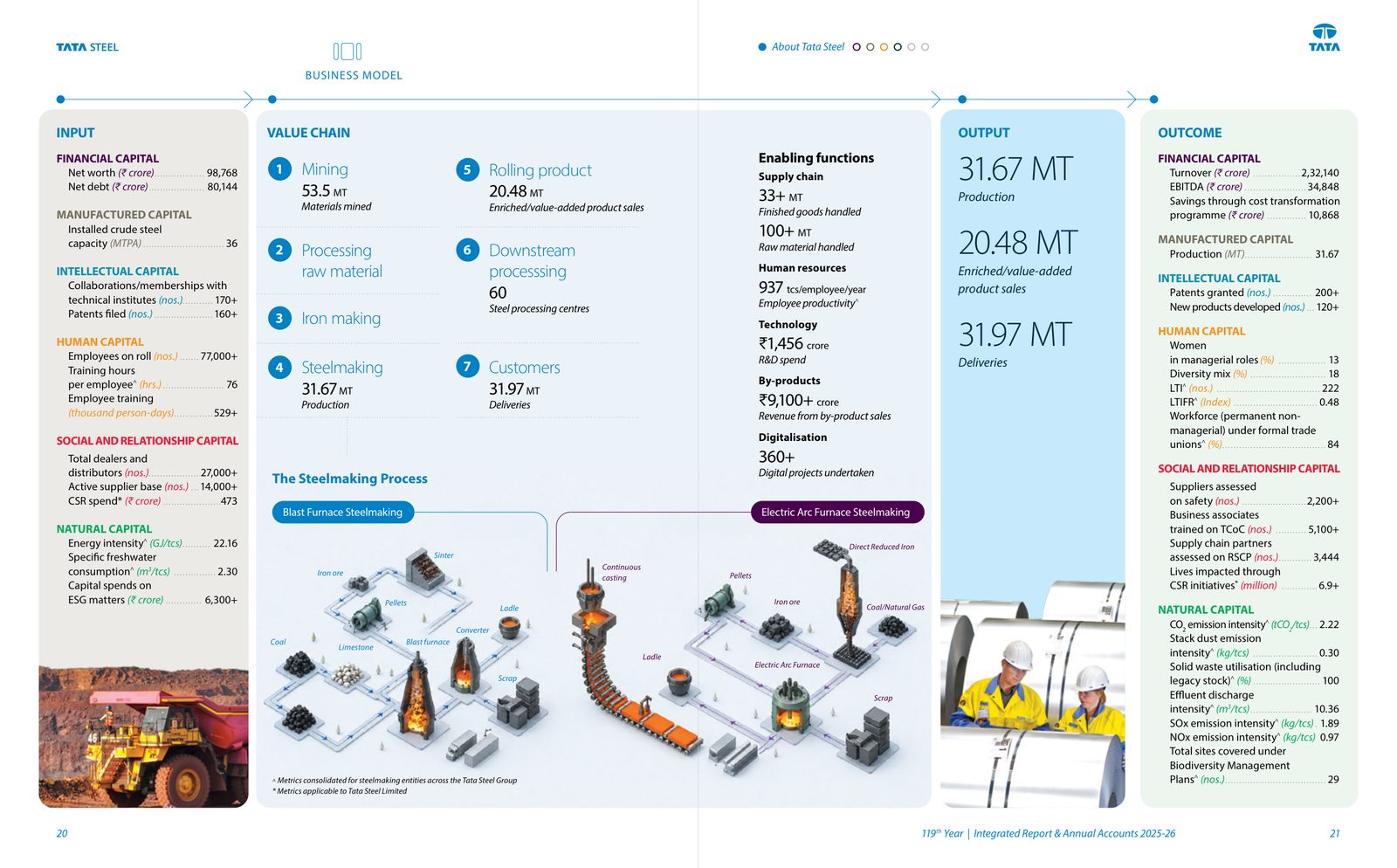
The business model spread (pages 20-21) is among the best in the series. Four columns: inputs by capital (₹98,768 crore net worth and ₹80,144 crore net debt; 36 MTPA capacity; 77,000+ employees and 76 training hours each; ₹473 crore CSR; 22.16 GJ/tcs energy intensity; ₹6,300 crore-plus of ESG capex), a seven-step value chain with volumes at each step (53.5 MT mined, 31.67 MT produced, 20.48 MT of value-added sales, 31.97 MT delivered), outputs, and outcomes by capital, including 222 lost-time injuries, 13% women in managerial roles and 2.22 tCO2/tcs.
The materiality chapter then maps all 15 material issues to capitals, KPIs and whether each is a risk or an opportunity with positive or negative financial implication, and states that every issue is mapped to the ERM framework. The SDG pages (48-55) tag each programme to the capitals it draws on.
The point is dropped in the capital chapters themselves (pages 78-105). Each opens with a full-page purple graphic and a slogan ("One performance pulse", "One engineered system"), and what follows is a well-written account of the year for that capital with little on trade-offs between them. The natural capital chapter, for example, discusses scrap use and water without connecting to the financial capital pages' ₹20,000 crore capex plan or to what decarbonisation will cost. L&T and TCS, both scored 5 here, carry material topics and linkages into each capital chapter; Tata Steel does it once, on the business model, and then stops.
BRSR and ESG integration: 4/5
The ESG Factsheet (pages 114-129) is the section every steel analyst will use. It covers Tata Steel Limited, NINL, Tata Steel Nederland, Tata Steel UK and Tata Steel Thailand, entities that the report says account for more than 95% of group turnover, with five years of data for each, explicit notes on boundary changes (UK steelmaking ceased in October 2024; mergers added subsidiaries from FY2023-24) and every assured KPI shaded green. Scope 3 is reported for each entity.
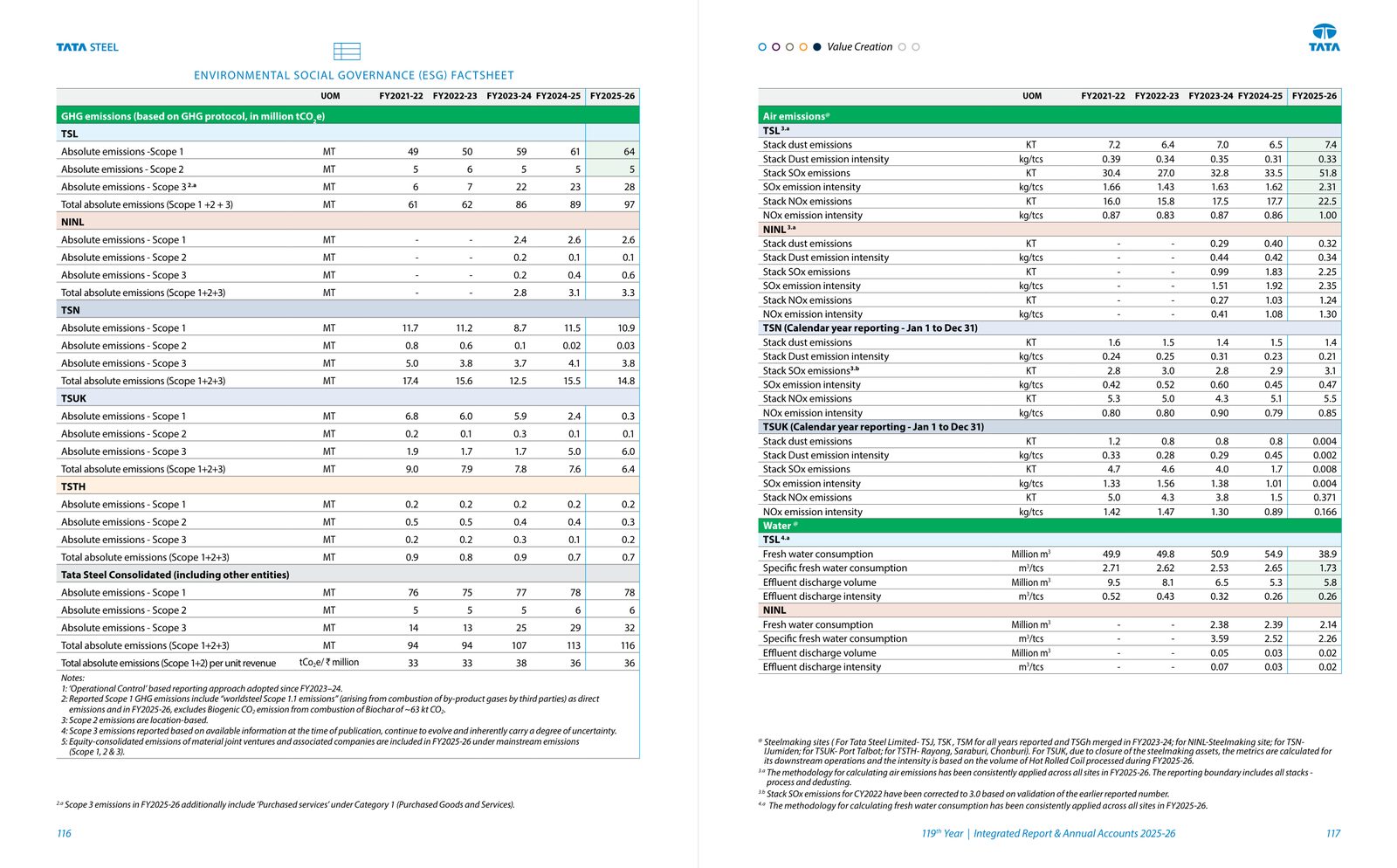
It is also honest in what it shows. Consolidated CO2 intensity was 2.21, 2.23, 2.22 and 2.22 tCO2/tcs over the last four years. Tata Steel Limited's Scope 1 emissions have gone from 49 to 64 million tonnes in five years as production rose from 18.38 to 22.47 MT, and its stack SOx emissions rose from 33.5 to 51.8 kilotonnes in a single year. There is good news too: specific freshwater consumption at Tata Steel Limited fell from 2.65 to 1.73 m³/tcs. The Climate Change Report (pages 106-113) follows the IFRS S2 and TNFD four-pillar structure, sets out five decarbonisation levers with progress, and says renewables were 2.4% of India's power mix.
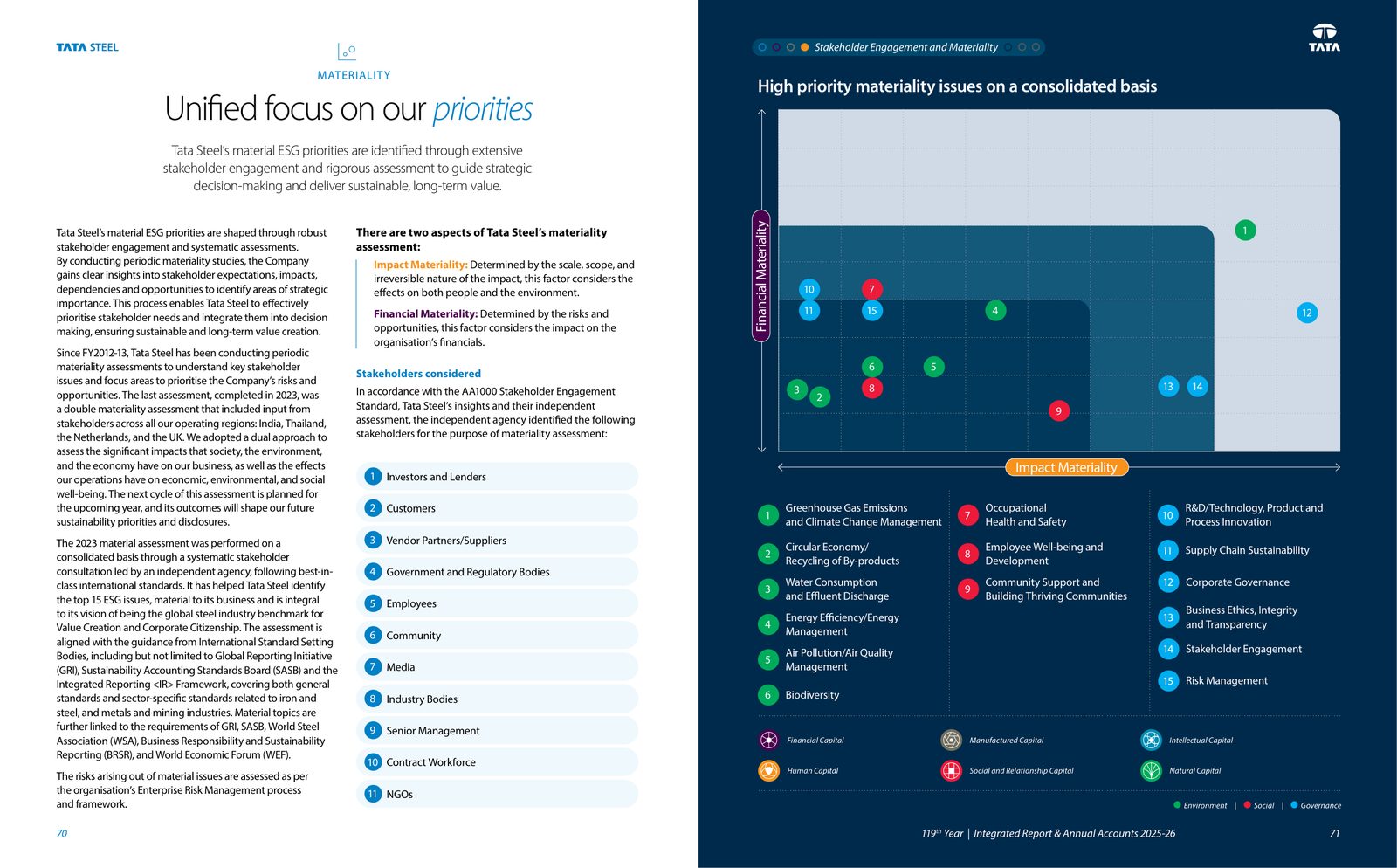
Three things keep this at 4. The materiality assessment was completed in 2023 by an independent agency, is described as double materiality and plots 15 issues, but publishes no thresholds and is due for renewal "in the upcoming year". The ESG Goals spread (pages 46-47) lists 28 targets and marks each as "new", "updated" or "on track" with a coloured dot, without a single status figure; the reader has to go to the factsheet to see that the freshwater target of under 1.1 m³/tcs by FY2030-31 compares with 1.73 today. And the headline India climate target, a 10-15% cut in emission intensity by FY2030-31 against FY2024-25, carries the footnote "depending upon regulatory framework". A target with a conditional footnote is a forecast.
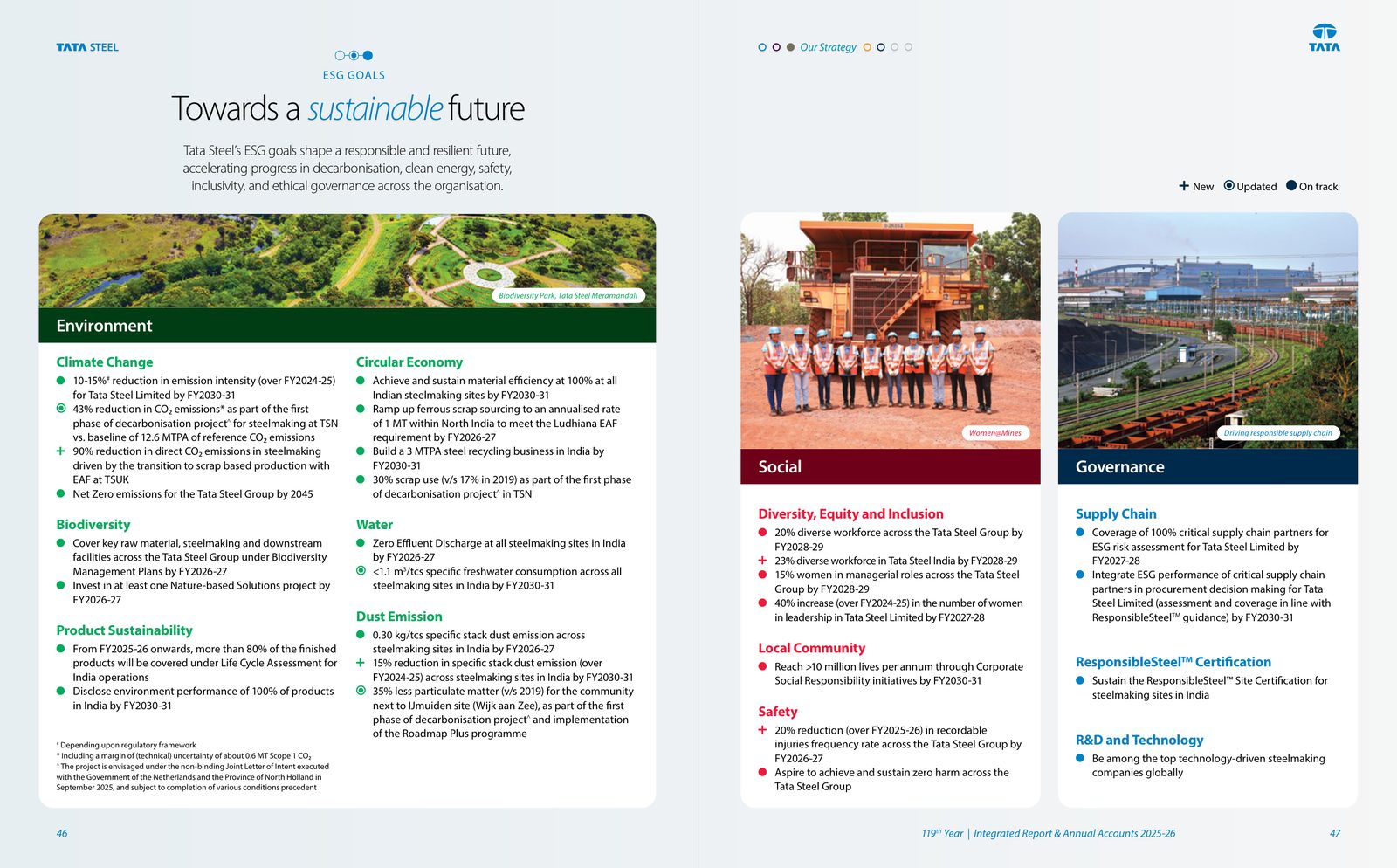
Safety deserves its own line. The BRSR (page 168) shows nine consolidated fatalities, one employee and eight workers, against five the year before, and the human capital chapter (pages 92-93) repeats the figure. The factsheet's entity table shows five at Tata Steel Limited, so the reader has to work out the boundary difference, but the group number is not hidden.
Governance disclosure: 4/5
The Board spread (pages 24-25) gives each director's role, committee memberships and year of appointment, with tenure and composition summarised: ten directors, five of them independent, two executive. Ethics and compliance (pages 62-63) covers the Management of Business Ethics framework, the Chief Ethics Counsellor's reporting line to the CEO and MD, a third-party whistleblowing line, and SA8000:2014 certification across 23 sites and more than a lakh workers. The shareholder engagement page publishes investor complaints for three years, including the 34 left open at 31 March 2026.
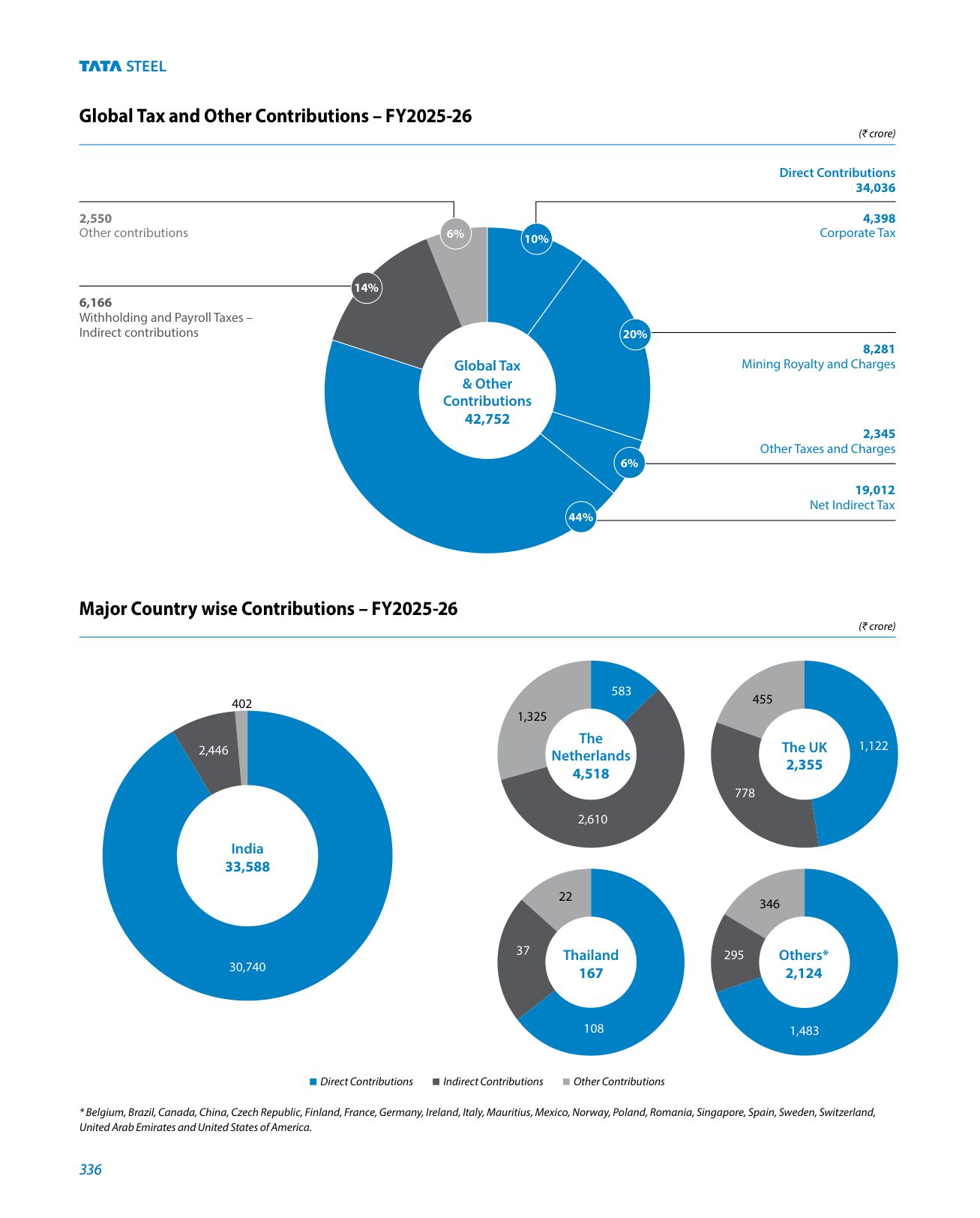
The standout is the Tax Transparency Report (pages 334-343). It is voluntary, follows GRI 207, and includes data from the OECD country-by-country report: ₹42,752 crore of global tax and other contributions in FY2025-26, of which ₹33,588 crore was in India, ₹4,518 crore in the Netherlands and ₹2,355 crore in the UK, with mining royalties of ₹8,281 crore shown separately. Hindustan Zinc is the other company in the series that publishes one.
The point dropped is accountability for the report itself. It is reviewed by management; the Board does not state its responsibility for the integrated report, as Hindustan Zinc's and Bharti Airtel's Boards do.
Financial storytelling: 3/5
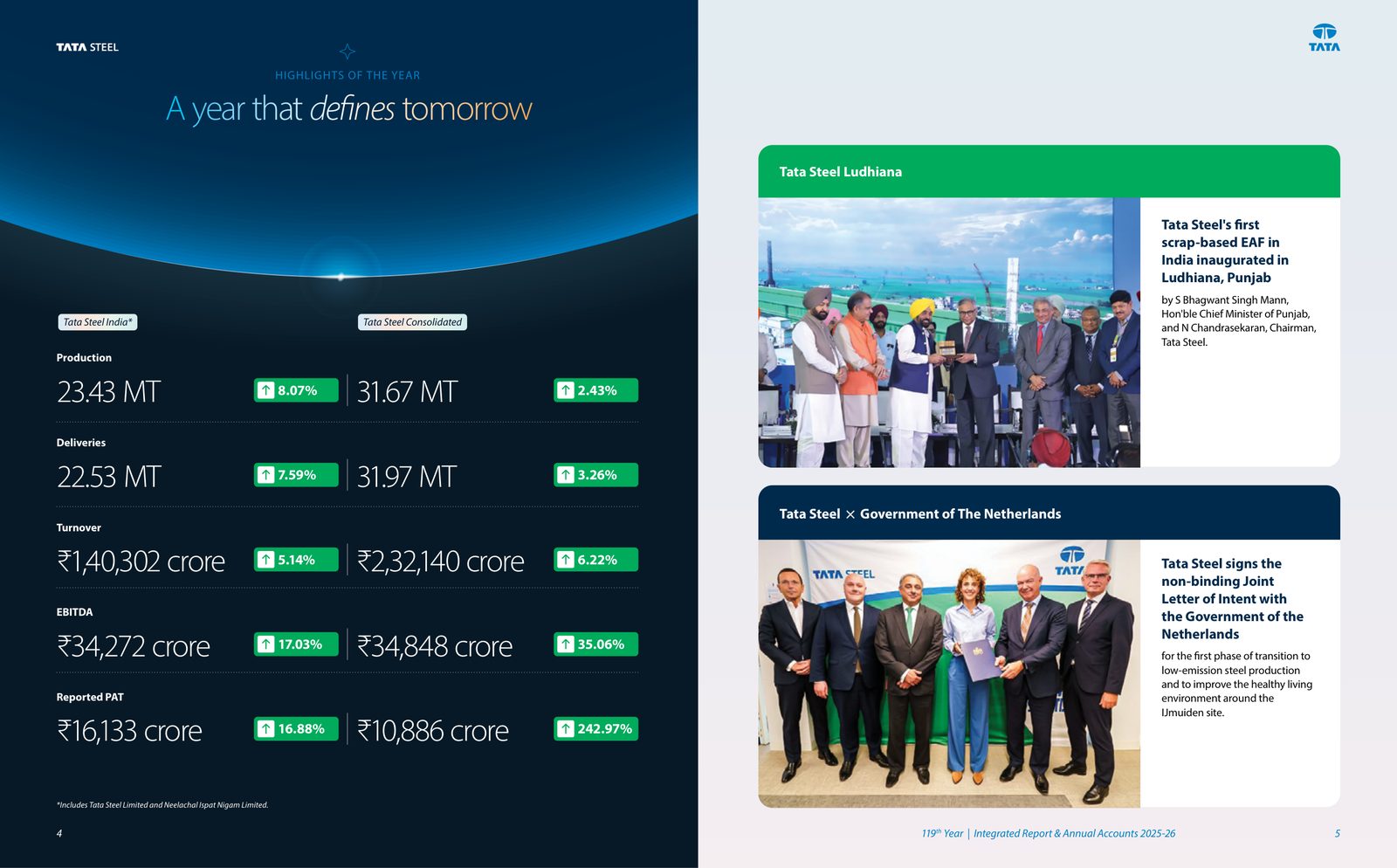
The highlights spread (pages 4-5) gets the basics right. It leads with production and deliveries, then turnover, EBITDA and "Reported PAT", for India and consolidated, with growth rates: ₹10,886 crore consolidated profit, up 242.97%. Nothing is adjusted, and the Chairman gives the base (₹3,174 crore in FY2024-25) so the reader can see the jump is partly a low comparative. Exceptional items are listed in the Board's Report, including ₹994 crore of redundancy charges in the UK and the Netherlands and a ₹901 crore fair-value gain on Tata Steel Colors.
The financial capital chapter (pages 78-81) adds free cash flow of ₹10,738 crore, a ₹5,442 crore working capital release, ₹7,556 crore of debt prepaid and net debt to EBITDA down from about 3.3x to 2.3x over two years. For a cyclical business, though, the report has no multi-year financial trend anywhere: the Financial Highlights and ratios at F2-F3 compare two years, and the long-run table at F4 is production statistics. A reader can't see this year's 15% EBITDA margin against the cycle without going to old reports. And the chapter that talks about "value creation" and a 24% rise in market capitalisation doesn't mention that the accounts of a subsidiary with 7 MTPA of steelmaking capacity carry a material going-concern uncertainty.
Design and readability: 3/5
The visual system is tidy: a consistent header with section dots, clear typography, full-bleed photography used with restraint on the working pages. The business model and factsheet spreads are well set.
The problem is weight. Six inspirational spreads ("Igniting sustainable steelmaking", "Magnetising young talent", "Connecting communities through movement" among them) interrupt the integrated section, each ending with "read further about" the next chapter. The SDG section runs to eight pages of CSR programme counts. Each capital chapter spends half its opening spread on a slogan. The awards take four pages. None of this is wrong individually, but together it pushes the integrated section to 137 pages, and the whole document to 582 PDF pages.
Digital version: 3/5
The company publishes a full HTML edition of the report, which we confirmed online, with sections for the business model, leadership messages, ESG goals and downloads. The PDF never mentions it. There's no URL and no QR code, and the related-documents page on the investor site is the only way in.
The PDF itself is a mixed build. The integrated section (PDF pages 2-71) is built as spreads and contains no working links at all, so "Read More Page 82" on the capitals page and "access here" for the assurance reports on page 3 are plain text. From the BRSR onwards, single pages carry clickable section tabs in the header, which work. There are no bookmarks, so a 582-page file has no navigation panel.
What reporting teams can take from it
Copy the business model spread, and in particular the value chain with a volume at every step. Copy the ESG factsheet's structure: five years, one table per entity, boundary changes in footnotes, assured figures shaded. Copy the Tax Transparency Report. Copy the Management Speak habit of answering the hard question in the leadership pages, including the fatality count.
Then finish the job. When a subsidiary's accounts carry a material uncertainty, say so where the subsidiary is discussed in the front half. Put status numbers next to ESG goals. Add a five- or ten-year financial table. Have the Board, not only management, take responsibility for the report. And link the PDF to the web edition, with bookmarks, so readers can find their way round it.
Series scorecard
Every report in this series is scored on the same seven-point card by the same reader. Scores are editorial opinion of the published document; each review carries the page references behind its findings.
| Company | Score (of 35) |
|---|---|
| Hindustan Zinc | 30 |
| TCS | 29 |
| HUL | 28 |
| Bharti Airtel | 27 |
| L&T | 27 |
| Reliance | 27 |
| HDFC Bank | 26 |
| Asian Paints | 25 |
| ICICI Bank | 25 |
| Infosys | 25 |
| LTM | 25 |
| Tata Steel (this review) | 25 |
| M&M | 24 |
| Titan | 23 |
| ITC | 21 |
| Sun Pharma | 21 |
| Bajaj Finance | 20 |
| NTPC | 20 |
Frequently asked questions
Who assures Tata Steel's BRSR and ESG data?
Price Waterhouse & Co. Chartered Accountants LLP provides reasonable and limited assurance on agreed indicators in the Integrated Report and the BRSR, under the ICAI's SSAE 3000 and SAE 3410 and the IAASB's ISAE 3000 (Revised) and ISAE 3410. The same firm audits the financial statements. The assurance reports themselves are published on the company's website rather than in the PDF, and assured KPIs in the ESG factsheet are highlighted in green.
How does Tata Steel assess materiality?
Through periodic assessments since FY2012-13. The latest, completed in 2023, was a double materiality assessment on a consolidated basis led by an independent agency, covering India, Thailand, the Netherlands and the UK and 11 stakeholder groups identified under the AA1000 Stakeholder Engagement Standard. It produced 15 high-priority issues, each mapped to the ERM framework, with KPIs and capital linkages. The next cycle is planned for the coming year.
What are Tata Steel's climate targets?
Net Zero for the group by 2045; a 10-15% reduction in emission intensity for Tata Steel Limited by FY2030-31 against FY2024-25, described as depending on the regulatory framework; a 43% CO2 reduction in the first phase of the Netherlands decarbonisation project; and a 90% cut in direct CO2 in UK steelmaking through the move to an electric arc furnace. Consolidated CO2 intensity was 2.22 tCO2/tcs in FY2025-26, unchanged from the previous year.
What does the report say about Tata Steel Nederland's going concern?
The MD&A (page 309) and the notes to the accounts state that after the Environment Agency and the Province of North Holland wrote on 23 April 2026 of their intention to revoke operating permits for the coke and gas plants, TSN's own financial statements were prepared on a going concern basis while recognising a material uncertainty. The Chairman's message and the Management Speak Q&A discuss the penalties and permit revocation but do not mention the material uncertainty.
What were Tata Steel's FY2025-26 results?
Consolidated turnover of ₹2,32,140 crore, up 6.22%; EBITDA of ₹34,848 crore, up 35%, a 15% margin; reported profit after tax of ₹10,886 crore against ₹3,174 crore; net debt of ₹80,144 crore and net debt to EBITDA of 2.3x; capex of ₹14,559 crore; and a ₹4 dividend. India delivered EBITDA of ₹34,272 crore at a 24% margin on record crude steel production of 23.43 MT.
How does The Footnotes score annual reports?
Seven criteria, each scored 1 to 5 with a one-line reason: strategy and narrative; integrated thinking and capitals; BRSR and ESG integration; governance disclosure; financial storytelling; design and readability; and the digital version. Scores are editorial opinion based on the published document, and the same card is used for every company so results can be compared.
Sources
- Tata Steel: Integrated Report & Annual Accounts 2025-26 and related documents — Tata Steel Limited
- Tata Steel: Integrated Report & Annual Accounts 2025-26 (online edition) — Tata Steel Limited
- Tata Steel investors: Integrated Report / Annual Report — Tata Steel Limited
- SEBI circular on BRSR Core: framework for assurance and ESG disclosures for value chain (12 July 2023) — SEBI