

LTM Integrated Annual Report 2025-26: A Review
The first annual report under the LTM name has a Board responsibility statement, a CFO's letter that explains the weaker numbers as well as the good ones, and honest six-year charts. It also has a materiality matrix with no date and no AI topic, a climate page that shows reductions while the BRSR shows Scope 2 emissions nearly doubling, two different renewable-energy figures, and a production note reading 'Need high-res image' printed on two pages.
 In short
Key takeaways
- LTIMindtree Limited became LTM Limited during FY26: the brand was unveiled on 11 February 2026, members approved the name change on 13 March and a fresh certificate of incorporation was issued on 17 March. The report is numbered to page 543 in four parts: Corporate Overview, Statutory Reports (including the BRSR at pages 212 to 273), Financial Statements, and Global Presence and Notice.
- The Report Profile includes a Board Responsibility Statement: the Board acknowledges responsibility for the report's integrity, says it addresses all material issues, and records approval on 23 April 2026.
- The five-year ambition, Lakshya 31, is to double revenue over five years; it appears once, on the business model spread, and nowhere in the three leadership letters.
- Materiality is a two-axis matrix of 11 topics aligned to GRI 2021, undated, with no stakeholder numbers and no topic on artificial intelligence, although AI is one of the report's own principal risks.
- The BRSR reports Scope 1 emissions of 1,764 tCO2e, location-based Scope 2 of 33,195 tCO2e (18,239 in FY25) and Scope 3 of 150,445 tCO2e after new categories were added; BDO India gives reasonable assurance on BRSR Core and asks the company to consider stronger data management and internal verification.
- FY26 financials: revenue INR 423,076 million (up 11.3%; USD 4.8 billion, up 5.3% in constant currency), PAT INR 49,827 million (up 8.3%) after a labour-code charge of INR 5,281 million, EBIT margin 15.4%, ROE 21.3%, order inflow USD 6.6 billion and dividends of INR 19,911 million.
FY26 was the year LTIMindtree stopped being LTIMindtree. The company unveiled the LTM brand on 11 February 2026, shareholders approved the new name on 13 March and the Registrar issued a fresh certificate of incorporation four days later, so the report is published by LTM Limited and carries the old name only in brackets on its statutory pages. It was also a year of a new CEO, a new CFO, a reorganised operating model, a one-off labour-code charge and the largest deal in the company's history. There's a lot to explain, and the report is at its best when a named person explains it in numbers.
As with every review in this series, we read the published PDF against the <IR> Framework, SEBI's BRSR Core expectations and plain readability, and score it on the same seven-point card. Scores are our opinion. Screenshots are small excerpts reproduced for review and remain the copyright of LTM Limited; the full report is on the company's investor pages and as an interactive edition.
The scorecard
| Criterion | Score (of 5) | In one line |
|---|---|---|
| Strategy and narrative | 4 | Three letters with numbers and a CEO's list of priorities; the five-year target appears only in the business model, and thirty pages of awards and case studies come first |
| Integrated thinking and the capitals | 3 | Numeric inputs for all six capitals and risks tagged by capital; outcomes are outputs, and a footnote points to the awards pages as evidence of value created |
| BRSR and ESG integration | 3 | BRSR inside with reasonable assurance and full Scope 3; undated materiality with no AI topic, and a progress page that disagrees with the BRSR |
| Governance disclosure | 4 | Board responsibility statement with approval date, skills matrix with counts, name change and leadership changes dated; sustainability sits with the CSR Committee |
| Financial storytelling | 4 | A CFO's letter that explains the weak lines, statutory profit with the exceptional item in view, six-year charts that include the market-cap fall |
| Design and readability | 3 | A clean, consistent system, but 543 pages, ten pages of awards, and 'Need high-res image' left in print |
| Digital version | 4 | An interactive online edition and 850 internal links; the PDF is spreads with no bookmarks and malformed email links |
| Total | 25 / 35 |
What the report is
The contents page divides 543 numbered pages into four parts. Corporate Overview (pages 2 to 161) runs through an introduction and leadership messages, "LTM at a Glance", "A Year Where we Outcreated" (KPIs and awards), case studies, "Delivering Value through Business Creativity" (business model, operating context, stakeholders, materiality, risk) and "Outcreate, Responsibly" (the ESG chapters). Statutory Reports hold the MD&A from page 162, the BRSR from 212, the Board's report from 274, the Corporate Governance Report from 310 and a Risk Management Report at 350. Standalone and consolidated financial statements follow, then the global office list and the notice of the thirtieth AGM.
The Report Profile (pages 16 to 17) is well built. It states the period and boundary (the parent and subsidiaries, 42 countries, 118 offices), names long-term investors as the primary audience, lists the six capitals with a pointer to the business model, and carries a Board Responsibility Statement: "As the Board, we acknowledge our responsibilities to ensure the integrity of this Integrated Annual Report", followed by the belief that it addresses all material issues and the approval date, 23 April 2026. The one slip is the framework citation, which describes the International Integrated Reporting Council as "(known as IFRS Foundation)". The Framework now sits with the IFRS Foundation, but the IIRC was never "known as" it.
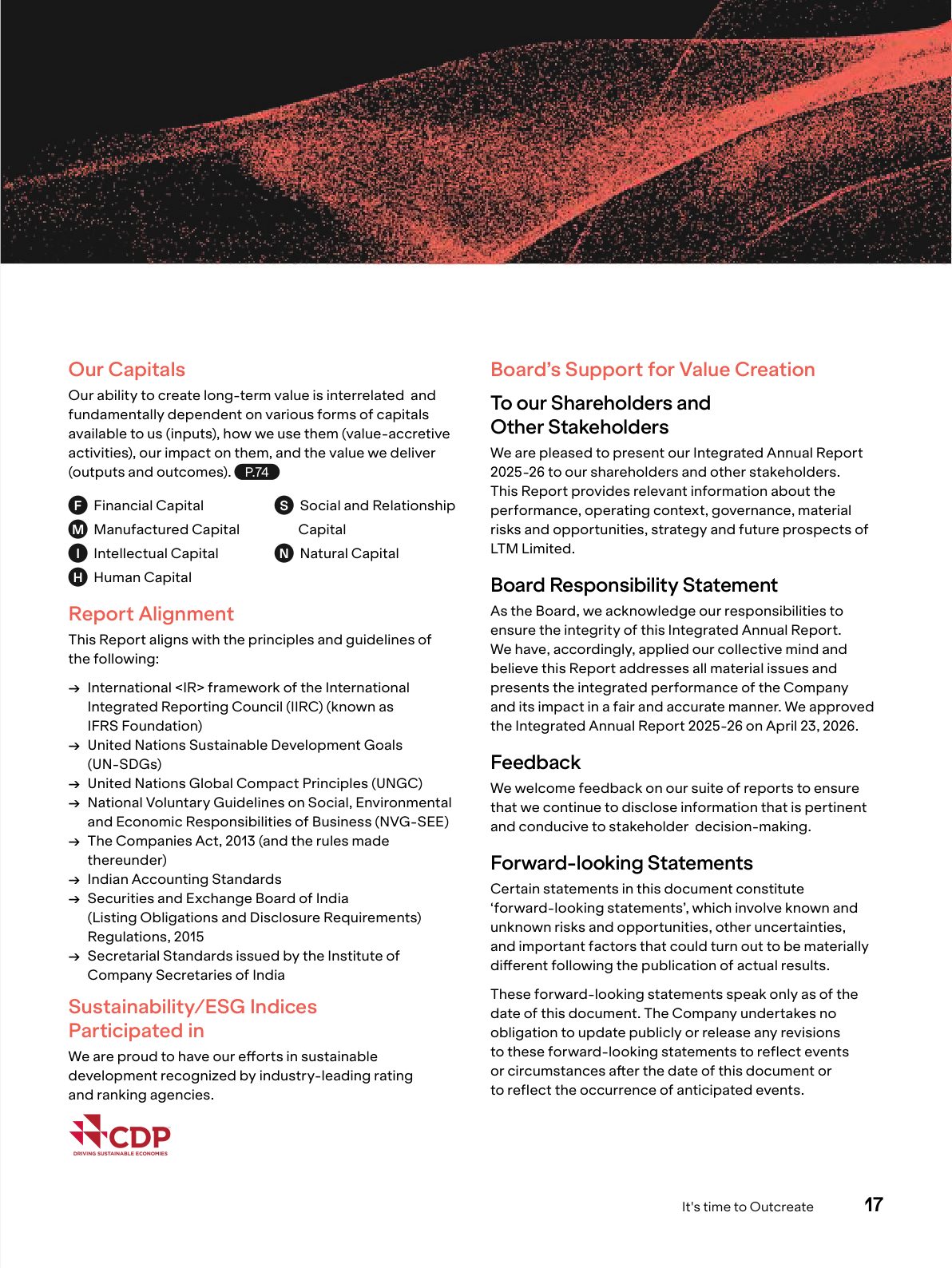
There is no separate sustainability report referenced from the integrated report; the BRSR, inside the PDF with its assurance statement, does that work.
Key number: 33,195 — tonnes of location-based Scope 2 emissions in FY26 according to the BRSR, up from 18,239 the year before. The ESG progress page in the front half reports reductions.
Strategy and narrative: 4/5
The leadership section has three letters, and they divide the work sensibly. The Chairman, S. N. Subrahmanyan, describes the year as "a defining year of transition" and covers the rename, the Board changes and the client base (751 active clients, 125 of them Fortune 500, 79 new). The CEO and MD, Venu Lambu, explains the strategic moves: the Fit4Future cost programme, a sales transformation, a simplified organisation with a dedicated AI and large deals engine, three lines of business (iRun, iTransform and Business AI), and the BlueVerse agentic AI platform. He ends with five priorities for FY27 and a few hard numbers: more than 6,700 freshers hired, 40% more than FY25, and more than 1,500 AI agents deployed. A QR code on the same page leads to an AI-generated podcast summary of the year.
The CFO's letter is the best of the three, and we return to it below. LTM's FY2024-25 report was ranked sixth in LACP's 2024/25 Vision Awards Worldwide Top 100, with a platinum award for its letter to shareholders; this year the letters remain the strongest writing in the report.
Two things cost a point. The first is that the company's actual five-year ambition, "Lakshya 31", which sets out to "double revenue over five years", appears exactly once, in a box on the business model spread (page 74). None of the three letters names it. A target of that size should be the spine of the narrative, with the letters reporting against it. The second is sequencing: before the reader reaches the business model, the report runs through twenty pages of service lines and verticals, ten pages of awards (pages 44 to 53) and twenty pages of client case studies (pages 54 to 73). The Chairman's letter also records "leadership transitions" and names the new CEO and CFO without mentioning that Debashis Chatterjee retired as CEO on 30 May 2025 or that Nachiket Deshpande resigned as a whole-time director in October; the Board's report states both plainly.
Integrated thinking and the capitals: 3/5
The business model spread (pages 74 to 75) has the right bones. Each of the six capitals gets a definition and numeric inputs: net worth of INR 241,077 million and cash and investments of INR 153,801 million; INR 1,840 million invested in green buildings and 118 offices; INR 1,221 million of R&D, three core platforms and 28 patents; 87,950 employees and 13.01 days of learning each; INR 960 million of CSR spend and 20 strategic alliances; 277,275 GJ of energy and 377.39 megalitres of water. In the centre sit Lakshya 31 and the three strategic pivots (domain and technology convergence, reimagined capabilities, reimagined ecosystem).
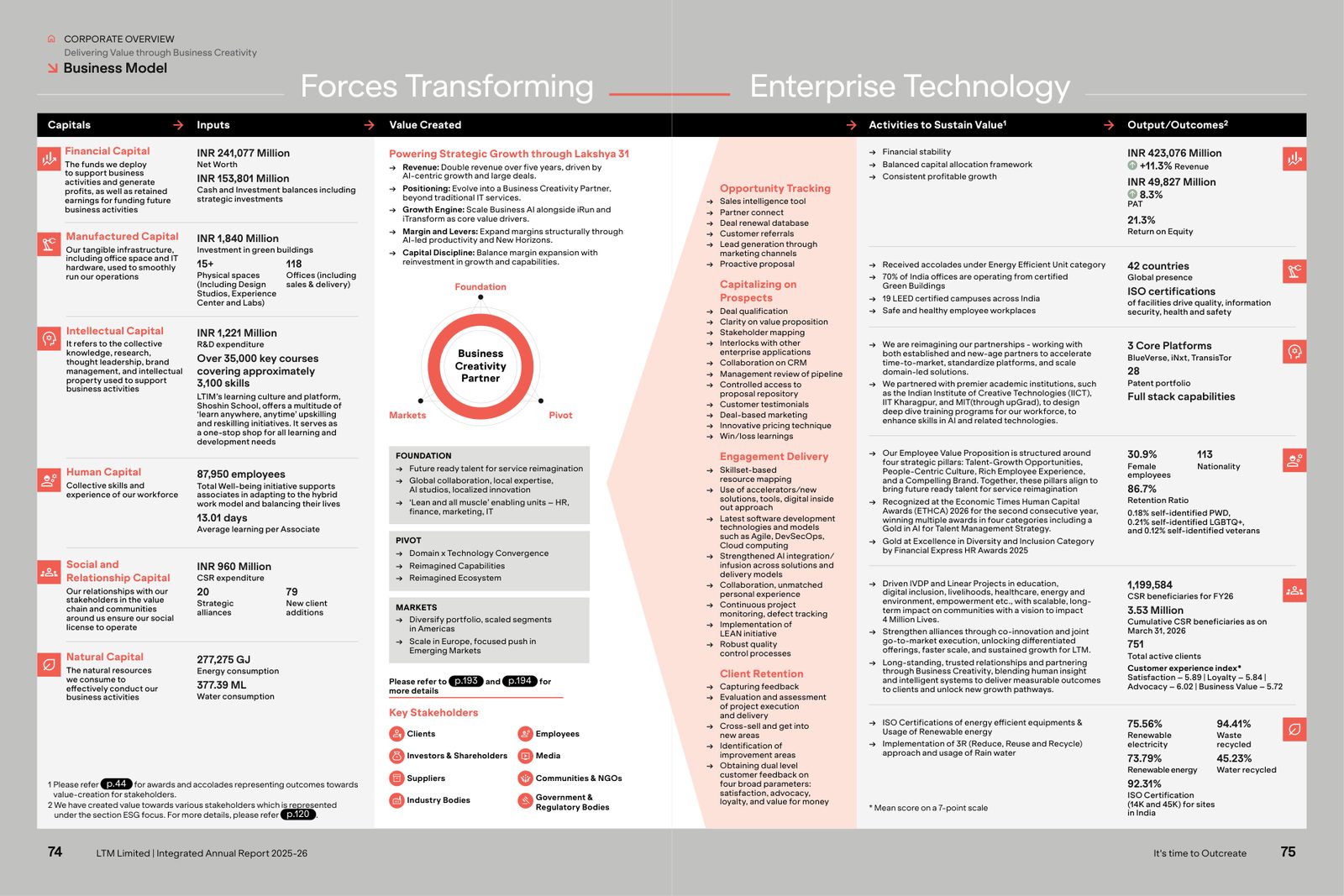
The right-hand side is weaker. The "Output/Outcomes" column is a list of results (revenue, PAT, ROE, 751 clients, 94.41% waste recycled) with no targets and, apart from revenue and PAT growth, no comparatives. The "Activities to Sustain Value" column describes sales and delivery processes ("deal qualification", "capturing feedback") rather than how the capitals are used or traded off. And footnote 1 sends the reader to page 44 "for awards and accolades representing outcomes towards value-creation for stakeholders". Awards are not outcomes for stakeholders. The same spread still refers to "LTIM's learning culture".
The risk chapter (pages 92 to 97) does the connecting better: each of eleven principal risks, from attrition and cybersecurity to client concentration and ESG, carries a treatment approach and the capitals it affects. Beyond that, the capitals disappear. The ESG chapters are organised by environment, social and governance, not by capital, and the stakeholder engagement pages list channels and topics without saying what changed as a result. TCS, the obvious peer, scores 5 here because its business model and capital chapters carry inputs, outcomes and connections all the way through.
BRSR and ESG integration: 3/5
The foundations are sound. The BRSR is inside the report (pages 212 to 273), prepared on a consolidated basis with environmental data under operational control. BDO India Services gives reasonable assurance on BRSR Core and select non-core indicators, and limited assurance on others. Scope 3 is now reported across all relevant categories (150,445 tCO2e, against 46,149 in FY25 under the older, narrower method), and the BRSR gives market-based as well as location-based Scope 2. The company has committed to the Science Based Targets initiative and targets net zero by 2040.
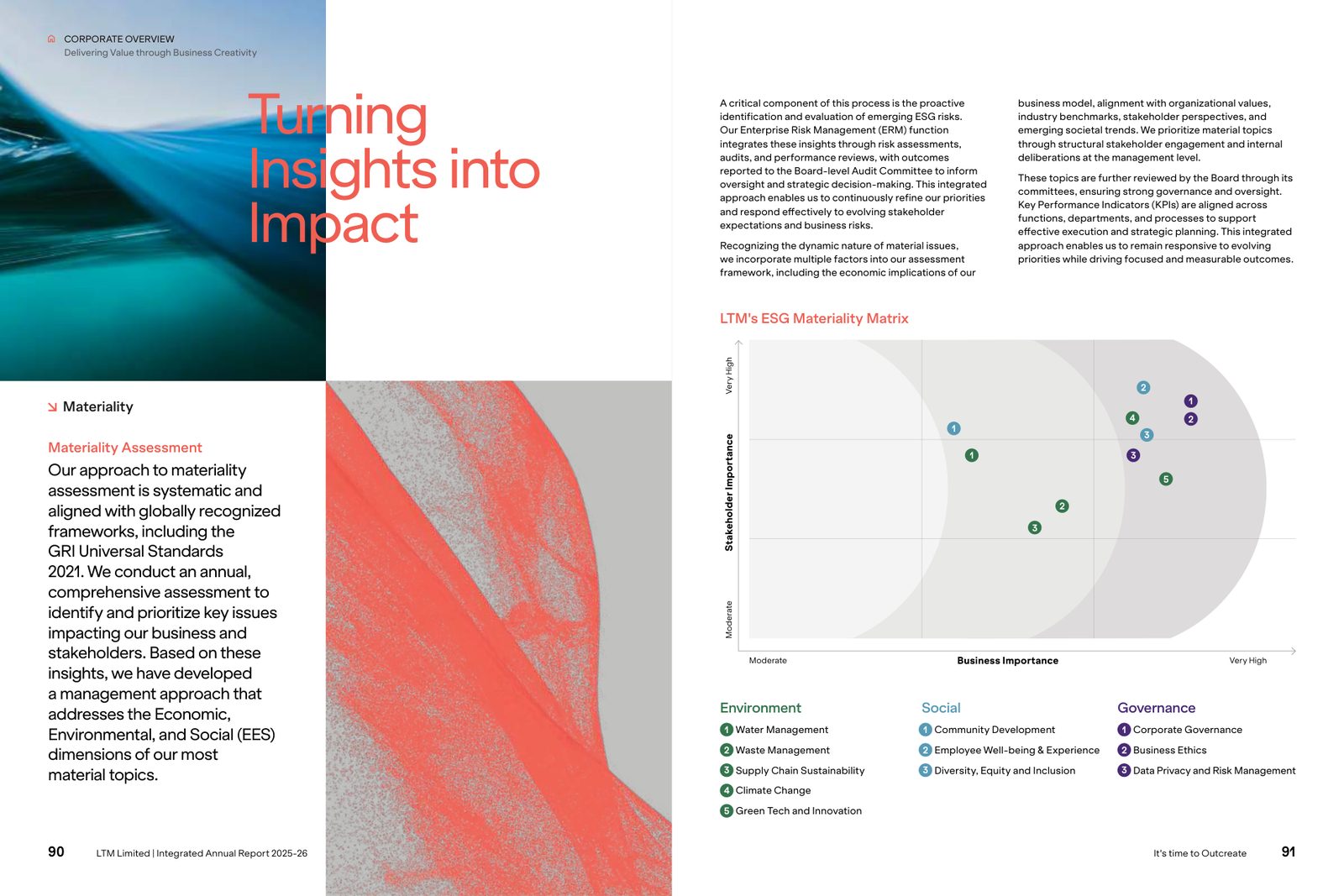
Materiality is where the report falls behind. The materiality spread (pages 90 to 91) describes an annual assessment aligned to the GRI Universal Standards 2021 and shows a matrix of eleven topics on stakeholder and business importance. There is no date, no count of stakeholders consulted, no method beyond a paragraph, and no double materiality. Nor is artificial intelligence among the topics, although the report describes the company as an "AI-centric organization" and lists AI among its principal risks on page 94. Responsible AI, data use and the effect of automation on the workforce are what readers of an IT services report most want to see assessed.
The ESG Vision and Progress spread (pages 98 to 99) is useful in form: each goal sits next to its FY26 status. Several of the status lines are candid: women are 30.87% of the workforce against a 40% goal, and 9.53% of leadership against 15% by 2030; diverse suppliers are 6.5% of spend against 10%; linking ESG to executive pay is "under review". The climate line is the problem. It reports Scope 1 and Scope 2 as per-employee reductions of 70% and 55% against an FY19 baseline. The BRSR tells a different year-on-year story: Scope 1 rose from 1,542 to 1,764 tCO2e, location-based Scope 2 from 18,239 to 33,195, and combined intensity from 0.23 to 0.42 tonnes per employee. The BRSR explains the increase as a wider boundary and better methodology, which may well be right, but the integrated section should say so, and it should show absolute emissions next to a 2040 net-zero target.
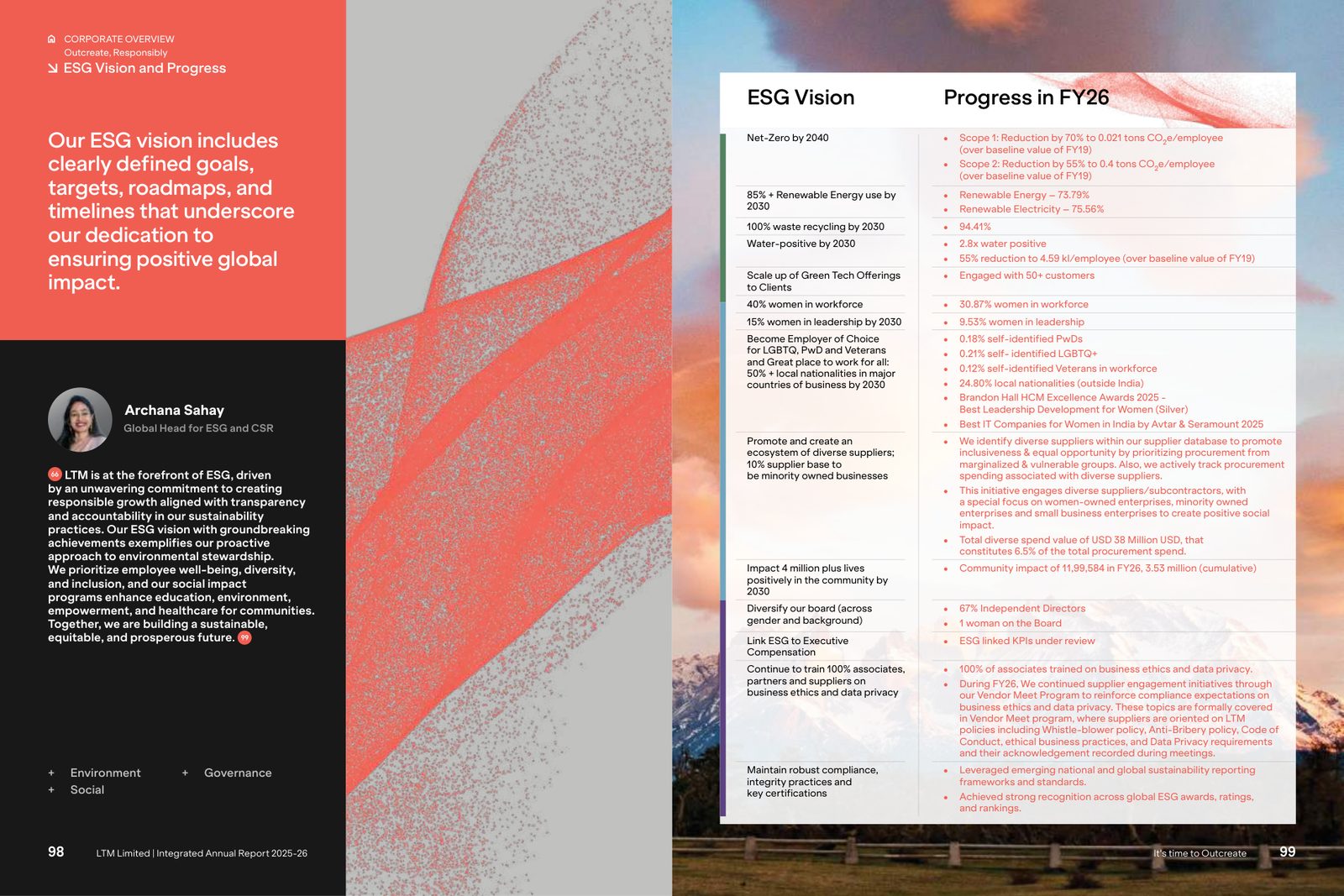
The numbers also disagree with each other. The Environment chapter's opening text on page 100 cites "94.91% waste recycling, and 39.48% renewable energy sourcing"; the panel beside it, the ESG progress page and the business model all say 94.41% and 73.79%. The same page lists the chapter's "Key Risks" as "No risks were identified", three pages after the risk chapter named ESG and environmental targets as a principal risk. BDO's assurance statement records that the company "may consider augmented processes for data management and internal verification for enhancing accuracy and completeness". The report's front half shows why.
Governance disclosure: 4/5
The Board Responsibility Statement, with its approval date, is what the Framework asks for, and it puts LTM alongside Asian Paints and Hindustan Zinc on this point. The governance chapter (pages 152 to 161) adds a Board composition graphic, age, experience and gender splits, committee memberships per director, and a skills matrix that counts how many directors are expert or proficient in each skill cluster (nine expert in strategy, five expert and four proficient in information technology). The corporate governance report is complete, and the transitions are dated: the Board had nine directors on 31 March 2026, six of them independent including one woman, and ten after Vipul Chandra joined as whole-time director on 23 April 2026. The rename itself is documented properly in the Board's report, with the dates of the brand launch, the shareholder approval and the new certificate.
The point dropped is sustainability oversight. The BRSR names the Corporate Social Responsibility Committee as the Board committee for sustainability decisions and the CEO and MD as the highest authority for the business responsibility policies. For a company with a net-zero target and an ESG risk in its principal risk list, a CSR committee is a thin home, and the Board has one woman among ten directors against a stated goal to diversify.
Financial storytelling: 4/5
The CFO's letter (pages 12 to 15) does what the rest of the front half doesn't: it gives prior-year figures in brackets and explains the lines that moved the wrong way. Revenue was USD 4.8 billion, up 5.3% in constant currency and 6.0% in dollars; order inflow USD 6.6 billion, up 10.3%. EBITDA margin rose to 17.9% (17.1%) and EBIT margin to 15.4% (14.5%), but the PAT margin fell to 11.8% (12.1%) "mainly due to a one-time provisioning impact of new labor codes". ROE slipped to 21.3% (21.5%), receivable days rose to 84 (79) "due to a buildup on account of certain large deals", and the current ratio fell to 2.8 (3.5). Operating cash conversion was 96.3%. A CFO who volunteers his receivable days is writing for investors.
The MD&A carries it through. Its summary table shows profit before exceptional items, the INR 5,281 million exceptional charge for past service costs under the new labour codes, and statutory profit, on consecutive lines, and the segment table gives revenue and results for each of five verticals, including the two whose results fell (Technology, Media & Communications, and Healthcare, Life Sciences & Public Services).
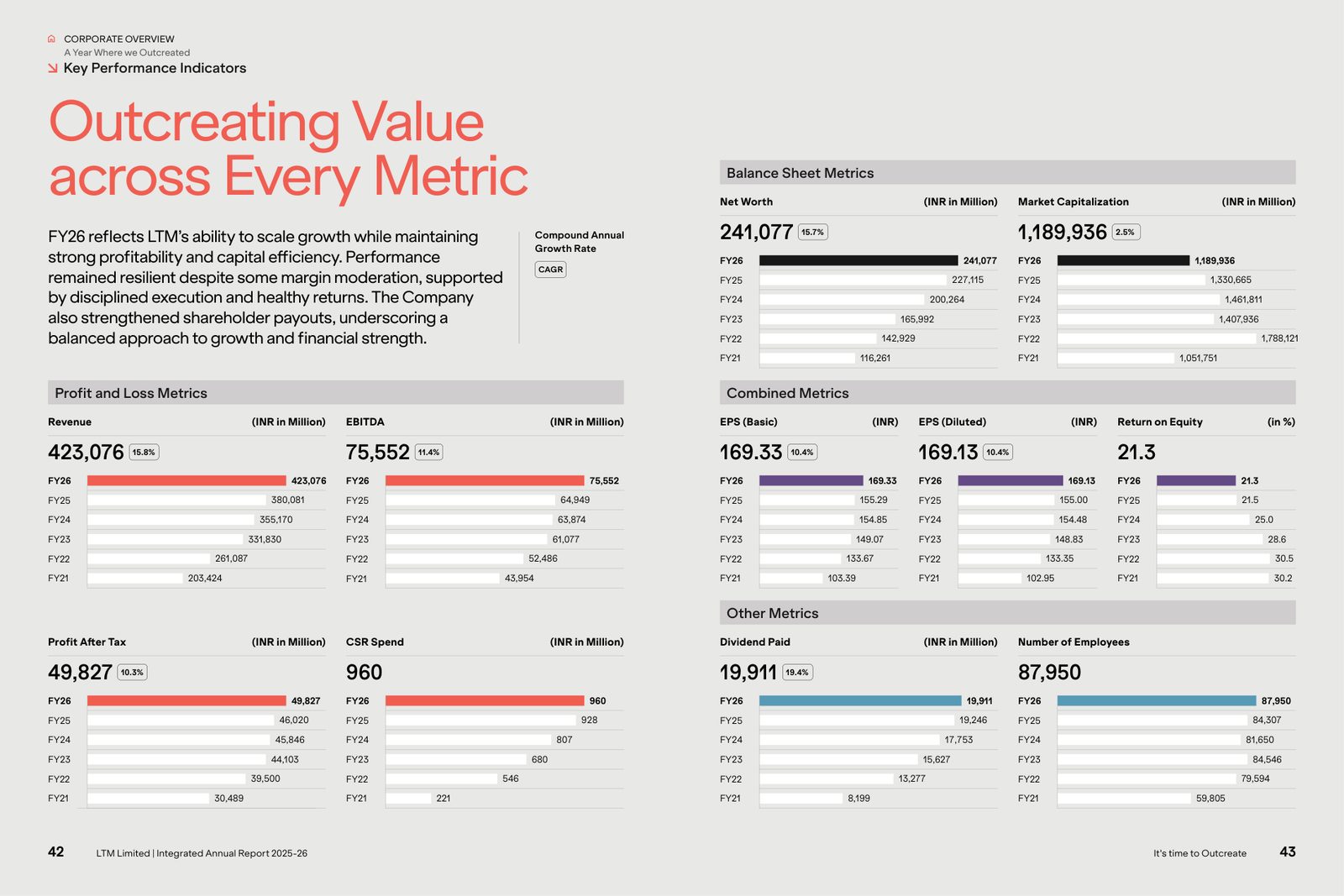
The six-year KPI spread (pages 42 to 43) is clean and complete. It shows market capitalisation of INR 1,189,936 million against 1,330,665 million a year earlier and 1,788,121 million in FY22, and ROE falling from 30.5% in FY22 to 21.3%. Printing both is honest. Commenting on neither is the missed point: the introduction to the spread talks of "healthy returns" and "strengthened shareholder payouts", and the badges beside each chart show only five-year growth rates. Infosys, which printed its market-capitalisation decline in the narrative itself, scored 5 here.
Design and readability: 3/5
The visual system is clean and consistent: a coral-and-charcoal palette, a section tab and breadcrumb on every spread, clear charts, and page-reference lozenges that link across the report. The ESG chapters mix site-level project boxes with metrics in a way that is easy to scan.
The problems are volume and finish. Ten pages of awards, twenty pages of case studies, twenty-odd of service lines and verticals, and a long MD&A section on partner tiers and partner-award photographs make a 543-page report longer than it needs to be. And on two of those MD&A pages, 172 and 184, a vertical magenta tag reading "Need high-res image" was left on the artwork and printed. The caption beside the first reads "Top Emerging Partner in Date Resiliency".
Digital version: 4/5
LTM publishes an interactive online edition of the report, reached from the investor page, with sections for the corporate overview, statutory reports and financial statements, carousels for awards and case studies, and interactive charts. The PDF's contents page points readers to it ("To read this report online, go to ltm.com/investors/annual-reports") and notes that the PDF itself has interactive elements.
It does. The PDF has 850 internal links, and the contents entries and page lozenges work. But it has no bookmarks at all, it is built as spreads (two printed pages per PDF page, 275 PDF pages in total), and the email links in the BRSR are malformed ("mailto:http://sustainability%40ltm.com"). On a phone, a spread-format PDF with no bookmarks is hard going; the online edition is the better way in.
What reporting teams can take from it
Copy the Board Responsibility Statement with its approval date. Copy the CFO's letter as a form: every ratio with its prior year in brackets, and a sentence of explanation wherever a number went the wrong way. Copy the ESG progress page's habit of putting goal and status side by side, and the six-year chart spread.
Then put the five-year target where the letters can report against it, date the materiality assessment and add the topics that define the business (for an AI company, AI), reconcile the front half's climate and energy figures to the assured BRSR before printing, move the awards to the back, and run a final check for production notes in the artwork.
Series scorecard
Every report in this series is scored on the same seven-point card by the same reader. Scores are editorial opinion of the published document; each review carries the page references behind its findings.
| Company | Score (of 35) |
|---|---|
| Hindustan Zinc | 30 |
| TCS | 29 |
| HUL | 28 |
| Bharti Airtel | 27 |
| L&T | 27 |
| Reliance | 27 |
| HDFC Bank | 26 |
| Asian Paints | 25 |
| ICICI Bank | 25 |
| Infosys | 25 |
| LTM (this review) | 25 |
| Tata Steel | 25 |
| M&M | 24 |
| Titan | 23 |
| ITC | 21 |
| Sun Pharma | 21 |
| Bajaj Finance | 20 |
| NTPC | 20 |
Frequently asked questions
Is LTM the same company as LTIMindtree?
Yes. The company changed its name from LTIMindtree Limited to LTM Limited during FY26. According to the Board's report, the new brand identity was unveiled on 11 February 2026, members approved the name change on 13 March 2026, and the Registrar of Companies issued a fresh certificate of incorporation on 17 March 2026. The company remains a Larsen & Toubro group company, and the report uses 'LTM Limited (formerly known as LTIMindtree Limited)' on its statutory pages.
What is LTM's Lakshya 31 plan?
Lakshya 31 is set out on the business model spread (pages 74 to 75). Its five points are to double revenue over five years through AI-centric growth and large deals, to become a 'Business Creativity Partner', to scale Business AI alongside the iRun and iTransform lines of business, to expand margins through AI-led productivity and the New Horizons programme, and to balance margin expansion with reinvestment.
What are LTM's climate targets and emissions?
LTM targets net zero by 2040 and 85% renewable energy by 2030, and has committed to the Science Based Targets initiative. The ESG progress page reports renewable energy at 73.79% and per-employee Scope 1 and 2 reductions against an FY19 baseline. The BRSR reports FY26 Scope 1 emissions of 1,764 tCO2e, location-based Scope 2 of 33,195 tCO2e against 18,239 in FY25, market-based Scope 2 of 9,597 tCO2e, and Scope 3 of 150,445 tCO2e, with the increases attributed to a wider boundary and more complete Scope 3 categories.
Who assures LTM's BRSR?
BDO India Services Private Limited provides reasonable assurance on BRSR Core and select non-core indicators, and limited assurance on other non-core indicators. Its statement observes that the company may consider augmented processes for data management and internal verification to improve accuracy and completeness.
What were LTM's FY26 results?
Consolidated revenue was INR 423,076 million, up 11.3% (USD 4.8 billion, up 6.0% in dollars and 5.3% in constant currency). EBITDA margin was 17.9% and EBIT margin 15.4%. Profit after tax was INR 49,827 million, up 8.3%, with the PAT margin down to 11.8% after a one-time charge of INR 5,281 million for India's new labour codes. ROE was 21.3%, diluted EPS INR 169.13, order inflow USD 6.6 billion, and dividends paid INR 19,911 million.
How does The Footnotes score annual reports?
Seven criteria, each scored 1 to 5 with a one-line reason: strategy and narrative; integrated thinking and capitals; BRSR and ESG integration; governance disclosure; financial storytelling; design and readability; and the digital version. Scores are editorial opinion based on the published document, and the same card is used for every company so results can be compared.
Sources
- LTM: Investors, annual reports — LTM Limited
- LTM: Integrated Annual Report FY26 (interactive edition) — LTM Limited
- LACP 2024/25 Vision Awards: Worldwide Top 100 — League of American Communications Professionals
- SEBI circular: BRSR Core, framework for assurance and ESG disclosures for value chain (12 July 2023) — SEBI