

Titan Annual Report 2025-26: A Review
Titan's 42nd annual report, its ninth year of integrated reporting, has a value creation model with numbers for every capital, a double materiality matrix drawn up under ESRS guidance and KPMG reasonable assurance on BRSR Core. It also scopes the integrated report to the standalone company in the year it bought Damas, has no letter from the Chair in a year the Chair changed twice, and says Scope 3 emissions are not tracked at all.
 In short
Key takeaways
- The report runs to 468 printed pages in three parts (Corporate Overview, pp. 1-105; Statutory Reports, pp. 106-266; Financial Statements, pp. 267-468). The company calls FY 2025-26 the ninth year of its integrated reporting, but the scope of the integrated report is limited to Titan Company Limited as a standalone entity.
- The value creation model (pp. 62-63) lists inputs, outputs and outcomes by capital with figures: 3,603 stores, 30% women in the workforce, ₹90 crore of CSR spend, 25,059 tCO2e of Scope 1 and 2 emissions, 16.65 tonnes of recycled gold in the Jewellery division and net promoter scores by brand.
- Materiality comes from a double materiality assessment first conducted in FY 2023-24 by a third party following ESRS guidance, with 17 topics on a matrix and seven critical topics feeding Pragati, the ESG strategy launched in July 2025.
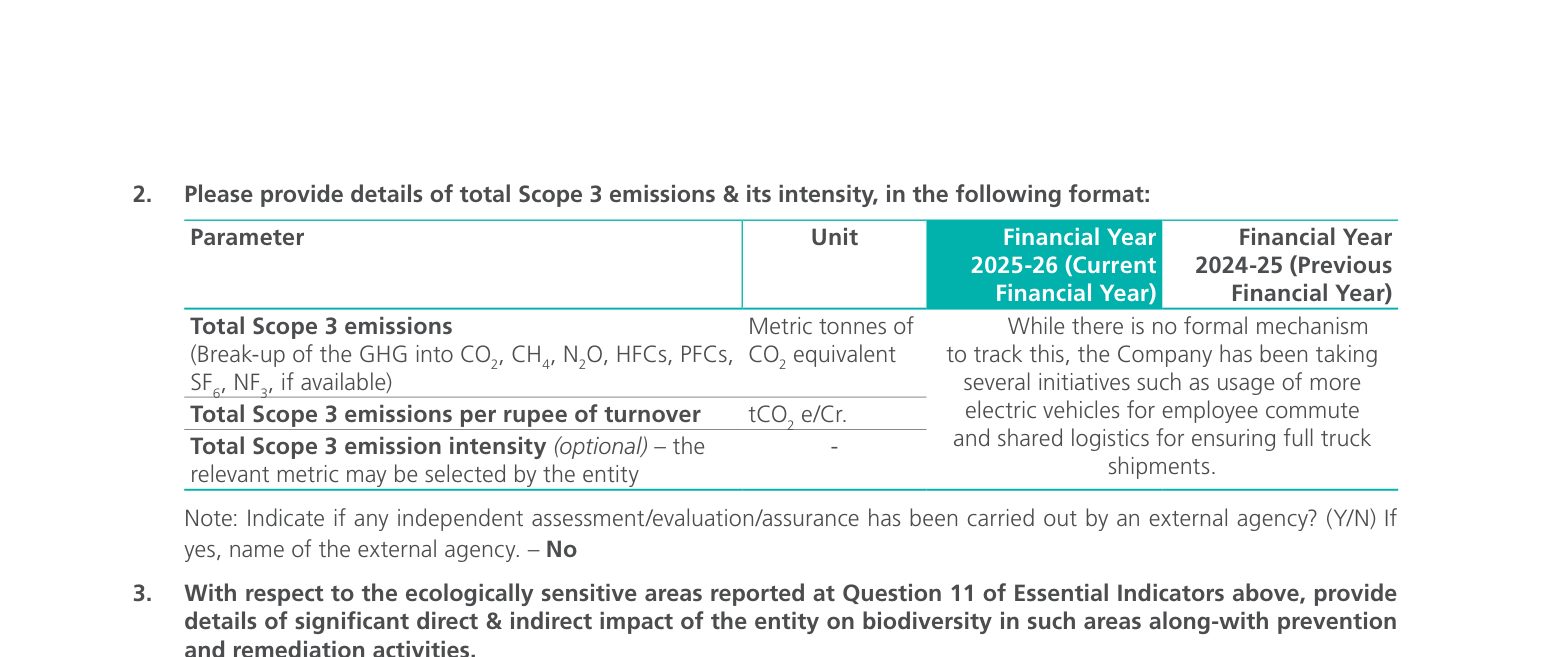
- Scope 1 and 2 emissions fell 17% to 25,059 tCO2e against a 2029-30 operational net zero goal. The BRSR says there is 'no formal mechanism' to track Scope 3 emissions, for a company whose jewellery business is 91.52% of standalone turnover.
- Standalone total income was ₹78,089 crore and profit after tax ₹4,630 crore (up 39%); consolidated revenue was ₹87,584 crore and profit ₹5,073 crore. The Damas acquisition (67% for ₹1,191 crore, plus a ₹1,668 crore put option liability) is explained in full only in the notes to the consolidated accounts.
- C K Venkataraman retired as Managing Director on 31 December 2025 and Ajoy Chawla succeeded him. The Chair passed from Arun Roy to Sandhya Sharma on 4 January 2026 and to Dr S Vijayakumar on 29 June 2026. There is no Chair's letter, and the report does not explain Ms Sharma's departure.
Titan crossed ₹75,000 crore of revenue in FY 2025-26, bought a 67% stake in the Gulf jeweller Damas, launched a lab-grown diamond brand, changed its Managing Director and, over six months, changed its Chair twice. Its 42nd annual report, themed "Fuelled by Ideas. Scaling Frontiers.", tells the first half of that story with confidence and the second half almost entirely in the statutory pages. It is a good-looking, well-navigated document whose integrated section has the right parts in the right order. What it lacks is the connective tissue that would make those parts explain the year.
As with every review in this series, we read the published PDF against the <IR> Framework, SEBI's BRSR Core expectations and plain readability, and score it on the same seven-point card. Scores are our opinion. Screenshots are small excerpts reproduced for review and remain the copyright of Titan Company Limited; the full report is on the company's investor pages.
The scorecard
| Criterion | Score (of 5) | In one line |
|---|---|---|
| Strategy and narrative | 3 | A candid MD's letter and strong business-segment chapters; no Chair's letter and no strategy page |
| Integrated thinking and the capitals | 3 | A value creation model with numbers for every capital and Pragati goals on each chapter; standalone scope and a financial capital chapter with no figures |
| BRSR and ESG integration | 3 | ESRS-guided double materiality, Scope 1 and 2 down 17%, KPMG reasonable assurance; Scope 3 untracked and a matrix now two years old |
| Governance disclosure | 3 | Statutory disclosure complete and the late board change addended; three Chairs in a year and a board page that leaves out the Chair who signed the Board's report |
| Financial storytelling | 3 | Segment tables, a ratio page and five-year statistics; highlights mix standalone and consolidated, and Damas is explained only in the notes |
| Design and readability | 4 | One clean visual system, 468 pages, awards at the back; a 14-page stories section and a dense value creation spread |
| Digital version | 4 | Full bookmark tree, hyperlinked contents and a navigation bar on alternate pages; no online edition |
| Total | 23 / 35 |
What the report is
The report is 468 printed pages in three parts: Corporate Overview (pp. 1-105), Statutory Reports (pp. 106-266) and Financial Statements (pp. 267-468). The Corporate Overview opens with the theme, an "About Titan" section, key highlights, the Managing Director's letter, key events and seven "Stories of Ideas in Action". Six business-segment chapters follow (Jewellery, Watches, EyeCare, Fragrances & Women's Bags, Indian Dress Wear and the engineering subsidiary TEAL), then the integrated section: Approach to Reporting, Materiality Assessment, the Value Creation Model and six capital chapters, followed by awards and board profiles. The BRSR sits inside the statutory section from page 215, with KPMG's assurance statement at the end.
The "Approach to Reporting" page (p. 56) says this is the ninth year of the company's integrated reporting and that disclosure beyond the statutory minimum is voluntary. Its most consequential sentence is short: "The scope of this IR is limited to Titan Company Limited as a standalone entity." In a year when the consolidated group added Damas, CaratLane and a growing international jewellery business, that boundary leaves a lot outside the integrated story. The page does not name the <IR> Framework; the only reference we found is in the Board's report (p. 123), which says the narrative disclosures "are guided by the principles of the Integrated Reporting Framework". There is no statement of responsibility for the integrated report from the Board.
Key number: 91.52% — the share of standalone turnover that comes from jewellery, according to the BRSR (p. 215). It frames every ESG question the report does and does not answer.
Strategy and narrative: 3/5
Ajoy Chawla's first letter as Managing Director (pp. 12-13) is better than most. It names the year's pressures without euphemism: US tariffs that "peaked in August 2025", gold price volatility that created "significant uncertainty amongst jewellery consumers", Jewellery and EyeCare growth that fluctuated by quarter, and "some headwinds due to the Middle East War" in the near term. It then gives the product, retail and brand initiatives behind the growth, including omni-channel sales of about ₹15,000 crore, up more than 50%. It is a letter written by someone who ran the jewellery business, and it reads that way.
The business-segment chapters are the report's strongest narrative pages. Each gives total income, EBIT and margin before exceptional items, then the year's retail, product and manufacturing moves: Jewellery at ₹67,602 crore of consolidated income excluding bullion (up 34%), Watches at ₹5,267 crore with EBIT up 50.4%, EyeCare at ₹916 crore with EBIT down 3.8%. The EyeCare figure is printed as plainly as the good ones.
What is missing is a strategy page. The report has a vision, a mission, values, a theme and seven stories, but no statement of strategic priorities that the letters and segment chapters report against. Pragati, the ESG strategy, is the only strategy the integrated section names. There is also no letter from the Chair, which matters more than usual this year (see Governance). The 14-page "Stories of Ideas in Action" section, from handbag beadwork to lake restoration, is well written and could sit in a brand book; it pushes the integrated section back to page 56.
Integrated thinking and the capitals: 3/5
The Value Creation Model spread (pp. 62-63) is the best page in the report and a good example of the form. Inputs on the left, by capital and with units: 40 top managers, 3,161 manufacturing employees and 5,032 in sales and retail; 30% women in the workforce; training spend per person; 3,603 showrooms and 45,97,118 sq. ft. of retail space; 16.65 tonnes of gold and 1.87 tonnes of silver recycled by the Jewellery division; energy and fresh water by division. The centre shows vision, mission and value creation approach across stakeholders and businesses. Outputs and outcomes on the right: 9.1% attrition, ₹90 crore of CSR reaching 9,88,870 beneficiaries, warranty complaint rates and net promoter scores by brand, specific energy and water per product, 25,059 tCO2e of Scope 1 and 2 emissions, ₹12.99 crore of R&D and seven patents granted.
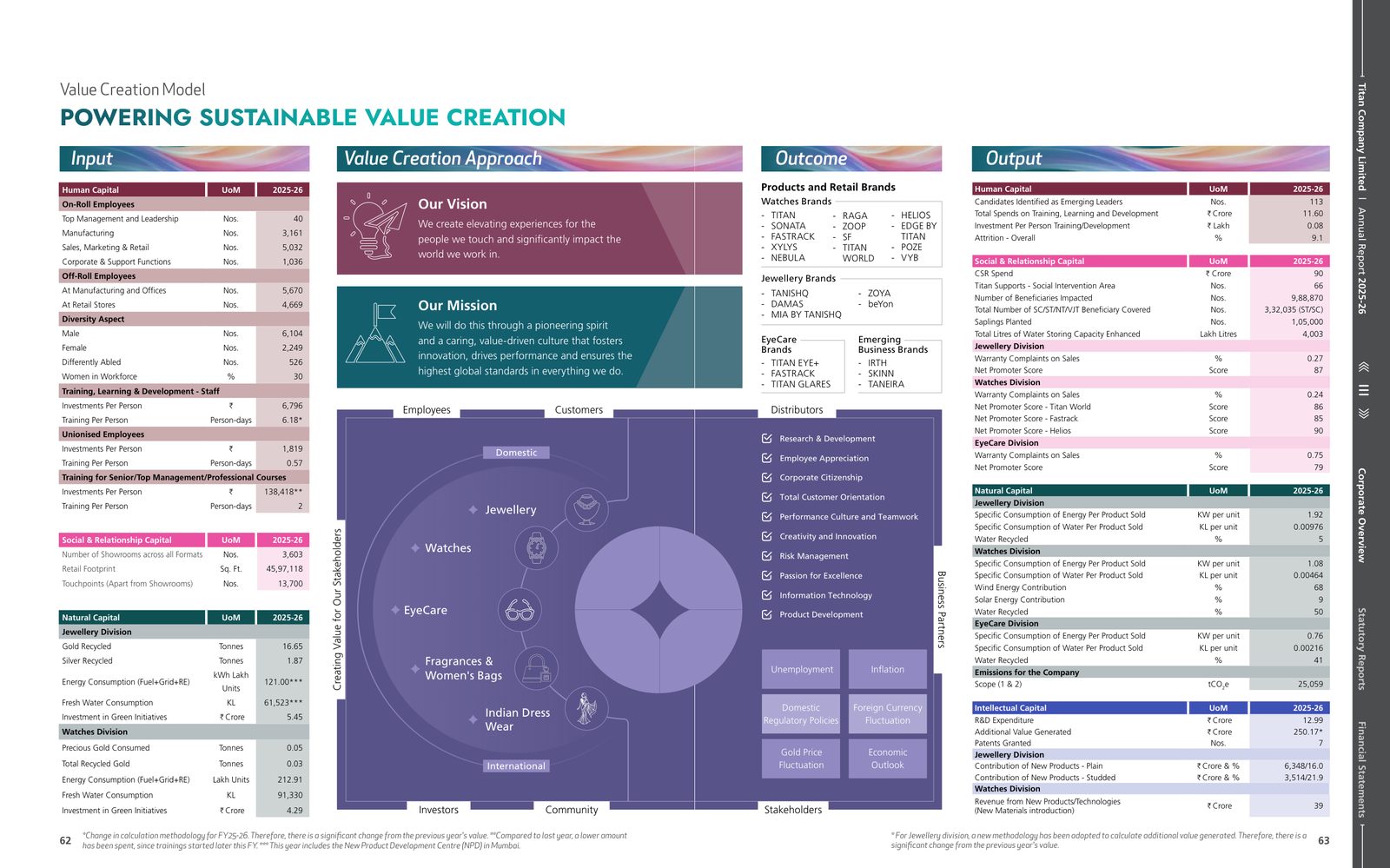
The footnotes are honest too: two figures carry notes that the calculation method changed this year, "therefore, there is a significant change from the previous year's value". The trouble is that there is no previous-year column on the spread for the reader to see the change. Every number is 2025-26 only.
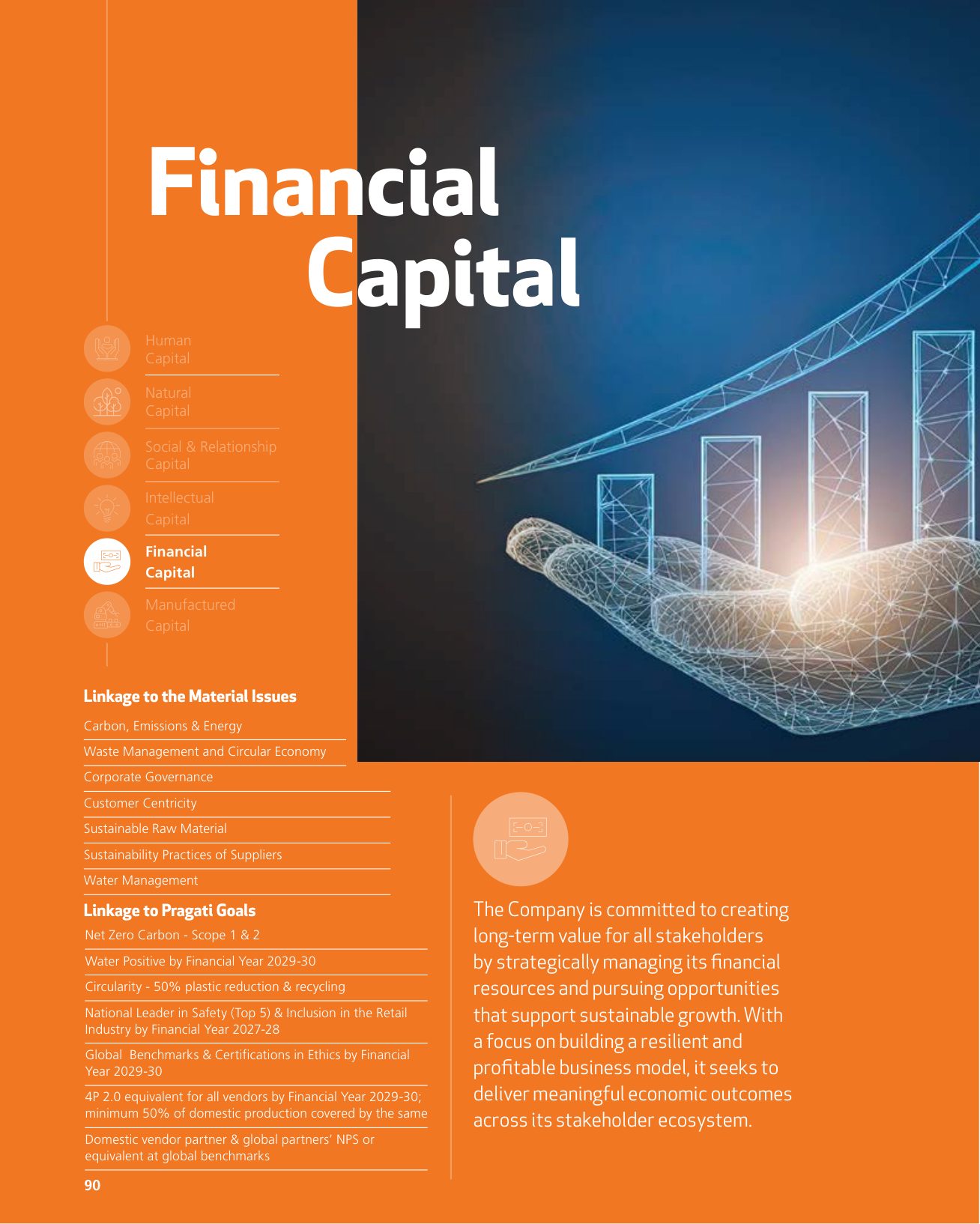
Each capital chapter then opens with the same scaffolding: linked material issues, linked Pragati goals and linked SDGs, and closes with an "Interlinkage with other capitals" paragraph. The scaffolding is right; the interlinkage paragraphs are generic ("will positively impact both the Company's Financial Capital as well as other capitals"). The Financial Capital chapter (pp. 90-91) is the weak point: two pages of material-issue links, Pragati goals and prose about cash-flow discipline, with no revenue, profit, return on capital or cash figure anywhere. For a company that grew standalone revenue 41%, that is a strange page to leave empty.
BRSR and ESG integration: 3/5
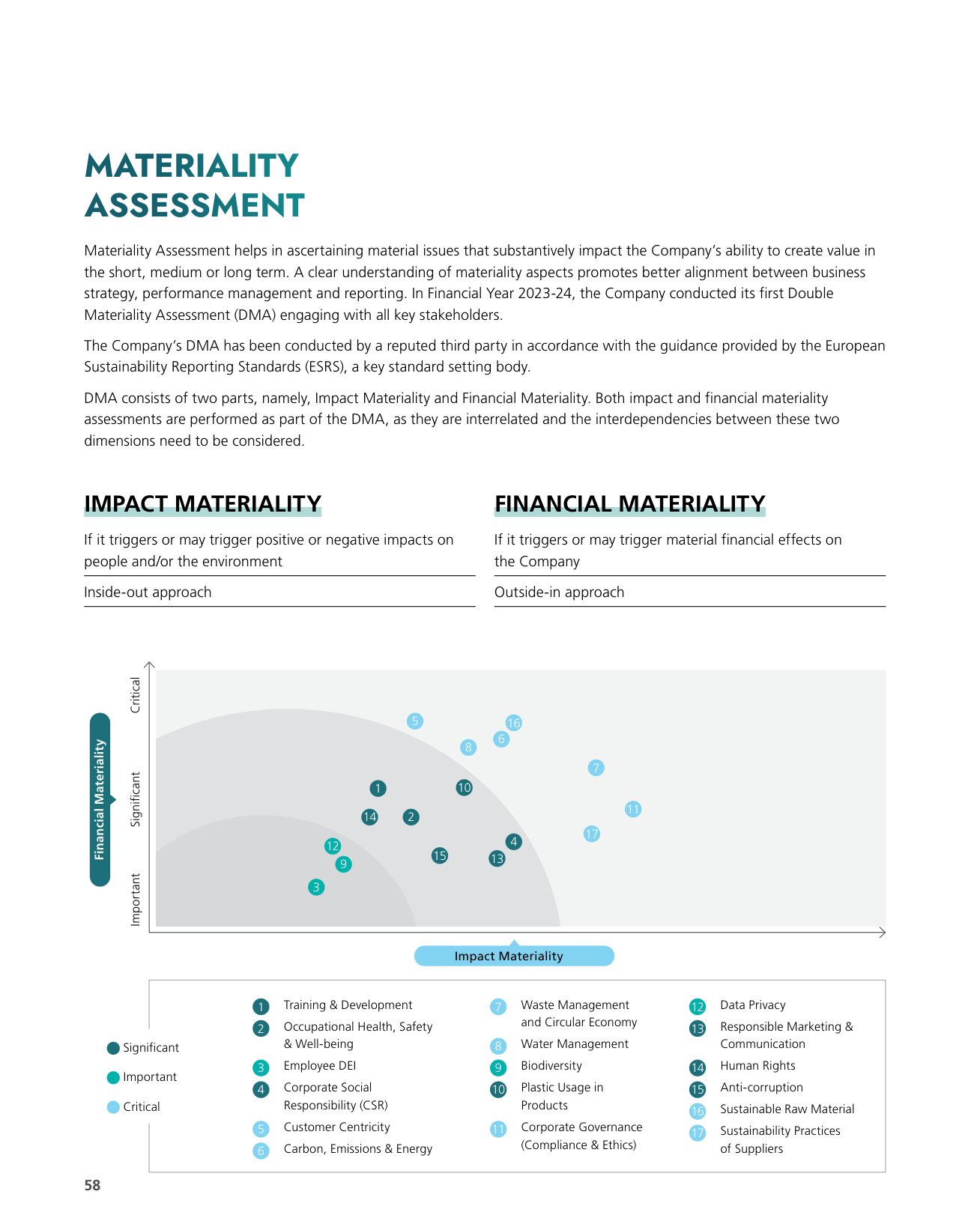
Materiality is better than average in method and weaker in currency. The double materiality assessment was "conducted by a reputed third party in accordance with the guidance provided by the European Sustainability Reporting Standards" (p. 58), covered impact and financial materiality, engaged seven stakeholder groups from investors to NGOs and franchisees, and plotted 17 topics on a matrix of critical, significant and important. Seven critical topics became the base of Pragati, launched in July 2025. But the assessment dates from FY 2023-24, the matrix has no scoring or thresholds, and the report does not say when it will be refreshed.
Pragati's entity-level targets are operational net zero for Scope 1 and 2 and water positive status, both by FY 2029-30, and a 50% reduction and recycling of plastics (BRSR, p. 224). The Natural Capital chapter reports Scope 1 and 2 at 25,059 tCO2e, 17% lower than FY 2024-25, with 19,048 tCO2e avoided through renewable energy, efficiency and sequestration, about 910 kW of new rooftop solar, and "80% and 88% emissions offset" in the Watches and Jewellery divisions. The BRSR supports the headline: Scope 1 of 3,878 tCO2e and Scope 2 of 21,181 tCO2e, against 3,952 and 26,326 the year before.
Water is where the reader needs to look twice. The chapter says the company achieved "Water-Positive status" in FY 2025-26 with a net water ratio of 1.65 against a target of 1.17, four years ahead of the Pragati date (p. 72). The same page says that of 54.43 crore litres of water augmentation, 40.03 crore litres came from CSR-led community water projects. Restoring lakes is valuable work, but a water-positive claim that rests mostly on community projects outside the fence should say so on the goals page, not three paragraphs later.
Then there is Scope 3. The BRSR's answer (p. 252) is that "there is no formal mechanism to track this", with a note on electric vehicles for employee commutes. For a company whose purchased gold, diamonds and outsourced manufacturing are almost certainly the largest part of its footprint, that is the most important gap in the report. It is also not flagged anywhere in the integrated section.
Assurance is the strength. KPMG Assurance and Consulting Services LLP gives reasonable assurance on BRSR Core attributes under ISAE 3000 (Revised), and its appendix lists each indicator covered. The BRSR's boundary note is also candid: it excludes 42 outsourced factories and 2,583 franchised stores as not material (p. 215). The supply-chain work on the 4P vendor framework, with audits of 55 jewellery vendors, is real and specific, and it is the natural starting point for a Scope 3 inventory.
Governance disclosure: 3/5
The statutory governance disclosure is complete: board composition by nominee group (TIDCO, Tata Group and independent directors), eight Board meetings with dates, attendance, skills and remuneration. The Ethics pages in the integrated section (pp. 81-83) are good, covering the Tata Code of Conduct programme, the third-party ethics helpline for vendors and the Board Ethics Committee. The company also added an "Additional information" page to the Board's report (p. 135) when TIDCO withdrew Arun Roy's nomination on 22 June 2026, correcting which director retires by rotation. That is careful practice.
The narrative, though, does not keep up with the year. C K Venkataraman retired as Managing Director on 31 December 2025 under the Tata Group retirement policy and Ajoy Chawla succeeded him. Arun Roy was Chairman until 4 January 2026, when TIDCO's nominee Sandhya Sharma became Chairperson; she signed the Board's report on 8 May 2026. On 29 June 2026 TIDCO's nominee Dr S Vijayakumar was appointed Chairman. The board profiles (pp. 100-104), dated 29 June 2026, open with Dr Vijayakumar and do not include Ms Sharma or Mariam Pallavi Baldev, and we could not find a sentence explaining Ms Sharma's departure. The committee list on page 105 also differs from the Corporate Governance Report, which lists Ms Baldev on the Audit Committee "as on date of the Report" (p. 185). Three Chairs, a new Managing Director and the Audit Committee chair's exit in May 2026 deserve a page in the front half, ideally from the Chair.
Financial storytelling: 3/5
The numbers are all there. The Board's report (p. 121) sets standalone and consolidated results side by side: standalone revenue from operations ₹77,554 crore (up 41%), profit before tax and exceptional items ₹6,287 crore (up 40%), profit after tax ₹4,630 crore (up 39%); consolidated revenue ₹87,584 crore and profit ₹5,073 crore. The ₹89 crore exceptional charge for the new Labour Codes is explained in the notes. The MD&A gives segment revenue, results and net assets, a three-year ratio table with explanations for every ratio that moved more than 25% (p. 170), and an outlook that names the West Asia conflict. Five-year financial statistics close the book (pp. 467-468).
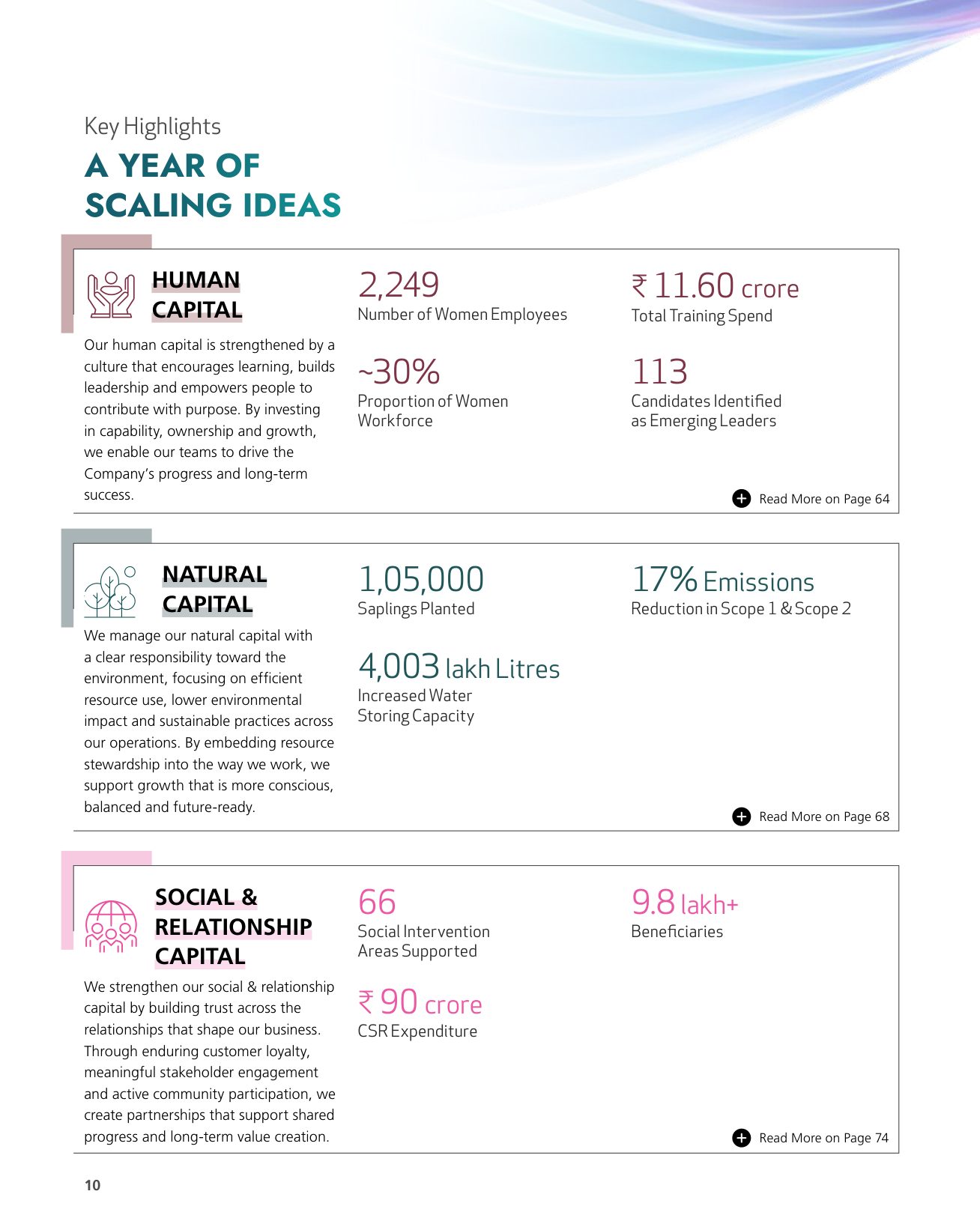
The storytelling is where points go. The highlights spread (pp. 10-11) is standalone; the MD's letter prints "₹5,073 crore Profit After Tax", the consolidated figure, without saying so; the MD&A opens with "₹76,000+ crore (excluding bullion sales) in consolidated revenues". A reader meets three bases in the first 150 pages. The Damas acquisition is a front-half "key event" and a strategic theme of the MD's letter, but its price is in note 40 to the consolidated accounts (pp. 461-462): ₹1,191 crore for 67%, a put option liability of ₹1,668 crore for the rest, total purchase consideration of ₹2,859 crore, and a ₹41 crore loss before tax since acquisition. The five-year balance sheet shows standalone inventory up from ₹24,517 crore to ₹34,980 crore and gold on loan roughly doubling to ₹14,314 crore; the front half, where gold price risk is the year's main theme, does not connect the two.
Design and readability: 4/5
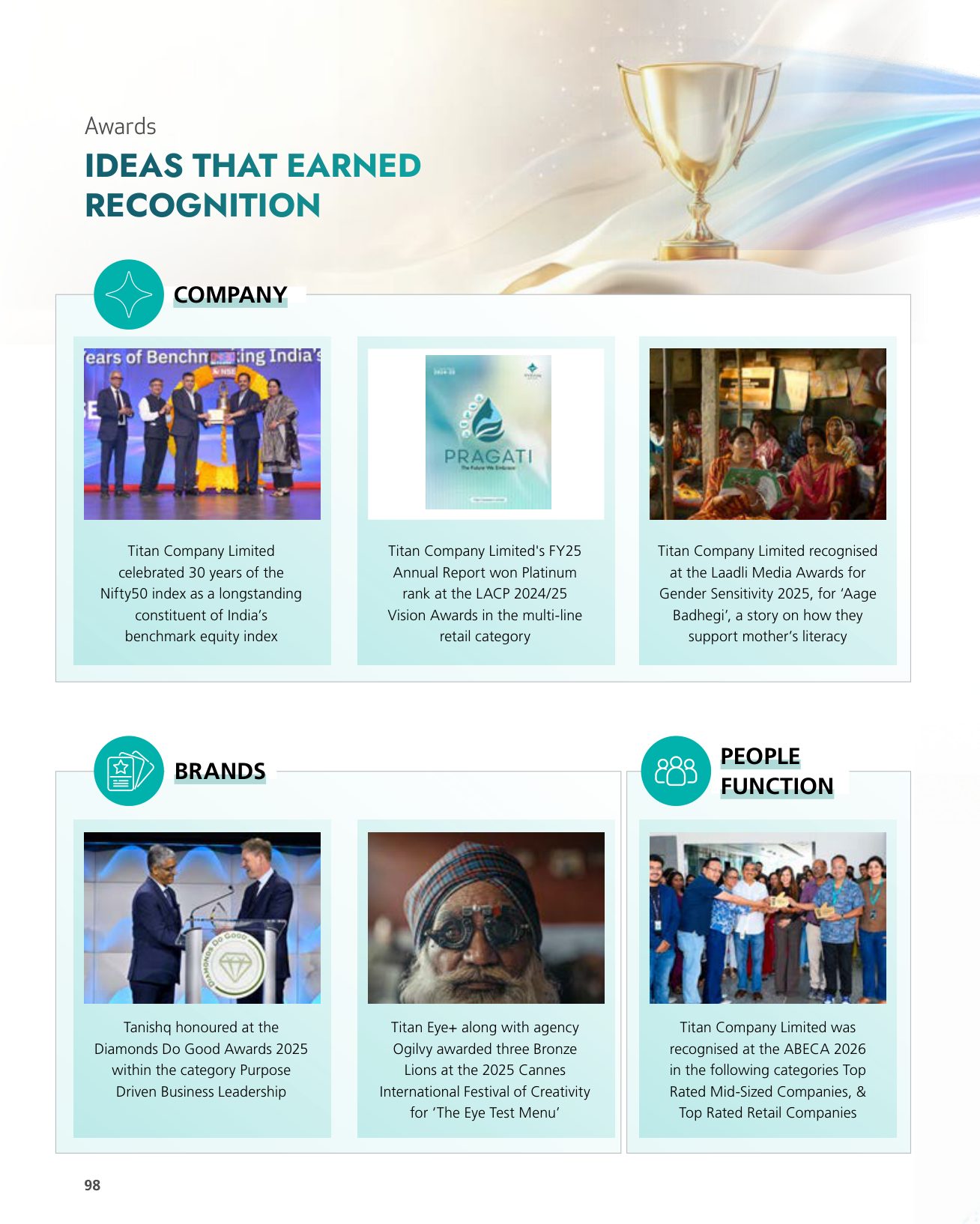
The design is clean and consistent: one palette and type system across the theme pages, the segment chapters and the capital chapters, a coloured capital index down the margin of each chapter opener, and "Read more on page" links from the highlights. At 468 pages it is shorter than most integrated reports in the series. Awards sit where they belong, at the back of the Corporate Overview (pp. 98-99), among them the previous report's Platinum award in its category at LACP's 2024/25 Vision Awards; LACP's own worldwide Top 100 for that year ranks the FY 2024-25 report 23rd. The point dropped is density: the value creation spread sets dozens of small figures in narrow tables, and the stories section delays the integrated content.
Digital version: 4/5
The PDF is well built for screens. It is laid out as single pages, has a full three-level bookmark tree, a hyperlinked contents page and nearly 2,000 links, including a navigation bar on every right-hand page with links to contents, the three parts and the previous and next page. Board's report references ("click here") link out to policies. The text layer is clean throughout.
There is no online or HTML edition. The investor page lists the report only as a PDF, and the one QR code in the report, on the inside cover, leads to the brands page on the company website rather than to the report. The navigation bar also appears only on alternate pages, so on a phone the reader finds it half the time.
What reporting teams can take from it
Copy the value creation model, and add a prior-year column so the method-change footnotes mean something. Copy the capital chapter openers that link each capital to material issues, goals and SDGs. Copy the Board's report addendum, which fixed a late change in plain words instead of leaving a contradiction in print.
Then widen the integrated report to the consolidated group, put a Chair's letter in front when the board changes, give the Financial Capital chapter its numbers, label every headline figure as standalone or consolidated, split the water-positive claim into operations and community projects, and start counting Scope 3 with the gold.
Series scorecard
Every report in this series is scored on the same seven-point card by the same reader. Scores are editorial opinion of the published document; each review carries the page references behind its findings.
| Company | Score (of 35) |
|---|---|
| Hindustan Zinc | 30 |
| TCS | 29 |
| HUL | 28 |
| Bharti Airtel | 27 |
| L&T | 27 |
| Reliance | 27 |
| HDFC Bank | 26 |
| Asian Paints | 25 |
| ICICI Bank | 25 |
| Infosys | 25 |
| LTM | 25 |
| Tata Steel | 25 |
| M&M | 24 |
| Titan (this review) | 23 |
| ITC | 21 |
| Sun Pharma | 21 |
| Bajaj Finance | 20 |
| NTPC | 20 |
Frequently asked questions
Is Titan's annual report an integrated report?
Partly. The Corporate Overview contains an integrated section (Approach to Reporting, Materiality Assessment, a Value Creation Model and six capital chapters, pp. 56-97), and the company describes FY 2025-26 as the ninth year of its integrated reporting. The Board's report says the narrative disclosures are guided by the principles of the Integrated Reporting Framework. The integrated section is limited to the standalone company, and the PDF is titled simply '42nd Annual Report 2025-26'.
How does Titan assess materiality?
Through a double materiality assessment first conducted in FY 2023-24 by a third party, following guidance in the European Sustainability Reporting Standards. It covered impact and financial materiality, engaged stakeholders from senior management and investors to suppliers, franchisees, customers, government bodies and NGOs, and plotted 17 topics on a matrix. Seven critical topics form the foundation of Pragati, the ESG strategy launched in July 2025.
What are Titan's climate and water targets?
Pragati sets operational net zero (Scope 1 and 2) and water positive status by FY 2029-30, and a 50% reduction and recycling of plastics. In FY 2025-26 Scope 1 and 2 emissions were 25,059 tCO2e, 17% lower than the previous year. The report says the company achieved water-positive status in the year with a net water ratio of 1.65, and that 40.03 crore of the 54.43 crore litres of water augmentation came from CSR-led community projects. Scope 3 emissions are not tracked.
Who assures Titan's BRSR?
KPMG Assurance and Consulting Services LLP provides reasonable assurance on BRSR Core attributes under ISAE 3000 (Revised), as stated in Section A of the BRSR. B S R & Co. LLP audits the financial statements.
What were Titan's FY 2025-26 results?
On a standalone basis, total income of ₹78,089 crore, revenue from operations of ₹77,554 crore (up 41%), profit before tax and exceptional items of ₹6,287 crore (up 40%) and profit after tax of ₹4,630 crore (up 39%), after an ₹89 crore exceptional charge for the new Labour Codes. Consolidated revenue was ₹87,584 crore and profit ₹5,073 crore. The Board recommended a dividend of ₹15 per share.
How does The Footnotes score annual reports?
Seven criteria, each scored 1 to 5 with a one-line reason: strategy and narrative; integrated thinking and capitals; BRSR and ESG integration; governance disclosure; financial storytelling; design and readability; and the digital version. Scores are editorial opinion based on the published document, and the same card is used for every company so results can be compared.
Sources
- Titan Company: Investors: annual reports — Titan Company Limited
- Titan Company: Annual Report 2025-26 (PDF) — Titan Company Limited
- LACP 2024/25 Vision Awards: Worldwide Top 100 — LACP
- SEBI circular: BRSR Core, framework for assurance and ESG disclosures for value chain (12 July 2023) — SEBI