

Sun Pharma Annual Report 2025-26: A Review
Sun Pharma's Annual Report 2025-26 is a conventional statutory report, not an integrated one: a 16-page corporate overview, a ten-year table, a well-organised governance report and a BRSR with DNV reasonable assurance. The US FDA's OAI classifications at Halol and Baska, a US$200 million settlement involving Taro and a 38% fall in standalone profit are all disclosed, but only in the BRSR and the notes to the accounts.
 In short
Key takeaways
- The report runs to 340 numbered pages: a Corporate Overview (pp. 2 to 17), Management Discussion and Analysis (pp. 18 to 45), the Board's Report, Corporate Governance Report and BRSR (pp. 46 to 145), standalone and consolidated financial statements (pp. 146 to 327) and the AGM notice. It does not cite the <IR> Framework and has no capitals or value creation model.
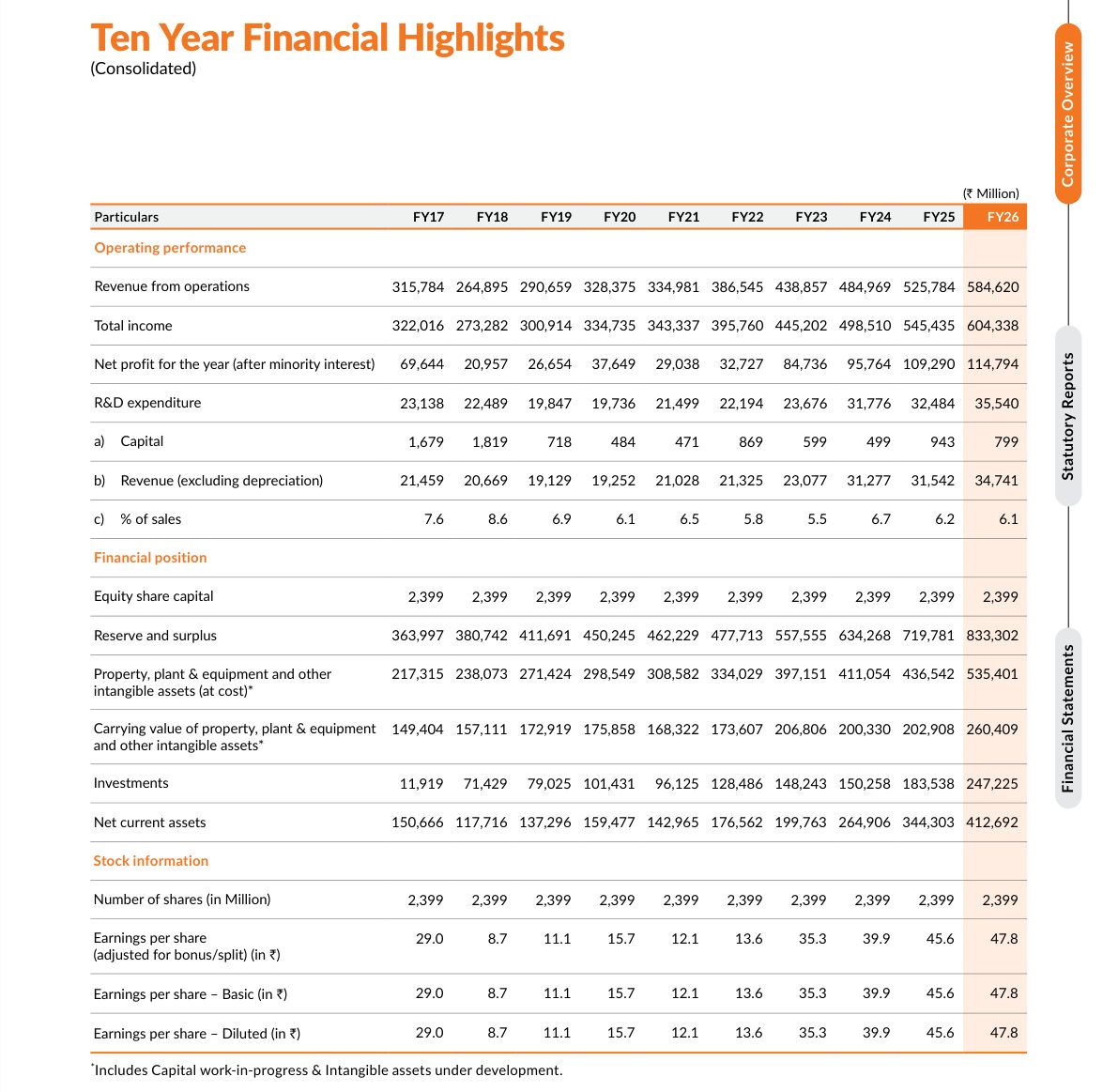
- Consolidated revenue from operations rose 11.2% to ₹584.6 billion, EBITDA 16.1% to ₹177.3 billion and net profit after minority interest 5.0% to ₹114.8 billion. Innovative Medicines reached 22% of sales and, for the first time, a larger share of US sales than US generics. The dividend was unchanged at ₹16 a share.
- Standalone revenue fell from ₹229.8 billion to ₹207.5 billion and standalone profit after tax from ₹42.3 billion to ₹26.2 billion. The only explanation in the report is a line in the ratio table on p. 33.
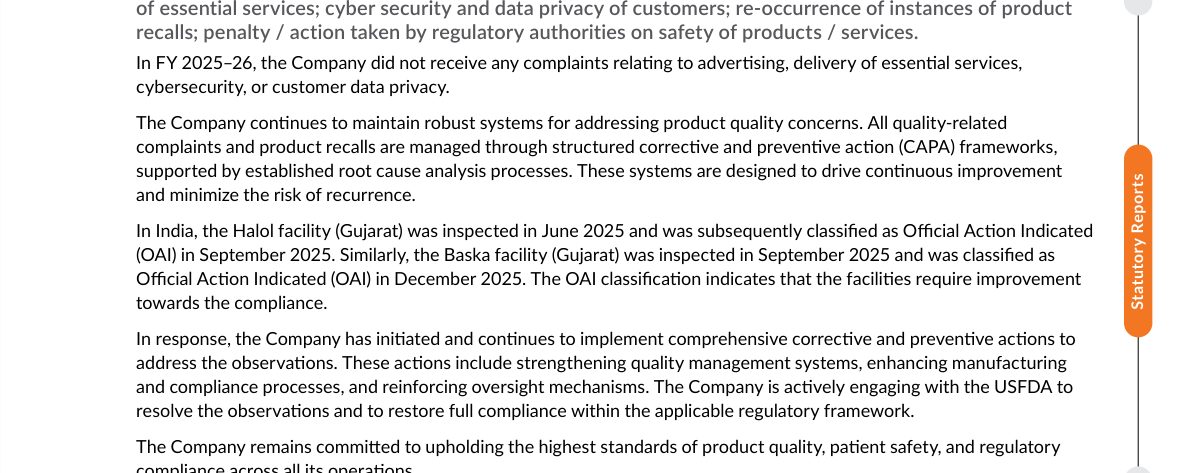
- The US FDA classified Halol (inspected June 2025) and Baska (inspected September 2025) as Official Action Indicated. The Managing Director refers to 'compliance-related constraints at certain of our facilities'; the sites are named only in the BRSR (p. 141) and the notes to the accounts.
- Exceptional items of ₹13,074.8 million include the discontinuation of SCD-044, additional charges on a US$200 million settlement by Taro and a US subsidiary with end-payer plaintiffs in the US, and ₹3,755.3 million for India's new labour codes. The KPI page leads with adjusted net profit, which excludes them.
- The BRSR (pp. 104 to 145) has reasonable assurance on BRSR Core from DNV Business Assurance India. Scope 1 and 2 emissions are 16.7% below the 2020 baseline against a 35% target for FY 2029-30, and renewable energy is 52.55% of the total. Materiality dates from FY 2020-21, Scope 3 is not disclosed, and Scope 1 more than halved on a footnoted 'change in the reporting boundary'.
Sun Pharma had a year it could describe with confidence. Consolidated sales grew by double digits, Innovative Medicines overtook US generics in the US business for the first time, the company kept its place as India's largest drugmaker, and weeks after the year closed it agreed to buy Organon for an enterprise value of US$11.75 billion. It also had two more Indian plants classified Official Action Indicated by the US FDA, settled a US lawsuit involving Taro, and changed its Managing Director. The Annual Report 2025-26, themed "Advancing Innovation Globally for Better Patient Care", tells the first set of facts up front and leaves the second to the statutory pages.
As with every review in this series, we read the published PDF against the <IR> Framework, SEBI's BRSR Core expectations and plain readability, and score it on the same seven-point card. Scores are our opinion. Screenshots are small excerpts reproduced for review and remain the copyright of Sun Pharmaceutical Industries Limited; the full report, the BRSR and section-wise PDFs are on the company's investor pages.

The scorecard
| Criterion | Score (of 5) | In one line |
|---|---|---|
| Strategy and narrative | 3 | Two letters with real numbers and a clear Innovative Medicines story; the FDA findings and the settlement are left to the back half |
| Integrated thinking and the capitals | 1 | No framework, no capitals, and a 'business model' that lists segments and strategy bullets |
| BRSR and ESG integration | 3 | BRSR inside with DNV reasonable assurance and an absolute target with progress; five-year-old materiality, no Scope 3, an unexplained boundary change |
| Governance disclosure | 4 | A governance-at-a-glance page, a Lead Independent Director and a dated timeline of every Board change; no Board statement of responsibility |
| Financial storytelling | 3 | A ten-year table that shows the bad years; adjusted profit leads, exceptional items and the standalone fall stay in the notes |
| Design and readability | 4 | A clean, short, single-page report with section tabs; eight pages of IQVIA market data open the MD&A |
| Digital version | 3 | 712 internal links and a working contents page, but no bookmarks and no online edition |
| Total | 21 / 35 |
What the report is
The report runs to 340 numbered pages in three parts. The Corporate Overview (pp. 2 to 17) holds Sun Pharma at a glance, a KPI page, a ten-year table, the Executive Chairman's and Managing Director's messages, and the Board and leadership team. Statutory Reports covers the Management Discussion and Analysis (pp. 18 to 45), the Board's Report (p. 46), the Corporate Governance Report (p. 81) and the Business Responsibility and Sustainability Report (pp. 104 to 145). Financial Statements run from p. 146 (standalone) and p. 228 (consolidated), and the AGM notice starts at p. 328.
It is a statutory annual report and makes no claim to be anything else. There is no "About this report" page, no reference to the <IR> Framework, no capitals and no statement of the reporting boundary outside the BRSR. The Board's Report says the company publishes a separate Sustainability Report and a CSR report on its website; the sustainability page we fetched links to a 2020-21 Sustainability Report and nothing later. The BRSR sits inside the PDF, and the investor page also offers it as a separate file alongside section-wise PDFs of the letters and MD&A, the Board's and governance reports, and the financial results.
Key number: 2: Indian plants classified Official Action Indicated by the US FDA during FY26 (Halol and Baska). Neither is named in the first 100 pages.
Strategy and narrative: 3/5
The two letters do more than most. Kirti Ganorkar's first letter as Managing Director opens its performance section with the year's numbers: revenue up 11.9% to ₹582 billion, EBITDA up 16.1% to ₹177 billion, net profit up 5.0% to ₹115 billion. It then goes market by market, including the uncomfortable one: US formulation sales fell 0.9% to US$1,904 million, with Innovative Medicines growth offsetting a decline in generics. It names products (ILUMYA up 16.7%, the US launches of LEQSELVI and UNLOXCYT, semaglutide in India under two brands) and lists FY27 priorities, including "restoring facilities to full regulatory compliance". Dilip Shanghvi's letter explains the leadership handover and the logic of Organon: a Women's Health business that would put Sun among "a handful of innovative companies with a presence in four or more therapy areas globally".
The strategy itself is set out on one MD&A page (p. 31) as four growth strategies and five focus areas, and the Innovative Medicines chapter adds three pillars. They are consistent with the letters. They have no targets or measures attached, and none of them comes back later in the report as a scorecard.
What the letters leave out holds the score at 3. The MD's "compliance-related constraints at certain of our facilities" is as close as the front half comes to the year's regulatory events. The US FDA classified the Halol plant Official Action Indicated in September 2025 after a June inspection, on top of an import alert in place since December 2022 and a warning letter, and classified Baska OAI in December 2025. Both facts are in the BRSR (p. 141) and the notes to the consolidated accounts (note 62), not in the MD&A. Nor does the front half mention the US$200 million settlement that Taro and a US subsidiary reached with end-payer plaintiffs in July 2025 (without admission of liability, the notes stress), which added to this year's exceptional charge. A reader of the letters and MD&A alone would not know either happened.
Integrated thinking and the capitals: 1/5
There is nothing here for this criterion to reward beyond the basics. The page titled "Business Model" (p. 31) is seven boxes naming the businesses (US, India, Emerging Markets, Rest of the World, Global Innovative Medicines, Global Consumer Healthcare, API) above bullet lists of growth strategies and focus areas. There are no inputs, no outputs, no outcomes and no stakeholders. The SWOT analysis on p. 44 is the closest the report comes to connecting strategy with risk, and the Board's Report describes the enterprise risk process without listing the principal risks.
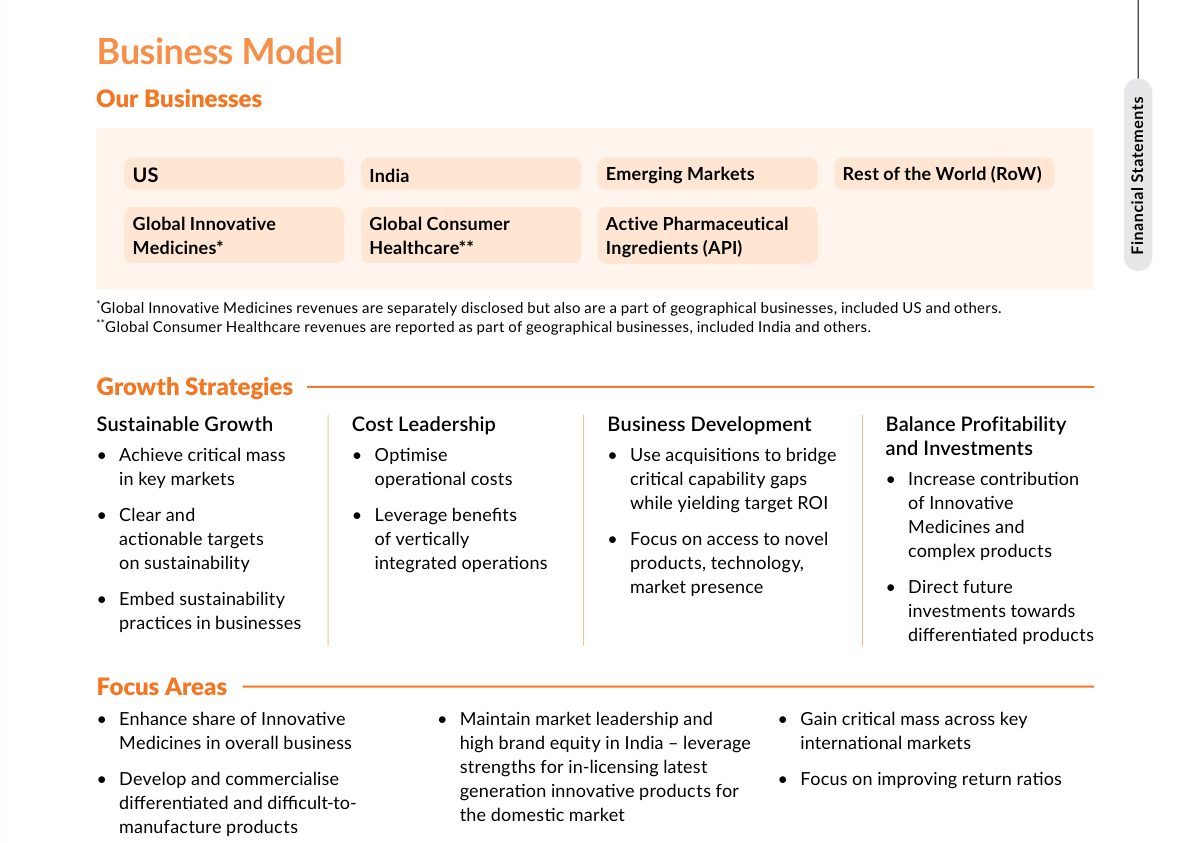
The material does exist elsewhere in the report: the R&D pages have filings and approvals, the manufacturing pages count 27 finished-dosage and 13 API facilities, and the BRSR has employee, energy and community data. Nothing links them. ITC scores 1 here for the same reason, and like ITC, Sun has chosen not to produce an integrated report, which is a legitimate choice with a cost on this card.
BRSR and ESG integration: 3/5
The BRSR is in the report, it is assured, and it comes with the one thing many ESG sections lack: an absolute target with progress against it. Aalok Shanghvi's Director's Message and Section B both state a 35% cut in absolute Scope 1 and 2 emissions by FY 2029-30 from a 2020 baseline, with 16.7% achieved so far. Renewable energy rose from 49.77% to 52.55% of total energy, and the MD's letter adds a 20.2% reduction in absolute water consumption against the same baseline. DNV Business Assurance India gives reasonable assurance on BRSR Core and limited assurance on other selected indicators, and its statement is printed at the end of the BRSR. There were no fatalities among employees or workers.
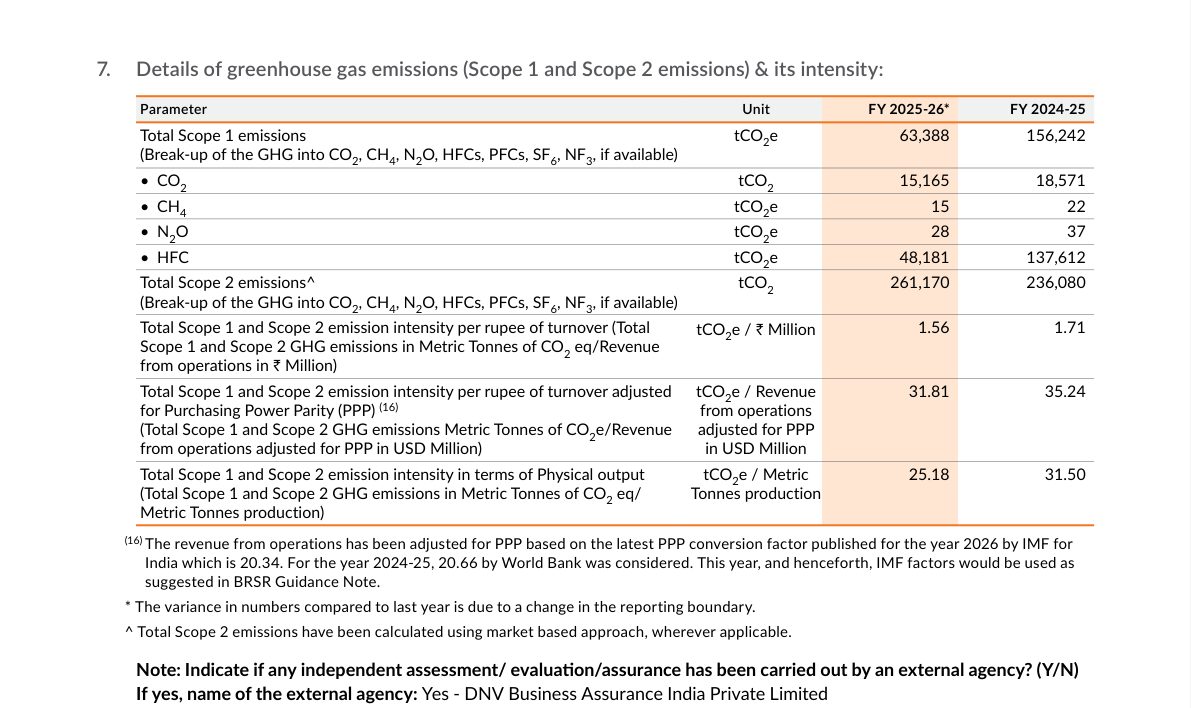
The weaknesses are in how much weight that can bear. Materiality rests on "the extensive stakeholder engagement exercise undertaken in FY 2020-21" (p. 126), five years ago, and the table of 13 material issues in Section A gives their financial implications only as words ("Positive", "Negative"). Scope 3 is not disclosed anywhere in the report. The baseline tonnage behind the 16.7% isn't printed, so the reader can't check it. And the emissions table on p. 132 shows Scope 1 falling from 156,242 to 63,388 tCO2e, almost all of it in HFCs (137,612 to 48,181), with a one-line footnote: "The variance in numbers compared to last year is due to a change in the reporting boundary." It doesn't say what changed. Scope 2, on the same page, rose from 236,080 to 261,170 tCO2.
The BRSR is also where the report's most important product-quality disclosure lives. Asked about "penalty / action taken by regulatory authorities on safety of products", it names Halol and Baska, the OAI classifications and the remediation under way. That is candid and in the right place for the BRSR. It belongs in the MD&A as well. The same page reports zero data breaches, with a footnote explaining that a third-party provider's cyber incident put certain data relating to a subsidiary on the dark web.
Governance disclosure: 4/5
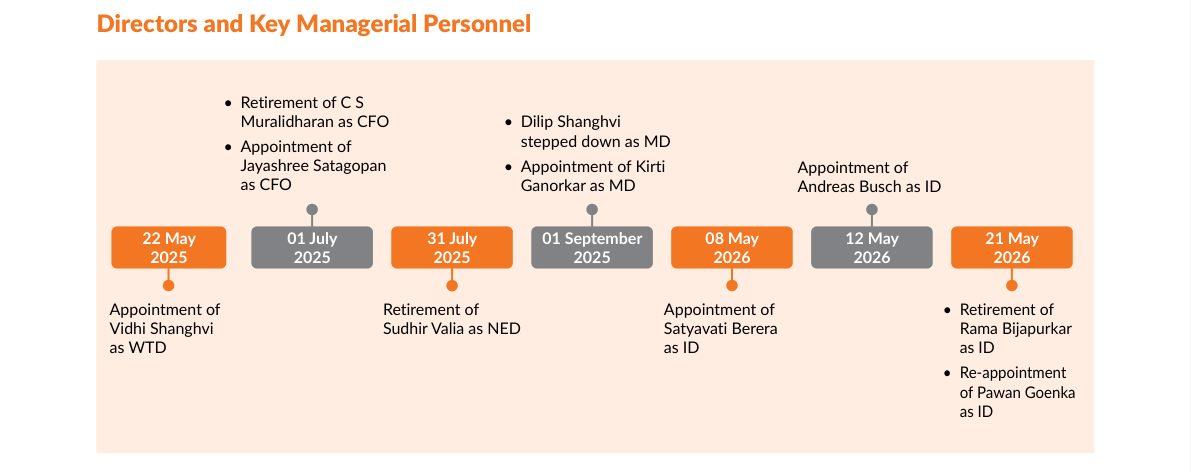
This is the best part of the report. The Corporate Governance Report opens with a one-page "Corporate Governance at a Glance" (p. 81) listing eight practices, several of them recent and voluntary: a Corporate Governance & ESG Committee, a Lead Independent Director (Dr. Pawan Goenka), separation of the Chairman and MD roles, external agencies to identify independent directors, and a skills matrix. The Board's Report (p. 50) draws every Board and key managerial change on a dated timeline from May 2025 to May 2026: Vidhi Shanghvi's appointment as Whole-time Director, a new CFO, Dilip Shanghvi stepping down as MD while remaining Executive Chairman, Kirti Ganorkar's appointment, Sudhir Valia's retirement, two new independent directors and Rama Bijapurkar's retirement. The Board composition table gives the inter-se family relationships between the three promoter directors plainly.
It stops at 4 for three reasons. There is no Board statement of responsibility for the report. The Board of Directors page (pp. 14 to 15) shows the post-May 2026 Board without saying so, while the governance report describes the eight-member Board at 31 March 2026, so the two lists don't match until the reader finds the timeline. And the BRSR (p. 113) names Aalok Shanghvi as "Whole-time Director and Chief Executive Officer" when every other page, including the governance report, calls him Chief Operating Officer.
Financial storytelling: 3/5
The ten-year table (p. 5) is a good start: revenue, profit, R&D, balance sheet and EPS for every year from FY17, including FY18, when net profit fell from ₹69.6 billion to ₹21.0 billion. It carries no margins, return ratios or dividends, but it leaves the bad years in. The MD&A adds five-year charts for each business and a ratio table with reasons for large movements.
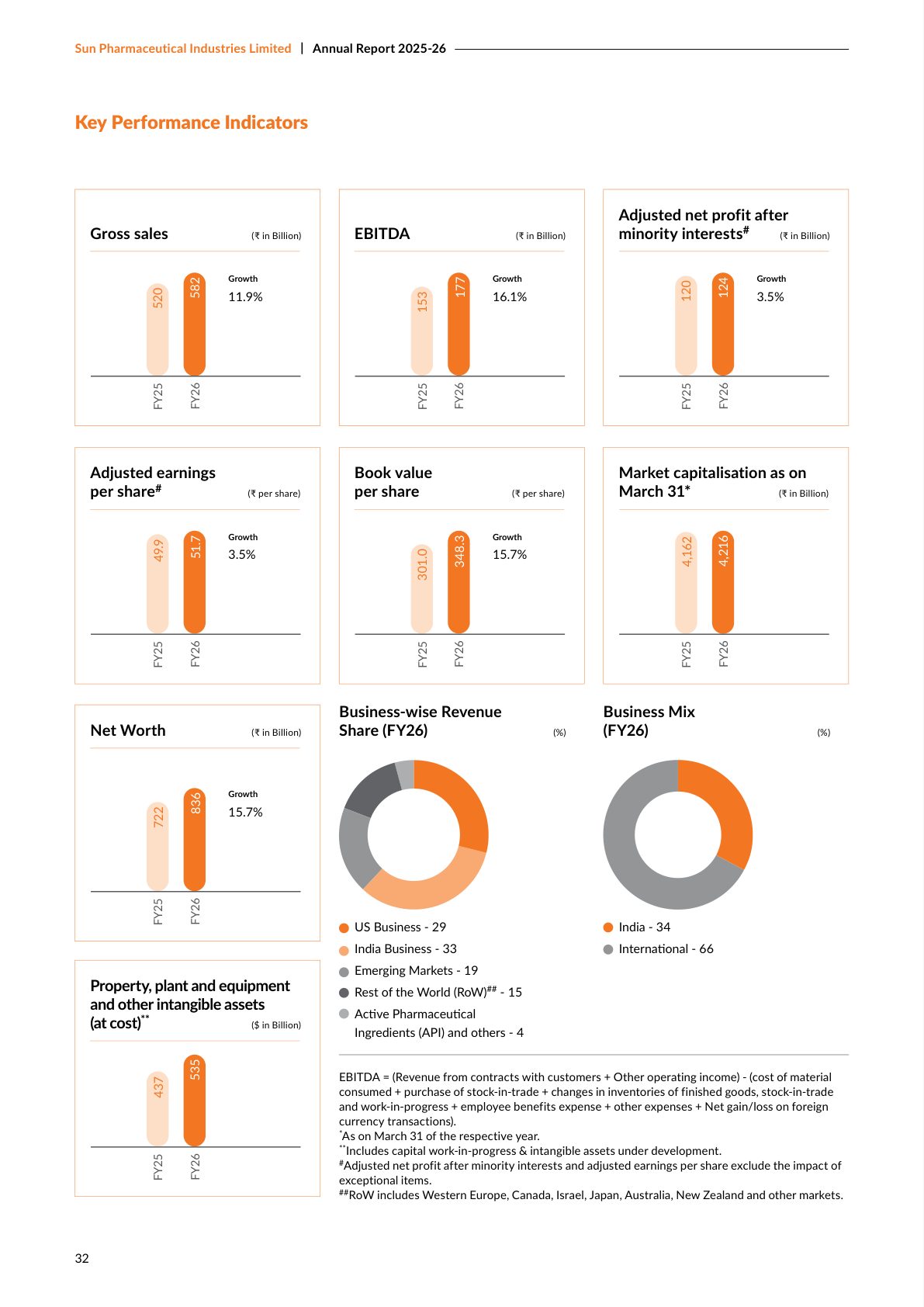
The KPI page (p. 32) leads with adjusted net profit of ₹124 billion, up 3.5%, and a footnote says it excludes exceptional items. It doesn't show the reported figure beside it, and nothing in the front half says what those items were. The notes do: ₹13,074.8 million of exceptional charges, covering the discontinuation of SCD-044 (₹2,876.4 million), further charges on the Taro end-payer settlement (US$62.0 million, then US$12.8 million after court approval), and ₹3,755.3 million for India's new labour codes. The same KPI page labels property, plant and equipment "($ in Billion)"; the figures (437 and 535) are the rupee values in the ten-year table.
The standalone numbers get even less attention. Standalone revenue fell from ₹229.8 billion to ₹207.5 billion and profit after tax from ₹42.3 billion to ₹26.2 billion, a 38% drop. The Board's Report prints both lines in its opening table without comment, and the only explanation is in the MD&A ratio table (p. 33): net profit margin lower "due to lower revenue". For a company whose Indian plants supply the US and whose US-bound plants are under FDA action, that deserved a paragraph.
Design and readability: 4/5
The report is easy to use. It is 340 pages where several peers run past 550, laid out as single A4 pages in one clean orange-and-grey system, with section tabs down the right edge of every odd page and no awards section. Tables are legible, the business pages follow a consistent pattern (revenue share, five-year chart, highlights, road ahead), and the governance report's at-a-glance page is a model of compression.
Two things cost it. The MD&A spends eight pages on IQVIA market data for the world, the US, Europe, Japan, pharmerging markets, India, APIs and consumer healthcare before Sun Pharma appears on p. 26. And the Corporate Overview is thin rather than concise: after the letters and Board pages there's no strategy, risk or outlook page in the front half, so the reader goes to the MD&A for everything.
Digital version: 3/5
The PDF is better linked than it looks. We counted 712 internal links: the contents page jumps to each section, every right-hand page carries clickable tabs for Corporate Overview, Statutory Reports and Financial Statements, and a home icon returns to the contents. It has a full text layer and single pages that read well on a phone. The contents page points readers to the investor page, and the Board's Report links the BRSR, policies and CSR report.
But there are no bookmarks at all, so a 344-page file shows an empty navigation pane, and there is no online edition: the investor page offers the full PDF and section PDFs, nothing more. Titan, with a bookmark tree and no online edition, scores 4; Sun has the links and not the bookmarks.
What reporting teams can take from it
Copy the governance timeline: one graphic that dates every Board and KMP change across the year and after it removes any doubt about who was in charge when. Copy the governance-at-a-glance page. Copy the MD's willingness to print a decline (US sales down 0.9% in dollars) in the same paragraph as the growth, and the ten-year table's refusal to drop FY18.
Then bring the regulatory and legal facts forward. Name Halol and Baska and the OAI classifications in the MD&A, show reported profit beside adjusted profit and list the exceptional items on the KPI page, explain the standalone decline, refresh the materiality assessment, disclose Scope 3 and explain the boundary change, fix the dollar label and the CEO designation, and add bookmarks.
Series scorecard
Every report in this series is scored on the same seven-point card by the same reader. Scores are editorial opinion of the published document; each review carries the page references behind its findings.
| Company | Score (of 35) |
|---|---|
| Hindustan Zinc | 30 |
| TCS | 29 |
| HUL | 28 |
| Bharti Airtel | 27 |
| L&T | 27 |
| Reliance | 27 |
| HDFC Bank | 26 |
| Asian Paints | 25 |
| ICICI Bank | 25 |
| Infosys | 25 |
| LTM | 25 |
| Tata Steel | 25 |
| M&M | 24 |
| Titan | 23 |
| ITC | 21 |
| Sun Pharma (this review) | 21 |
| Bajaj Finance | 20 |
| NTPC | 20 |
Frequently asked questions
What is in Sun Pharma's Annual Report 2025-26?
A 340-page statutory annual report themed 'Advancing Innovation Globally for Better Patient Care'. It opens with Sun Pharma at a glance, key performance indicators, a ten-year financial table, messages from the Executive Chairman and the Managing Director, and the Board and leadership team. The Statutory Reports section holds the Management Discussion and Analysis, the Board's Report, the Corporate Governance Report and the Business Responsibility and Sustainability Report. Standalone and consolidated financial statements and the AGM notice follow.
Is Sun Pharma's annual report an integrated report?
No. The report does not refer to the <IR> Framework, the six capitals or a value creation model. Its 'Business Model' on page 31 lists the company's businesses, growth strategies and focus areas. The Board's Report says the company publishes a separate Sustainability Report and a CSR report on its website.
Is Sun Pharma's BRSR inside the annual report?
Yes. The Business Responsibility and Sustainability Report is at pages 104 to 145 of the annual report, opens with a Director's Message from Aalok Shanghvi, is prepared on a standalone basis, and ends with DNV's assurance statement. The company's investor page also offers the BRSR as a separate PDF.
Who assures Sun Pharma's sustainability disclosures?
DNV Business Assurance India Private Limited gives reasonable assurance on BRSR Core indicators and limited assurance on other selected indicators, as stated in Section A of the BRSR. The statutory auditor is S R B C & CO LLP.
What were Sun Pharma's FY 2025-26 results?
Consolidated revenue from operations of ₹584.6 billion (up 11.2%), gross sales of ₹582 billion (up 11.9%), EBITDA of ₹177.3 billion (up 16.1%), net profit after minority interest of ₹114.8 billion (up 5.0%) and EPS of ₹47.8. Adjusted net profit, excluding exceptional items, was ₹124 billion (up 3.5%). India sales grew 14% to ₹192.9 billion; US revenue rose 3.6% in rupees to ₹168.2 billion but fell 0.9% in dollars. R&D spend was ₹35.5 billion, 6.1% of sales, and the total dividend was ₹16 per share.
How does The Footnotes score annual reports?
Seven criteria, each scored 1 to 5 with a one-line reason: strategy and narrative; integrated thinking and capitals; BRSR and ESG integration; governance disclosure; financial storytelling; design and readability; and the digital version. Scores are editorial opinion based on the published document, and the same card is used for every company so results can be compared.
Sources
- Sun Pharma: Annual Reports and Presentations (investor pages) — Sun Pharmaceutical Industries Limited
- Sun Pharma: Annual Report 2025-26 (PDF) — Sun Pharmaceutical Industries Limited
- Integrated Reporting Framework (IFRS Foundation) — IFRS Foundation
- SEBI circular: BRSR Core, framework for assurance and ESG disclosures for value chain (12 July 2023) — SEBI