

NTPC Integrated Annual Report 2025-26: A Review
NTPC's seventh integrated report sets out a clear corporate plan (149 GW by 2032, 244 GW by 2037) and is candid in its statutory pages about a Board that never had enough independent directors. It also reports 358 million tonnes of Scope 1 emissions with no prior-year figure and no target, and calls FY26 its best profit year without saying that profit before tax fell and a deferred tax remeasurement did the lifting.
 In short
Key takeaways
- The report is NTPC's 50th annual report and 7th integrated annual report, 556 printed pages in four parts: Our Group's Overview, Innovating for Sustainability (the capitals chapters), Statutory Disclosures, and Statutory and Financial Results. It says it follows the <IR> Framework, GRI, BRSR, the SDGs and the UN Global Compact.
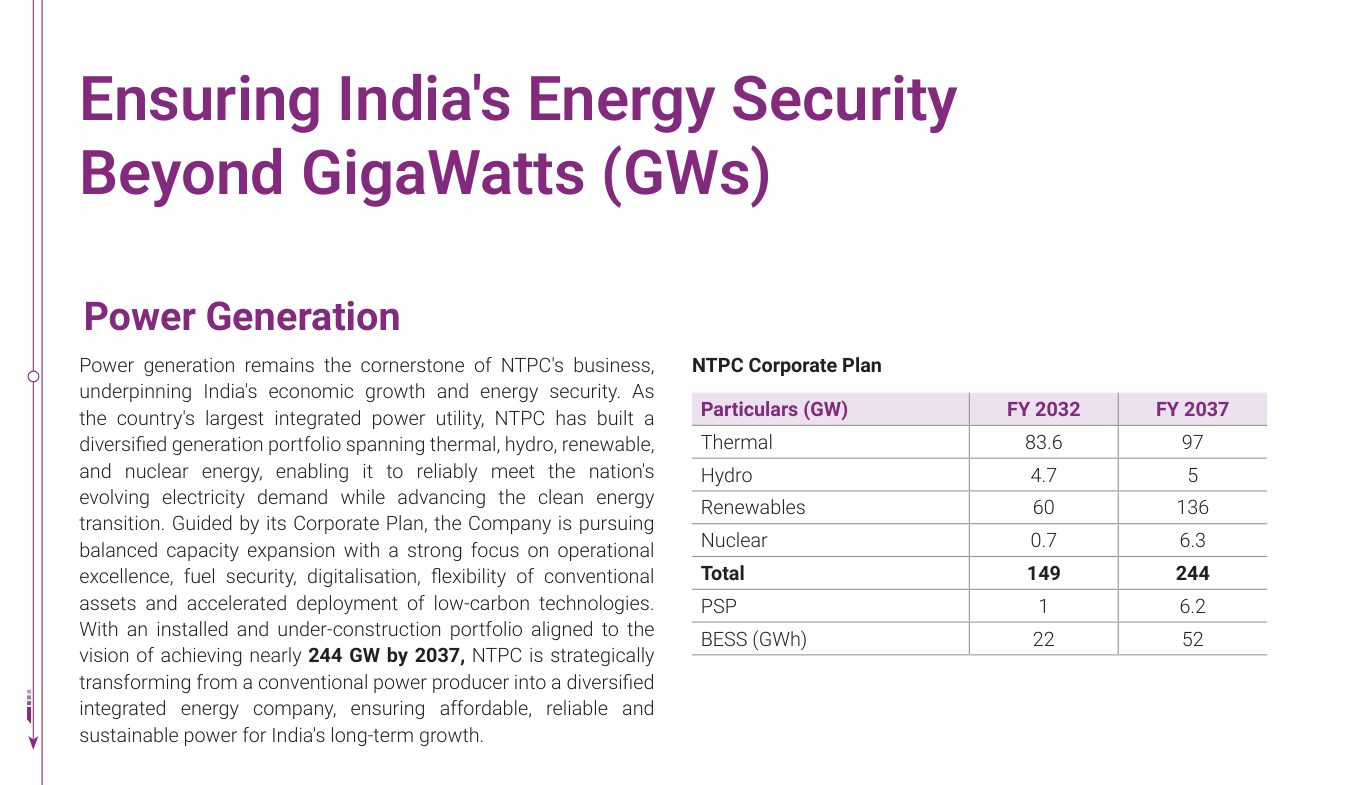
- The corporate plan is set out by source: 149 GW by FY2032 (83.6 GW thermal, 60 GW renewables, 0.7 GW nuclear) and 244 GW by FY2037 (97 GW thermal, 136 GW renewables, 6.3 GW nuclear), with 52 GWh of battery storage and 6.2 GW of pumped storage. Of 34,188 MW under construction, 16,520 MW is coal.
- Group Scope 1 emissions were 358.00 million tCO2e and Scope 2 0.71 million tCO2e, at an intensity of 830.02 g/kWh, down 2% year on year. Non-fossil sources supplied 7.6% of generation. The report gives no prior-year absolute figure, no Scope 3 number and no company emissions target; intensity is named as 'the primary decarbonisation progress metric'.
- Standalone profit after tax rose 17.9% to ₹23,162.22 crore and consolidated profit 15% to a record ₹27,545.76 crore. Profit before tax fell on both bases. Deferred tax was remeasured at 25.168% instead of 34.944% in view of an expected move to the new tax regime, turning standalone tax into a credit of ₹3,503.61 crore; the MD&A's explanation of profit growth does not mention it.
- The C&AG gave nil comments on the standalone and consolidated financial statements after its supplementary audit (letters dated 1 August 2026). The corporate governance report and secretarial audit state that fewer than half the Board were independent throughout FY26 and that NSE and BSE levied fines for it.
- TUV India Private Limited assured the BRSR Core indicators under ISAE 3000, but the BRSR itself is not in the annual report; it is on the company website. The PDF has hyperlinked contents and a home link on almost every page, but five bookmarks named after InDesign files, spread pages, and C&AG letters reproduced as scanned images.
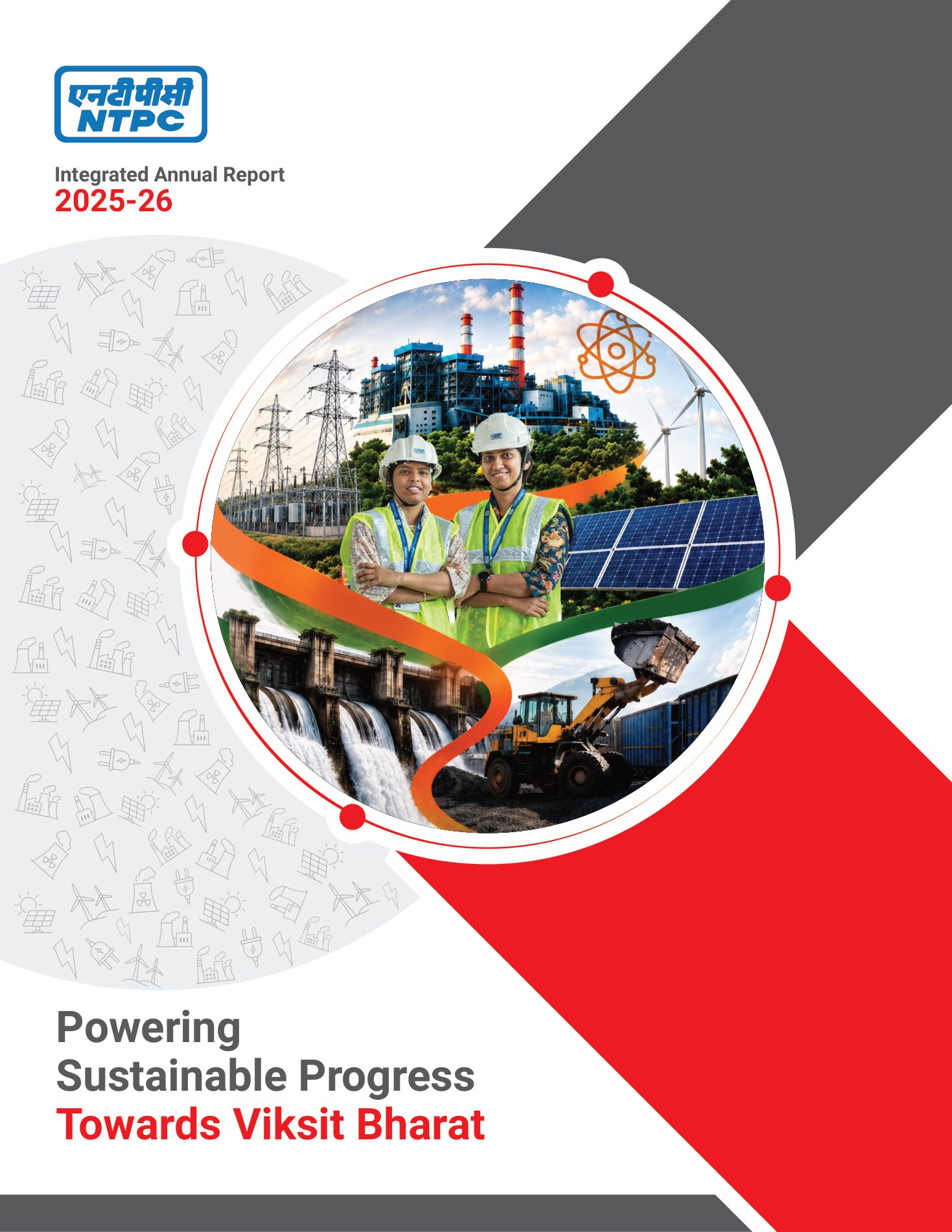
NTPC generates close to a quarter of India's electricity, most of it from coal, and it is building towards a portfolio in which renewables, storage and nuclear make up more than half of its capacity by 2037. In FY 2025-26 it added a record 9.6 GW, most of it renewable, and reported its highest ever consolidated profit. The Integrated Annual Report 2025-26, themed "Powering Sustainable Progress Towards Viksit Bharat", is clear about where the company wants to go. It is much less clear about what that journey does to its emissions, and about why profit rose.
As with every review in this series, we read the published PDF against the <IR> Framework, SEBI's BRSR Core expectations and plain readability, and score it on the same seven-point card. Scores are our opinion. Screenshots are small excerpts reproduced for review and remain the copyright of NTPC Limited; the full report is on the company's investor pages.
The scorecard
| Criterion | Score (of 5) | In one line |
|---|---|---|
| Strategy and narrative | 3 | A corporate plan by source to 2032 and 2037 and a thoughtful national-context chapter; one letter, no CFO, and no discussion of the coal trade-off |
| Integrated thinking and the capitals | 3 | A value creation model with numbers for every capital; outcomes are slogans and the capitals chapters rarely connect |
| BRSR and ESG integration | 2 | 358 million tCO2e reported once, with no prior year, no target and no Scope 3; undated materiality; BRSR outside the report |
| Governance disclosure | 3 | C&AG nil comments and the Board's independence shortfall disclosed plainly; no Board responsibility for the integrated report |
| Financial storytelling | 3 | A five-year table in the integrated section; the profit narrative leaves out the deferred tax remeasurement behind the record |
| Design and readability | 3 | A compact integrated section with section tabs; 556 pages of spreads, a two-page roster of 66 executives and conflicting numbers |
| Digital version | 3 | Hyperlinked contents and a home link on most pages; no online edition, file-name bookmarks, spreads and scanned C&AG letters |
| Total | 20 / 35 |
What the report is
The Directors' Report describes this as NTPC's 50th annual report and 7th integrated annual report. It runs to 556 printed pages in four tabbed parts. Our Group's Overview and Innovating for Sustainability together form the integrated section (pp. 2 to 105), which covers the highlights, a chapter on India's twin goals of Viksit Bharat and net zero, the Chairman and Managing Director's letter, board and senior management profiles, the business verticals, the value creation model, materiality, risk, ethics and vigilance, and the six capitals. Statutory Disclosures (pp. 106 to 193) holds the Directors' Report, MD&A, corporate governance and CSR reports and the secretarial audit. The standalone and consolidated statements, each followed by the C&AG's comments, and the AGM notice make up the rest.
"About the Report" (p. 2) says the report follows the principles and content elements of the <IR> Framework, "now under the purview of the IFRS Foundation", alongside GRI, BRSR, the SDGs and the UN Global Compact. It gives the boundary (financial disclosures for the group; non-financial for NTPC and the subsidiaries and joint ventures it controls), names TUV India Private Limited as the assurer of the BRSR Core indicators under ISAE 3000, and says the temporal and material boundaries "have been reviewed and approved by senior management". There is no Board statement of responsibility. The BRSR itself is not in the document; the Directors' Report points to the website.
NTPC has a record in this field: ICAI's results post lists it as a joint gold shield winner in the public sector category of the SAFA Best Presented Annual Report Awards for 2022.
Key number: 358.00 million tCO2e. NTPC's Scope 1 emissions for FY 2025-26, printed once on page 76, without the previous year's figure beside it.
Strategy and narrative: 3/5
The strategy is easy to state and the report states it. The corporate plan table (p. 26) sets out capacity by source: 149 GW by FY2032, of which 83.6 GW thermal, 60 GW renewables, 4.7 GW hydro and 0.7 GW nuclear, rising to 244 GW by FY2037 with 97 GW thermal, 136 GW renewables and 6.3 GW nuclear, plus 22 and 52 GWh of battery storage. The Directors' Report adds the share that matters: renewables from 13% of installed capacity today to 44% by 2032 and 56% by 2037. The "Energising India's Growth" chapter (pp. 12 to 15) is a readable account of India's power transition, drawing on NITI Aayog's scenarios, and notes that in NITI Aayog's scenarios coal capacity peaks "around the mid-2040s".
The business verticals chapter (pp. 26 to 37) gives each line of business a highlights box with numbers: 1.52 million tonnes of biomass sourced, 46.52 BU traded, 48.65 MMT of captive coal, an 18 GW pumped storage portfolio. The nuclear pages set out the Mahi Banswara project through ASHVINI and an ambition of 30 GW by 2047 (p. 28), which sits oddly beside the 6.3 GW the corporate plan shows for 2037 and deserves a sentence of reconciliation.
The contents page promises "Letters to the Stakeholders"; there is one, from the Chairman and Managing Director. It opens with global energy security, gives the year's numbers (89.1 GW installed, 432.2 BU generated, 72.04% coal PLF, record profit) and lists four priorities. There is no CFO's letter, and nothing in the narrative engages with the obvious tension: of the 34,188 MW under construction, 16,520 MW is coal (Directors' Report), and thermal capacity is planned to rise to 97 GW. The MD&A's SWOT names declining coal PLF and underused gas as weaknesses, but not emissions.
Integrated thinking and the capitals: 3/5
The value creation model (pp. 38 to 39) has the right parts: inputs for all six capitals with numbers (net worth of ₹2,03,023.74 crore, green capex of ₹25,127.52 crore, 18,451 employees, R&D of ₹583.19 crore, CSR of ₹487.59 crore), a value chain from coal sourcing to customer billing, outputs, outcomes and a column of what each stakeholder group gets.
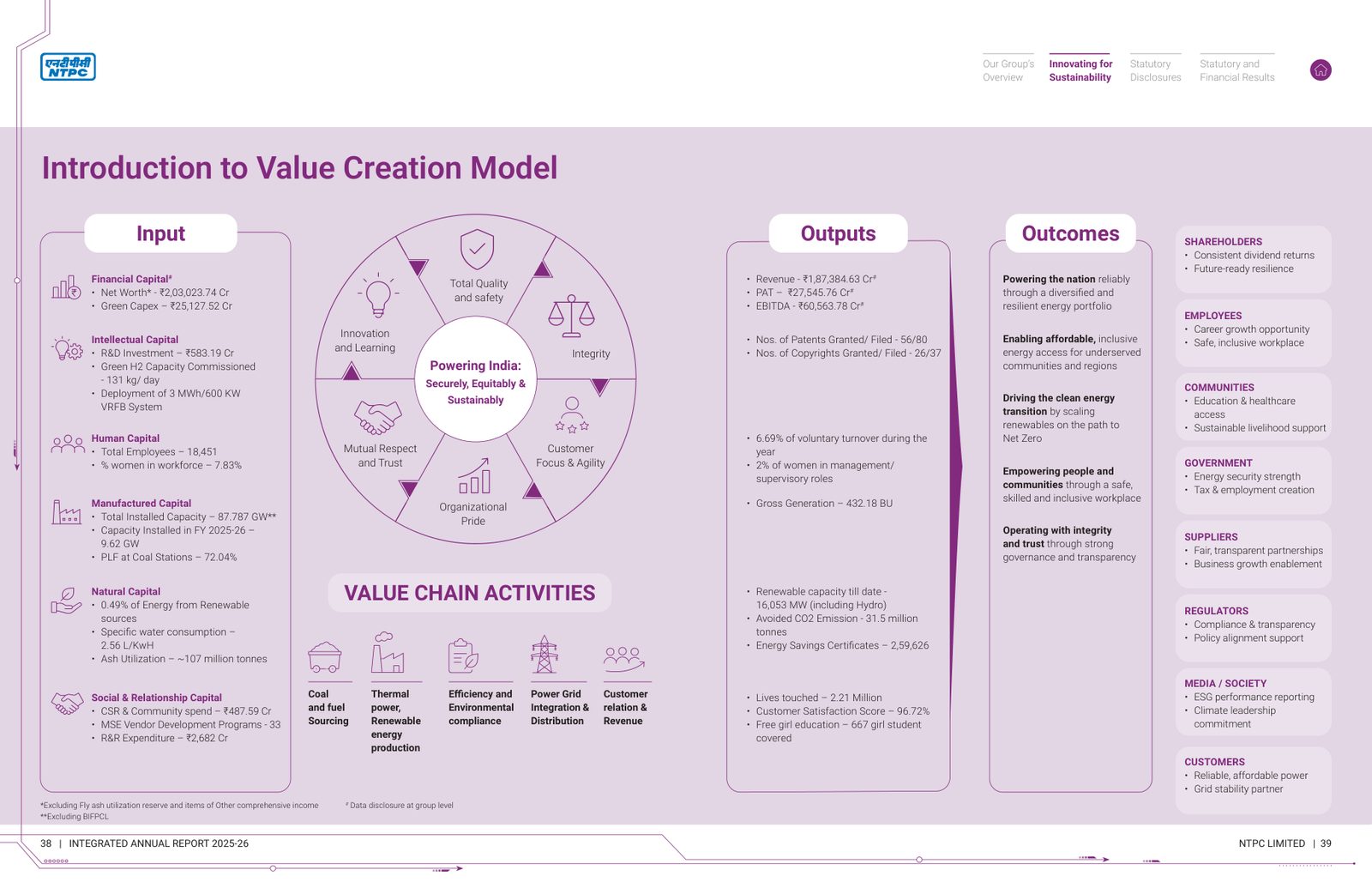
Read closely, it is less connected than it looks. The outcomes are five sentences ("Powering the nation reliably", "Driving the clean energy transition") and the stakeholder column is a pair of phrases each ("Consistent dividend returns", "Climate leadership commitment"). Natural capital's first input is "0.49% of Energy from Renewable sources", unexplained and at odds with the 7.6% non-fossil share of generation on page 76. Emissions, the largest thing NTPC takes from natural capital, don't appear in the model at all; "Avoided CO2 Emission - 31.5 million tonnes" does.
The capitals chapters follow a consistent pattern with SDG mapping and a highlights strip, and several are substantive: the financial capital chapter breaks the ₹49,067.87 crore capex into renewables, hydro, environmental infrastructure and nuclear, and the manufactured capital chapter carries a station-by-station capacity and generation table. But the chapters rarely refer to each other or to material topics, and "green capex" includes ₹3,280.90 crore of emission control and ash infrastructure at coal plants, which a reader may not expect under that label.
BRSR and ESG integration: 2/5
This is where a coal-heavy generator's report is tested, and where this one is weakest. The GHG section (p. 76) gives group Scope 1 emissions of 358.00 million tCO2e, Scope 2 of 0.71 million, an intensity of 830.02 g/kWh, a 2% fall in intensity and a 7.6% non-fossil share of generation. It says NTPC tracks Scope 1, 2 and 3, and that intensity is "the primary decarbonisation progress metric".
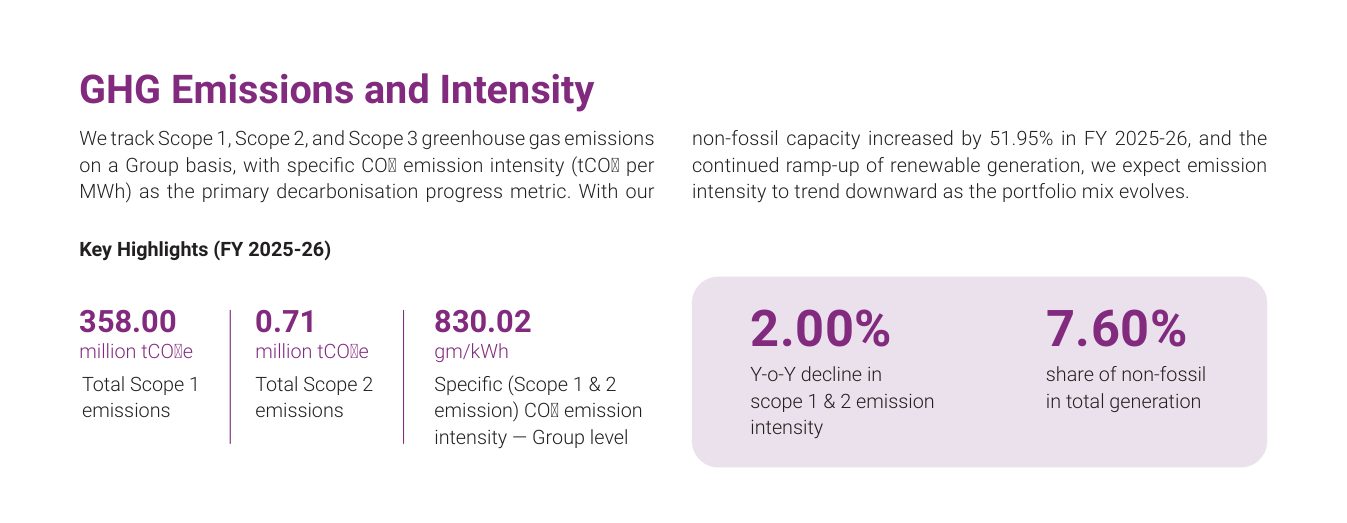
What is missing matters more than what is there. There is no prior-year Scope 1 figure, so the reader can't tell whether absolute emissions rose or fell. There is no Scope 3 number. There is no company target of any kind, absolute or intensity; the report refers to India's Panchamrit goals and to a net zero roadmap it is "co-developing" with NITI Aayog. And there is no discussion of what the corporate plan does to absolute emissions when thermal capacity grows from about 72 GW of coal and gas today (p. 60) to 97 GW. Against 358 million tonnes, the 6,000 tonnes a year of commissioned CO2 capture described on page 78 is a research project, and the report would be more credible for saying so.
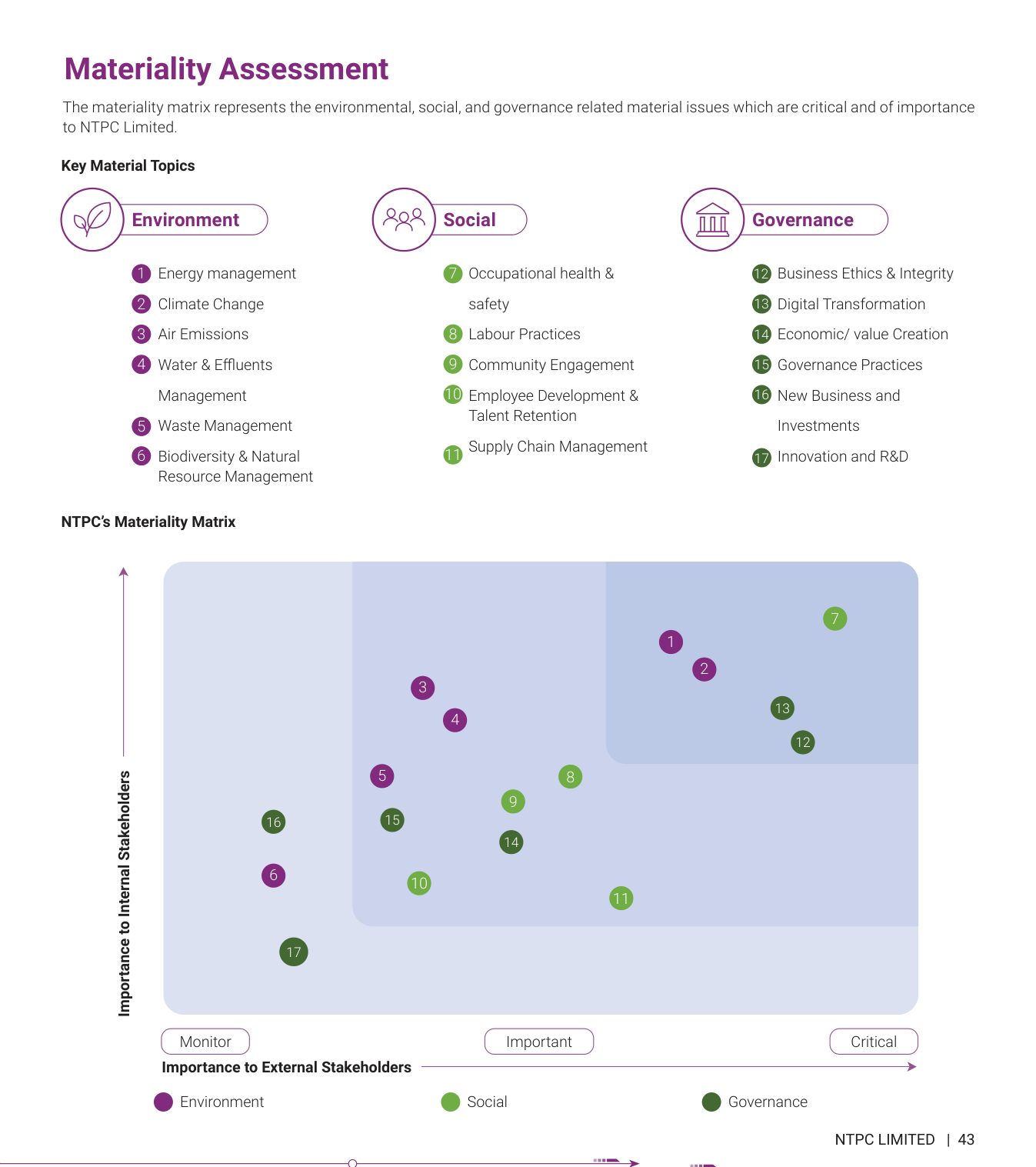
Materiality is thin. The process (p. 42) lists five generic steps and cites SASB, MSCI and S&P ratings as sources, and the matrix (p. 43) plots 17 topics against internal and external importance. There is no date, no count of stakeholders, no statement of who approved the results and no link from topics to targets or chapters.
Safety data is partial: LTIFR of 0.027 for employees and 0.065 for workers, one and 19 recordable injuries, and 27,701 near misses (p. 86). The word "fatality" doesn't appear anywhere in the 556 pages; for a company with this workforce and contractor base, that figure belongs in the integrated report, not only in a BRSR on the website. The report's own numbers also disagree in places. Biomass pellets received since inception are "3.105 million tonnes" on page 27 and "3.105 Lakh MT" on page 64; contracts awarded are 3.08 million tonnes on page 27 and 10.18 million MT on page 64. Ash utilisation is 107% in the capitals chapters and "~106%" in the MD&A.
Governance disclosure: 3/5
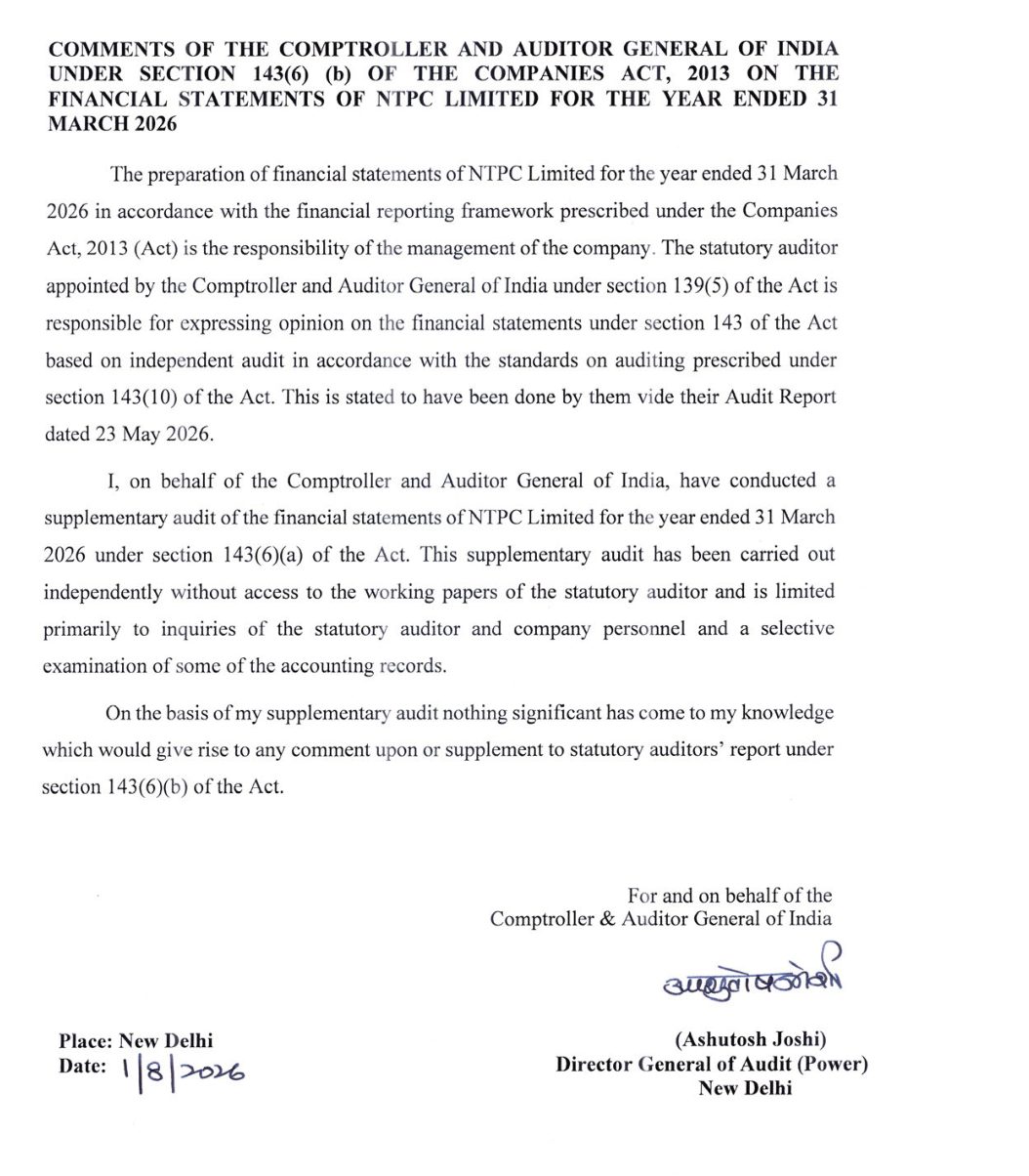
The public sector parts of governance are handled well. The Directors' Report states that the C&AG, in letters dated 1 August 2026, gave "NIL comments" on both the standalone and consolidated statements after its supplementary audit, and the letters are reproduced after each auditors' report (pp. 360 and 539), with an annexure listing which group entities the C&AG audits. The emphasis of matter paragraphs (the transfer of coal mines to NTPC Mining and the fly ash reserve accounting) are summarised with management's comments.
The corporate governance report is also candid about the Board. The approved composition is 16 directors, including eight independent; at 31 March 2026 there were 13, with five independent, so independent directors were fewer than half the Board throughout the year. The report lists the resulting non-compliances for three years, the NSE and BSE fines (₹27,19,900 each for the Board composition breach across five quarters, per the secretarial audit), and BSE's waiver of ₹31,03,400 of earlier fines. It explains, correctly, that the power to appoint directors sits with the President of India through the Ministry of Power. Few reports in this series set out a governance failing so plainly.
What holds the score at 3 is the integrated section. There is no Board statement of responsibility for the integrated report, only senior management approval of its boundaries. The risk chapter (p. 44) describes the Risk Management Committee as chaired by the Director (Projects), while the Directors' Report lists an independent director as its chair after the July 2026 reconstitution; the integrated section wasn't updated. The ethics and vigilance chapter is detailed on process but reads as a list of initiatives.
Financial storytelling: 3/5
The integrated section includes a five-year standalone table (pp. 56 to 57) with revenue, expenses, tax, regulatory deferral movements, balance sheet, ratios and value added per employee, and the MD&A walks through every line of the standalone income statement with reasons. Both are useful.
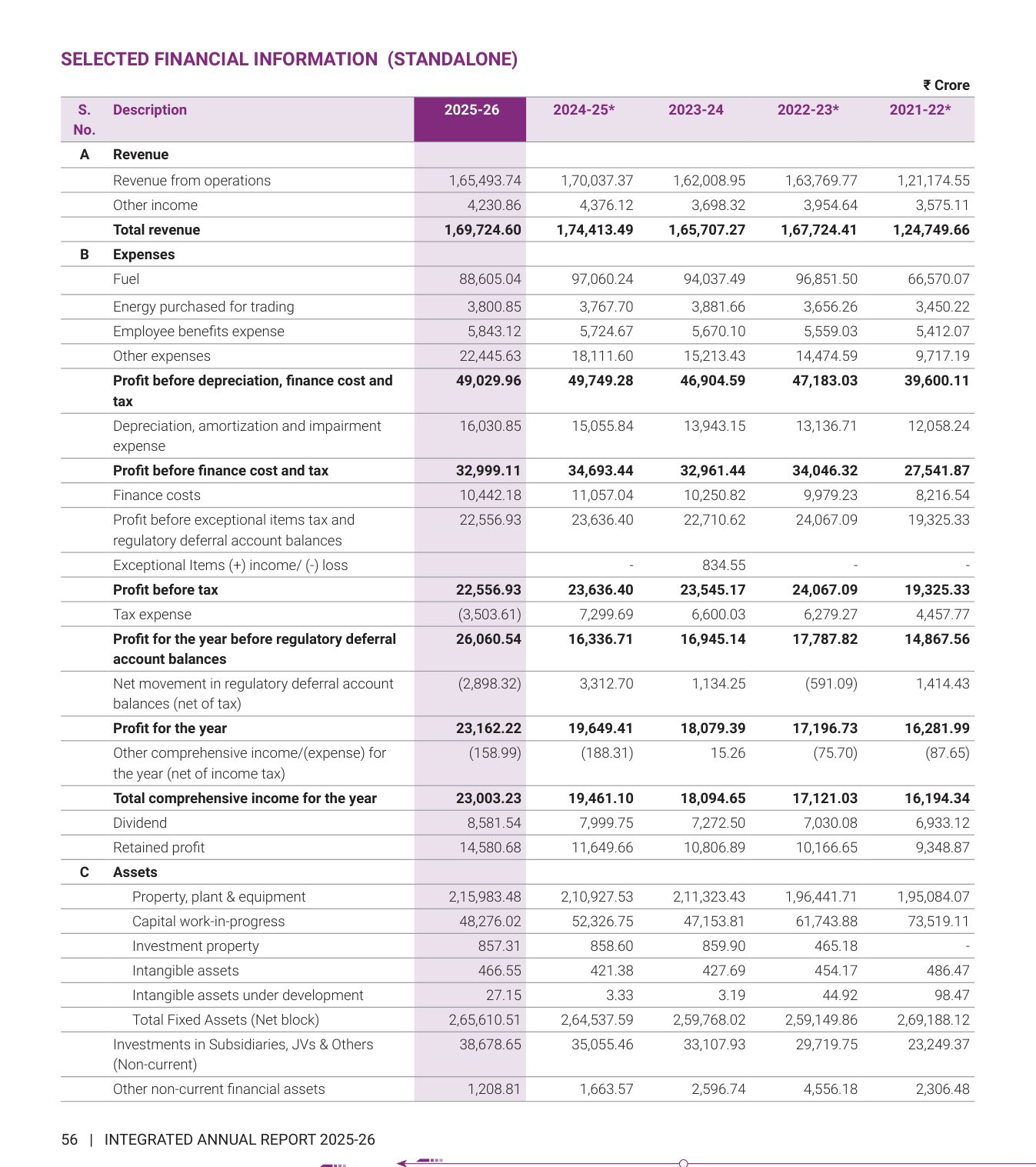
The table also shows what the narrative leaves out. Standalone profit before tax fell 4.6%, from ₹23,636.40 crore to ₹22,556.93 crore, and revenue from operations fell 2.7%. Profit after tax rose 17.9% because tax expense became a credit of ₹3,503.61 crore, against a charge of ₹7,299.69 crore the year before, partly offset by a negative regulatory deferral movement of ₹2,898.32 crore. Note 22 explains why: in view of the company's "expected transition to the new tax regime", deferred tax was remeasured at 25.168% instead of 34.944%, cutting deferred tax by ₹7,561.43 crore. The consolidated picture is the same: profit before tax and regulatory deferral fell from ₹28,496.41 crore to ₹27,133.56 crore, and total tax was a credit of ₹2,876.42 crore.
None of this reaches the narrative. The Chairman's letter calls ₹27,546 crore the "highest-ever consolidated Profit After Tax". The MD&A attributes the standalone rise to "higher regulated equity", dividend income from group companies, favourable tariff orders and the CERC amendment. The highlights page (p. 10) charts EBITDA and PAT, not profit before tax. A reader who relies on the front half will not learn that this year's record owes its growth to a tax remeasurement.
Design and readability: 3/5
The integrated section is compact at about 104 pages, the section tabs and home icon run across every page, and the business verticals chapter's highlights boxes make a sprawling group readable. The station-wise capacity and generation table is the kind of reference data utility reports often omit.
Against that, the document is 556 pages of two-page spreads, the senior management section is a two-page roster of 66 executives, the Prime Minister's Internship Scheme gets close to a page of round-by-round statistics, and a half-spread photograph of an office building sits next to the India map. The numerical conflicts noted above (biomass, ash utilisation, a dividend payout of 37.68% in the letter and 37.67% in the Directors' Report) point to sections produced separately and not reconciled.
Digital version: 3/5
NTPC's annual reports page, which we confirmed, offers the report as a PDF download only; we found no online or HTML edition, and the PDF doesn't reference one. The PDF has a text layer, a hyperlinked contents page and a home link on almost every page, and its web links (to policies, board profiles, the annual return) work as links. But it has only five bookmarks, named after the InDesign files ("NTPC_Initial Pg_AR_25-26_13-8-26_For Double Spread Final"), every inside page is a two-page spread, and the C&AG's letters and their annexures are scanned images with no searchable text.
What reporting teams can take from it
Copy the corporate plan table: capacity by source for two target years is the most useful single exhibit a utility can give. Copy the candour of the corporate governance report on Board composition, and the practice of reproducing the C&AG's comments with an annexure of which entities it audits.
Then print absolute emissions with the previous years beside them, set a company target and show Scope 3; date the materiality assessment and say who approved it; put the fatality count in the integrated report; explain the tax line wherever the profit is celebrated; reconcile the numbers across sections before release; and publish single pages with proper bookmarks and text-searchable audit letters.
Series scorecard
Every report in this series is scored on the same seven-point card by the same reader. Scores are editorial opinion of the published document; each review carries the page references behind its findings.
| Company | Score (of 35) |
|---|---|
| Hindustan Zinc | 30 |
| TCS | 29 |
| HUL | 28 |
| Bharti Airtel | 27 |
| L&T | 27 |
| Reliance | 27 |
| HDFC Bank | 26 |
| Asian Paints | 25 |
| ICICI Bank | 25 |
| Infosys | 25 |
| LTM | 25 |
| Tata Steel | 25 |
| M&M | 24 |
| Titan | 23 |
| ITC | 21 |
| Sun Pharma | 21 |
| Bajaj Finance | 20 |
| NTPC (this review) | 20 |
Frequently asked questions
What is in NTPC's Integrated Annual Report 2025-26?
A 556-page document themed 'Powering Sustainable Progress Towards Viksit Bharat'. The integrated section (printed pages 2 to 105) covers the group overview, financial and operational highlights, a chapter on India's twin goals of Viksit Bharat and net zero, the Chairman and Managing Director's letter, board and senior management profiles, business verticals, the value creation model, stakeholder engagement and materiality, risk, ethics and vigilance, and six capitals chapters. The Directors' Report, MD&A, corporate governance and CSR reports, secretarial audit, standalone and consolidated financial statements with the C&AG's comments, and the AGM notice follow.
What are NTPC's capacity and clean energy targets?
The corporate plan targets 149 GW of group capacity by FY2032, including 60 GW of renewables, 83.6 GW of thermal and 0.7 GW of nuclear, and 244 GW by FY2037, including 136 GW of renewables, 97 GW of thermal and 6.3 GW of nuclear, plus 22 GWh and 52 GWh of battery storage and 1 GW and 6.2 GW of pumped storage. The report also states an ambition of 30 GW of nuclear by 2047. Renewable capacity was 11.6 GW at 31 March 2026, with about 15 GW under execution.
What are NTPC's greenhouse gas emissions?
For FY 2025-26 the report gives group Scope 1 emissions of 358.00 million tCO2e, Scope 2 of 0.71 million tCO2e, and a Scope 1 and 2 intensity of 830.02 g/kWh, 2% lower than the year before. Non-fossil sources made up 7.6% of generation. It states that Scope 3 is tracked but does not give a figure, and it sets no company-level absolute or intensity target, referring instead to India's Panchamrit goals and a net zero roadmap being co-developed with NITI Aayog.
Did the C&AG comment on NTPC's accounts?
No. As a government company NTPC's statutory auditors are appointed by the Comptroller and Auditor General of India, which then conducts a supplementary audit. In letters dated 1 August 2026, the C&AG said nothing significant had come to its knowledge that would give rise to any comment on the standalone or consolidated financial statements. The Directors' Report records these as 'NIL comments' and the letters are reproduced after each auditors' report.
Who assures NTPC's sustainability disclosures?
TUV India Private Limited assured the BRSR Core indicators for FY 2025-26 under ISAE 3000, according to the 'About the Report' page and the Directors' Report. The BRSR and the assurance report are published on NTPC's website rather than in the annual report. The financial statements are audited by six joint statutory auditors appointed by the C&AG.
How does The Footnotes score annual reports?
Seven criteria, each scored 1 to 5 with a one-line reason: strategy and narrative; integrated thinking and capitals; BRSR and ESG integration; governance disclosure; financial storytelling; design and readability; and the digital version. Scores are editorial opinion based on the published document, and the same card is used for every company so results can be compared.
Sources
- NTPC: Annual Reports (investor pages) — NTPC Limited
- ICAI: SAFA Best Presented Annual Report Awards results — The Institute of Chartered Accountants of India
- Integrated Reporting Framework (IFRS Foundation) — IFRS Foundation
- SEBI circular: BRSR Core, framework for assurance and ESG disclosures for value chain (12 July 2023) — SEBI