


Bajaj Finance has a real five-year plan with numbers you can check. But its highlights page leads with a profit that leaves out the year's biggest cost, and the clearest sign of stress in the loan book is in a note on page 342.
In this article
 In short
Key takeaways
- The highlights page (pp. 2-3) leads with PAT of ₹20,689 crore, up 24%, and ROE 'up from 19.1%'. Reported consolidated PAT was ₹19,332 crore, up 15%, and reported ROE fell from 19.19% to 18.05%. The ₹1,813 crore excluded is mostly credit provisions.
- Impairment on financial instruments rose 34% to ₹9,482 crore, faster than net interest income (21%) or operating expenses (19%) (p. 37).
- The sectoral exposure note (p. 342) shows gross NPAs rising among micro and small service enterprises (1.19% to 2.49%) and transport operators (4.40% to 6.08%), while personal loans improved (1.10% to 0.98%). None of this is in the front section.
- The Long Range Strategy table (p. 39) sets FY2030 targets against FY2026 values, including 200-220 million customers and ROE of 19-21%. Gold loans were the fastest-growing book: 313 new branches and AUM up 115% to ₹17,831 crore (p. 40).
- Employee commuting is 63,124 of the 102,679 tCO2e Scope 3 total, about 61% (p. 222). Emissions financed by the ₹5 lakh crore loan book are not measured.
- Managing Director Anup Saha, elevated on 1 April 2025, resigned on 21 July 2025 (p. 84). Nothing in the Corporate Overview mentions it.
Official report: Get the Bajaj Finance Annual Report 2025-26 from the company's website. This page is The Footnotes' independent review of it.
Verdict: Bajaj Finance has a five-year plan you can hold it to, and a highlights page that leaves out the year's biggest cost. The most useful page for anyone judging the loan book is a note to the accounts on page 342. The front section never points to it. Score: 20 of 35.
This is not an integrated report, and it doesn't claim to be. It has a 32-page Corporate Overview (pp. 2-32), statutory reports including a 47-page MD&A and the BRSR (pp. 33-223), and the accounts (pp. 225-479). There is no "About this report" page, no capitals and no value creation model. The BRSR sends readers to a separate ESG Report for materiality, the capitals and targets. We still score it on the same card as everyone else, because the card measures what a reader can learn, not compliance. Page numbers are the printed ones. Screenshots are small excerpts reproduced for review and remain the copyright of Bajaj Finance Limited. There is also a digital edition.
The profit on page 2 is not the profit in the accounts
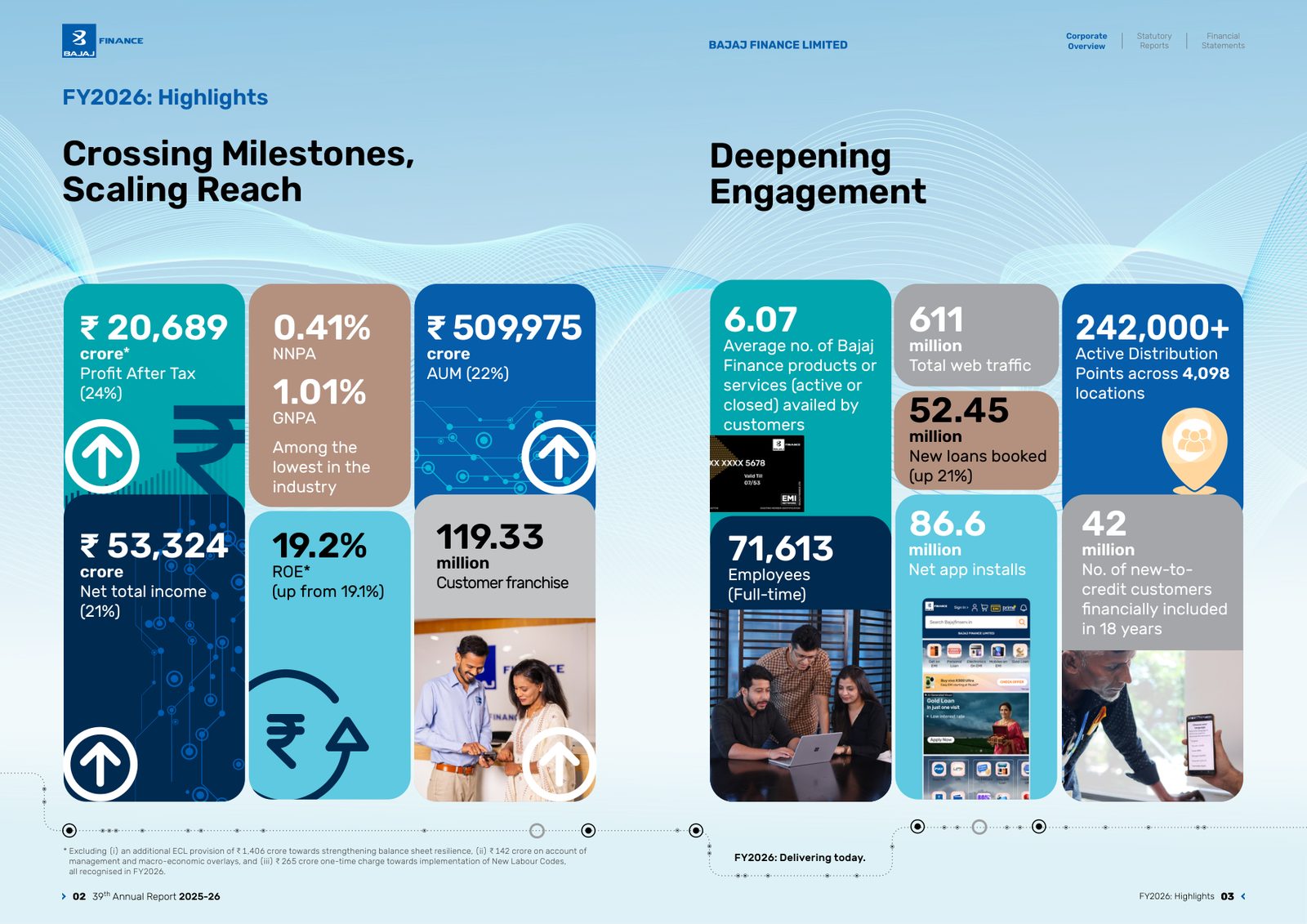
The highlights spread leads with profit after tax of ₹20,689 crore, up 24%, and ROE of 19.2%, "up from 19.1%". An asterisk excludes three things: an extra ₹1,406 crore of expected credit loss provision from introducing a floor on loss given default, ₹142 crore of management and macroeconomic overlays, and a ₹265 crore Labour Codes charge.
Reported consolidated PAT was ₹19,332 crore, up 15%. Reported ROE fell from 19.19% to 18.05%. That is a ₹1,357 crore gap between the profit most readers see and the profit in the accounts.
The MD&A (p. 37) shows why this matters. Impairment on financial instruments rose 34% to ₹9,482 crore. That is faster than net interest income (up 21%), operating expenses (up 19%) or pre-impairment profit (up 22%). Credit cost is the fastest-growing line in the business. For a lender, a provisioning change that raises it is not a one-off to be stripped out. It is the cost of the loans.
To be fair, the report doesn't hide the reported numbers. They are in the Chairman's letter (p. 5), in Table 6 (p. 50), and the strategy table uses 18.1% as its ROE baseline. But the highlights page is the one most people read, and it should lead with the accounts.
The page that matters most is 342
Note 54 to the standalone accounts includes a sectoral exposure table that RBI rules require. It is the clearest picture of where the loan book is under strain, and nothing in the first 300 pages mentions it.
| Sector (standalone) | Gross NPA, March 2025 | Gross NPA, March 2026 |
|---|---|---|
| Micro and small enterprises (services) | 1.19% | 2.49% |
| Retail trade | 1.40% | 2.15% |
| Transport operators | 4.40% | 6.08% |
| Services, total | 0.88% | 1.31% |
| Personal loans | 1.10% | 0.98% |
Source: Bajaj Finance Limited, 39th Annual Report 2025-26, note 54, p. 342. Gross NPAs as a percentage of total exposure in each sector.
The picture is mixed, and that makes it more useful. Consumer lending, the core of the brand, improved. Small-business lending got clearly worse, with the bad-loan ratio for small service businesses roughly doubling. The MD&A talks about tightening underwriting and the "Lowest Risk Company" ambition. It would be more convincing if it said which books had got riskier and what was being done about them.
A strategy you can hold them to
The Long Range Strategy 2026-30 (pp. 16-19) rests on three priorities: customer centricity, technology leadership, and being the "Lowest Risk Company in India". The MD&A then prints something most strategy pages in Indian reports don't: a table of FY2026 values against FY2030 targets (p. 39).
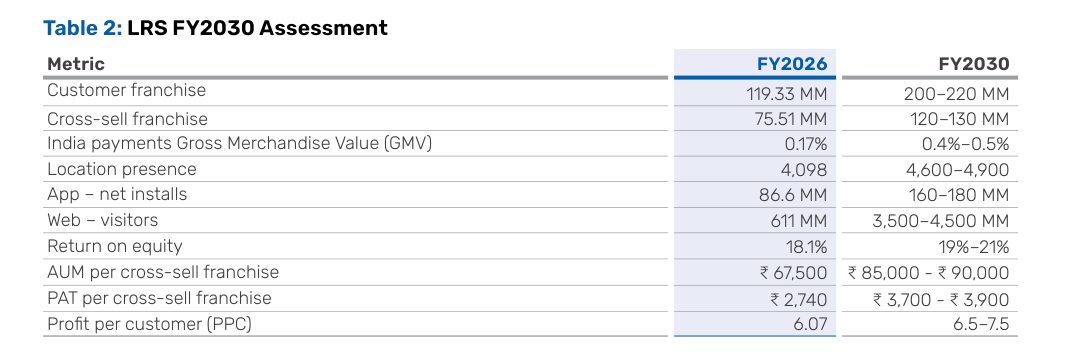
Customer franchise of 119.33 million against 200 to 220 million. 4,098 locations against 4,600 to 4,900. ROE of 18.1% against 19% to 21%. PAT per cross-sell franchise of ₹2,740 against ₹3,700 to ₹3,900. A reader can check these in 2030.
One label is wrong: the last row says "Profit per customer (PPC)" with values of 6.07 and 6.5 to 7.5. Those are products per customer.
The execution snapshot on the next page (p. 40) is the most specific page in the front half of the report:
- Gold loans were the fastest-growing book. Bajaj opened 313 branches, taking the total to 1,507, and gold loan AUM rose 115% to ₹17,831 crore.
- Commercial vehicle loans grew from ₹942 crore to ₹2,352 crore, up 150% (p. 46).
- AI in lending: 27 conversational AI bots led to disbursals of over ₹5,500 crore, and 44% of document checks are automated.
This is the kind of detail that makes "FINAI" more than a slogan. The Chairman's letter (pp. 4-7) adds that AI converted 52 million voice logs to text, which supported about ₹700 crore of loans.
The Managing Director who left in July
Anup Saha became Managing Director on 1 April 2025, for a term to March 2028. He resigned on 21 July 2025 "due to personal reasons", and Rajeev Jain was re-designated Vice Chairman and Managing Director (p. 84).
The Directors' report records this correctly. Nothing in the Corporate Overview does. The Chairman's letter opens with Middle East tensions and the Strait of Hormuz, but never mentions that the company's chief executive changed after four months. Rajeev Jain doesn't write a letter either.
The rest of the governance disclosure is complete. The Board had ten directors at 31 March 2026, seven of them independent and one a woman (p. 122). The ESG Priorities page (p. 23) headlines a "Board-approved ESG Committee", but the BRSR (p. 171) shows that committee is made up of senior management. The Board reviews ESG performance once a year. There is no Board statement of responsibility for the report.
A ₹5 lakh crore lender whose biggest emission is staff commuting
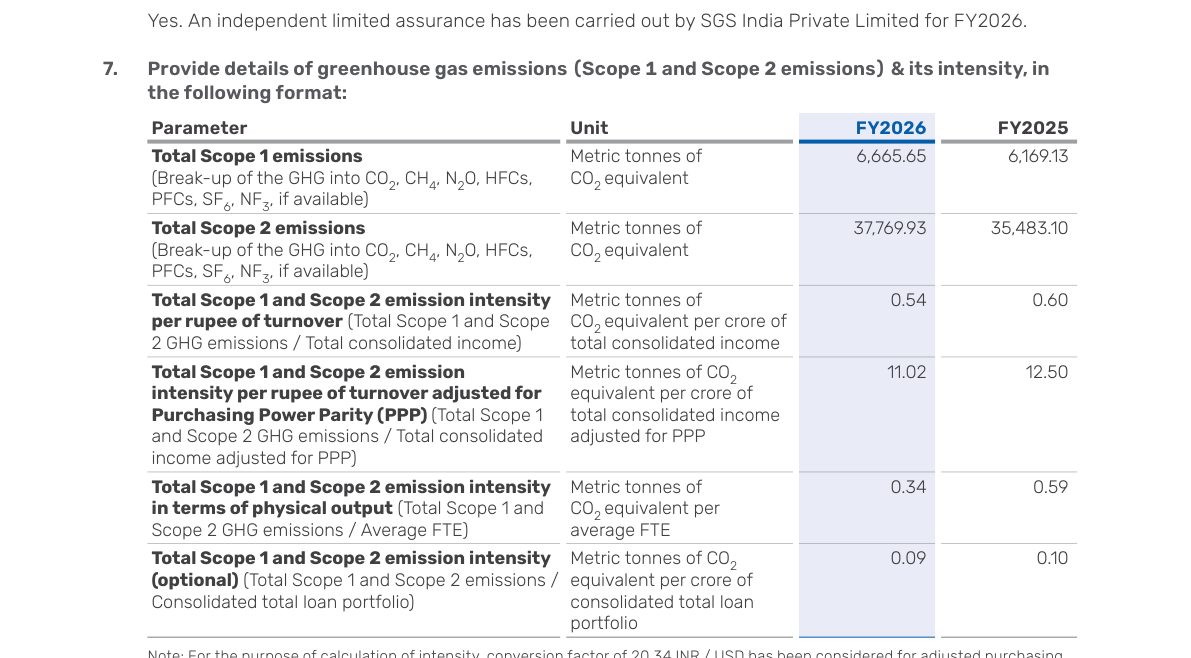
The BRSR is inside the report and SGS India gives reasonable assurance on BRSR Core (statements on pp. 219-222). Scope 1 was 6,665.65 tCO2e and Scope 2 was 37,769.93 tCO2e, both up on the year (p. 197). Scope 3 jumped from 20,452 to 102,679 tCO2e because new categories were added, and the BRSR says so (p. 201).
The SGS verification statement breaks Scope 3 down by category (p. 222). The largest is employee commuting, at 63,124 tCO2e, about 61% of the total. Business travel is 19,424. What is missing is Category 15: the emissions financed by a loan book of over ₹5 lakh crore. For any lender that is the number that matters, and HDFC Bank already measures its own.
Other gaps:
- Renewable energy is 0.30% of consumption: 803.59 GJ out of 268,251.85 GJ (p. 195).
- No emissions target of any kind.
- Materiality: a table of 19 issues (pp. 165-169) with no date or method.
- Next year's commitments (p. 170) are six items, including reforestation at Satara and 15,000 solar loans.
Nineteen years of numbers
The back half of the MD&A is the strongest part of the report. Chart D (p. 51) plots ROA and ROE for 12 years and shows the unflattering trend: ROE from 23.5% in FY2023 to 18.1% in FY2026. Table 7 prints adjusted and reported returns on adjacent lines.
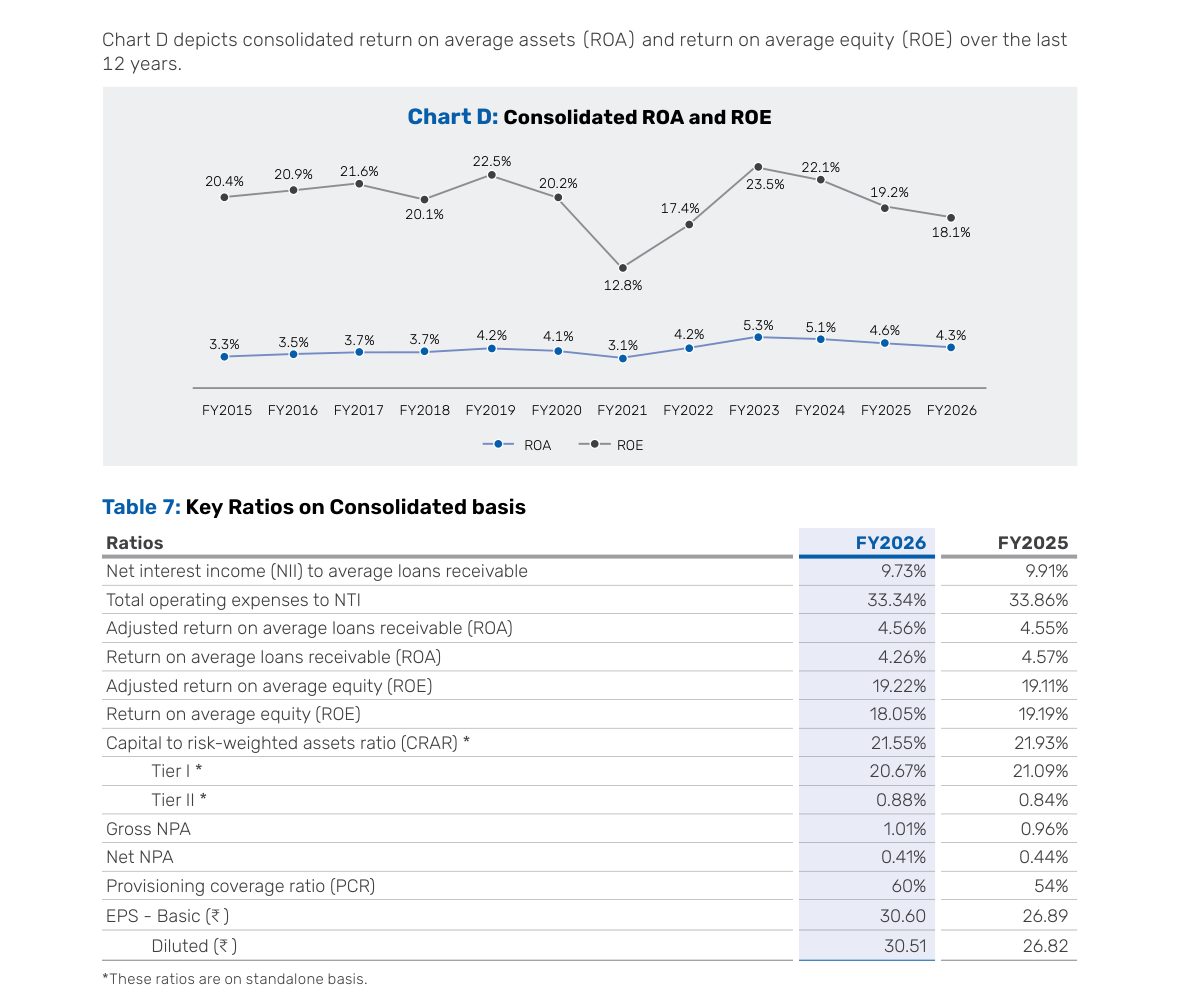
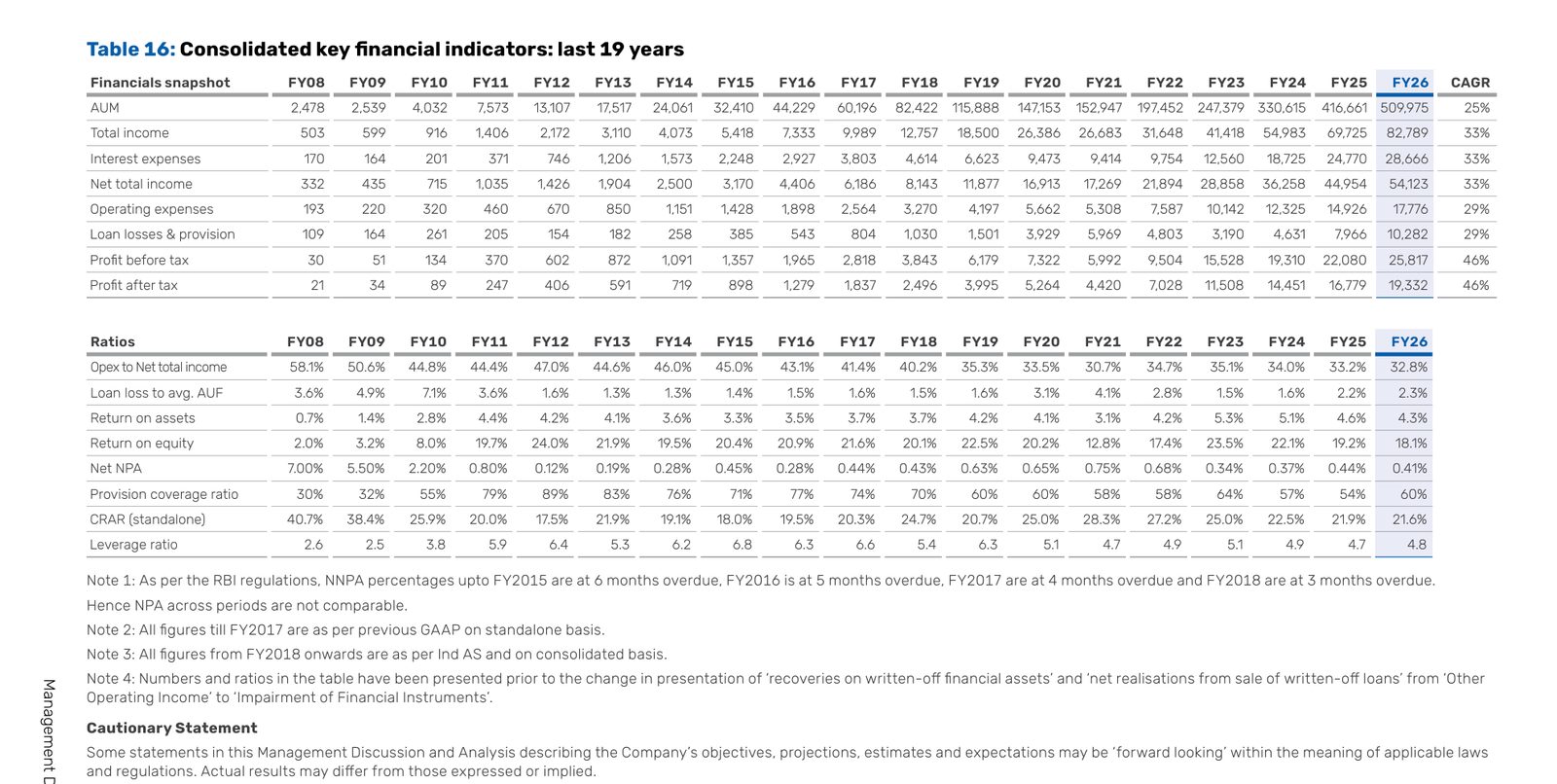
Table 16 (p. 79) gives 19 years of consolidated AUM, income, costs, provisions and profit, from FY08 to FY26, with footnotes on changes in accounting basis. It is set sideways on a portrait page, but no other report we have reviewed goes back this far.
One slip reached the Directors' report: it lists "Number of new loans booked: 119 million" (p. 83). That is the customer franchise. New loans were 52.45 million.
Reading it on screen
The PDF is built for screens. The contents page is hyperlinked, section tabs link to each part, and almost every page is a single page. The HTML edition is searchable. Against that: the PDF has no bookmarks, never mentions the HTML edition, and its text layer turns the rupee symbol into letters ("C", "L" or "K"). A search for "₹" finds nothing, and a screen reader reads amounts wrongly.
What other companies can copy
- A current-versus-target strategy table (p. 39). One row per strategic metric, today's value, the five-year target, and reported ROE as the baseline.
- A long financial record (p. 79). Nineteen years, with footnotes where the accounting basis changed.
- A chart that shows the bad years (p. 51). Twelve years of ROE, falling, printed anyway.
- An execution snapshot with numbers (p. 40). Branches opened, AUM growth, bots live and loans disbursed, product by product.
- Explain why an emissions figure jumped (p. 201). Bajaj says which Scope 3 categories were added.
And what not to copy: adjusted profit as the headline when the adjustment is credit cost, a CEO change left out of the narrative, and asset-quality stress left in a note to the accounts.
The score
| Criterion | Score (of 5) | Why |
|---|---|---|
| Strategy and narrative | 3 | Numeric FY2030 targets and a specific execution snapshot; one letter, which skips the MD's exit |
| Integrated thinking and the capitals | 2 | No framework, capitals or value creation model; the strategy pages link AI, risk and cost to measurable outcomes |
| BRSR and ESG integration | 2 | Assured BRSR; no financed emissions, no climate target, materiality and targets sent to another report |
| Governance disclosure | 3 | Complete statutory disclosure; MD resignation only in the statutory pages, management-level ESG committee |
| Financial storytelling | 3 | A 19-year table and a falling ROE chart; the highlights lead with adjusted profit, and sector stress sits in a note |
| Design and readability | 3 | Compact front section and well-tabled MD&A; CSR takes eight of 31 overview pages, and slips reach the Directors' report |
| Digital version | 4 | Hyperlinked contents, single pages, a searchable HTML edition; no bookmarks, broken rupee symbol |
| Total | 20 / 35 |
How it compares
Every review on The Footnotes uses the same seven-point card, so scores can be compared. Scores are editorial opinion of the published document.
| Company | Score (of 35) |
|---|---|
| Hindustan Zinc | 30 |
| HUL | 28 |
| TCS | 28 |
| Bharti Airtel | 27 |
| L&T | 27 |
| Reliance | 27 |
| HDFC Bank | 26 |
| Asian Paints | 25 |
| ICICI Bank | 25 |
| Infosys | 25 |
| LTM | 25 |
| Tata Steel | 25 |
| Mahindra & Mahindra | 24 |
| Titan | 23 |
| Adani Ports | 22 |
| ITC | 21 |
| SBI | 21 |
| Sun Pharma | 21 |
| Bajaj Finance (this review) | 20 |
| NTPC | 20 |
Frequently asked questions
Is Bajaj Finance's annual report an integrated report?
No. The 39th Annual Report 2025-26 is a statutory annual report with a 32-page corporate overview in front of the MD&A, Directors' report, corporate governance report, BRSR and financial statements. It does not state adherence to the <IR> Framework and has no six-capitals structure or value-creation model. The BRSR refers readers to a separate ESG Report for capital-by-capital detail, the materiality assessment and targets.
What were Bajaj Finance's FY2026 results?
On a consolidated basis, AUM grew 22% to ₹5,09,975 crore, net interest income 21% to ₹44,110 crore, profit before tax 17% to ₹25,817 crore and profit after tax 15% to ₹19,332 crore. Impairment on financial instruments rose 34% to ₹9,482 crore. Excluding an additional ECL provision, management overlays and a labour code charge, PAT was ₹20,689 crore, up 24%. Gross NPA was 1.01% and net NPA 0.41%.
Where is Bajaj Finance's asset quality under pressure?
The standalone sectoral exposure note (note 54, p. 342) shows gross NPAs as a share of exposure rising for services overall (0.88% to 1.31%), micro and small service enterprises (1.19% to 2.49%), retail trade (1.40% to 2.15%) and transport operators (4.40% to 6.08%). Personal loans improved from 1.10% to 0.98%.
What is Bajaj Finance's Long Range Strategy 2026-30?
A five-year plan launched in FY2026 with three priorities: customer centricity, technology leadership through data and AI (the FINAI programme), and being the lowest-risk company in India. The MD&A prints FY2030 targets (p. 39), including a customer franchise of 200 to 220 million, ROE of 19% to 21%, and 160 to 180 million net app installs.
Who assures Bajaj Finance's BRSR, and what does it report on emissions?
SGS India Private Limited provides reasonable assurance on BRSR Core indicators and limited assurance on the rest, and separately verifies the GHG inventory. Scope 1 emissions were 6,665.65 tCO2e and Scope 2 37,769.93 tCO2e (p. 197). Scope 3 was 102,678.55 tCO2e, of which employee commuting was 63,124.27 (p. 222). Financed emissions from the loan book are not included.
How does The Footnotes score annual reports?
Seven criteria, each scored 1 to 5 with a one-line reason: strategy and narrative; integrated thinking and capitals; BRSR and ESG integration; governance disclosure; financial storytelling; design and readability; and the digital version. Scores are editorial opinion based on the published document, and the same card is used for every company so results can be compared.
Sources
- Bajaj Finance: Investor relations, annual reports — Bajaj Finance Limited
- Bajaj Finance: Annual Report 2025-26 (digital edition) — Bajaj Finance Limited
- Bajaj Finserv group: Environmental, social and governance reports — Bajaj Finserv
- SEBI circular: BRSR Core, framework for assurance and ESG disclosures for value chain (12 July 2023) — SEBI
- Integrated Reporting Framework (IFRS Foundation) — IFRS Foundation