

An Indian listed company can put out five documents with "responsibility", "sustainability" or "ESG" in the name. Only two are compulsory, and they answer different laws. We explain each one and show where 33 large caps put them in their FY 2025-26 annual reports. Twelve point to a separate sustainability or ESG report. Five keep the BRSR out of the annual report altogether.
In this article
 In short
Key takeaways
- Only two of the five reports are required by law: the CSR report (under the Companies Act) and the BRSR (under SEBI). The other three are optional.
- CSR is about money given to social causes, usually 2% of profit. ESG is about how the whole business behaves: its emissions, water use, worker safety and how it is run.
- The BRSR is India's official ESG report. A separate "ESG report" or "sustainability report" is an optional, longer version.
- We checked the FY 2025-26 annual reports of 33 large Indian companies. 12 publish a separate sustainability or ESG report, 9 put that content inside the annual report, and 12 do neither.
- 5 of the 33 (Axis Bank, ICICI Bank, NTPC, Reliance and SBI) leave the BRSR out of the annual report and give a website link instead. The rules allow this.
- SBI spent ₹709 crore on CSR but has no CSR report of the usual kind. It is not a company under the Companies Act, so RBI rules apply instead.
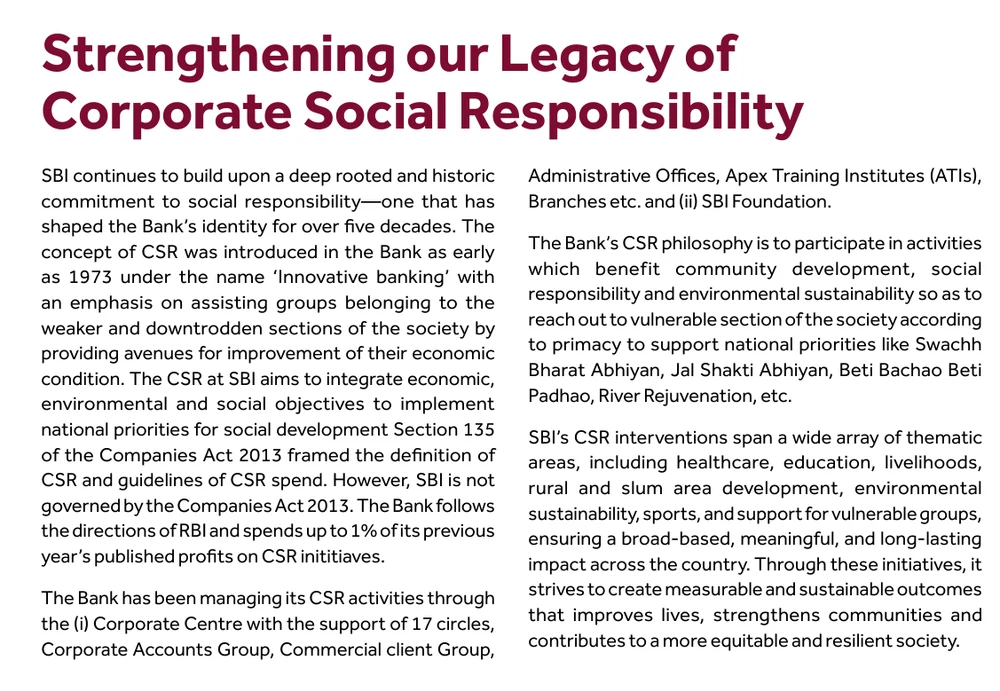
SBI spent ₹709 crore on CSR in FY 2025-26. Yet its annual report has no CSR report of the kind most companies include. That's not a mistake. SBI is a bank set up by its own law, not a company under the Companies Act, so it follows RBI rules for social spending instead. It explains this on page 215 of its Sustainability Report.
That one example shows the problem. Indian companies can publish up to five reports with similar-sounding names: a CSR report, a BRSR (with a section called BRSR Core), a sustainability or ESG report, and an integrated report. Only two are required by law, and two different regulators require them. The rest are optional.
This guide explains each one in plain terms: who has to publish it, which rule requires it, who reads it, what's in it, whether an outside firm must check it, and where you find it. Then we show what 33 large Indian companies actually did in their FY 2025-26 annual reports, with page numbers.
The five documents at a glance
| CSR annual report | BRSR | BRSR Core | Sustainability or ESG report | Integrated report | |
|---|---|---|---|---|---|
| Who must produce it | Every company crossing a Section 135 threshold, listed or unlisted | Top 1,000 listed companies by market cap | Same top 1,000 (FY 2026-27) | Nobody. Voluntary | Nobody. Voluntary |
| Governed by | Companies Act s.135 and s.134(3)(o); CSR Rules, Rule 8 and Annexure II | SEBI LODR Reg 34(2)(f); LODR master circular | LODR Reg 34(2)(f) proviso; master circular, Section IV-B | GRI Standards; often ISSB (IFRS S1, S2), TCFD, SASB | International Integrated Reporting Framework (IFRS Foundation) |
| Main reader | Board, MCA, shareholders | SEBI, exchanges, ESG analysts, rating agencies | Investors comparing assured data | Global investors, lenders, customers, ratings | Investors and analysts |
| What it covers | CSR policy, committee, obligation, spend by project, unspent amount, impact assessment | Nine principles of responsible business conduct, with essential and leadership indicators | Nine ESG attributes, a subset of BRSR | Material sustainability topics, chosen by the company | Strategy, business model, capitals, performance and outlook |
| Assurance | None. CFO certificate; auditor checks unspent CSR | Not for the full BRSR | Third-party assessment or assurance | Voluntary, often limited assurance | Voluntary |
| Where it sits | Annexure to the Board's report | Annual report, or a link in it | Inside the BRSR | Standalone document, or a section of the annual report | Usually the front half of the annual report |
The table shows how little the five overlap. Only the CSR report comes from company law, and it binds unlisted companies too. Only the BRSR comes from securities law, and it binds only the largest listed ones. Everything else is a company's own choice about how much more to say.
Three confusions worth clearing up first
ESG report or sustainability report? In practice they're the same kind of document under two names. "Sustainability report" is the older term, used by GRI since its first guidelines in 2000, and it's still the commonest title in India. "ESG report" is the investor's name for it. Infosys, ICICI Bank and Bajaj Finance publish ESG reports. Mahindra, ITC, HCLTech and Sun Pharma publish sustainability reports. Read the standard on the inside cover rather than the title on the front.
CSR is spending. ESG is performance. CSR in India is a legal obligation to spend, in practice 2% of a company's average net profit over three years, on activities listed in Schedule VII. It tells you what the company gave. ESG covers how the business itself runs: its emissions, water, waste, safety record, pay gaps, board and ethics. A cement company can spend its full CSR budget on schools and still have the highest emissions intensity in its sector. In an ESG report, CSR spending is one line in the social section.
The BRSR is India's ESG report. When a regulator, rating agency or analyst in India asks for "your ESG disclosures", the BRSR is the baseline. It's the only ESG document that's compulsory, standardised and filed with the exchanges in a machine-readable format. A separate ESG report is the voluntary long version.
Search interest suggests this confusion is common. On Google Trends for India over the past 12 months, "sustainability report" is the biggest of these terms, followed by "esg report", "csr report" and "brsr report". The top related query is "what is esg report", and interest peaks between December and March, when next year's reporting cycle is being planned.
The CSR annual report: an account of money spent
Section 135 of the Companies Act applies to any company that, in the preceding financial year, had a net worth of ₹500 crore or more, turnover of ₹1,000 crore or more, or net profit of ₹5 crore or more. It must form a CSR committee (unless its obligation is ₹50 lakh or less), adopt a CSR policy and spend at least 2% of its average net profit of the three preceding years. Our CSR applicability guide works through the thresholds and the calculation.
The reporting part sits in Rule 8 of the Companies (CSR Policy) Rules, 2014, as rewritten in January 2021. The Board's report must include an annual report on CSR in the format of Annexure II to the Rules. Section 134(3)(o) of the Act separately requires the Board's report to describe the CSR policy and the initiatives taken during the year.
The Annexure II format is fixed and fairly short. It asks for:
- a brief outline of the CSR policy;
- the CSR committee's members and meetings;
- web links to the committee composition, policy and approved projects;
- an executive summary of any impact assessment, with a link;
- the obligation: 2% of average net profit, any surplus or set-off, and the total;
- the amount spent, split between ongoing and other projects, administrative overheads and impact assessment;
- any unspent amount and where it went, with a project-by-project account of earlier unspent money;
- capital assets created through CSR, and reasons if the company didn't spend the full amount.
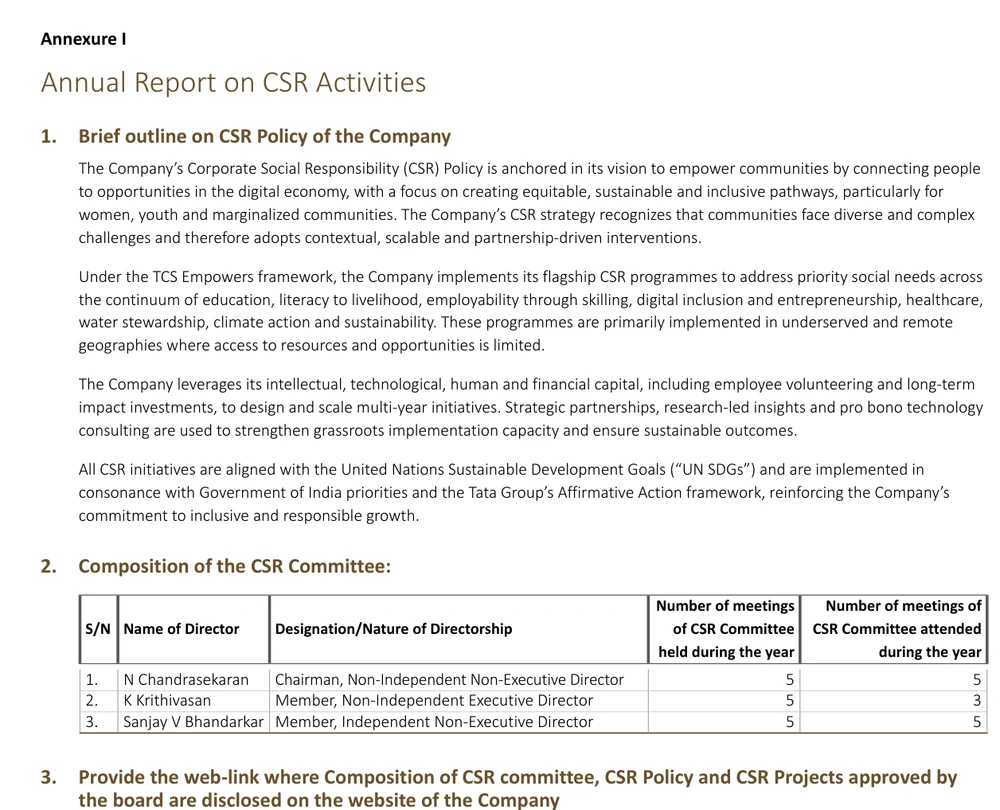
Nothing in it has to be externally assured. Rule 4(5) requires the CFO to certify that the money was used for the purposes and in the manner the board approved, and most Board's reports say so. Adani Enterprises does it in one sentence on PDF page 158. The statutory auditor reports on any unspent CSR amount under clause 3(xx) of CARO 2020. A company with an average CSR obligation of ₹10 crore or more over the three preceding years must have an independent agency assess the impact of projects of ₹1 crore or more, and annex the reports to the CSR report under Rule 8(3).
So the CSR report is a ledger with a narrative attached. Its readers are the board, the Ministry of Corporate Affairs and shareholders checking that the money went where the policy said. Few investors read it, and it says nothing about how the company itself affects the environment.
BRSR and BRSR Core: the ESG report SEBI requires
Regulation 34(2)(f) of SEBI's LODR Regulations requires the annual report of the top 1,000 listed entities by market capitalisation to include "a Business Responsibility and Sustainability Report on the environmental, social and governance disclosures", in the format SEBI specifies. The format has three sections. Section A covers general disclosures about the company. Section B covers management and processes, mainly policies against each principle. Section C covers performance against the nine principles of the National Guidelines on Responsible Business Conduct, with essential indicators that are mandatory and leadership indicators that are voluntary.
BRSR Core is a smaller set of key indicators under nine ESG attributes, including greenhouse gas emissions, water, energy, waste, employee well-being and safety, gender diversity, inclusive development and openness of business. It's the part that has to be checked. For FY 2026-27 the glide path reaches all of the top 1,000, who must get a third-party assessment or assurance of their BRSR Core. Value chain disclosure remains voluntary. Our guides to BRSR Core and BRSR applicability set out the rules and the master circular paragraphs behind them.
Two practical points are less well known. The BRSR has to be filed with the stock exchanges in both PDF and XBRL on the same day the annual report is filed, according to an NSE FAQ circular (NSE/CML/2024/11, 10 May 2024). And the same circular, at question 9, says a company can give a BRSR link in the annual report "instead of publishing the whole report". Five of the 33 companies we checked did exactly that.
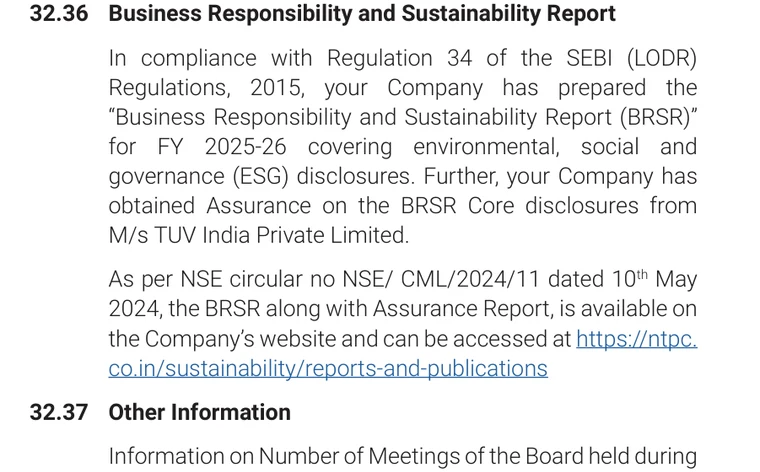
The BRSR's readers are regulators, exchanges, ESG rating agencies and analysts who want comparable data across 1,000 companies. That's its strength. The fixed format makes it dull to read and easy to compare, which is the point of a regulatory filing.
Sustainability and ESG reports: the voluntary long version
Nothing in Indian law requires a separate sustainability report. Companies publish one because the BRSR doesn't tell their story in the way global investors, lenders, multinational customers and rating agencies want it told.
Most Indian sustainability reports follow the GRI Standards, which focus on a company's impacts on the economy, environment and people. A report can claim to be "in accordance with" GRI or "with reference to" it, and the difference matters: the first requires a full content index and reasons for any omissions. Investor-focused companies add climate disclosures under IFRS S2, the ISSB standard that took over from the TCFD recommendations after the TCFD was disbanded in 2023, and sometimes industry metrics from SASB. India hasn't made the ISSB standards mandatory, but Adani Enterprises, for one, now prints "ISSB Disclosures for IFRS S1 and S2" in its annual report.
Assurance is voluntary but common. Indian practitioners use ICAI's SSAE 3000 or the international ISAE 3000, usually at a limited level. HDFC Bank's annual report includes SGS India's limited assurance statement on its Sustainability Report for FY 2025-26 (PDF page 236). Mahindra says its 18th Sustainability Report was assured by DNV (PDF page 126).
SEBI anticipated the overlap. Companies that already report under GRI, SASB, TCFD or integrated reporting may cross-reference those disclosures in their BRSR rather than repeat them, and the NSE's FAQ asks them to give the specific page number where each answer appears. So a well-built sustainability report can carry most of the BRSR's load. It can't replace the filing.
The integrated report: the annual report, rewritten
An integrated report isn't a separate document in most Indian companies. It's a way of writing the front half of the annual report so that strategy, governance, performance and prospects read as one account of how the company creates value over time. The International Integrated Reporting Framework, now maintained by the IFRS Foundation, sets out seven guiding principles, eight content elements and the six capitals.
It's voluntary. SEBI's circular of 6 February 2017 suggested that the top 500 listed companies consider it from FY 2017-18, and that circular is now among those rescinded by the January 2026 LODR master circular. Nothing has replaced it, and no assurance is required. Our guide to integrated reporting in India covers the framework, and our review of ten value creation models shows how differently companies apply it.
The integrated report is the only one of the five aimed squarely at investors as a narrative. In practice it's the front of the book, and the statutory reports follow it: the Board's report with the CSR annexure, the MD&A, the corporate governance report, the BRSR and the financial statements. That's why the CSR annexure and the BRSR so often turn up a few hundred pages after the six capitals.
What 33 large caps did in FY 2025-26
We read the FY 2025-26 annual report PDFs of 33 large-cap Indian companies, the same files the site uses for its annual report reviews, downloaded from company and exchange websites. For each one we recorded what the report calls itself, whether it points to a separate sustainability or ESG report, and where the CSR annexure and the BRSR begin. Page numbers are PDF page numbers, because printed numbering in spread-format PDFs can run to twice the page count. "None referenced" means the annual report doesn't mention a separate report. The company may still publish one.
| Company | What the report calls itself | Separate sustainability or ESG report? | CSR annexure (PDF p.) | BRSR (PDF p.) |
|---|---|---|---|---|
| Adani Enterprises | Integrated Annual Report | No. ESG section, GRI index and ISSB S1/S2 disclosures inside | 164 | 193 |
| Adani Ports | Integrated Annual Report | No. GRI index and assured sustainability disclosures inside | 401 | 459 |
| Asian Paints | Integrated Annual Report | No. GRI and TCFD indexes inside | 125 | 157 |
| Axis Bank | Integrated Annual Report | None referenced | 299 | Website link (p. 409) |
| Bajaj Auto | Annual Report | None referenced | 100 | 382 |
| Bajaj Finance | Annual Report | Yes, ESG Report | 104 | 155 |
| Bharti Airtel | Integrated Report | No. GRI index inside | 129 | 103 |
| Britannia | Annual Report | None referenced | 29 | 55 |
| Cipla | Annual Report, integrated section | No. GRI index inside; separate TCFD report | 169 | 185 |
| Godrej Consumer | Annual Report, integrated section | None referenced | 254 | 281 |
| HCLTech | Integrated Annual Report | Yes, Sustainability Report FY26 | 166 | 237 |
| HDFC Bank | Integrated Annual Report | No. GRI index and assured sustainability content inside | 298 | 556 |
| Hero MotoCorp | Integrated Annual Report | None referenced | 143 | 149 |
| Hindustan Zinc | Integrated Annual Report | Yes, Sustainability Report | 164 | 190 |
| HUL | Integrated Annual Report | None referenced | 59 | 67 |
| ICICI Bank | Annual Report, integrated section | Yes, ESG Report | 104 | Website link (p. 67) |
| Infosys | Integrated Annual Report | Yes, ESG Report | 63 | 141 |
| ITC | Report and Accounts | Yes, Sustainability Report, published later | 142 | 348 |
| JSW Steel | Integrated Report | No. GRI index inside | 199 | 165 |
| L&T | Integrated Annual Report | None referenced | 469 | 347 |
| LTM | Integrated Annual Report | Yes, Sustainability Report | 156 | 108 |
| Mahindra | Integrated Annual Report | Yes, Sustainability Report | 141 | 250 |
| NTPC | Integrated Annual Report | Yes, Sustainability Reports | 91 | Website link (p. 63) |
| Pidilite | Annual Report | Yes, Sustainability Report | 111 | 123 |
| Power Grid | Integrated Annual Report | No. GRI index inside | 190 | 132 |
| Reliance | Integrated Annual Report | None referenced; separate BRSR and CSR report | 46 | Website link (p. 42) |
| SBI | Annual Report | Yes, Sustainability Report, bundled in the filing | None (not under s.135) | Website link (p. 199) |
| Sun Pharma | Annual Report | Yes, Sustainability Report | 72 | 107 |
| Tata Consumer | Integrated Annual Report | None referenced | 106 | 179 |
| Tata Motors PV | Integrated Annual Report | None referenced | 173 | 185 |
| Tata Steel | Integrated Report and Annual Accounts | None referenced | 160 | 73 |
| TCS | Integrated Annual Report | No. GRI index inside; separate IFRS S2 report | 47 | 106 |
| Titan | Annual Report | None referenced | 144 | 217 |
Four things stand out.
The companies split three ways on sustainability reporting. Twelve point readers to a separate sustainability or ESG report. Nine build GRI-based sustainability reporting into the annual report and print a GRI content index in it, so the annual report doubles as the sustainability report. Twelve point to neither, which leaves the BRSR as the only ESG document the annual report acknowledges. Our classification counts only what the annual report itself says.
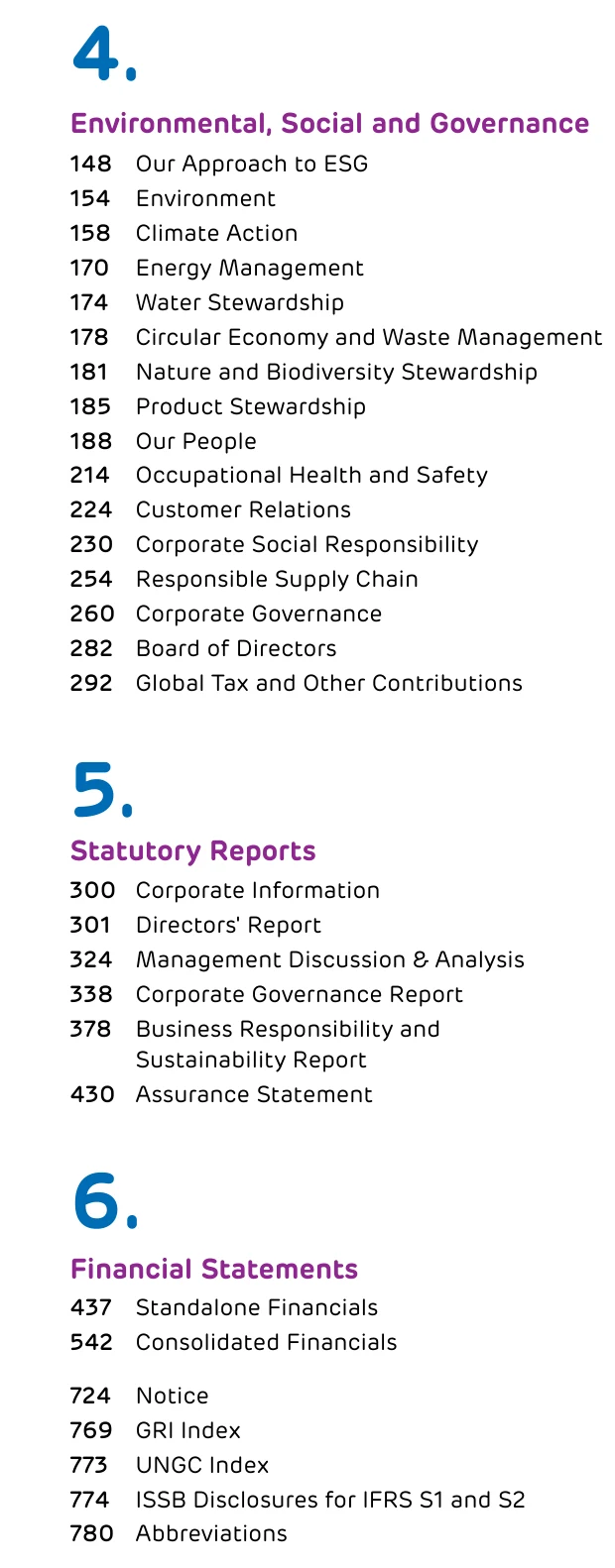
Adani Enterprises shows how far the folding can go. One contents page has CSR twice: as a chapter in the ESG section (page 230) and as the statutory annexure in the Directors' Report. It also has the BRSR, an assurance statement, a GRI index and ISSB disclosures. All five of this article's documents are in one PDF.
"Integrated" is a label more than a framework. Twenty-five of the 33 call the whole document integrated or include an integrated report section. Only eight use a plain title: Bajaj Auto, Bajaj Finance, Britannia, ITC's Report and Accounts, Pidilite, SBI, Sun Pharma and Titan. Whether the content follows the IR Framework is another matter, and our value creation review found most models fall short of it.
Five companies keep the BRSR out of the book. Axis Bank, ICICI Bank, NTPC, Reliance and SBI give a website link in the annual report instead of printing the BRSR. That's permitted, and it keeps the annual report 40 or more pages shorter. But it means a reader of the annual report alone won't see the company's mandatory ESG data. SBI's filing PDF adds a twist: the Sustainability Report bundled after the annual report carries the BRSR inside it.
The CSR annexure is the one fixed point. All 32 companies under the Companies Act print it as an annexure to the Board's report, in the format the CSR Rules prescribe. The exception proves the rule.
The BRSR's position is the least settled. Tata Steel, JSW Steel, L&T, LTM and Airtel print it before the Board's report. Axis Bank's and SBI's contents pages put it after the corporate governance report. Power Grid makes it Annexure II to the Directors' Report, and TCS says it forms part of the Board's report. The regulation says only that the annual report shall contain it.
Which one do I need?
Work through four questions in order. The first two decide what's compulsory. The last two are strategy.
- Is the company covered by Section 135? Any company, listed or unlisted, with net worth of ₹500 crore, turnover of ₹1,000 crore or net profit of ₹5 crore in the preceding financial year needs a CSR policy, a CSR spend and the annual report on CSR in its Board's report. Bodies outside the Companies Act, such as SBI, follow their own regulator.
- Is it among the top 1,000 listed companies by market capitalisation on 31 March? Then it files a BRSR with the annual report, in PDF and XBRL, and gets its BRSR Core assessed or assured. Once in, it stays in until it has been outside the top 1,000 for three consecutive years. Other listed companies, including SME-listed ones, may file a BRSR voluntarily.
- Do global investors, lenders, customers or rating agencies want more than the BRSR gives? Then a sustainability or ESG report under GRI is the usual answer, with IFRS S2 climate disclosures if investors are asking about climate risk. Decide early whether it's a separate document or a section of the annual report with a GRI index.
- Does the board want the annual report to tell one connected story about value creation? That's the case for integrated reporting. It costs more in drafting time than design, because finance, strategy and sustainability have to agree on the same numbers.
For an unlisted company that crosses a Section 135 threshold, the answer stops at the CSR report. For a listed mid-cap outside the top 1,000, it's the CSR report and possibly a voluntary BRSR. The full set of five belongs to large caps with international investors.
How to keep the five from contradicting each other
The risk with five documents isn't the workload. It's five versions of the same numbers.
- Use one data set. CSR spend, emissions, headcount and safety figures should come from one source, used in the CSR annexure, the BRSR, the sustainability report and the integrated report alike. Agree each boundary, standalone or consolidated, and state it.
- Let the BRSR cross-refer. If you publish a GRI report, map BRSR questions to its pages, as the NSE FAQ asks, rather than drafting the same answer twice.
- Assure the numbers once. BRSR Core indicators are now checked for the whole top 1,000. Use the assured figures everywhere they appear, and say which ones were assured.
- Mind the timing. The BRSR goes to the exchanges with the annual report. ITC says its FY 2025-26 Sustainability Report will follow "in due course". If the separate report comes months later, its numbers must still match the BRSR already filed.
- Don't call CSR spending ESG performance. A chairman's letter that answers an ESG question with CSR spending tells analysts the company hasn't understood the question.
If your team is starting FY 2026-27, list the five documents across the top of a page and the twenty numbers that appear in more than one of them down the side. Every cell should come from the same source. The gaps in that grid are the place to start.
Frequently asked questions
What is an ESG report?
An ESG report discloses how a company performs on environmental, social and governance issues: emissions, energy, water, waste, employees, safety, communities, board oversight and ethics. In India the mandatory ESG report is the Business Responsibility and Sustainability Report (BRSR), which the top 1,000 listed companies file under Regulation 34(2)(f) of SEBI's LODR Regulations. Many large companies also publish a voluntary ESG or sustainability report, usually under the GRI Standards, for investors, lenders, customers and rating agencies.
What is the difference between a CSR report and an ESG report?
A CSR report is an account of social spending. In India it's the annual report on CSR activities required by Section 135 of the Companies Act and Rule 8 of the CSR Rules: the policy, the committee, the obligation (usually 2% of average net profit), what was spent, on which projects, and any unspent amount. An ESG report covers the performance of the whole business, including emissions, resource use, workforce, safety and governance. CSR spending appears in an ESG report as one item among many.
Is the BRSR the same as a sustainability report?
Not quite. The BRSR is a mandatory SEBI format with fixed questions under nine principles, filed in PDF and XBRL with the stock exchanges. A sustainability report is a voluntary document whose structure the company chooses, usually following the GRI Standards. SEBI and the NSE allow a company to cross-reference its BRSR answers to a sustainability report instead of repeating the data, but the BRSR has to be filed either way.
Are ESG report and sustainability report the same thing?
In practice, yes. "Sustainability report" is the older term, used by GRI since 2000 and still the most common title in India. "ESG report" is the investor-facing name for the same kind of document. Infosys, ICICI Bank and Bajaj Finance call theirs ESG reports, and Mahindra, ITC, HCLTech and Sun Pharma call theirs sustainability reports. The content is broadly similar. What matters is which standard it follows and whether it is assured.
Does a CSR report need to be audited or assured?
No external assurance is required. The CFO certifies that CSR funds were used for the purposes and in the manner approved by the board, and the statutory auditor reports on any unspent CSR amount under CARO 2020. Companies with an average CSR obligation of ₹10 crore or more must also get an independent impact assessment of large projects and annex its summary to the CSR report.
Is an integrated report mandatory in India?
No. SEBI's circular of 6 February 2017 suggested that the top 500 listed companies consider integrated reporting from FY 2017-18, and that circular is now among those rescinded by the January 2026 LODR master circular. Even so, most large caps use the label: 25 of the 33 FY 2025-26 annual reports we read call themselves integrated or include an integrated report section.
Can a company put its BRSR on its website instead of in the annual report?
The NSE says yes. Question 9 of its FAQ circular NSE/CML/2024/11 of 10 May 2024 says a BRSR link can be given in the annual report instead of the whole report. The BRSR must still be filed with the exchanges in PDF and XBRL on the same day as the annual report. Axis Bank, ICICI Bank, NTPC, Reliance and SBI used the link route for FY 2025-26.
Sources
- SEBI (Listing Obligations and Disclosure Requirements) Regulations, 2015, consolidated (Regulation 34(2)(f)) — SEBI
- Master Circular for compliance with the provisions of the LODR Regulations by listed entities (30 January 2026) — SEBI
- NSE circular NSE/CML/2024/11: BRSR FAQs and guidelines for filing (10 May 2024) — National Stock Exchange of India
- Companies (Corporate Social Responsibility Policy) Amendment Rules, 2021 (22 January 2021) — Ministry of Corporate Affairs
- SEBI circular SEBI/HO/CFD/CMD/CIR/P/2017/10, Integrated Reporting by Listed Entities (6 February 2017) — SEBI
- International Integrated Reporting Framework, January 2021 — IFRS Foundation
- GRI Standards — Global Reporting Initiative
- IFRS S1 and IFRS S2, IFRS Sustainability Disclosure Standards — IFRS Foundation
- NTPC, Integrated Annual Report 2025-26 — NTPC
- State Bank of India, Annual Report and Sustainability Report FY 2025-26 — State Bank of India
- Tata Consultancy Services, Integrated Annual Report 2025-26 — TCS
- Adani Enterprises, Integrated Annual Report 2025-26 — Adani Enterprises