


CSR applies for FY 2026-27 if FY 2025-26 net worth, turnover or net profit crossed ₹500 crore, ₹1,000 crore or ₹5 crore. The spend is 2% of the three-year average Section 198 profit, after two exclusions. Here is the whole sum, worked through.
In this article
 In short
Key takeaways
- For FY 2026-27, the three Section 135(1) tests look only at FY 2025-26: net worth of ₹500 crore, turnover of ₹1,000 crore or net profit of ₹5 crore. Crossing any one of them is enough.
- Net profit for CSR is profit before tax, adjusted under Section 198 and then reduced by the two exclusions in Rule 2(1)(h) of the CSR Rules: overseas branch profit and dividends from Indian companies that comply with Section 135.
- The obligation is 2% of the average of the three preceding years' CSR profit. A loss year counts as a negative figure, and a negative average means nothing is due.
- Under Rule 7(3), excess spending can reduce the obligation of the next three financial years, but only with a board resolution and never using surplus earned from CSR activities.
- Unspent money for an ongoing project goes to an Unspent CSR Account within 30 days of the year end. Any other shortfall goes to a Schedule VII fund within six months.
- A board can do the CSR committee's work only if the obligation is ₹50 lakh or less. Since September 2022, any balance in the Unspent CSR Account means the committee must stay.
- The Corporate Laws (Amendment) Bill, 2026 would lift the profit test to ₹10 crore. A Joint Parliamentary Committee reported on it on 3 August 2026, but it was not law as of 17 October 2026.
A company must spend on CSR in FY 2026-27 if, in FY 2025-26, it had net worth of ₹500 crore, turnover of ₹1,000 crore or net profit of ₹5 crore. Crossing any one of these is enough. The amount is at least 2% of its average net profit for the three years before FY 2026-27.
CSR, or corporate social responsibility, is the spending on social causes that Section 135 of the Companies Act, 2013 makes compulsory for larger companies. The hard part isn't the 2%. It's the net profit that the 2% is taken on, which is not the profit in the annual report. We'll work one company through the whole sum below. If you'd rather enter your own figures, our free CSR calculator runs the same steps and shows each one.
The three Section 135(1) tests for FY 2026-27
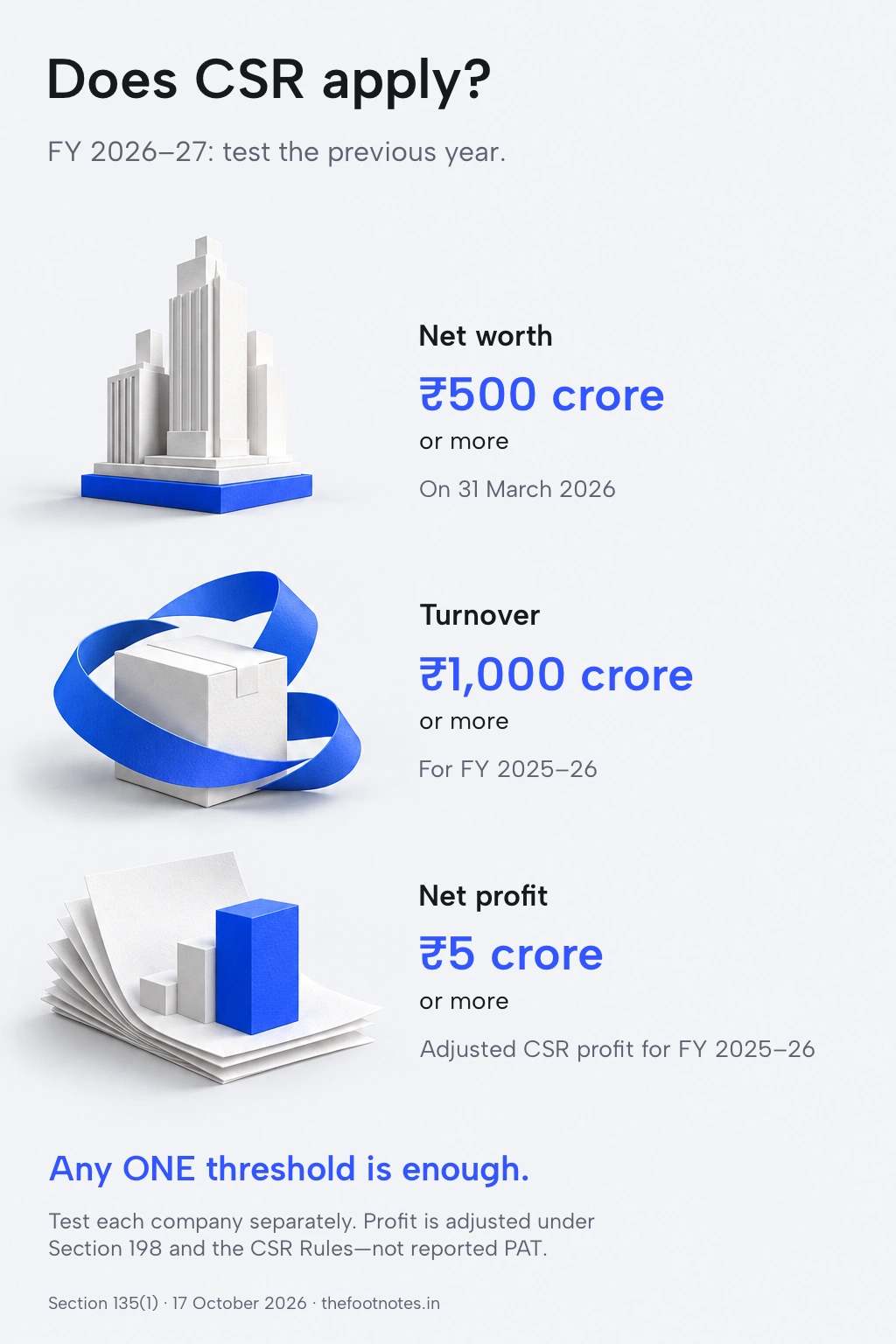
Read the infographic as text
- Net worth. ₹500 crore or more on 31 March 2026.
- Turnover. ₹1,000 crore or more in FY 2025–26.
- Net profit. ₹5 crore or more in FY 2025–26. Use Section 198 profit after CSR Rule exclusions, not reported PAT.
Any one threshold is enough. Test each company separately. Section 135(1); framework used in this article as at 17 October 2026.
Section 135(1) looks at the immediately preceding financial year. For FY 2026-27, that means the audited figures for FY 2025-26.
| Test | Threshold | Figure to use |
|---|---|---|
| Net worth | ₹500 crore or more | Net worth on 31 March 2026 |
| Turnover | ₹1,000 crore or more | Turnover for FY 2025-26 |
| Net profit | ₹5 crore or more | Section 198 net profit for FY 2025-26 |
The tests apply to each company on its own figures. A group doesn't add its subsidiaries together. Private companies are covered on the same terms as public ones, and so are Indian branches of foreign companies.
Two points often catch people out. First, the ₹5 crore profit test doesn't use the profit in the annual report. It uses the same adjusted profit as the 2% sum, explained in the next section. Second, a company that falls below all three tests is free of CSR from the next year. An older rule made such companies keep spending for three more years, but it was deleted in September 2022.
Net profit for CSR: two steps
The profit used for CSR is worked out in two steps. The first comes from Section 198 of the Companies Act. The second comes from the CSR Rules, whose full name is the Companies (Corporate Social Responsibility Policy) Rules, 2014.
Step 1: adjust profit before tax under Section 198
Start with profit before tax, not after tax. Section 198 doesn't allow income tax to be deducted, and the Ministry of Corporate Affairs (MCA) confirmed this in its CSR FAQs of 25 August 2021. Section 198 is the same section companies use to cap directors' pay.
Section 198 then removes one-off gains and gains that exist only on paper. The idea is to keep only regular profit that the company has actually earned. The items that come up most often:
- Gains from selling a long-term asset, such as a building, a factory or shares in a subsidiary. These one-off gains come out. The exception is the part that only makes up for depreciation charged in earlier years, which stays in. The worked example shows how.
- Gains that exist only on paper. If investments rose in value but weren't sold, that gain comes out.
- Losses from earlier years, worked out the same way. They're carried forward and deducted until they're used up.
Money raised by issuing shares above face value never goes through the profit and loss account, so it needs no adjustment. Past CSR spending isn't added back either. This year's CSR budget rests on earlier years' profits, so this year's own CSR spending never enters the figure.
Step 2: remove two items under the CSR Rules
Rule 2(1)(h) of the CSR Rules then takes out:
- profit of any branch outside India, whether run as a separate company or not
- dividends from other Indian companies that must spend on CSR themselves and do so
The second item stops the same profit being counted twice, because the company paying the dividend already has its own CSR duty.
Worked example: CSR calculation for FY 2026-27
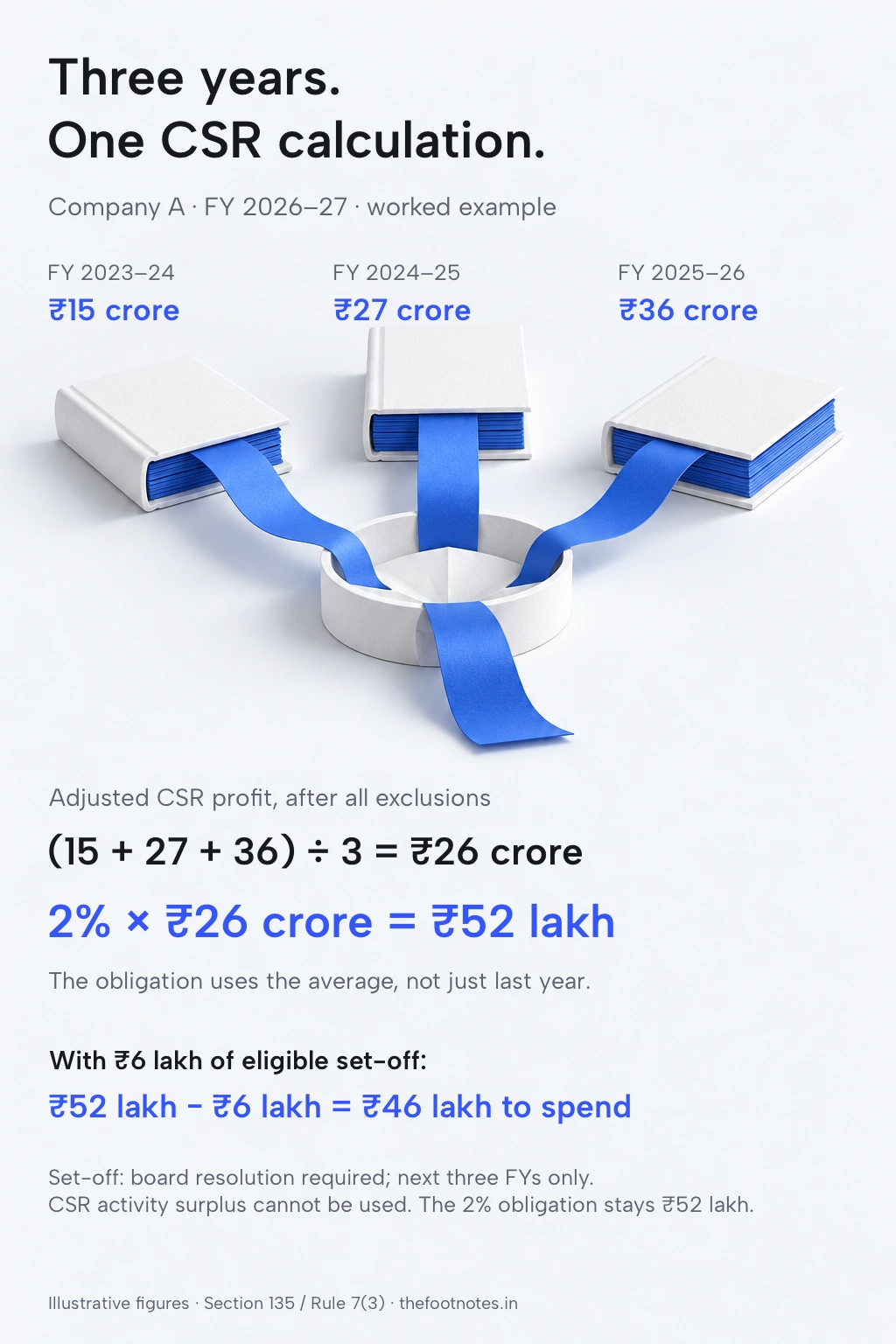
Read the infographic as text
- Use adjusted CSR profit. FY 2023–24: ₹15 crore. FY 2024–25: ₹27 crore. FY 2025–26: ₹36 crore. These are after Section 198 adjustments and CSR Rule exclusions.
- Average the three years. (₹15 crore + ₹27 crore + ₹36 crore) ÷ 3 = ₹26 crore.
- Apply 2%. 2% × ₹26 crore = ₹52 lakh obligation for FY 2026–27.
- Then apply eligible set-off. In this example, ₹52 lakh − ₹6 lakh = ₹46 lakh to spend. Set-off requires a board resolution, must be within the next three financial years, and cannot use surplus from CSR activities.
Illustrative Company A figures from the article. Set-off reduces spending due, not the underlying 2% obligation.
Take Company A, a private company. Its turnover is ₹600 crore and its net worth ₹300 crore, so only the profit test can bring it in. All figures are in ₹ crore.
| Step | FY 2023-24 | FY 2024-25 | FY 2025-26 |
|---|---|---|---|
| Profit before tax in the accounts | 21.0 | 30.0 | 52.0 |
| Less: capital profit on sale of a subsidiary | (4.0) | – | – |
| Less: gain on sale of a building above original cost | – | – | (10.0) |
| Less: unrealised fair value gain on investments | – | (1.0) | (2.0) |
| Net profit under Section 198 | 17.0 | 29.0 | 40.0 |
| Less: profit of the Dubai branch | (2.0) | (2.0) | (3.0) |
| Less: dividend from an Indian subsidiary that does its own CSR | – | – | (1.0) |
| Net profit for CSR | 15.0 | 27.0 | 36.0 |
The building row needs a word. Company A bought an office building for ₹10 crore. After years of depreciation, its value in the books was ₹4 crore. It then sold the building for ₹20 crore, so the accounts show a ₹16 crore gain. The first ₹6 crore only makes up for the depreciation charged earlier, so it stays in. The other ₹10 crore is the amount above the original price. That's a one-off gain, and it comes out.
Now the three steps:
- Does CSR apply? FY 2025-26 net profit for CSR is ₹36 crore. That clears ₹5 crore, so yes.
- What's the average? (15 + 27 + 36) ÷ 3 = ₹26 crore.
- What's 2%? 2% of ₹26 crore is ₹52 lakh.
Notice that the obligation uses the average, not the latest year. Company A made ₹36 crore last year but owes 2% of ₹26 crore.
A year with a loss goes into the average as a negative number. If the three-year average comes out negative, nothing is due. A company less than three years old averages only the years it has completed, as Section 135(5) allows.
Carrying excess spending forward (set-off under Rule 7(3))
A company that spends more than its 2% can use the extra to reduce later years' spending. The CSR Rules call this set-off. Say Company A spent ₹6 lakh more than it had to in FY 2025-26, and its board passed a resolution to carry that excess forward. Rule 7(3) lets it set that ₹6 lakh against the next three years' obligations. Its FY 2026-27 spend falls from ₹52 lakh to ₹46 lakh.
The conditions are tight:
- The excess can be used only in the three financial years after the year it arose. After that it lapses.
- The board must pass a resolution to claim it.
- Surplus that CSR activities themselves earn, such as interest on CSR funds, can't count as excess.
- The MCA's 2021 FAQs say set-off applies only to excess spent from FY 2020-21 onwards.
Set-off reduces what the company has to spend. It doesn't change the 2% obligation itself, and that obligation still decides the committee question below.
Does the company need a CSR committee?
Section 135(1) asks covered companies to form a CSR committee of the board. It needs at least three directors, one of them an independent director, meaning one with no business or family link to the company. A company that doesn't have to appoint independent directors, such as most unlisted private companies, can have two directors on it.
Under Section 135(9), a company doesn't need the committee if its obligation is ₹50 lakh or less. The full board does the committee's work instead. Company A's obligation is ₹52 lakh, so it needs a committee. We read the ₹50 lakh limit as applying to the 2% figure before any set-off, so the ₹6 lakh doesn't bring it under the line. Our calculator works the same way. Some advisers take the opposite view, so check with yours if you're close to the line.
A rule change on 20 September 2022 added one more case. A company with any money left in its Unspent CSR Account must keep its CSR committee, however small its obligation. That account is explained in the next section. Until it's empty, the ₹50 lakh exemption doesn't help.
Unspent CSR money: two accounts, two deadlines
Suppose Company A spends only ₹40 lakh of its ₹46 lakh in FY 2026-27. Its ₹6 lakh shortfall splits into two, depending on what the money was meant for.
The CSR Rules define an ongoing project as one that runs over several years, for up to three years after the year it started. Say ₹4 lakh of the shortfall belongs to such a project and ₹2 lakh doesn't. The law treats the two amounts differently.
Schedule VII, mentioned below, is the list at the end of the Companies Act of activities and funds that count as CSR.
| Shortfall | Where it goes | Deadline for FY 2026-27 |
|---|---|---|
| ₹4 lakh for an ongoing project | Unspent CSR Account, a separate bank account opened only for this money | 30 April 2027, which is 30 days after year end |
| ₹2 lakh for anything else | A government fund named in Schedule VII, such as the PM CARES Fund or the PM National Relief Fund | 30 September 2027, which is six months after year end |
The company then has three financial years to spend the money in the Unspent CSR Account. For Company A, that runs to the end of FY 2029-30. Anything still left then goes to a Schedule VII fund within 30 days.
The board's report must also explain why the money wasn't spent. Those reasons go in the annual report on CSR, which sits in the board's report section of the annual report.
Missing either transfer is costly. Under Section 135(7), the company can be fined twice the amount it should have moved, up to ₹1 crore. Each officer responsible can be fined a tenth of the amount, up to ₹2 lakh. On Company A's ₹6 lakh, that's up to ₹12 lakh for the company and ₹60,000 for each officer.
Other limits worth checking
- Administrative overheads can't exceed 5% of the year's total CSR spending, under Rule 7(1).
- A company whose CSR obligation averaged ₹10 crore or more over the last three years must hire an outside agency to study what its larger projects achieved. This impact assessment covers projects of ₹1 crore or more that finished at least a year earlier.
- Since September 2022, the cost of that assessment can be up to 2% of the year's CSR spend or ₹50 lakh, whichever is higher.
- Since 27 May 2026, a company can also spend CSR money by subscribing to zero coupon zero principal (ZCZP) instruments issued on a Social Stock Exchange by a not-for-profit registered with it. The Companies (Corporate Social Responsibility Policy) Amendment Rules, 2026 (G.S.R. 415(E)) insert Rule 4A, which caps this route at 10% of the company's total CSR expenditure for the year and exempts these projects from the impact assessment requirement. A separate notification (G.S.R. 416(E)) adds ZCZP subscriptions to Schedule VII as item (xiii).
What the Corporate Laws (Amendment) Bill, 2026 would change
The government introduced the Corporate Laws (Amendment) Bill, 2026 in the Lok Sabha on 23 March 2026. The same day, it was sent to a Joint Parliamentary Committee, a group of MPs from both houses, for closer study. PRS Legislative Research records that the committee reported on 3 August 2026. As of 17 October 2026, the Bill had not been passed, so it doesn't apply to FY 2026-27 budgets yet.
| Point | Law in force today | Bill as introduced |
|---|---|---|
| Net profit test in Section 135(1) | ₹5 crore | ₹10 crore, or another amount the government sets by rules |
| No committee needed, Section 135(9) | Obligation of ₹50 lakh or less | ₹1 crore or less, or a higher amount set by rules |
| Transfer to the Unspent CSR Account | 30 days after year end | 90 days after year end |
| Companies exempt from CSR | None | Companies meeting conditions the government sets by rules |
Net worth and turnover limits stay at ₹500 crore and ₹1,000 crore. For Company A, the Bill would change one thing. Its ₹36 crore profit still clears ₹10 crore, but with a ₹52 lakh obligation it would no longer need a CSR committee.
The bigger effect is lower down. A company with ₹5 crore to ₹10 crore of CSR profit and no other test met would drop out of CSR altogether. The Bill also lets the government change these limits later through rules, without going back to Parliament. Even after the Bill passes, nothing changes until the government announces a start date. That date will decide which financial year is the first one affected.
Our CSR calculator has a switch that shows both views side by side. We'll update this page and the calculator when the Bill is passed.
A checklist for the CSR budget meeting
Before the board approves the FY 2026-27 CSR budget, the company secretary and CFO should have:
- the FY 2025-26 net worth, turnover and Section 198 net profit, checked against the three tests
- a Section 198 calculation for each of FY 2023-24, FY 2024-25 and FY 2025-26, showing every item removed
- the overseas branch profit and qualifying Indian dividends for each year, with a note on whether each paying company complies with Section 135
- the board resolution for any excess being set off, and the year each excess arose
- the balance in any Unspent CSR Account, since it decides whether the committee can be dropped
- any planned ZCZP subscriptions on a Social Stock Exchange, checked against the 10% cap under Rule 4A
- a note on the Bill's status, so the board knows which numbers could change
CSR is one of several applicability tests a listed company runs each year. The BRSR applicability test is another, and it uses different figures.
Frequently asked questions
Is CSR applicable for FY 2026-27 if net profit was ₹5 crore in FY 2025-26?
Yes. Section 135(1) applies at a net profit of ₹5 crore or more in the immediately preceding financial year, so ₹5 crore exactly is enough. The profit is the Section 198 figure, before tax, after the Rule 2(1)(h) exclusions. The ₹10 crore figure in the Corporate Laws (Amendment) Bill, 2026 does not apply until the Bill is passed and the change is brought into force.
Is net profit for CSR before tax or after tax?
Before tax. The Explanation to Section 135 says net profit is calculated under Section 198, and Section 198(5) does not allow income tax to be deducted. The MCA's CSR FAQs of 25 August 2021 confirm that profit before tax is used.
How is net profit for CSR calculated?
Start with profit before tax. Remove the items Section 198 does not allow, such as one-off gains from selling a building or a subsidiary, and gains on investments that haven't been sold. Then deduct overseas branch profit and dividends from Indian companies that comply with Section 135. Do this for each of the three preceding years, average the three, and take 2%.
Is CSR spending added back when working out next year's net profit?
No. Vinod Kothari and Company's Section 198 FAQ notes that CSR spending is not an item under Section 198. The CSR obligation for a year is based on earlier years' profits, so the CSR expense already charged in those years stays deducted.
How long can excess CSR spending be carried forward?
For the three financial years after the year of the excess, under Rule 7(3) of the CSR Rules. The board must pass a resolution, and surplus earned from CSR activities cannot be counted as excess. Any excess still unused after three years lapses.
Does a company with a CSR obligation below ₹50 lakh need a CSR committee?
Usually not. Section 135(9) lets the board do the committee's work when the obligation is ₹50 lakh or less. Since the CSR Amendment Rules of 20 September 2022, though, a company with any amount in its Unspent CSR Account must keep its CSR committee.
Sources
- Companies (Corporate Social Responsibility Policy) Amendment Rules, 2026 (G.S.R. 415(E), 27 May 2026) — Ministry of Corporate Affairs (Gazette of India)
- Schedule VII amendment: ZCZP instruments on Social Stock Exchange (G.S.R. 416(E), 27 May 2026) — Ministry of Corporate Affairs (Gazette of India)
- Section 135, Companies Act, 2013 (full text) — LawX
- Rule 2, Companies (CSR Policy) Rules, 2014, as substituted on 22 January 2021 — ca2013.com
- MCA FAQs on CSR, General Circular 14/2021 dated 25 August 2021 (reproduced) — AUBSP
- Frequently asked questions on section 198 of Companies Act, 2013 — Vinod Kothari and Company
- Companies (CSR Policy) Amendment Rules, 2021: detailed analysis — TaxGuru
- FAQs on CSR 2021 amendments — Vinod Kothari and Company
- Highlights of the CSR Amendment Rules, 2022 — Vinod Kothari and Company
- The Corporate Laws (Amendment) Bill, 2026 — PRS Legislative Research
- The Corporate Laws (Amendment) Bill, 2026: proposed changes to Section 135 of the Companies Act, 2013 — S.S. Rana & Co.