


No Indian law requires a Chairman's or CEO's letter, yet it's the page that sets the tone for the whole report. We went back to the leadership messages in the FY2025-26 reports we've scored and pulled eight real pages: the letters that make an argument, give the numbers early and name the bad news, and the ones that leave a 26% profit fall to the MD&A. Here's a structure for each message, a checklist, and what it means for CFOs, company secretaries and IR teams.
In this article
 In short
Key takeaways
- No statute requires a leadership letter. The Board's report (section 134 of the Companies Act) and the MD&A (LODR Regulation 34(2)(e) and Schedule V Part B) are the mandatory narratives, so the letter's job is to lead the reader into them, not repeat them.
- The Integrated Reporting Framework asks for 'all material matters, both positive and negative, in a balanced way' (paragraph 3.39) and lists reporting against previously reported targets as a method of ensuring balance (paragraph 3.45).
- HUL's new CEO gave turnover, volume growth and quarterly acceleration in the second paragraph of her first letter. TCS's CEO reported against each of five strategy pillars with numbers.
- Infosys's Chairman asked the question investors were asking, 'If coding becomes automated, then why are we needed at all?', and answered it. Titan's MD named US tariffs and gold price volatility.
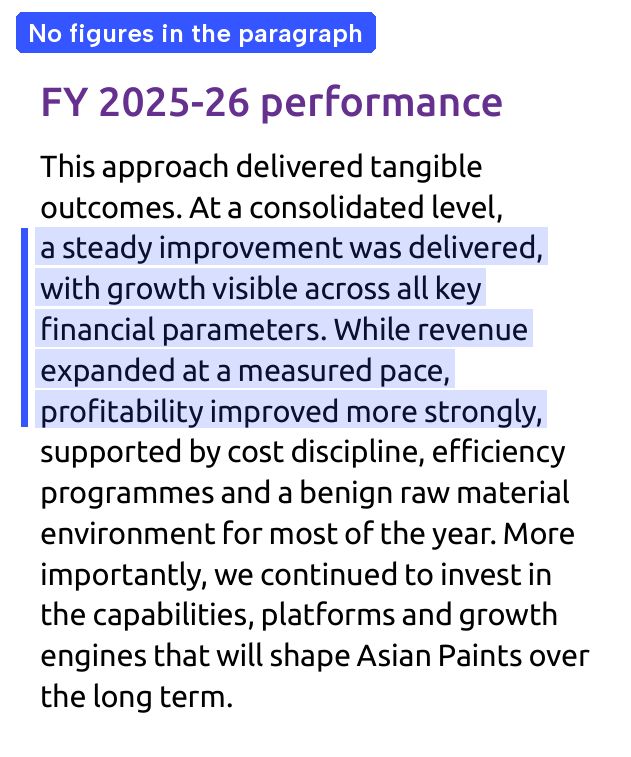
- Dr. Reddy's letter gives revenue growth of 3.2% and an EBITDA margin of 22.8% but not the 26% fall in net profit that its MD&A states (PDF pp. 4 and 60). Asian Paints' MD and CEO's 'FY 2025-26 performance' paragraph contains no figures.
- Where there are several letters, divide the work. Hindustan Zinc (30 of 35, the top score in our reviews) has a Chairperson's message, a CEO's message and a separate CFO's statement that explains the move from net debt to net cash.
The Chairman's message is usually the first thing in an Indian annual report after the highlights, and it's the one section with no rulebook. That freedom is why so many letters read alike: a paragraph on the global economy, a paragraph on India's growth, a list of achievements, thanks to employees.
We've scored twenty FY2025-26 annual reports on a seven-point card, and the leadership messages explain a fair share of the gap between the top and the bottom. Below are eight real pages from those reports, what each one does, and how to write yours.
What the law asks for, and what it doesn't
Neither the Companies Act, 2013 nor the SEBI LODR Regulations requires a Chairman's or CEO's letter. The mandatory narratives are the Board's report under section 134 of the Act and, for listed companies, the Management Discussion and Analysis under Regulation 34(2)(e), which Schedule V Part B fills out with ten items from industry structure to the 25% key-ratio rule. We've covered those clause by clause in our MD&A guide.
So the letter is optional, but it isn't free of standards. SEBI's February 2017 circular invited the top 500 listed companies to adopt integrated reporting voluntarily, and many large Indian reports now follow the Integrated Reporting Framework. Paragraph 3.39 of the Framework says a report "should include all material matters, both positive and negative, in a balanced way". Paragraph 3.45 lists ways to achieve balance, including reporting against previously reported targets and forecasts. A letter that celebrates the good lines and drops the bad ones fails that test even though no regulator will penalise it.
There's a second check people forget. Under SA 720 (Revised), the auditor must read the "other information" in the annual report and consider whether it's materially inconsistent with the financial statements (ICAI implementation guide). How far that reaches depends on how the auditor's report defines the other information. HUL's standalone auditor's report defines it as the information in the Annual Report (PDF p. 132), which takes in the letters. Infosys's lists the MD&A, Board's report, BRSR and corporate governance report (PDF p. 198). Either way, a number in the CEO's letter that doesn't match the accounts is a problem someone will find.
What the best FY2025-26 letters do
They make an argument

- The questionWhy did margins fall? Why this acquisition? What changes after the leadership transition?
- The evidenceGive the headline result, the decision and the facts that support the explanation.
- The answerState leadership’s response, its rationale and what shareholders should watch next.
Editorial writing method distilled from this article. The artwork represents the logic of a letter, not actual financial data.
Nandan Nilekani's Chairman's message in the Infosys report is the best piece of leadership writing we've read this season, because it argues a case instead of listing events. It names the question every IT services investor was asking and then spends the letter answering it: testing, validation, architecture, cybersecurity, data governance and what it calls the deployment gap in large enterprises. It runs to well under 900 words on one spread.
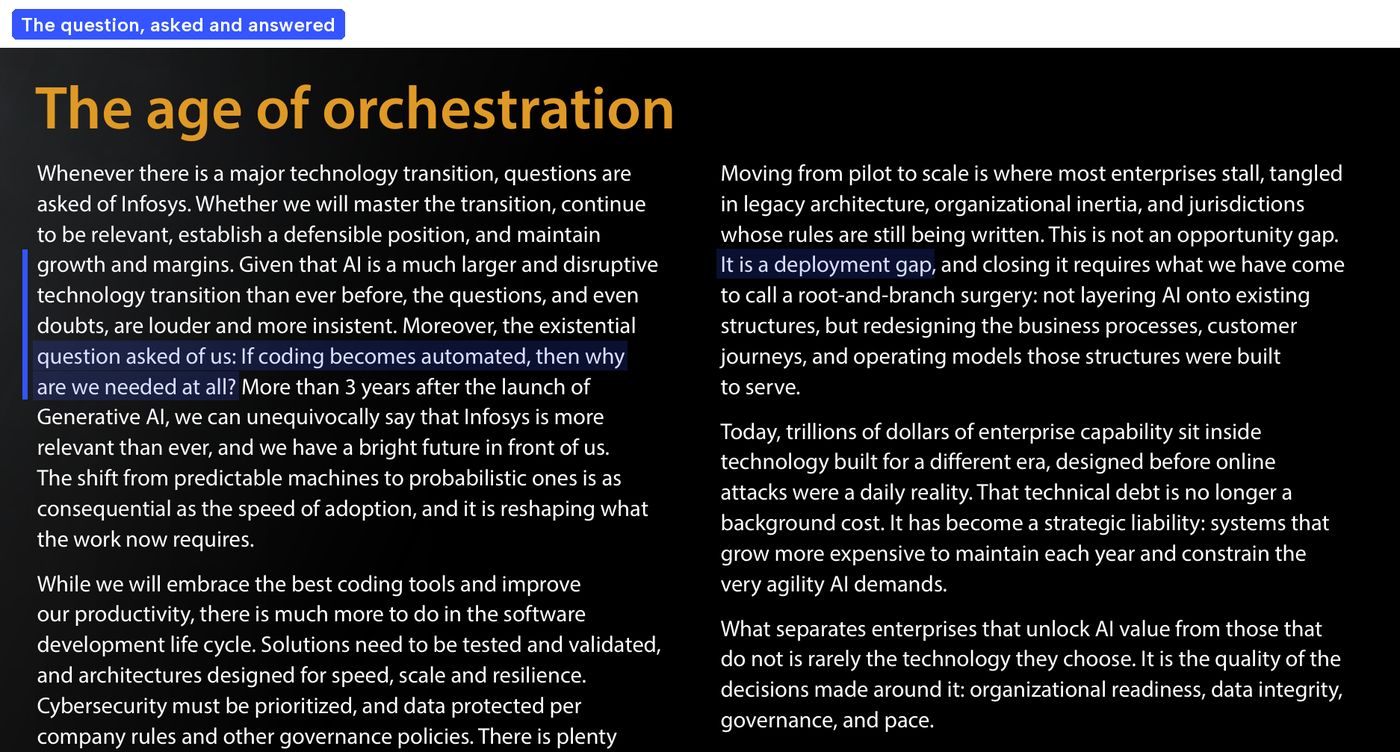
You don't need a technology shift to do this. Every company has one question its shareholders want answered that year: why margins fell, why the acquisition, why the new chairman. A Chairman who picks that question and answers it has written a letter worth reading.
They give the numbers early
Priya Nair's first letter as CEO and Managing Director of HUL gets to the results in its second paragraph: turnover of ₹63,763 crore, 5% growth, 4% underlying volume growth, and underlying sales growth that stepped up from 3% in the first half to 7% in the March quarter. The next paragraph gives the EBITDA margin (23.6%), profit after tax from continuing operations (₹10,652 crore) and the dividend. HUL scored 28 of 35.
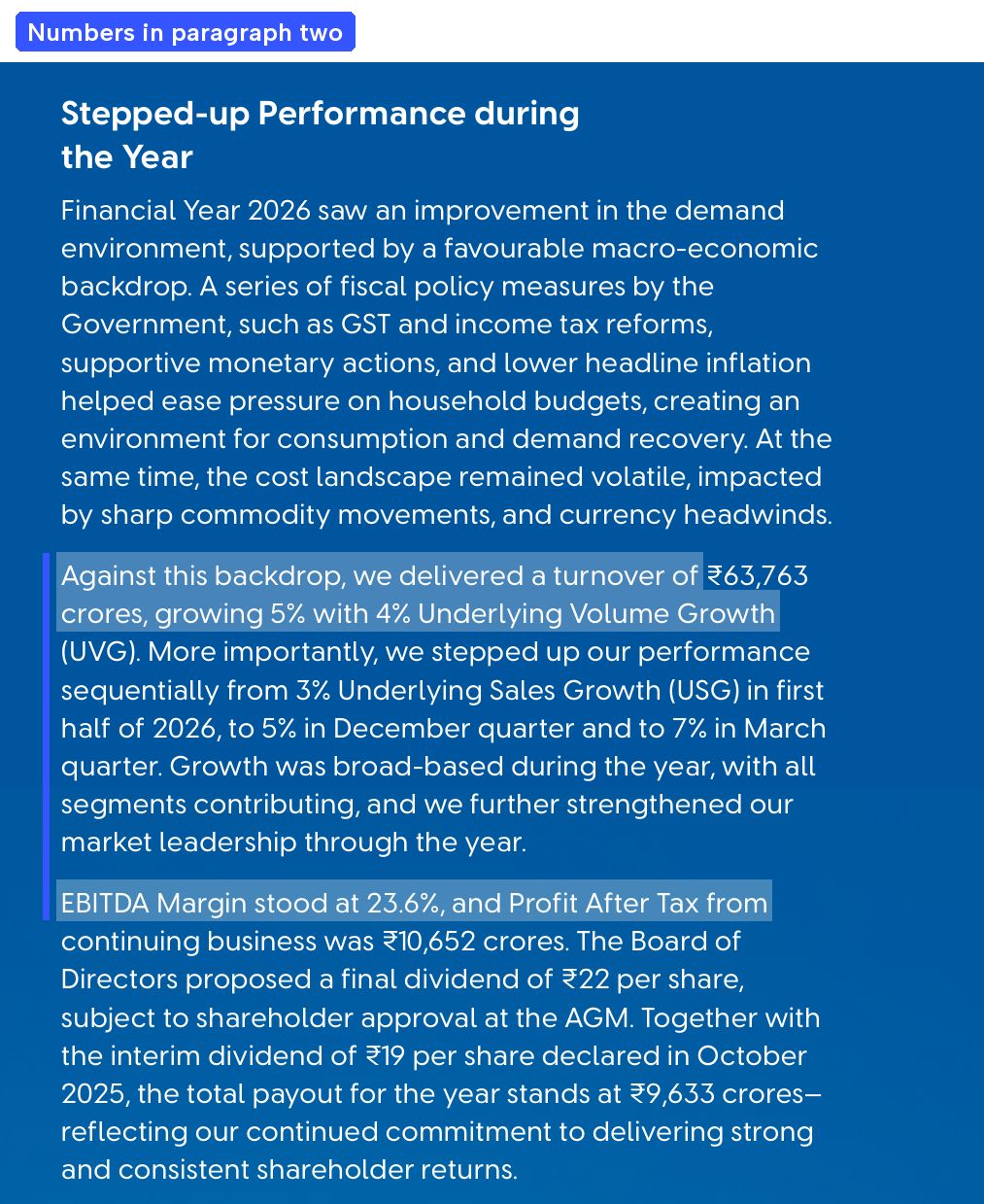
Compare that with the opening most letters still use. Bajaj Finance's only letter opens with Middle East tensions and the Strait of Hormuz, and the HDFC Bank Chairman's message reaches the previous Chairman's resignation only after a page of IMF growth statistics. Macro context belongs in the MD&A, where Schedule V asks for it.
They name the pressure
Ajoy Chawla's first letter as Titan's Managing Director doesn't pretend the year was smooth. It says US tariffs on India "peaked in August 2025", that gold price volatility created significant uncertainty among jewellery buyers, and that Jewellery and EyeCare growth fluctuated across quarters. Later it flags near-term headwinds from the Middle East war.
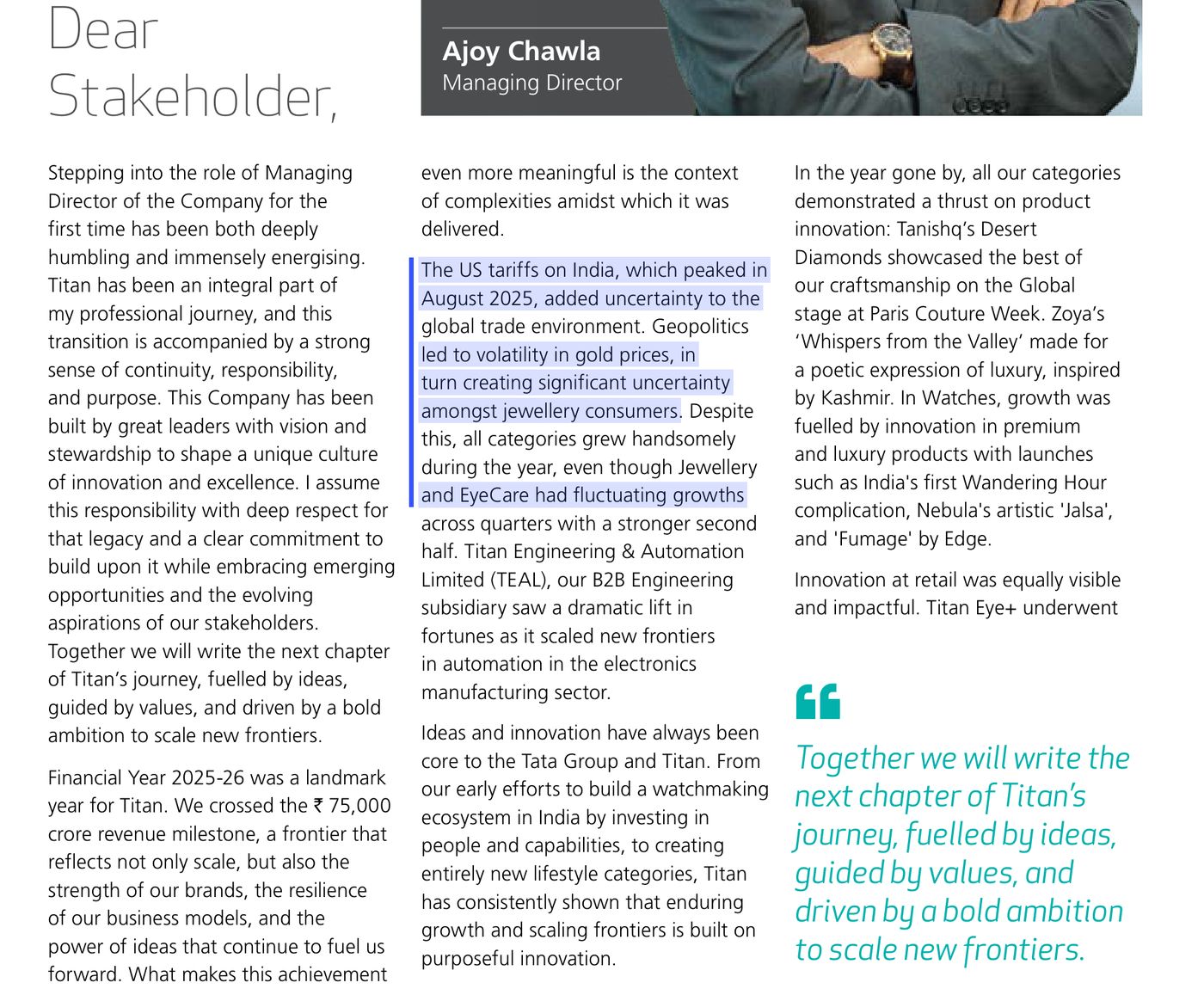
That candour is why the letter reads as credible when it then reports the good news. The Titan report still scored only 23 of 35, and one reason is a letter that's missing: there's no Chair's message in a year when the Chair changed.
The CFO explains the weak line
A CFO's review is rare in Indian annual reports. We found few among the 35 reports in our agency comparison. Where one exists, it should do the job the CEO's letter can't: explain the movements.
LTM's Whole-time Director and CFO does exactly that. Net profit rose 8.3% to ₹49,827 million, and in the same sentence he gives the PAT margin, 11.8% against 12.1%, and the reason for the dip: a one-time provision for the new labour codes from the third quarter. He goes on to cash conversion, days sales outstanding (up from 79 to 84) and the current ratio, which fell from 3.5 to 2.8.
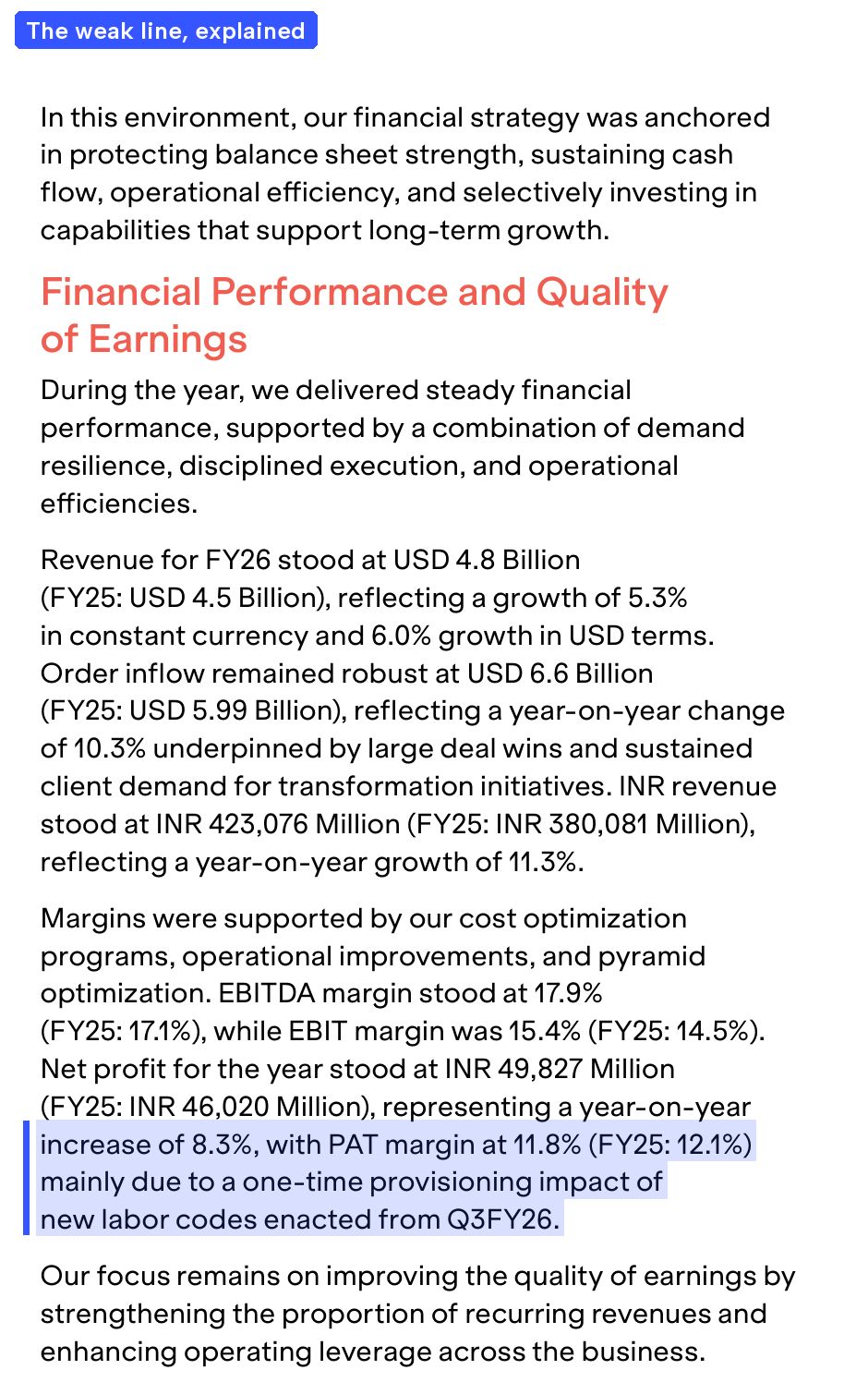
Hindustan Zinc, which scored 30 of 35, the highest in our reviews, has the most complete set: a Chairperson's message, a CEO's message with the year in numbers, and a separate CFO's statement that says the year beat the company's own guidance and explains the swing from ₹1,169 crore of net debt to ₹5,594 crore of net cash.
They don't leave safety to the BRSR
Tata Steel's best leadership pages aren't the Chairman's message, which is conventional. They're "Management Speak", a question-and-answer section with the CEO and the CFO. On safety it says the company deeply regrets nine fatalities across the group, eight in India and one in the UK. Elsewhere in the same Q&A it covers the Netherlands penalties and the permit revocation notice.
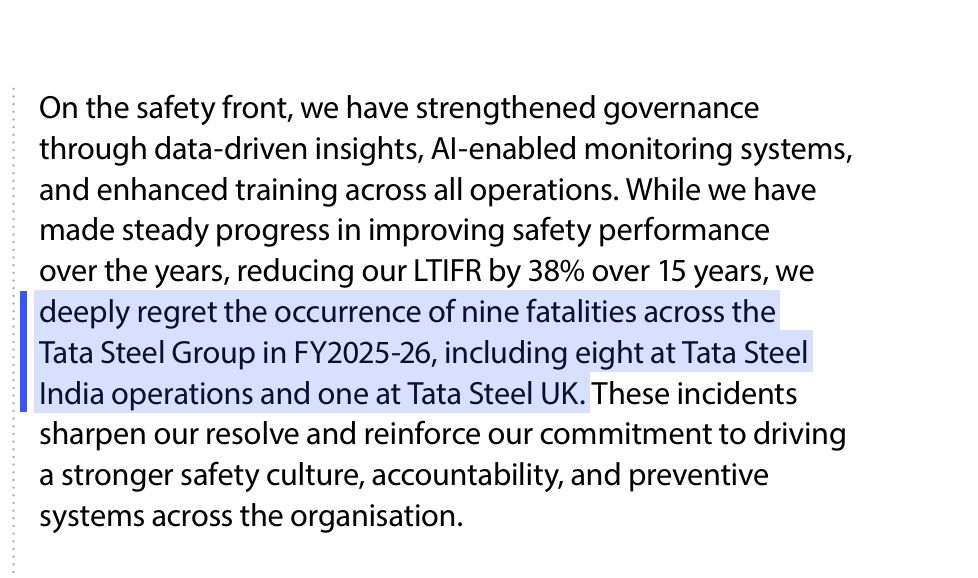
The Q&A format is worth copying. It forces the writer to answer questions instead of choosing topics, and readers can jump to the one they care about. It's also harder to skip an uncomfortable question once the reader can see what's been asked. Our Tata Steel review has the rest.
They report against the strategy they set
The TCS CEO's letter states one aspiration and five transformation pillars, then takes each pillar in turn with a number attached: more than 281,000 hackathon participants under tcsAI, 69 million learning hours under the talent model. The Chairman's letter adds the year's financials and four focus areas for the coming year. TCS scored 29 of 35, second only to Hindustan Zinc.
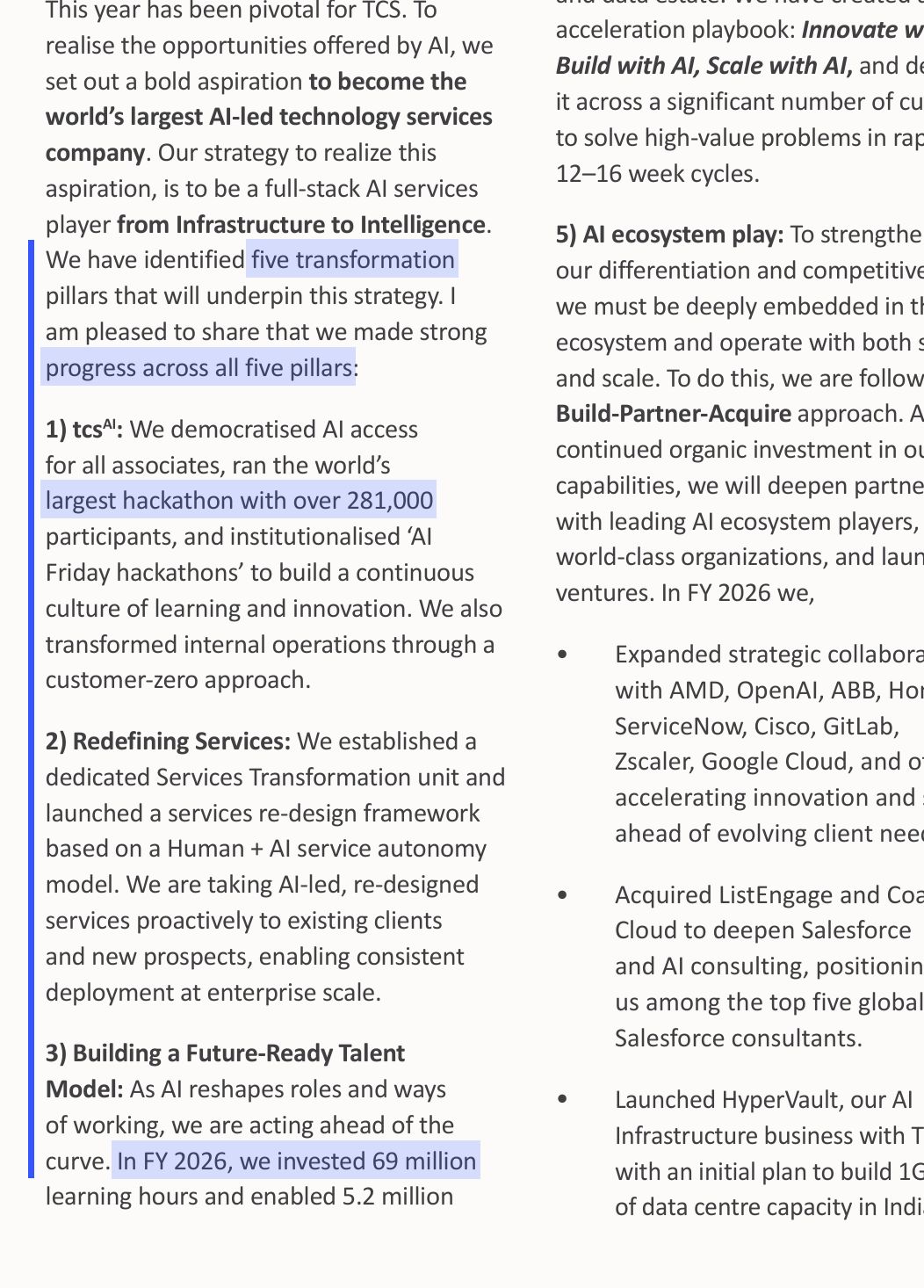
Airtel goes a step further with a "Quarterly Strategic Progress" page that tracks what was announced against what was delivered. If your strategy has targets, the letter is where you say how close you are.
Where letters go wrong

- ResultState what improved and what deteriorated. Put the prior year alongside.
- CauseExplain the drivers of the weaker line, including material one-off items.
- ResponseSay what management is doing, and distinguish completed action from future plans.
Show reported results first. Where adjusted measures help, provide the reconciliation or a clear page reference.
Conceptual illustration. Explain material setbacks alongside achievements; use reported figures and a consistent basis.
The bad number is in the MD&A only
Dr. Reddy's joint message from the Chairman and the Co-Chairman and MD gives revenue growth of 3.2% and an EBITDA margin of 22.8%, explains both by the expected decline in US lenalidomide sales and one-off items, and adds adjusted figures. It doesn't mention net profit. The MD&A, 56 pages later, says net profit fell 26% to ₹42,466 million from ₹57,245 million.
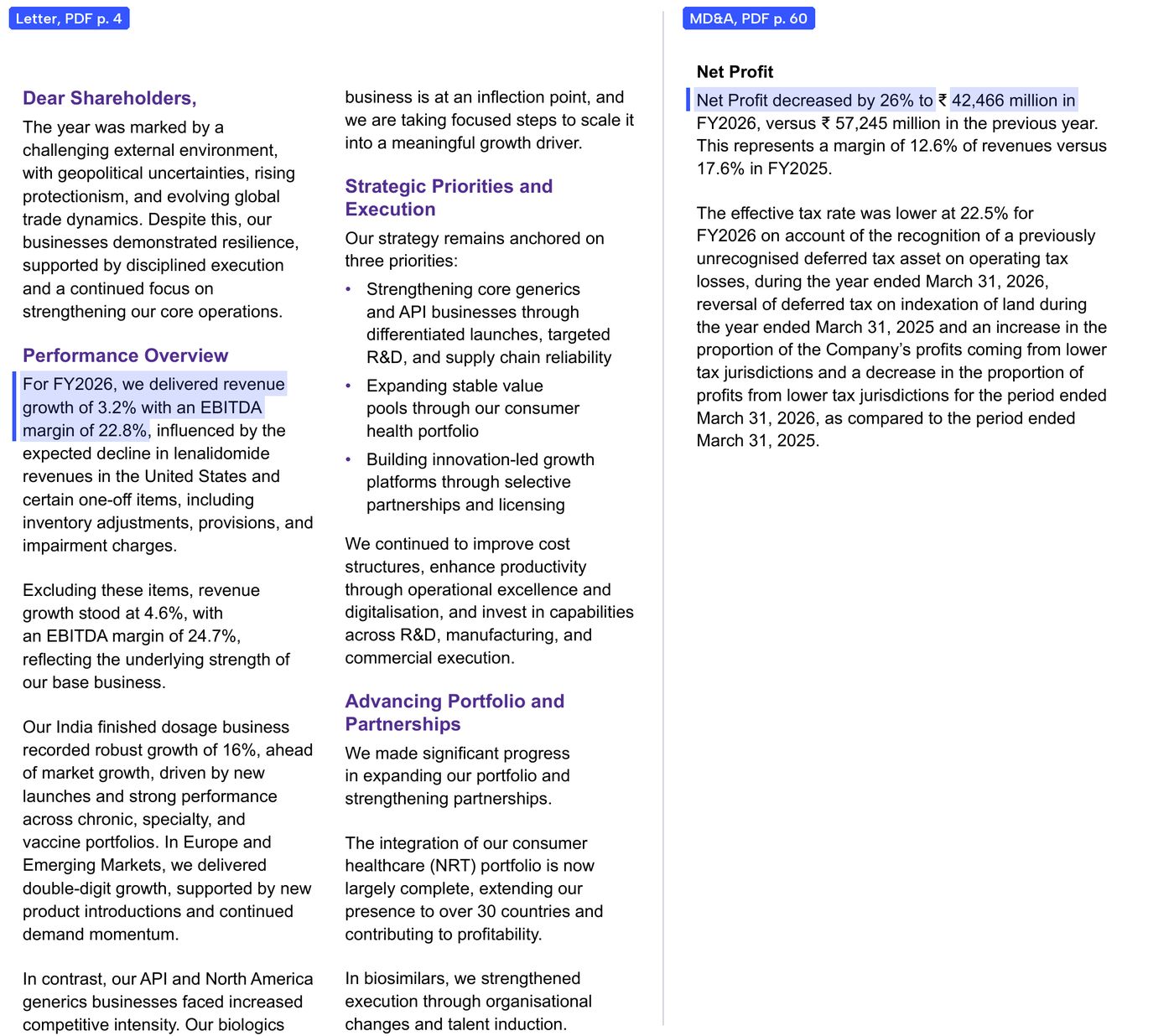
It's a report we otherwise rate highly (27 of 35), with ESG targets set out against progress in one table. That's what makes the silence in the letter stand out. The same pattern shows up at L&T, where a combined Chairman and MD message of about 2,500 words discusses record order inflow but not the ₹6,843 crore exceptional charge.
Adjectives where figures should be
Asian Paints' MD and CEO's letter has a section headed "FY 2025-26 performance". It says growth was "visible across all key financial parameters" and that revenue "expanded at a measured pace". There isn't a figure in the paragraph. Standalone revenue grew 4.3% that year, which is the number a shareholder wanted. The Chairman's letter in the same report cites "unprecedented competitive intensity" without saying where it came from.
ICICI Bank has a softer version of the same problem: a "Message from the Wholetime Directors" made of four short statements from the MD and CEO and three executive directors, none with a financial figure. The Chairman's message carries the numbers instead.
Missing letters, and letters that are essays
ITC has no leadership letter at all; the Chairman's AGM speech is published separately, and the Board's report opens with the IMF's global growth forecast. Mahindra's Chairman writes a well-crafted essay on the Samudra Manthan and Formula E, and the only company numbers in it are patents and one plant investment. Neither is wrong, but in both cases the reader has to go elsewhere to learn what the leadership thinks of the year.
A structure for each message
- Board decisions and capital allocation
- Governance and succession
- The shareholder question and the board’s answer
- Revenue, profit and margin early
- Strategy progress, pillar by pillar
- Setbacks, people, safety and outlook
- Reported results and adjustments
- Cash flow and working capital
- Weak lines, material ratios and capital allocation
Suggested editorial roles and word ranges from this article, not statutory requirements. A combined Chairman–MD letter can carry both roles.
These aren't templates, and the best letters break them. They're a sensible default for teams starting from a blank page.
The Chairman's message (600 to 1,200 words)
- One or two sentences on the year's headline result, with the number.
- The question shareholders are asking this year, and the board's answer.
- Capital allocation: what the board approved (acquisitions, capex, dividends, buybacks) and why.
- Governance changes: new directors, leadership succession, any resignation and its reason. HUL's Chairman's statement records the CEO succession; Airtel's sets out the move to an Executive Vice Chairman and a new CEO.
- The long view: where the company should be in five years and what could stop it.
- A short close. Thanks to employees are fine in one line.
The CEO's or MD's letter (900 to 1,800 words)
- Revenue, profit and margin in the first three paragraphs, with the prior year alongside. If profit fell, say so here.
- The stated strategy, pillar by pillar, with a number for each. Use the same names as the strategy pages.
- What didn't go to plan, with the cause and the response.
- Segment or geography highlights, briefly. Detail belongs in the MD&A.
- Safety, people and the one or two ESG metrics that matter most to the business.
- The outlook, including guidance if the company gives it publicly.
The CFO's review (600 to 1,000 words)
- Reported profit first, then any adjusted measure with the reconciliation or a page reference to it.
- The lines that moved against the company, with the reason.
- Cash flow, net debt or net cash, and working capital.
- Capital allocation and dividend policy.
- Ratios that changed materially, ideally the same ones the MD&A must explain under Schedule V's 25% rule.
Where one person is both Chairman and MD, a single letter can carry the Chairman's and CEO's jobs. It needs the discipline of the CEO's structure more, not less, because there's no second voice to carry the numbers.
Write yours: a checklist
- The headline number is in the first three paragraphs.
- Every figure in the letter matches the financial statements or the MD&A, to the decimal.
- If reported profit fell, the letter says by how much and why.
- Adjusted figures appear only next to the reported ones.
- The strategy pillars use the same names as the strategy pages, and each has a progress figure.
- Last year's targets or guidance are reported against.
- Any change of Chairman, CEO, MD or CFO is explained.
- Fatalities, regulatory penalties and material litigation are mentioned if the BRSR or the notes disclose them.
- No more than one paragraph on the global or Indian economy.
- The letter is dated and signed, and the signatory has rewritten it in their own words.
- Chairman's, CEO's and CFO's messages don't repeat each other.
- Length is checked: one spread per letter is a good target.
What this means for CFOs, company secretaries and IR teams
- IR drafts the argumentUse investor questions, strategy commitments and the actual year’s performance.
- Finance ties every numberCheck figures, units, periods, reported and adjusted results against the accounts and MD&A.
- Company secretary checks governanceVerify appointments, resignations, committees and dividend statements against the formal reports.
- The signatory makes it their ownRewrite in their voice; confirm the account is balanced, then date and sign the final version.
Editorial review workflow from this article. This checklist is not an audit opinion or a substitute for the report’s formal approval process.
CFOs should own the numbers in every letter, not just their own. Under Regulation 17(8) of the LODR Regulations, the CEO and CFO certify the financial statements to the board. A letter that quotes a different profit figure, or picks an adjusted figure without the reported one beside it, sits awkwardly next to that certificate. A tick-and-tie of every figure in the front section against the accounts should be part of the close, done by the same team that ties the MD&A.
Company secretaries should check that every governance statement in the letters matches the Board's report and the corporate governance report: dates of appointments and resignations, committee changes, dividends recommended. They should also check how the auditor's report defines "other information", so the team knows whether the letters will be read against the financial statements under SA 720.
IR teams usually draft the letters, so they set the tone. The useful test is the last earnings call. If analysts asked about a margin fall, a lost contract or a delayed project, the letter should answer it, because those analysts will read the letter looking for exactly that. Draft from the questions, not from last year's letter.
The short version
Leadership letters are the one part of an Indian annual report nobody has to write, which is why the good ones stand out. Give the numbers early, answer the question shareholders are actually asking, explain what went wrong, and make sure the MD&A doesn't contain a surprise the letter left out. For how the strongest reports handle the rest of the front section, see our value creation model guide and the best annual reports of 2025-26.
Frequently asked questions
Is a Chairman's message mandatory in an Indian annual report?
No. Neither the Companies Act, 2013 nor the SEBI (Listing Obligations and Disclosure Requirements) Regulations, 2015 requires a Chairman's, CEO's or MD's letter. What is mandatory is the Board's report under section 134 of the Companies Act and, for listed entities, the Management Discussion and Analysis under Regulation 34(2)(e) read with Schedule V Part B. ITC's Report and Accounts 2026 has no leadership letter at all; its Chairman's AGM speech is published separately.
What is the difference between the Chairman's message and the CEO's letter?
In the strongest FY2025-26 reports, the Chairman covers the long view, capital allocation, the board's decisions and any governance or leadership change, while the CEO or MD covers the year's results and progress against strategy. Where one person holds both roles, a single letter can do both, but it should still give the numbers early. Airtel's Chairman and Executive Vice Chairman split the work this way, with the Chairman covering the leadership transition and the Vice Chairman the year's execution.
How long should a Chairman's or CEO's letter be?
Long enough to cover the year's results, the main decisions and the outlook, and no longer. Reliance holds its Chairman and Managing Director's statement to one spread and Infosys's Chairman's message runs to well under 900 words. L&T's combined Chairman and MD message runs to about 2,500 words and still leaves out the year's ₹6,843 crore exceptional charge. Length is no guide to completeness.
Does the auditor check the Chairman's letter?
The auditor doesn't give an opinion on it. Under SA 720 (Revised), which ICAI applies to audits of periods beginning on or after 1 April 2018, the auditor must read the 'other information' in the annual report and consider whether it is materially inconsistent with the financial statements. Whether the letters fall within that scope depends on how the auditor's report defines other information. HUL's standalone auditor's report defines it as the information in the Annual Report (PDF p. 132), which includes the letters.
Should a CEO's letter mention bad results?
Yes, if the results are material. The Integrated Reporting Framework expects balance, and readers who find a profit fall in the MD&A that the letter left out will discount the rest of the letter. LTM's CFO gave the dip in PAT margin from 12.1% to 11.8% and the reason (a one-time provision for the new labour codes). Tata Steel's leadership Q&A states nine fatalities across the group.
Who should draft the Chairman's message?
Usually the corporate communications or IR team drafts it, with the CFO's office checking every number and the company secretary checking that governance statements match the Board's report and corporate governance report. The signatory should then rewrite it in their own voice. The letters that read best in our reviews, such as Infosys's and Titan's, sound like a person who ran the business that year.
Sources
- SEBI (Listing Obligations and Disclosure Requirements) Regulations, 2015 [last amended on 22 January 2026] — SEBI
- Integrated Reporting by Listed Entities, circular SEBI/HO/CFD/CMD/CIR/P/2017/10 (6 February 2017) — SEBI
- Integrated Reporting Framework (January 2021) — IFRS Foundation
- Implementation Guide to SA 720 (Revised), The Auditor's Responsibilities Relating to Other Information — ICAI
- Infosys Integrated Annual Report 2025-26: A Review — The Footnotes
- HUL Integrated Annual Report 2025-26: A Review — The Footnotes
- TCS Integrated Annual Report 2025-26: A Review — The Footnotes
- Management Discussion and Analysis Under LODR: What Schedule V Requires — The Footnotes