

Nine shifts that should shape the FY 2026-27 annual report brief, each backed by evidence rather than agency opinion: AI tools now read reports alongside analysts, HTML editions get cited three times as often as PDFs, AI-themed covers have started to look identical, and accessibility is moving from optional to expected. For each one, a verdict and a line to paste into the brief.
In this article
 In short
Key takeaways
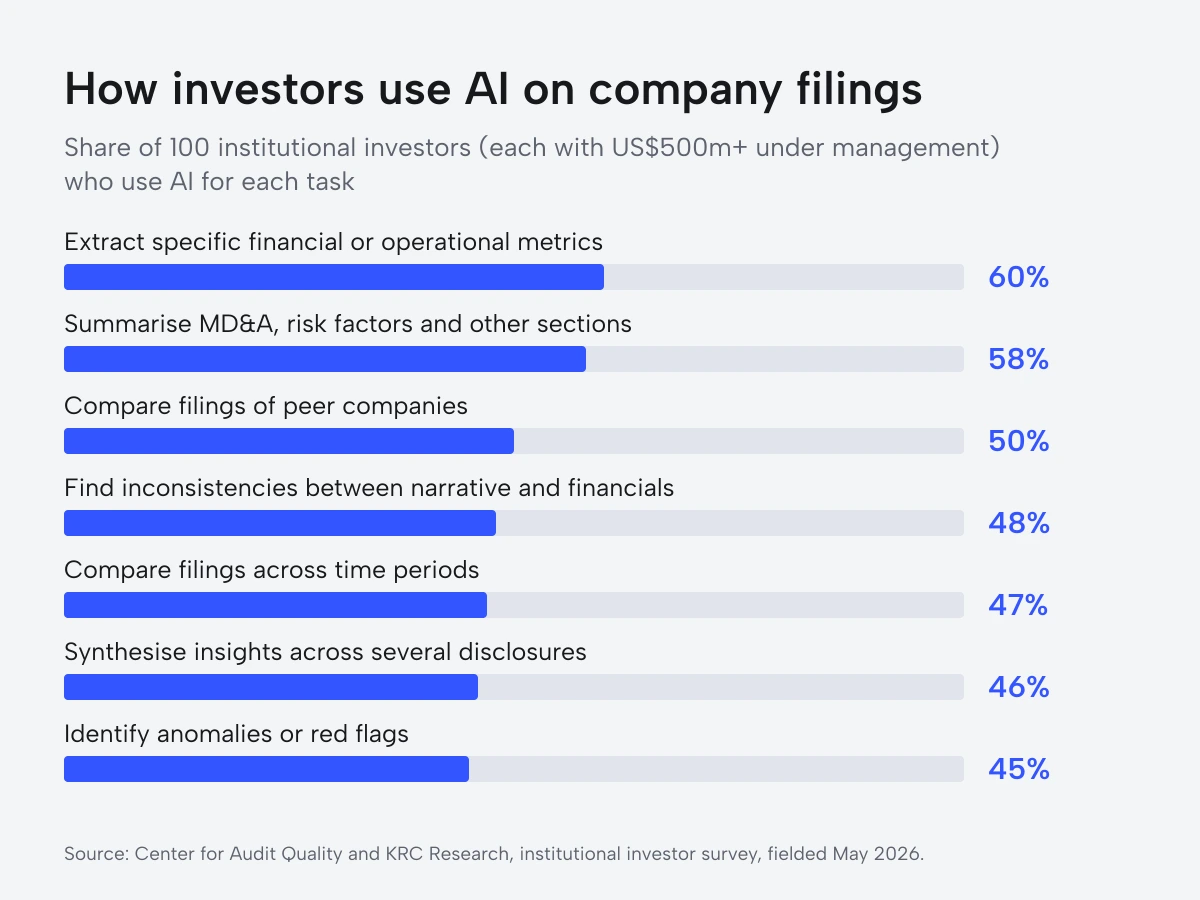
- Institutional investors now read reports through AI. In the Center for Audit Quality's May 2026 survey of 100 investors with at least US$500 million under management, 60% use AI to extract metrics from filings and 48% use it to find inconsistencies between the narrative and the financials.
- In a study of about 2,500 ChatGPT prompts on 20 listed companies, HTML annual reports appeared about three times as often in answers as PDFs, and answers built on HTML were correct 71% of the time against 54% for PDFs.
- Indian companies are ahead on 'ask the report' assistants. Hindustan Zinc's Zincky dates from its FY 2023-24 digital report, Infosys added a Topaz-powered assistant in FY 2024-25, and Jubilant Ingrevia (VIA) and SRF (SRFi) launched theirs for FY 2025-26. The ones worth copying answer only from the report and link every figure to its page.
- Three of 23 Indian FY 2025-26 covers we compared name AI, and all three use the same deep-blue, glowing palette. Generic AI imagery is the trend to avoid.
- Accessibility is becoming expected. SEBI's July 2025 circular already binds regulated entities such as exchanges, depositories and fund houses, and draft RPwD rules published in July 2026 would cover electronic documents.
- With BRSR Core assessment or assurance extended to the top 1,000 listed companies for FY 2026-27, designers need a consistent way to mark which ESG figures were assured.
Most "annual report design trends" lists are written by agencies, and most of them say the same things: bold minimalism, data visualisation, authentic photography, digital-first. Some of that is true. Little of it comes with evidence, and almost none of it is about India.
This list is different in one way. Each shift below is backed by something you can check: a survey, a study, a regulation, an award result, or a count we made ourselves. For each one we give a verdict (follow it, adapt it, wait, or avoid it) and a line you can paste into the FY 2026-27 brief.
The timing matters. For most Indian listed companies, with a 31 March year end, the annual report season runs from April to September. Content and design start once the year closes, the audited results land by the end of May, and the report goes out at least 21 days before an AGM held by 30 September. That leaves no room to rethink the format in May. Choices like an HTML edition, an accessible PDF or a report assistant have to be in the brief and the budget before the year ends, so the time to write the brief is between now and February.
The nine shifts at a glance
| # | Shift | Verdict | Evidence |
|---|---|---|---|
| 1 | AI is now a reader of your report | Follow | CAQ survey of 100 institutional investors, May 2026 |
| 2 | HTML editions beat PDFs in AI answers | Follow if budget allows | USTP / HHL / nexxar study, 2,500 prompts |
| 3 | "Ask the report" assistants | Adapt | Hindustan Zinc (Zincky), Infosys, Jubilant Ingrevia (VIA), SRF (SRFi) |
| 4 | AI-themed covers look the same | Avoid | 3 of 23 Indian FY26 covers, one palette |
| 5 | Covers are judged at thumbnail size | Follow | Our 120-pixel test of 23 covers |
| 6 | Accessibility moves from optional to expected | Follow | SEBI circular, July 2025; draft RPwD rules, July 2026 |
| 7 | Assured ESG numbers need to be visible | Follow | BRSR Core extended to the top 1,000 for FY 2026-27 |
| 8 | QR codes and video as bridges from print | Adapt | 88 of about 110 Indian FY26 PDFs mention a QR code |
| 9 | Pages that work alone on a screen | Adapt | All Indian FY26 PDFs we checked are portrait; some now ship single-page and spread versions |
1. AI is now a reader of your report
What's changing. For years the design brief has imagined one reader: an analyst or shareholder turning pages, or scrolling a PDF. That reader now often sends an AI tool in first.
The clearest evidence comes from the Center for Audit Quality and KRC Research, which surveyed 100 institutional investors, each managing at least US$500 million, in May 2026. Of those investors, 60% use AI to extract specific financial or operational metrics from filings, 58% to summarise sections such as MD&A and risk factors, and 48% to find inconsistencies between the narrative and the financials. About 60% use AI on earnings call transcripts always or often.
We see the same thing on this site. The crawlers that feed ChatGPT search, Claude and Perplexity fetch our annual report pages every day, and the requests that come from a live user question in ChatGPT or Claude go mostly to pages about specific companies' reports.
What it means for design. An AI tool reads text, not pictures. A revenue figure set inside a decorative graphic, a KPI shown only as an image, or a table built from text boxes is invisible to it, or gets misread. A tool that can't find the number in your report finds it somewhere else, from a data aggregator or a news story, and you lose control of the answer.
Verdict: follow.
For the brief: "Every figure that matters appears as live, selectable text, in a real table where it's tabular, with its unit and period stated next to it. No key number appears only inside an image."
2. HTML editions beat PDFs in AI answers
What's changing. The most useful study on this so far comes from Austria and Germany. Researchers at USTP St. Pölten and HHL Leipzig, working with the reporting consultancy nexxar, ran about 2,500 prompts on 20 listed companies through ChatGPT between September and November 2025, then fact-checked about 200 of the answers. They published the results in February 2026:
- Annual reports were the most-cited source of all, at 58% of citations.
- HTML annual reports appeared about three times as often in answers as PDF reports.
- Answers based on HTML reports were correct 71% of the time. Answers based on PDFs were correct 54% of the time.
- Overall, only about 63% of AI statements about the reports were complete and correct, and 20% contained misinformation.
- When a company only had a PDF, ChatGPT reached for external sources in 24% of cases. With HTML, 7%.
The sample is European, and nexxar sells digital reports, so treat the exact ratios with care. But the direction is consistent with how these tools work, and with what we see in India.
In India the HTML edition is still the exception. HUL is one example that builds it into the launch: it filed the web link for its FY 2025-26 performance-highlights microsite with the exchanges in June 2026. Of the 19 FY 2025-26 reports we reviewed in depth on this site, ten have an online edition, and four of those PDFs never tell the reader it exists. Across about 110 Indian FY 2025-26 PDFs we searched, only 17 even mention an online version, microsite or interactive edition. Our guide to what a digital annual report costs in India puts a straightforward HTML adaptation at about ₹1.5 lakh and a full interactive edition at upwards of ₹10 lakh.
Verdict: follow, if the budget allows. If it doesn't, the minimum is a well-tagged PDF (shift 6) plus a simple HTML page carrying the highlights, KPIs and the chairman's letter as text.
For the brief: "Quote for an HTML edition of at least the front section and five-year KPIs, built from the same source files as the PDF so the numbers can't drift. The PDF links to it on page 1."
3. "Ask the report" assistants: India is already ahead
What's changing. Several Indian companies now put an AI assistant on top of their report, and some have done it for years:
- Hindustan Zinc launched Zincky, which it calls India's first generative AI tool for annual reports, with its digital report for FY 2023-24. The company says that report won Platinum at the AVA Digital Awards 2025, and Zincky has run alongside each digital report since.
- Infosys offered an AI assistant powered by its own Infosys Topaz platform in its online Integrated Annual Report 2024-25. Readers type a question and get answers drawn from the report, with AI-narrated takeaways for investors, analysts and employees.
- Jubilant Ingrevia's VIA, new for FY 2025-26, answers only from the company's FY26 annual report. Every figure links to the page it came from, it says when the report doesn't cover a question, and a toggle lets it answer from the FY26 and FY25 reports together.
- SRF's SRFi does the same for SRF's FY26 report, with suggested questions and a sources panel that links each answer back into the report. SRF also has an Audio Intelligence page that reads the report aloud, chapter by chapter, in English and Hindi.
Abroad, the best-known examples are more recent. Sumitomo Corporation launched a chatbot for its Integrated Report 2026 on 30 September 2026, but only on a trial basis, until 23 December. Sri Lanka's People's Leasing has video and text chatbots and ten video summaries in Sinhala, Tamil and English.
The risk to design around. General-purpose AI still gets annual reports wrong. In the study behind shift 2, one in five ChatGPT statements about annual reports contained misinformation. An assistant on your own website that gets a number wrong is your error, in a document that carries legal weight. The better Indian assistants show how to handle this. VIA answers only from the report, cites the page for every figure and admits when it has no answer. Those are design decisions, not technical extras.
Verdict: adapt. An assistant is worth building only if it's grounded in the report and shows its sources. If the budget doesn't stretch that far this year, make the report assistant-ready instead: clean HTML, consistent labels and units, and data tables that a tool can read.
For the brief: "If we add a report assistant, it answers only from this year's (and optionally last year's) report, links every figure to its page, says plainly when the report doesn't answer a question, and carries a 'not investment advice' note. If not this year, the HTML edition is structured so one can be added without rework."
4. AI-themed covers have started to look the same
What's changing. When we put 23 Indian FY 2025-26 covers side by side, three of the cover lines named AI: TCS, Infosys and HDFC Bank. All three covers use the same deep-blue, dark, luminous palette of glowing circuits and light. Cover the logos, and two of them are hard to tell apart. (Infosys escapes through typography, building the "I" of AI into a doorway.)
The same sameness shows up in wording. Adani Ports and Adani Enterprises printed the identical cover line, "Accelerating Infrastructure, Leveraging Intelligence".
AI image tools tend to make this worse: ask one for "AI, growth, the future" and it reaches for the same glowing blue.
A few Indian companies have started labelling AI imagery, which is the right instinct. Nestlé India's FY 2025-26 annual report cover carries the line "This image has been generated using AI", and so do two pages inside it. ITC marks an image in its digital section "Indicative image, generated using AI" (PDF page 22), and UltraTech labels one "AI generated Image" in its integrated and sustainability report. Across about 110 Indian FY 2025-26 annual report PDFs we searched, those were the only three that labelled an image this way. Many more almost certainly use AI imagery without saying so.
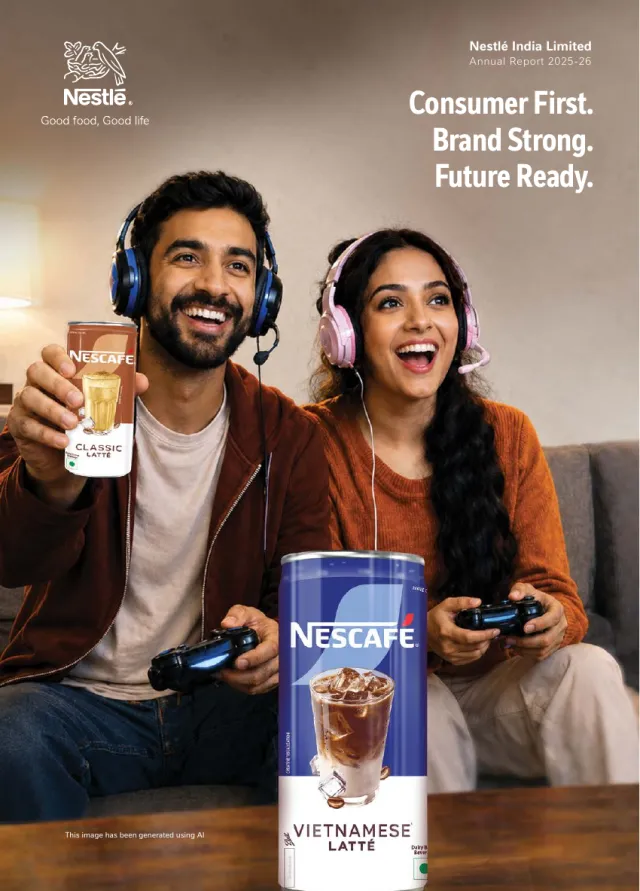
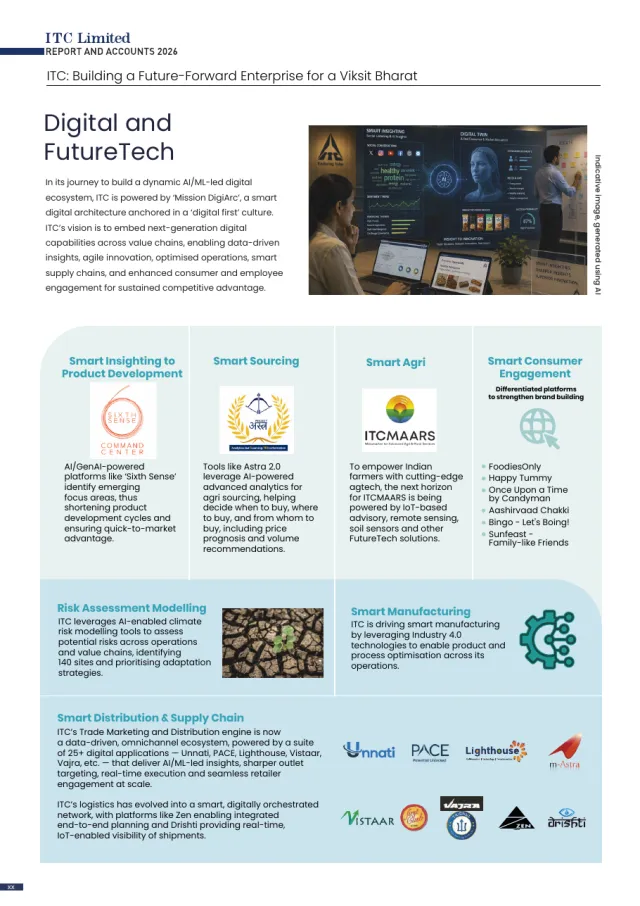
Both labels are small, and the ITC one runs vertically up the margin. That's better than nothing, but a label a reader can't find doesn't do its job. Put it in the caption, in the same type as other captions.
Verdict: avoid. If AI is genuinely the story of your year, say something only you can say about it, as Infosys did with type, or show your own people and products.
For the brief: "No generic technology imagery (glowing circuits, globes, data cubes, robot hands). Any AI-generated image is labelled in its caption, and none is presented as a photograph of a real site, event, employee or result."
5. Covers are judged at thumbnail size
What's changing. More people now meet the cover as a 120-pixel thumbnail (on an exchange filings page, a search result, a LinkedIn post or the first frame of a PDF preview) than as a printed object. Most covers are still approved at full size on a large monitor.
In our test of 23 FY 2025-26 covers at 120 pixels wide, the theme lines of ICICI Bank, Zee, LTM, Hero MotoCorp, ITC and Infosys could still be read. Those of TCS, L&T, Adani Ports, Sun Pharma, JSW Steel, Hindustan Zinc and Dr. Reddy's couldn't. On most covers the financial year was the smallest type on the page. Dr. Reddy's was the exception.
Award juries notice the first impression too. The LACP Vision Awards scoring sheet gives 30 of 100 points to "first impression" and another 10 to the cover, more than any other criterion (see our guide to annual report awards in India).
Verdict: follow.
For the brief: "Cover concepts are reviewed at 120 pixels wide as well as full size. The theme (four words or fewer at large size), the company name and the financial year must all be legible in the thumbnail."
6. Accessibility moves from optional to expected
What's changing. No SEBI or MCA rule yet requires a listed company's annual report to be accessible. But the direction of travel is clear:
- SEBI, July 2025. SEBI's circular of 31 July 2025 requires its regulated entities to make their digital platforms accessible under the RPwD Act, 2016, against WCAG 2.1, the government website guidelines (GIGW) and IS 17802, with a follow-up compliance circular in September 2025. That binds stock exchanges, depositories, fund houses and brokers, several of which are listed companies and publish annual reports of their own.
- Draft RPwD rules, July 2026. Draft amendment rules published for comment on 20 July 2026 would extend accessibility requirements to electronic documents, including non-web documents such as PDFs, with a one-year deadline for establishments with turnover of ₹500 crore or more.
How far Indian reports have to go: we checked about 110 FY 2025-26 annual report PDFs from Indian listed companies, and only eight were tagged at all (HUL, SBI, NTPC, Hero MotoCorp, Max Financial Services, Prestige Estates, KRBL and Sify). A tagged PDF isn't automatically an accessible one, but an untagged PDF can't be: a screen reader has no structure to follow.
An accessible report also helps the AI reader in shift 1: tagged headings, real tables and alt text are exactly what a machine needs to read the report in the right order.
Verdict: follow. Our step-by-step guide to making an annual report PDF accessible covers the InDesign set-up, tagging and free testing tools.
For the brief: "Deliver a tagged PDF that passes the free PAC checker against PDF/UA, with alt text on every chart and photo, real tables with header rows, set reading order, and the document title and language set. Budget for it in the quote, not as an afterthought."
7. Assured ESG numbers need to be visible
What's changing. For FY 2026-27, BRSR Core assessment or assurance extends to the top 1,000 listed companies, up from the top 500. More companies will have a set of ESG figures that an assurance provider has checked, sitting next to other figures that haven't been.
Readers, rating agencies and AI tools can't tell the difference unless the design shows it. Today the assurance statement usually sits at the back of the BRSR, while the same emissions or water figures appear, unmarked, in the integrated report's front section and KPI pages. A reader who sees a number in the chairman's letter has no way of knowing it was assured.
Verdict: follow. This is a small design job with a large credibility pay-off.
For the brief: "Create one symbol and footnote style for assured or assessed BRSR Core figures, used identically wherever those figures appear: in the integrated report, the ESG section, the KPI pages and the BRSR itself. State the assurance level and provider once, near the first use."
8. QR codes and video as bridges from print
What's changing. Printed reports are shrinking (shareholders without a registered email address now get a letter with a link rather than a printed copy), but the printed or PDF page is still where many readers start. Companies increasingly use it as a doorway. ITC's FY 2025-26 back cover carries QR codes to its website and social channels. Abroad, People's Leasing turns its report into short video summaries, and even LACP introduced video guides to its 2025 Vision results.
QR codes are already everywhere in Indian reports. Of the about 110 FY 2025-26 PDFs we searched, 88 mention a QR code somewhere, often for the AGM notice, e-voting or a video. Hero MotoCorp's report mentions one 37 times, Sun Pharma's 22 times.
Verdict: adapt. A QR code is only useful if it goes somewhere specific. One that opens the investor relations home page wastes the reader's effort.
For the brief: "QR codes link to a specific destination (the HTML version of that section, the chairman's video, the downloadable data table), each with a short label saying where it goes. Any video is under two minutes, captioned, and backed by a text version."
9. Pages that work alone on a screen
What's changing. Some agency trend lists say annual reports are moving to landscape, screen-shaped pages. Abroad, a few are: three Dubai-listed companies' 2025 integrated reports we looked at use landscape pages. In India, not yet. Every one of the about 110 Indian FY 2025-26 PDFs we checked uses a portrait page, mostly A4 or US Letter, with a few in narrower custom sizes.
What is changing is how the file is delivered. Some companies now upload two versions: a "single page" PDF for screens and a "spread view" PDF that mirrors the printed double-page layout. UltraTech's web file is labelled as the single-page edition of its integrated and sustainability report, and Tilaknagar Industries labels its upload "Spread View". A two-page spread uploaded as one wide page reads badly on a phone, and a single page that only makes sense next to its neighbour reads badly anywhere.
Verdict: adapt. Don't switch to landscape for its own sake. Do design the front section so each page makes sense on its own, and publish single-page PDFs as the default.
For the brief: "Each page of the front section must make sense on its own, with no chart, sentence or table split across a spread. Deliver a single-page PDF for web upload (and a spread version only if needed)."
What we'd leave out of the brief
Some things on agency trend lists don't survive contact with how annual reports are actually read:
- Heavy animation and parallax in the HTML edition. It slows the page, breaks on phones and makes the text harder for AI tools to extract.
- 3D renders of things that don't exist. They age quickly, and in a document that carries legal weight, a picture of a plant that hasn't been built invites questions.
- "Bold minimalism" applied to the financial statements. White space helps the front section. In the notes to accounts, readers need density, consistent tables and clear page numbers.
- A theme that changes every year for its own sake. Our guide on how to decide an annual report theme explains why a theme should come from the year's strategy, not the design.
The FY 2026-27 design brief: a one-page checklist
- FormatsOpen the report on a phone
Check that figures are selectable and tables have headers, units and periods. Test the tagged PDF and compare it with the HTML edition if commissioned.
- CoverShrink it to 120 px
Check whether the company name, year and main idea still read. Use imagery tied to the company’s people, products or places.
- DataTrace an assured ESG figure
Follow the assurance mark to its explanation. Compare the KPI definition and the five-year series.
- LinksFollow the links from print
Scan each QR code and check the destination. Check video captions and ask any report assistant to cite its source page.
Build review time into the brief. Leave room for accessibility checks and any HTML edition before dispatch.
Paste this into the brief, or use it to check the agency's proposal.
Readers and formats
- Every key figure is live text, in a real table where it's tabular, with unit and period stated
- HTML edition of at least the front section and five-year KPIs, quoted separately
- PDF and HTML built from the same source, with a link to the HTML on page 1 of the PDF
- Tagged PDF that passes PAC against PDF/UA, with alt text, header rows, reading order, title and language set
- PDF bookmarks that match the contents page, and printed page numbers that match PDF page numbers (or a note explaining the difference)
Cover and imagery
- Cover reviewed at 120 pixels wide: theme, company name and financial year legible
- Theme line of four words or fewer at large size
- No generic technology or stock imagery; own people, products and places preferred
- Any AI-generated image labelled in its caption, and none presented as a photograph of a real site, event, employee or result
Data and assurance
- Five or more years of KPIs, weak years included
- One symbol and footnote style for assured or assessed BRSR Core figures, used everywhere
- Assurance level and provider stated once, near first use
- KPI definitions consistent with last year's report, or changes flagged
Links and extras
- QR codes go to a specific page, with a label saying where
- Videos under two minutes, captioned, with a text version
- Any report assistant answers only from the report, links each figure to its page and says when it has no answer; otherwise HTML structured so one can be added later
Timeline
- Agency, brief and budget settled by February, and the theme agreed before 31 March
- Production plan for April to August that leaves time for accessibility checks and the HTML edition before dispatch (at least 21 days before an AGM held by 30 September)
About our counts
The counts of tagged PDFs, AI-image labels, QR codes and page sizes come from about 110 Indian FY 2025-26 annual report PDFs, taken from company websites and the stock exchanges. A text search can miss a label that's part of an image, so treat them as minimums.
Frequently asked questions
What are the main annual report design trends for 2026-27?
Designing for AI readers as well as people (live text and real tables rather than numbers inside images), an HTML edition alongside the PDF, tagged and accessible PDFs, covers that still read at thumbnail size, clear marking of assured BRSR Core data, QR codes that go to a specific page, and a move away from generic AI imagery and heavy decorative effects.
Should our annual report have an AI assistant or chatbot?
Only if it's grounded in the report. Several Indian companies already have one: Hindustan Zinc's Zincky (since its FY 2023-24 digital report), Infosys's Topaz-powered assistant (FY 2024-25), Jubilant Ingrevia's VIA and SRF's SRFi (both FY 2025-26). The risk is wrong answers: in one 2025-26 study, 20% of ChatGPT statements about annual reports contained misinformation. So copy VIA's approach: answer only from the report, link every figure to its source page, and say plainly when the report doesn't cover a question. If the budget doesn't allow that, make the report itself easy for any AI tool to read: an HTML edition, real tables, consistent labels and units.
Is it acceptable to use AI-generated images in an annual report?
No law in India stops it, but it carries two risks: the report looks like everyone else's (three AI-themed Indian FY 2025-26 covers we compared share the same blue palette), and readers may question images that show things that don't exist. If you use AI-generated imagery, label it in the caption (Nestlé India and ITC both did in FY 2025-26), and never present it as a photograph of a real site, event, employee or result.
Does SEBI require annual reports to be accessible?
Not for listed companies in general. SEBI's July 2025 circular on digital accessibility applies to SEBI-regulated entities such as stock exchanges, depositories, mutual funds and brokers, several of which are themselves listed. For other companies, the RPwD Act, 2016 and IS 17802 point the same way, and draft RPwD amendment rules published in July 2026 would extend accessibility requirements to electronic documents.
When should the FY 2026-27 annual report design brief go out?
Between now and February. For a 31 March year end, the annual report is produced from April to August, once the year closes and the audited results are in, and has to be sent to shareholders at least 21 days before an AGM held by 30 September. That production window is tight, so the agency, the brief and the theme should be settled before 31 March. Decisions that add work, such as an HTML edition, an accessible PDF or a report assistant, need to be in the brief and the budget by then.
Sources
- How Investors Are Using AI to Review Your Disclosures (on the CAQ / KRC Research institutional investor survey, May 2026) — TheCorporateCounsel.net
- Study: AI-optimized reporting (USTP, HHL Leipzig and nexxar) — Euro Security
- Sumitomo Corporation publishes Integrated Report 2026 with trial AI chatbot — Sumitomo Corporation
- Hindustan Zinc Annual Deck FY 2024-25 (Zincky, AVA Digital Awards 2025) — Hindustan Zinc
- VIA: ask the Jubilant Ingrevia FY26 Annual Report — Jubilant Ingrevia
- SRFi: SRF Annual Report 2025-26 assistant — SRF Limited
- People's Leasing sets new benchmark in corporate reporting with AI-enabled 13th Integrated Annual Report — Daily Mirror (Sri Lanka)
- HUL Integrated Annual Report 2025-26 performance highlights microsite — Hindustan Unilever
- SEBI mandates digital accessibility for regulated entities (circular dated 31 July 2025) — Taxmann
- Nestlé India Annual Report 2025-26 — Nestlé India
- ITC Report and Accounts 2026 — ITC Limited
- LACP 2025 Vision Awards: Worldwide Top 100 — League of American Communications Professionals