

Adani Ports Integrated Annual Report 2025-26: A Review
Adani Ports' Integrated Annual Report 2025-26 sets numeric targets for FY27 and FY31, publishes a 2030 ESG scorecard with target and actual side by side, describes each of the year's four contractor fatalities, and has its whole BRSR reasonably assured. It is also 847 pages long, opens with 18 pages about the wider Adani portfolio, and gives political contributions as ₹200 crore in the governance chapter and ₹80 crore to one electoral trust in the standalone accounts, without explaining how the two relate.
 In short
Key takeaways
- The report runs to 847 numbered pages (855 in the PDF) in six parts: Portfolio Overview (pp. 6 to 23), Corporate Overview, Strategic Review, a 234-page ESG section (pp. 138 to 371), Statutory Reports including the BRSR (pp. 455 to 502), and Financial Statements, followed by GRI, UNGC, CEO Water Mandate and IBBI indices and the AGM notice.
- The 'About the Report' page names the <IR> Framework of the IFRS Foundation, sets out scope (199 entities for financials, 56 entities with over 95% of revenue for ESG) and includes a Board and management statement acknowledging responsibility for the report's integrity. MSKA & Associates audits the accounts; TUV India assures the ESG data.
- Consolidated revenue rose 25% to ₹38,736 crore, EBITDA 20% to ₹22,851 crore and PAT to ₹12,782 crore from ₹11,061 crore; the five-year charts show EBITDA margin falling from 61% to 59% and PAT margin from 36% to 33%. The MD's letter gives FY27 guidance of ₹43,000 to 45,000 crore revenue and the CEO's letter a 2031 target of more than ₹90,000 crore revenue and ₹50,000 crore EBITDA.
- The 2030 ESG targets table reports FY26 target, FY26 actual and 2030 target for 21 indicators, including four fatalities against a target of zero; its footnote says the base year was moved from FY2015-16 to FY2024-25 this year. Scope 1 and 2 emissions fell 6.7% to 4.42 lakh tCO2e, Scope 1 rose 5.7%, and Scope 3 was 20.1 lakh tCO2e.
- The governance chapter (p. 323) says the company contributed ₹200 crore in FY 2025-26 under 'Political Expenses'. The standalone accounts (note 26(d), p. 587) record ₹80 crore to Prudent Electoral Trust. The risk register (p. 86) describes a policy of avoiding contribution to any party. The ₹200 crore figure is not broken down, so a reader can't tell whether it covers other group entities or other recipients; the report does not reconcile the three.
- The audited notes disclose the 2023 short seller report, the Supreme Court's January 2024 order, SEBI's September 2025 order closing two show cause notices with no penalty, and a US DOJ indictment and SEC civil complaint against a non-executive director, in which the company is not named and which the notes say were pending at the reporting date (p. 813). The auditor's opinion is unmodified and none of these is a key audit matter.
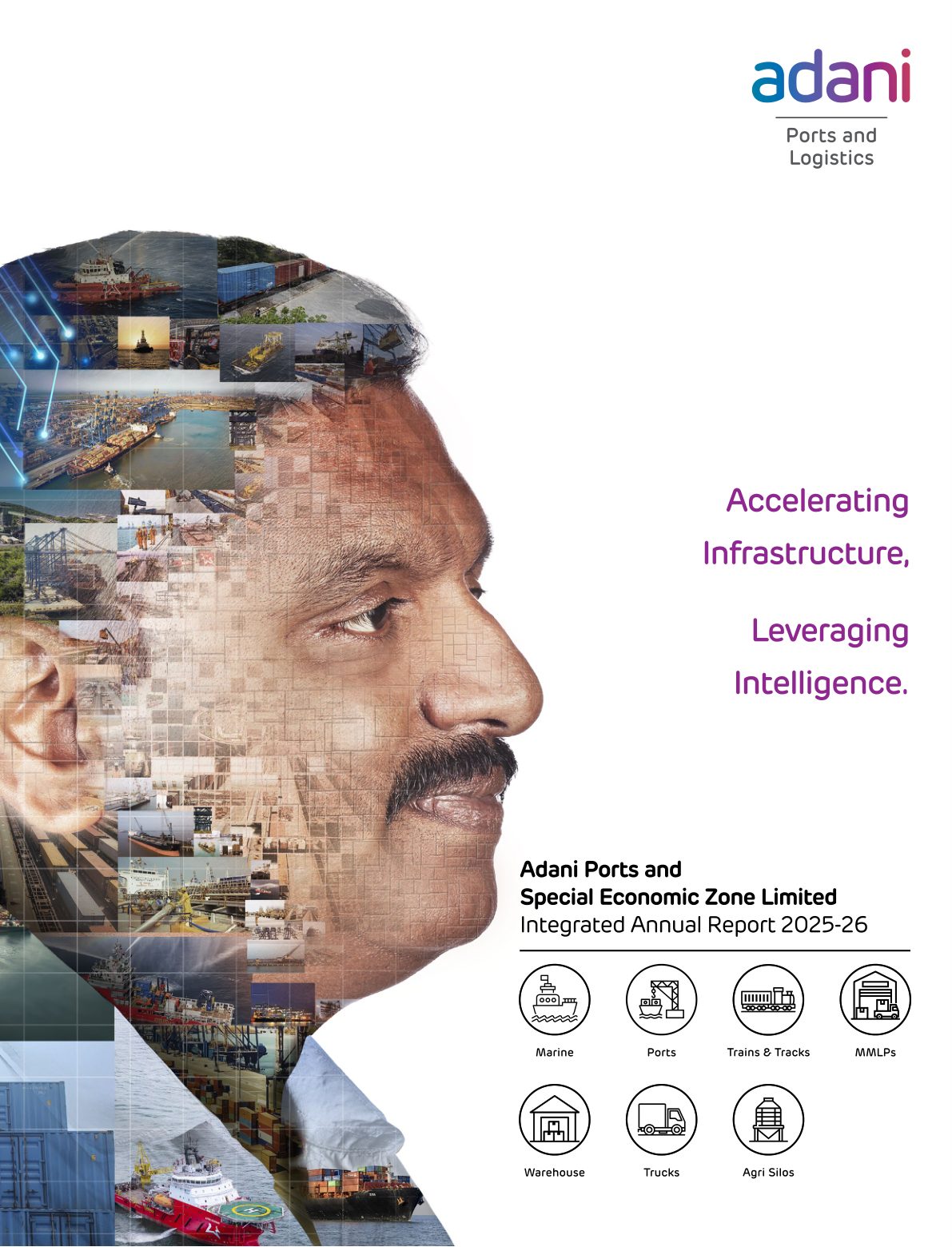
Adani Ports and Special Economic Zone crossed 500 million tonnes of cargo in FY 2025-26, the first private port operator in India to do so, and grew revenue by a quarter. It bought an Australian coal terminal, opened a VLCC terminal at Mundra, and watched its Colombo terminal handle a million containers in its first year. The Integrated Annual Report 2025-26, themed "Accelerating Infrastructure, Leveraging Intelligence", has plenty to report and much of the machinery to report it well. It also has more pages than any report we have scored, and several places where one part of the document says something another part doesn't.
As with every review in this series, we read the published PDF against the <IR> Framework, SEBI's BRSR Core expectations and plain readability, and score it on the same seven-point card. Scores are our opinion. Screenshots are small excerpts reproduced for review and remain the copyright of Adani Ports and Special Economic Zone Limited; the full report is on the company's investor pages and in a digital edition. On legal and regulatory matters we report only what the PDF itself discloses, with page references.
The scorecard
| Criterion | Score (of 5) | In one line |
|---|---|---|
| Strategy and narrative | 3 | FY27 guidance and FY31 targets from management; a group-wide Chairman's letter and 18 pages of portfolio overview come first |
| Integrated thinking and the capitals | 4 | Numeric inputs and outcomes for every capital, and a coded system tying topics, risks and strategies to the capitals; outcomes are outputs and 'financial implication' is an arrow |
| BRSR and ESG integration | 4 | Target-versus-actual 2030 table, five years of Scope 3 by category, reasonable assurance on the whole BRSR; a rebased baseline and a copy-paste error on the safety topic |
| Governance disclosure | 3 | Board responsibility statement and legal matters disclosed in the notes; political contributions and the NQXT related-party deal are not joined up |
| Financial storytelling | 3 | Honest five-year charts showing margins down and guidance with ranges; no CFO's voice and the share-funded acquisition is left to the back |
| Design and readability | 2 | 847 pages, a group prospectus up front, and copy-editing slips that reach the MD&A |
| Digital version | 3 | A real HTML edition and a text-searchable single-page PDF; no bookmarks, and the PDF points only to the home page |
| Total | 22 / 35 |
What the report is
The contents page lists six parts: Portfolio Overview (pp. 6 to 23), Corporate Overview (pp. 24 to 51), Strategic Review (pp. 52 to 137), Environment, Social and Governance (pp. 138 to 371), Statutory Reports (pp. 372 to 509, with the BRSR at 455) and Financial Statements (pp. 510 to 821), followed by GRI, UNGC, CEO Water Mandate and India Business & Biodiversity Initiative indices and the AGM notice, which ends on page 847. The PDF has 855 pages. The previous edition was ranked ninth worldwide in LACP's 2025 Vision Awards Top 100; this one is longer than any other report on our card, including Hindustan Zinc's 610 pages.
The "About the Report" page (p. 2) is sound. It says the company has reported on an integrated basis since FY 2019-20, cites the <IR> Framework "of the IFRS Foundation", separates the financial boundary (199 entities) from the ESG boundary (56 entities covering more than 95% of revenue), names M S K A & Associates LLP as statutory auditor and TUV India as ESG assurer, and carries a Board and management statement acknowledging "their responsibility to ensure the integrity of this Integrated Report". The statement is undated, which is the one thing Asian Paints and LTM do better.
Key number: 4 — contractor fatalities in FY 2025-26, printed against a target of zero on the 2030 ESG scorecard and described one by one in the safety chapter.
Strategy and narrative: 3/5
Management puts numbers on the table. The Managing Director, Karan Adani, gives FY27 guidance of ₹43,000 to 45,000 crore revenue, ₹25,000 to 26,000 crore EBITDA and ₹12,000 to 14,000 crore capex, with net debt to EBITDA held at up to 2.5 times (p. 35). The CEO, Ashwani Gupta, sets 2031 targets of more than ₹90,000 crore revenue and ₹50,000 crore EBITDA (p. 39). The business model gives FY26 actuals against FY31 targets for each asset class: 500 MMT to one billion tonnes, 132 to 200 rakes, 3.1 to 12 million sq. ft. of warehousing (p. 53). Seven strategic priorities each carry actions taken, the way forward and the KPIs tracked (pp. 98 to 101). Few reports in the series commit to this much.
The narrative is weaker at the top. The report opens with eighteen pages on the Adani portfolio of companies, including group market capitalisation, the group's renewable capacity and a portfolio ownership chart (pp. 6 to 23). The Chairman's letter (pp. 26 to 31) is a group letter: Adani Ports gets one paragraph among updates on renewables, airports, data centres, cement and defence. It also contains the report's most consequential sentence, that "the matters related to our US legal proceedings are now behind us", which we come back to under governance.
Integrated thinking and the capitals: 4/5
The linking system is thorough. A key page (p. 3) assigns codes to six capitals, six stakeholder groups, 19 material topics (M1 to M19), seven strategies (S1 to S7) and 16 risks (R1 to R16), and those codes follow the reader through materiality, risk and strategy. Every risk card names the capitals, strategies and material topics at stake (pp. 86 to 92). The business model (pp. 52 to 55) gives numeric inputs for every capital: ₹96,125 crore net worth, ₹15,320 crore organic capex, 3,471 employees, ₹199 crore of CSR, 5,763 tier-one suppliers, ₹1,255 crore invested in environmental initiatives.
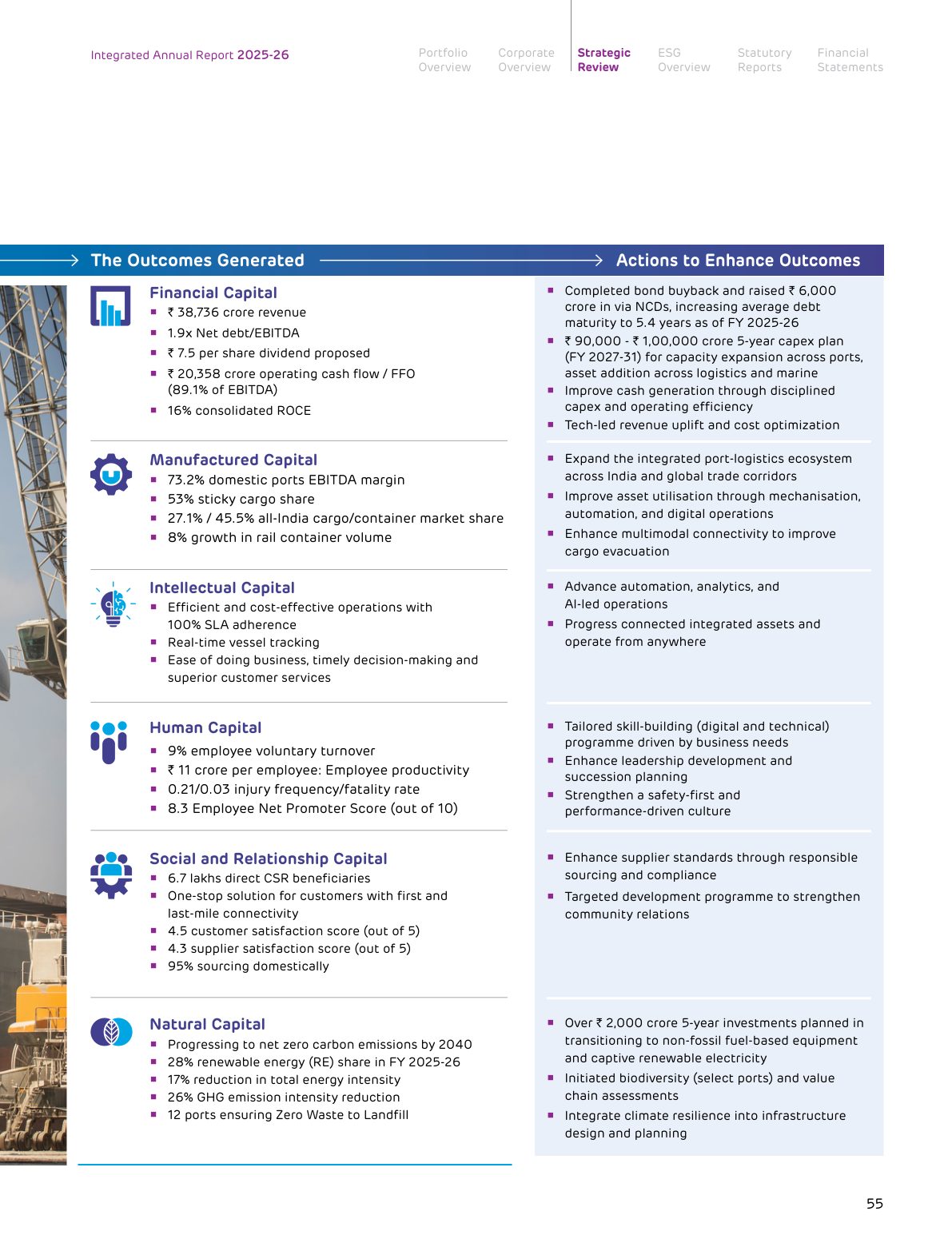
The outcomes page is where it thins. Most "outcomes" are outputs (revenue, market share, sticky cargo at 53%), none has a prior-year comparison, and the Intellectual Capital outcomes are phrases such as "Real-time vessel tracking". On the materiality cards each topic has a "Financial Implication" heading followed only by a small arrow, with no amount and no explanation (pp. 69 to 79). The system is there; it's not yet saying much.
BRSR and ESG integration: 4/5
Materiality follows double materiality principles. The last full assessment, in FY 2024-25, was run bottom-up with reference to GRI 2021 and ESRS, scoring impacts on scale, scope and irremediability and financial effects through senior-management responses; FY 2025-26 saw an internal review. The outcome was validated by the Board and verified by a third party (p. 67). No thresholds are printed, which is the gap to Hindustan Zinc and Asian Paints.
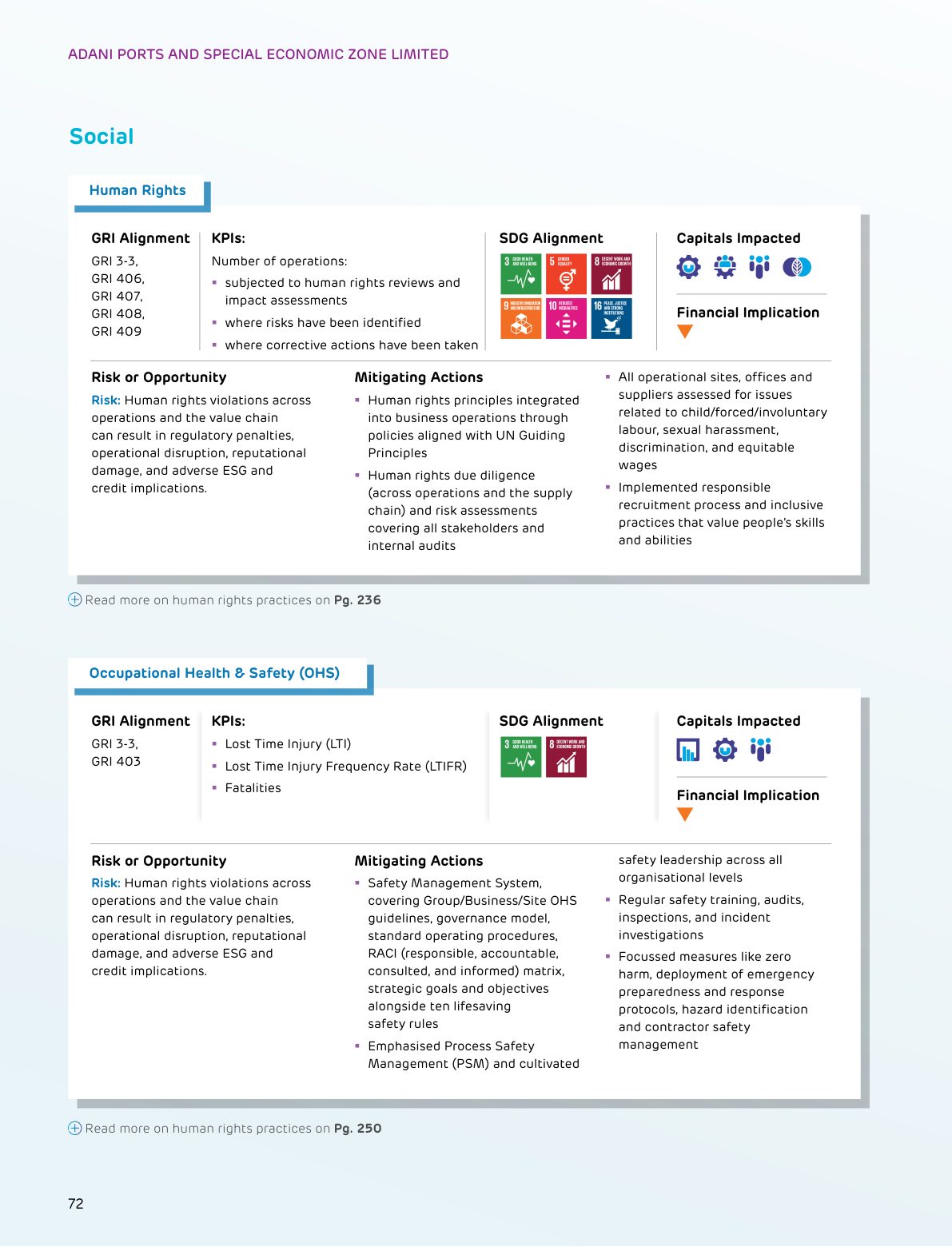
The copy on one topic card shows how little the cards are read. Under Occupational Health & Safety, the "Risk" paragraph is a word-for-word repeat of the human rights risk above it, and the cross-reference sends the reader to "human rights practices on Pg. 250" (p. 72).
The 2030 ESG targets table (p. 148) is the best page in the ESG section. For 21 indicators it gives the FY26 target, the FY26 actual and the 2030 target: renewable electricity 28% against 25%, emission intensity down 26% against 10%, 12 zero-waste-to-landfill ports against a 2030 goal of 16, women 6% of the workforce, and "Safety (fatalities)" at 4 against 0.
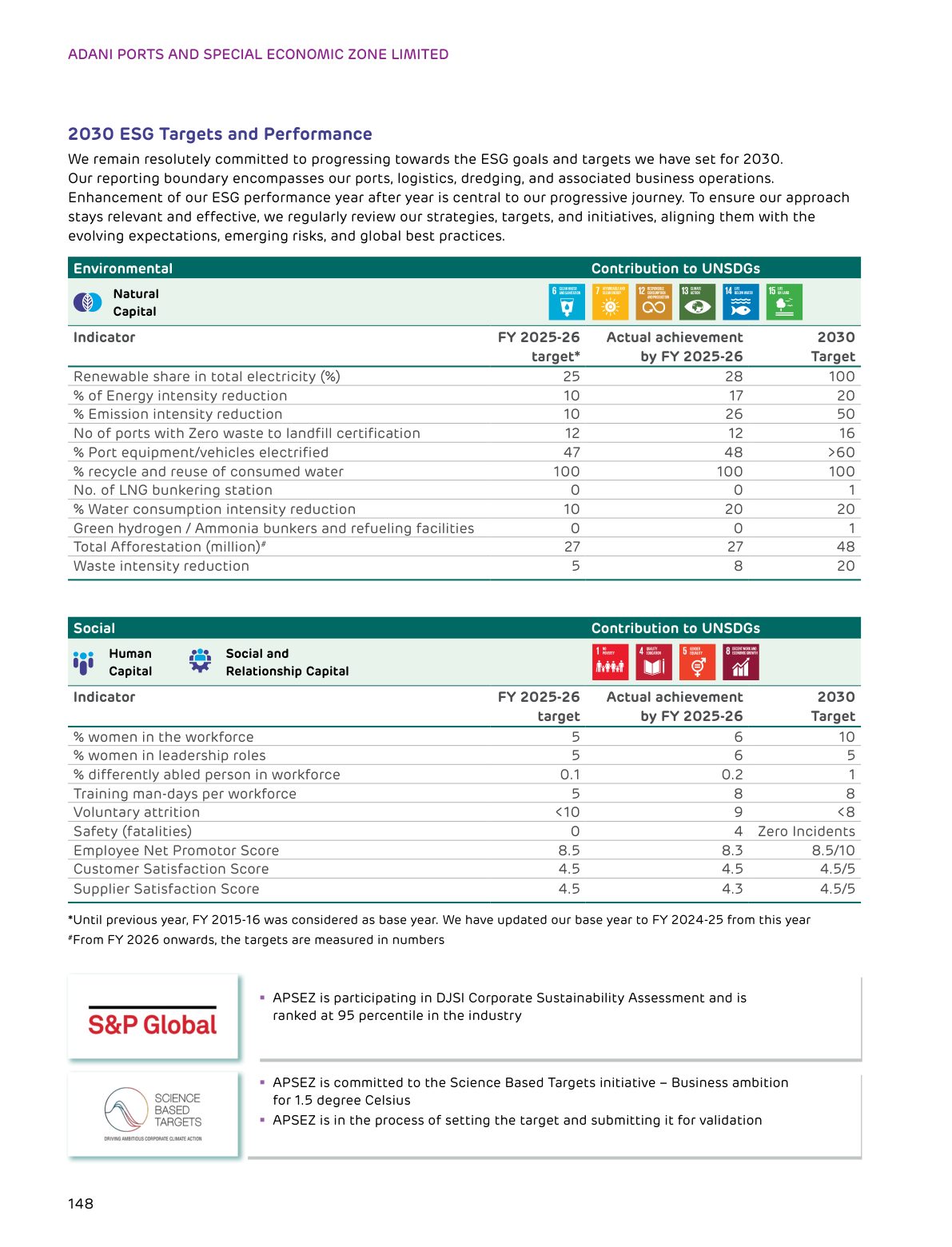
A footnote to that table says the base year has been moved from FY2015-16 to FY2024-25 "from this year". The investment case still quotes a 60% cut in emission intensity "over the past decade" (p. 49), while the scorecard starts again at 26%. The intensity is measured in tCO2e per crore, and revenue grew 25%, so most of the year's improvement comes from the denominator. The absolute numbers are published in full, which is to the company's credit: Scope 1 rose 5.7% to 1,58,998 tCO2e, Scope 2 fell 12.5% to 2,82,690, and Scope 3 was 20,13,014 tCO2e, with five years of history and a category-by-category table (p. 172). One boundary note needs tidying: emissions use operational control (p. 172) and energy uses financial control (p. 174).
Assurance scope is among the widest in the series. TUV India gives reasonable assurance on the BRSR Core attributes and on all nine BRSR principles, leadership indicators included (pp. 503 to 505), and reasonable assurance on selected integrated report indicators and Scope 3 (pp. 348 to 353). Its own recommendation that the company should "strengthen Scope 3 disclosure" is printed in the statement. The company is also a TNFD adopter and applies an internal carbon price of US$20 a tonne (p. 81); its SBTi target is still "in the process of" being set (p. 148).
Governance disclosure: 3/5
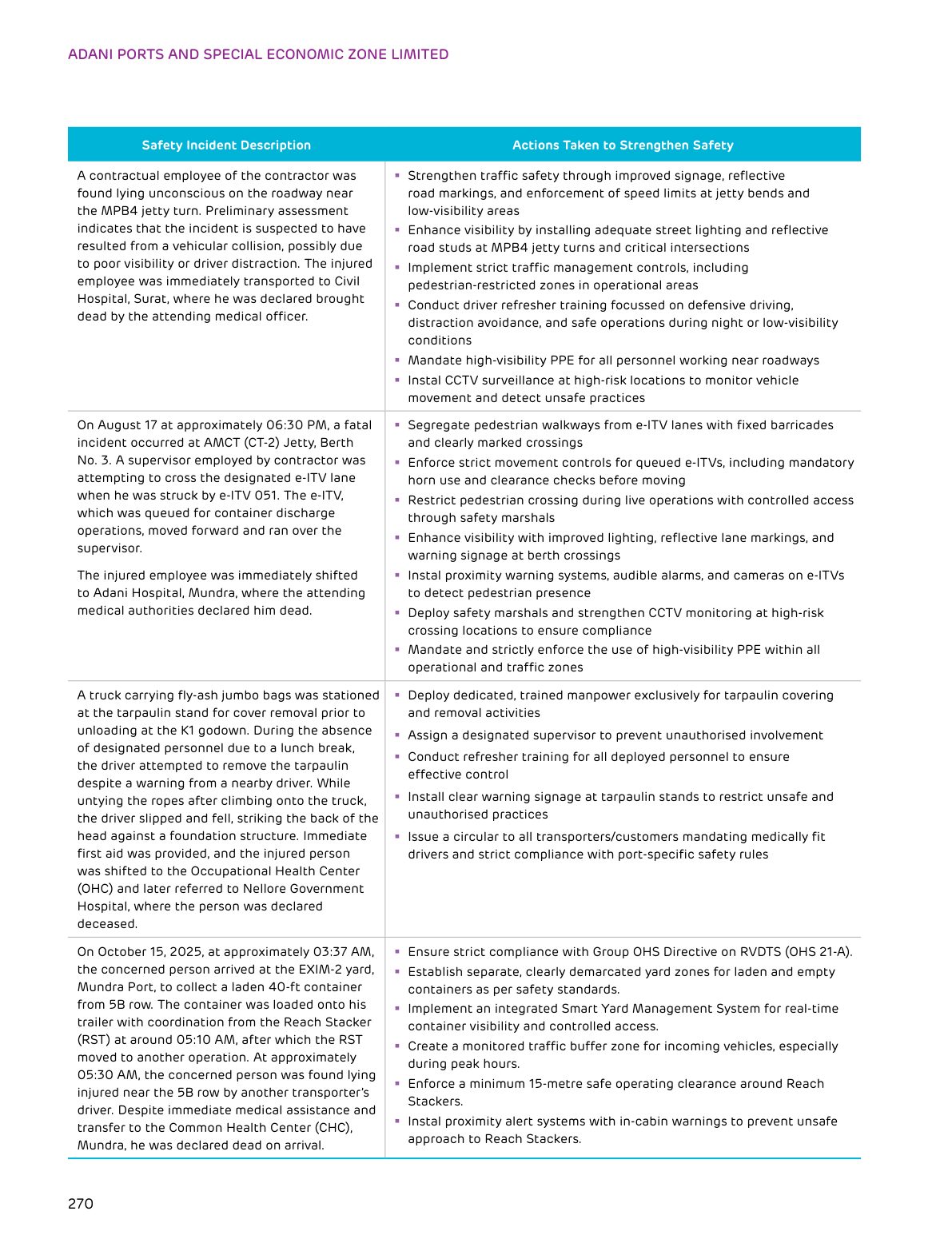
Several things are done properly. The Board responsibility statement is there. The safety chapter describes each of the four contractor fatalities, where and how they happened, and lists the controls changed afterwards (p. 270), which is rarer than it should be.
The Directors' Report records that Gautam S. Adani was redesignated Non-Executive Chairman from 5 August 2025 and that the Board, at 30 April 2026, had ten members: two executive, three non-executive non-independent and five independent, including one woman (p. 376). The notes to the accounts disclose the legal matters. Note 50 to the consolidated statements (p. 812) records the 2023 short seller report, the Supreme Court order of 3 January 2024 disposing of the related matters, and a SEBI order of 18 September 2025 that concluded two show cause notices, found no non-compliance and closed them "with no penalty or further directions". Note 54 (p. 813) discloses a US DOJ indictment and an SEC civil complaint in the Eastern District of New York against a non-executive director; the company "has not been named", and "as at reporting date, the matter is pending to be heard". The accounts were authorised on 30 April 2026. MSKA's opinion is unmodified and its key audit matters are revenue recognition, the Astro Offshore acquisition, goodwill and hedge accounting (pp. 641 to 644).
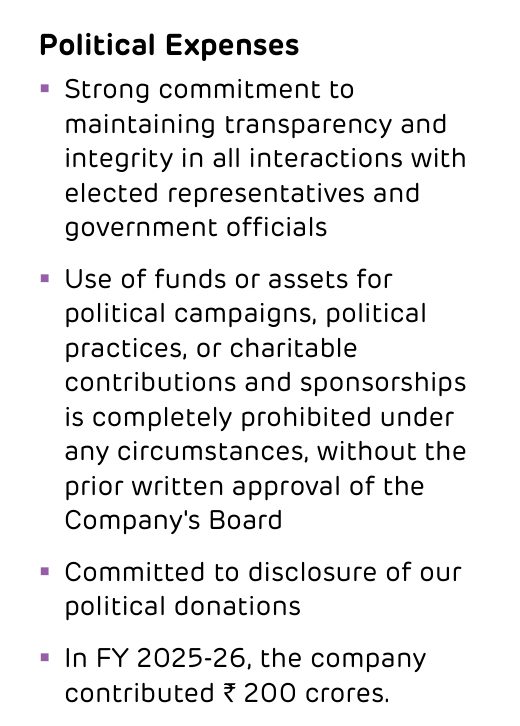
Three things don't join up. The Chairman's letter says the US legal proceedings "are now behind us" (p. 26); the audited note describes a matter pending at the reporting date, and states that it does not pertain to the Company. The letter is undated; if something changed after the accounts were authorised on 30 April, the report doesn't say what. The governance chapter says, under "Political Expenses", that "In FY 2025-26, the company contributed ₹200 crores" (p. 323); the standalone accounts record ₹80 crore contributed to Prudent Electoral Trust (note 26(d), p. 587); and the political risk card describes "avoiding affiliation or contribution to any party" (p. 86). Contributions through an electoral trust are lawful and common; the issue is presentation. The ₹200 crore isn't broken down by entity or recipient, and nothing in the report connects the three statements.
The third is the year's largest transaction. The CEO's letter and the strategy pages mention "the NQXT acquisition in Australia" (pp. 36, 100). The statutory pages add what the front half leaves out: the company issued 14,38,20,153 shares to Carmichael Rail and Port Singapore Holdings for Abbot Point Port Holdings (p. 375), at an enterprise value of AUD 3,975 million (p. 569); the secretarial auditor describes it as "a material related party transaction" (p. 385); and the seller now holds 6.24% of the company (p. 570). An integrated report should tell that story where the reader meets the deal.
Financial storytelling: 3/5
The five-year KPI pages (pp. 102 to 105) are honest. Revenue rose from ₹31,079 crore to ₹38,736 crore and EBITDA from ₹19,025 crore to ₹22,851 crore, and the same charts show EBITDA margin down from 61% to 59% and PAT margin from 36% to 33%. The average cost of debt is charted rising from 6.0% to 7.6%. The MD&A ratio table repeats the falls in margin and interest cover (p. 408), and segment revenue and EBITDA are given for domestic ports, international ports, logistics, marine and SEZ.
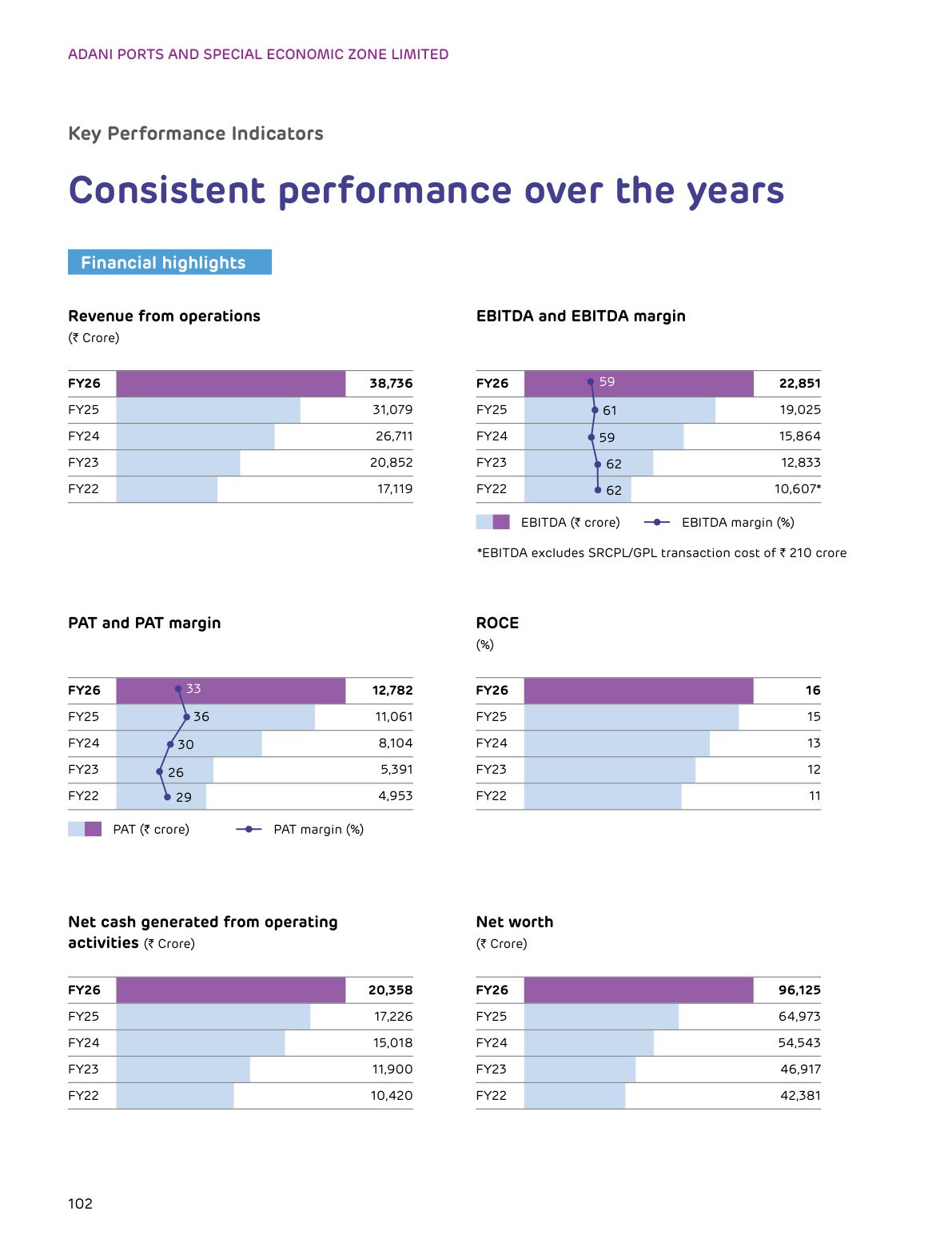
What's missing is an explanation. There is no CFO's statement. The CEO gives revenue and EBITDA growth but not profit growth, which was about 16%. Net worth rose from ₹64,973 crore to ₹96,125 crore, and the reader has to work out from the Directors' Report that much of that came from the shares issued for NQXT. Forward guidance with ranges earns the report credit; the missing bridge from the deal to the balance sheet costs it.
Design and readability: 2/5
The page furniture is consistent, the section tabs work, the risk cards are clear, and AI-generated images are labelled as such. But 847 pages is a lot to ask of anyone, and the first 18 read as a prospectus for the wider group. The ESG section alone runs to 234 pages. The copy-editing slips go beyond the safety card: the MD&A says the company "plans to become carbon positive by 2030" (p. 406) where every other page says net zero by 2040, refers to the Audit Committee's work "during FY 2024-25" (p. 409), mentions OHSAS 18001 where the ESG chapter cites ISO 45001, and reports "ESG investments amounting to ₹1,255" with no unit. The renewable electricity goal is 2030 on the targets page and 2027 on the strategy page (p. 98). The contents lists "Awards and Accolades" before the investment case, a page of 20 award entries that includes a best annual report award from the Free Press Journal and CareEdge.
Digital version: 3/5
A full HTML edition exists on the investor downloads page, with the same six sections, executive messages, a performance dashboard and section downloads. The PDF's only pointer to it is a line on the contents page: "To view this report online, please visit: www.adaniports.com". The PDF itself is built as single pages with a clean text layer and a hyperlinked contents page, and it links out to policies and charters on the company website. There are no bookmarks, which in an 855-page file is a real cost.
What reporting teams can take from it
Copy the 2030 targets table, with the year's target and actual next to the long-term goal, and keep the fatalities line on it. Copy the safety chapter's incident-by-incident account. Copy the coded linking of topics, risks and strategies to capitals, and print absolute Scope 1, 2 and 3 with five years of history. Put guidance in the letters, as this report does.
Then cut the group section to a page, date the responsibility statement, print materiality thresholds, show progress against the old baseline when you change it, tell related-party acquisitions in full where you first mention them, reconcile every figure that appears in both the narrative and the accounts (political contributions above all), make sure the Chairman's letter and the audited notes describe legal matters the same way, and add bookmarks.
Series scorecard
Every report in this series is scored on the same seven-point card by the same reader. Scores are editorial opinion of the published document; each review carries the page references behind its findings.
| Company | Score (of 35) |
|---|---|
| Hindustan Zinc | 30 |
| TCS | 29 |
| HUL | 28 |
| Bharti Airtel | 27 |
| L&T | 27 |
| Reliance | 27 |
| HDFC Bank | 26 |
| Asian Paints | 25 |
| ICICI Bank | 25 |
| Infosys | 25 |
| LTM | 25 |
| Tata Steel | 25 |
| M&M | 24 |
| Titan | 23 |
| Adani Ports (this review) | 22 |
| ITC | 21 |
| SBI | 21 |
| Sun Pharma | 21 |
| Bajaj Finance | 20 |
| NTPC | 20 |
Frequently asked questions
What is in Adani Ports' Integrated Annual Report 2025-26?
An 847-page report themed 'Accelerating Infrastructure, Leveraging Intelligence'. It opens with an 18-page overview of the Adani portfolio of companies, then a Corporate Overview with letters from the Chairman, the Managing Director and the CEO, a Strategic Review (business model, stakeholder engagement, materiality, risks, strategy, KPIs and operational performance), a 234-page ESG section that includes a TCFD-aligned climate report and a tax contributions chapter, the Directors' Report, MD&A, corporate governance report and BRSR, and standalone and consolidated financial statements. A digital HTML edition is published on the company's investor pages.
How does Adani Ports assess materiality?
The report says the company runs a comprehensive assessment at least once every two years with an annual review. The last full assessment, in FY 2024-25, was a bottom-up exercise guided by the GRI Standards 2021 and ESRS, using a double materiality approach with impact scored on scale, scope and irremediability and financial materiality based on senior management responses. FY 2025-26 saw an internal review. Nineteen topics are mapped on a matrix; the process and outcomes were presented to the Board for validation and verified by a third-party assurance provider. No scoring thresholds are published.
What are Adani Ports' climate targets and emissions?
Net zero by 2040, 100% renewable electricity by 2030 (the strategy page says 2027), and a 50% cut in emission intensity by 2030 against a FY2024-25 baseline. In FY26 Scope 1 emissions were 1,58,998 tCO2e, Scope 2 2,82,690 tCO2e (market-based) and Scope 3 20,13,014 tCO2e. Renewable share of electricity was 28%. The company says it is committed to the Science Based Targets initiative and is in the process of setting a target for validation, and it applies an internal carbon price of US$20 per tonne to Scope 1 and 2.
Who assures Adani Ports' sustainability disclosures?
TUV India Private Limited. For the BRSR it gives reasonable assurance on the BRSR Core attributes and on all nine BRSR principles, including leadership indicators. For the integrated report's ESG disclosures it gives reasonable assurance under ISAE 3000 (Revised) on 30 selected indicators and on Scope 3 data, and Type 2 moderate assurance under AA1000AS v3. MSKA & Associates LLP audits the financial statements and gave an unmodified opinion.
What were Adani Ports' FY 2025-26 results?
Cargo of 500.8 MMT, up 11.2%, including about 451 MMT at Indian ports. Consolidated revenue from operations of ₹38,736 crore (up 25%), EBITDA of ₹22,851 crore (up 20%) at a 59% margin, PAT of ₹12,782 crore, operating cash flow of ₹20,358 crore, ROCE of 16% and net debt to EBITDA of 1.9 times. The Board recommended a dividend of ₹7.50 per share, about ₹1,725 crore.
How does The Footnotes score annual reports?
Seven criteria, each scored 1 to 5 with a one-line reason: strategy and narrative; integrated thinking and capitals; BRSR and ESG integration; governance disclosure; financial storytelling; design and readability; and the digital version. Scores are editorial opinion based on the published document, and the same card is used for every company so results can be compared.
Sources
- Adani Ports: Investor Downloads (annual reports) — Adani Ports and Special Economic Zone Limited
- Adani Ports: Integrated Annual Report 2025-26 (digital edition) — Adani Ports and Special Economic Zone Limited
- LACP 2025 Vision Awards: Top 100 Reports Worldwide — LACP
- SEBI circular: BRSR Core, framework for assurance and ESG disclosures for value chain (12 July 2023) — SEBI