


India hasn't notified IFRS 18, the new global rulebook for the profit and loss statement, but ICAI has already exposed an Indian version, Ind AS 118, with a proposed start of 1 April 2027. Here's what it changes, where it stands, and what finance teams can start on now.
In this article
 In short
Key takeaways
- IFRS 18 is the new global standard for how companies present their profit and loss statement. It replaces IAS 1 and applies from 1 January 2027.
- ICAI exposed an Indian version, Ind AS 118, in January 2025 (comments closed on 6 May 2025), with a proposed effective date of annual periods beginning on or after 1 April 2027. MCA hasn't notified it yet.
- ICAI's Accounting Standards Board is running three training sessions on 13, 19 and 26 October 2026 that follow the standard's three main changes.
- Under IFRS 18, every line in the P&L sits in one of five categories, and every company shows the same two subtotals: operating profit, and profit before financing and income taxes.
- Company-defined measures such as adjusted EBITDA, which management uses in public, move inside the financial statements and get audited.
- Finance teams can start now: list every adjusted metric the company publishes, and map the chart of accounts to the five new categories.
India hasn't yet notified IFRS 18, the new global standard for the profit and loss statement. But the Indian version is well past the idea stage. ICAI's Accounting Standards Board (ASB) published an exposure draft of Ind AS 118 in January 2025, proposing that it apply from 1 April 2027, and this October it is running three training sessions that cover the standard's three main changes. CFOs and company secretaries should plan on the new format arriving, even though the final date rests with the Ministry of Corporate Affairs.
Is India adopting IFRS 18?
It is in progress. On 6 January 2025 the ASB issued an exposure draft of Ind AS 118 Presentation and Disclosure in Financial Statements, the draft ICAI publishes for public comment before a new standard. The comment period was extended to 6 May 2025 and has closed. The draft proposes that Ind AS 118 replace Ind AS 1 for annual periods beginning on or after 1 April 2027, three months after IFRS 18 takes effect globally.
What hasn't happened is notification. An Ind AS becomes binding only when the Ministry of Corporate Affairs notifies it under the Companies (Indian Accounting Standards) Rules. ICAI's Compendium of Indian Accounting Standards still runs from Ind AS 1 to Ind AS 41, and MCA's most recent amendment, G.S.R. 725(E) of 12 August 2026, changes other standards and describes Ind AS 118 as "under formulation". So 1 April 2027 is a proposed date, not a confirmed one. Where this article describes how the Indian P&L would change, it follows IFRS 18 and the exposure draft; the notified text could still differ.
The three ICAI sessions
The sessions are listed on the ICAI Live events calendar. All three are run by the ASB, a week apart, and the first has already taken place:
- 13 October 2026, 2 pm to 4 pm: "The New Statement of Profit and Loss: Categories and Subtotals"
- 19 October 2026, 3 pm to 5 pm: "Management-Defined Performance Measures and Industry Specifics"
- 26 October 2026, 3 pm to 5 pm: "Consequential Amendments, Transition and Implementation Roadmap"
Together, the titles match what IFRS 18 changed when the International Accounting Standards Board (IASB) issued it in April 2024: new categories and subtotals in the P&L, new disclosure of company-defined measures, and a plan for moving to the new rules. With the exposure draft already out, the sessions read as implementation training for Ind AS 118, so it's worth understanding what the global standard requires.
What is IFRS 18?
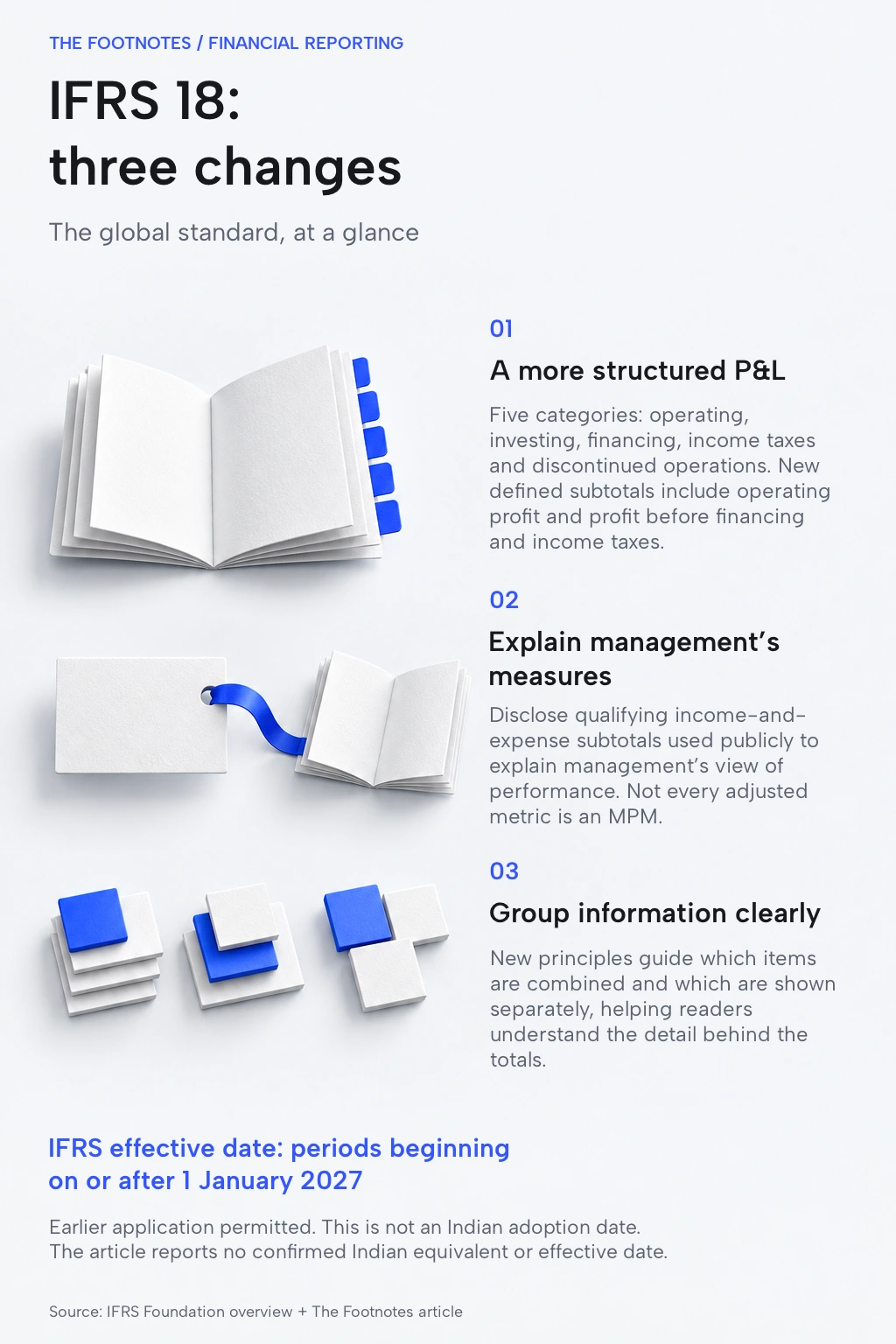
Read the infographic as text
- A more structured P&L. Five categories: operating, investing, financing, income taxes and discontinued operations. New defined subtotals include operating profit and profit before financing and income taxes.
- Explain management’s measures. Qualifying management-defined performance measures are disclosed in the financial statements. These are income-and-expense subtotals used in public communications to convey management’s view—not every adjusted metric.
- Group information clearly. New principles guide which items are combined and which are shown separately, helping readers understand the detail behind the totals.
IFRS 18 applies to annual reporting periods beginning on or after 1 January 2027; earlier application is permitted. This global IFRS date is not an Indian adoption date. The article reports no confirmed Indian equivalent or effective date. Sources: the article and the IFRS Foundation overview.
IFRS 18 Presentation and Disclosure in Financial Statements replaces IAS 1. It sets out how companies present and explain their financial performance, and it applies to annual reporting periods starting on or after 1 January 2027. Companies can adopt it earlier. The IASB's aim is to make companies' results easier for investors to analyse and compare. It does that through three changes, one for each ICAI session.
1. Fixed categories and two required subtotals
Today, Ind AS 1, like IAS 1, lets each company design its own P&L. IFRS 18 ends that. Every item of income and expense has to go into one of five categories: operating, investing, financing, income taxes and discontinued operations. Every company then shows the same two subtotals: operating profit, and profit before financing and income taxes.
2. Company-defined performance measures
Many companies report profit figures they define themselves, such as adjusted EBITDA. IFRS 18 calls these management-defined performance measures, or MPMs. If a company uses one in public, it now has to explain it in the financial statements, and the explanation is audited. This is the change finance teams should watch most closely, and we come back to it below.
3. Grouping rules and the move to the new standard
IFRS 18 also tightens the rules on how items are grouped or split out in the accounts, makes related changes to other standards, and sets out how companies move to the new format. The Ind AS 118 exposure draft carries those transition rules into the Indian framework.
Key date: 1 January 2027, when IFRS 18 takes effect worldwide.
What changes in the Ind AS P&L, line by line
For an Indian CFO used to the current Ind AS 1 format, the change is easiest to see side by side.
| Element | Ind AS 1 today | IFRS 18 and the Ind AS 118 draft |
|---|---|---|
| Structure of the P&L | No set categories; each company chooses its own groupings | Five fixed categories: operating, investing, financing, income taxes, discontinued operations |
| Required subtotals | In practice, only profit before tax and profit for the period | Two new standard subtotals: operating profit, and profit before financing and income taxes |
| "Operating profit" | Each company defines its own, so peers aren't comparable | One definition for everyone, so one company's operating profit means the same as another's |
| Adjusted metrics (adjusted EBITDA, core profit and so on) | Voluntary, outside the audited accounts, often only in investor presentations | Inside the financial statements, explained and reconciled in a note, and audited |
| Grouping of expenses | By nature or function, at management's choice, with little guidance | Stricter rules, including more detail on expenses by nature |
| Effective date | Ind AS 1 applies now | IFRS 18 applies globally from 1 January 2027; Ind AS 118 is proposed for periods from 1 April 2027, subject to MCA notification |
The first row would create the most work. Today, two companies in the same sector can both report an "operating profit" and calculate it in completely different ways. The IFRS Foundation itself names this as the problem the standard is fixing. Once Ind AS 118 is notified, finance teams will have to re-map their chart of accounts to five fixed categories instead of the structures most companies design for themselves today.
The second change is quieter. IFRS 18 asks companies to give more detail on operating expenses. That matters for Indian manufacturers and FMCG companies that today fold cost of materials and employee costs into a few large lines. It would eventually reach quarterly results too, because SEBI's Regulation 33 results format takes its line items from the Ind AS presentation standard.
When adjusted EBITDA becomes an audited number
Most coverage of IFRS 18 has focused on the new subtotals, because they visibly change the P&L. The change Indian CFOs should pay more attention to is the second one: MPMs.
Indian companies already publish many self-defined measures in investor presentations, press releases and the MD&A required under LODR Schedule V: adjusted EBITDA, core operating profit, underlying profit after tax and sector-specific versions. Today these sit outside the audited accounts. Analysts find them useful because management decides how they're built, and that same freedom is why no auditor checks them.
This year's reports show how common they are. TCS's headline profit growth excludes ₹3,366 crore of exceptional items that a reader only finds on page 197. Bharti Airtel's highlights page leads with "Net Profit (before exceptional items)". L&T's standalone results table is the better model: recurring profit, the exceptional item and statutory profit on three lines next to each other.
IFRS 18 closes the gap between these measures and the audited accounts. The IASB's reasoning is simple: investors find these measures useful, but most companies don't explain how they're calculated or how they connect to the standard figures in the P&L. So any measure like this that a company uses in public has to be explained in a note to the financial statements, reconciled to the nearest standard subtotal, and covered by the statutory audit.
That last part matters most to CFOs and audit committees. A number that today lives in an investor presentation, built in a spreadsheet outside the accounting system, would move into the audited accounts and be signed off by the auditor.
In practice: start a list now of every adjusted or "non-GAAP" measure your company publishes. Note where each one is defined, who calculates it, and whether finance or investor relations controls it. That list is where any future MPM note starts, and it's the first thing your auditors will ask about.
For audit committees, the point is that adjusted measures can't stay informal investor relations numbers forever once Ind AS 118 applies. They'd need a written calculation policy, the same method every period and an audit trail, just like any statutory line item. Committees that have worked through NFRA's going-concern questions will recognise the pattern: the number is one thing, but what the auditor focuses on is whether it's properly explained.
What CFOs, company secretaries and IR teams should do now
- Attend the two remaining ICAI sessions. The 19 October session on MPMs is where the audit and control issues come up, and the 26 October session covers transition and the implementation roadmap.
- List your adjusted measures. Write down every adjusted or non-GAAP measure used in results presentations, the annual report's MD&A, analyst calls and credit rating submissions, with how each is calculated and who owns it. Most finance teams have never written this down.
- Test your chart of accounts against the five categories. Even without an Indian standard, mapping today's ledger to operating, investing, financing, income tax and discontinued operations shows where business units group things differently.
- Talk to your statutory auditors early. If adjusted measures end up being audited, the conversation about where the data comes from and how the calculation is controlled should start well before any deadline, not in the quarter before the new rules apply.
- Brief the audit committee and the board. Directors who approve investor communications built on adjusted measures should know that those numbers may move from voluntary disclosure into the audited accounts.
- Watch for MCA's notification. The exposure draft is out and comments have closed. The real trigger now is the Companies (Indian Accounting Standards) Amendment Rules that notify Ind AS 118, which will fix the start date. If it lands on 1 April 2027, the first Ind AS 118 financial statements will be for FY 2027-28, with FY 2026-27 comparatives to re-present.
None of this needs restatement work today. It does mean finance teams should stop treating adjusted EBITDA as a presentation number that sits outside the accounts. The global standard, ICAI's exposure draft and its training plan all point to a future where that number gets the same scrutiny as revenue.
Frequently asked questions
Is India adopting IFRS 18?
India has a draft but not a notified standard. ICAI's Accounting Standards Board issued an exposure draft of Ind AS 118 on 6 January 2025, proposing that it apply to annual periods beginning on or after 1 April 2027. Comments closed on 6 May 2025. An Ind AS only becomes law when the Ministry of Corporate Affairs notifies it, and MCA's August 2026 Ind AS amendment says Ind AS 118 is still "under formulation".
What is IFRS 18 and when does it apply?
IFRS 18 Presentation and Disclosure in Financial Statements is a standard issued by the International Accounting Standards Board in April 2024. It replaces IAS 1 and sets out how companies present their profit and loss statement. It applies to annual reporting periods starting on or after 1 January 2027, and companies can adopt it earlier. It makes three main changes: fixed categories and subtotals in the P&L, disclosure of company-defined performance measures, and clearer rules on how items are grouped.
What is a management-defined performance measure?
A management-defined performance measure, or MPM, is a profit figure the company defines for itself and uses in public communications, rather than one set by the accounting standards. Adjusted EBITDA, core operating profit and underlying profit after tax are typical examples. Under IFRS 18, companies have to explain each MPM, reconcile it to a standard subtotal, and include it in the audited financial statements.
Will adjusted EBITDA become an audited number in India?
Yes, once Ind AS 118 is notified. The exposure draft follows IFRS 18 on this point. Under IFRS 18, measures like adjusted EBITDA that a company uses in public move into a note in the financial statements, reconciled to a standard subtotal, and are covered by the audit. For Indian companies that would mean moving from a spreadsheet owned by investor relations to a documented calculation with an audit trail.
How would the Ind AS profit and loss format change under IFRS 18?
Today, Ind AS 1 lets each company design its own P&L, so one company's operating profit can be calculated differently from another's. Under IFRS 18, every item of income and expense goes into one of five categories (operating, investing, financing, income taxes or discontinued operations), and every company shows two standard subtotals: operating profit, and profit before financing and income taxes. The rules on grouping expenses also get stricter.
What should a CFO do before Ind AS 118 is notified?
Three things are useful whatever the Indian timeline: make a list of every adjusted or non-GAAP measure the company publishes, with how it's calculated and who owns it; map the existing chart of accounts to IFRS 18's five categories to find where business units are inconsistent; and start talking to the statutory auditors about how those adjusted numbers are produced and controlled.
Sources
- Exposure Draft of Ind AS 118, Presentation and Disclosure in Financial Statements (6 January 2025) — ICAI Accounting Standards Board
- Companies (Indian Accounting Standards) Amendment Rules, 2026 (G.S.R. 725(E), 12 August 2026) — Ministry of Corporate Affairs (Gazette of India)
- ICAI Live Events Calendar (ASB webinar schedule, October 2026) — ICAI
- Compendium of Indian Accounting Standards — ICAI
- IFRS 18 Presentation and Disclosure in Financial Statements — IFRS Foundation