


Q2 FY27 results are due by Saturday 14 November 2026, but the deadline is only one of seven dates. Here's the whole sequence, from the trading window closing on 1 October to the call transcript, with the Diwali holiday that moves the board-meeting notice.
In this article
 In short
Key takeaways
- Regulation 33(3)(a) of SEBI LODR gives 45 calendar days from the quarter end, so Q2 FY27 results are due by Saturday 14 November 2026. The deadline does not move to Monday because it falls on a weekend.
- The board-meeting notice under Regulation 29(1) counts working days of the stock exchange, and both the notice date and the meeting date are left out. For a meeting on Thursday 12 November 2026, the NSE holiday on 10 November pushes the last filing day back to Friday 6 November.
- Under Schedule B of the SEBI insider trading regulations, the trading window closes from the end of the quarter, so on 1 October 2026, and stays shut until 48 hours after the results become public. Since 2025 the automated PAN freeze also covers immediate relatives of designated persons.
- The proviso added to Regulation 30(6)(i) in December 2024 gives three hours, not 30 minutes, to file the outcome of a board meeting that closes after market hours and more than three hours before the next session.
- Regulation 47(1) now asks for a newspaper advertisement within 48 hours of the meeting with a QR code and the web address of the full results. Printing the full results is optional.
- The earnings call needs two clear working days' notice. The audio recording is due before the next trading day or within 24 hours, whichever is earlier, any video within 48 hours and the transcript within five working days.
Results for the quarter ended 30 September 2026, Q2 FY27, are due by Saturday 14 November 2026. That's 45 calendar days under Regulation 33 of the SEBI (Listing Obligations and Disclosure Requirements) Regulations, 2015. But the deadline is the middle of the sequence, not the start. The trading window shut six weeks earlier, the board-meeting notice has to beat it by two clear working days, and four more clocks start the moment the board rises.
We've put every step in time order below, with Q2 FY27 dates. If you'd rather enter your own meeting date and time, our free quarterly results deadline calculator runs the same rules, counts NSE's 2026 holidays and shows each date with the regulation behind it.
The Q2 FY27 timeline at a glance
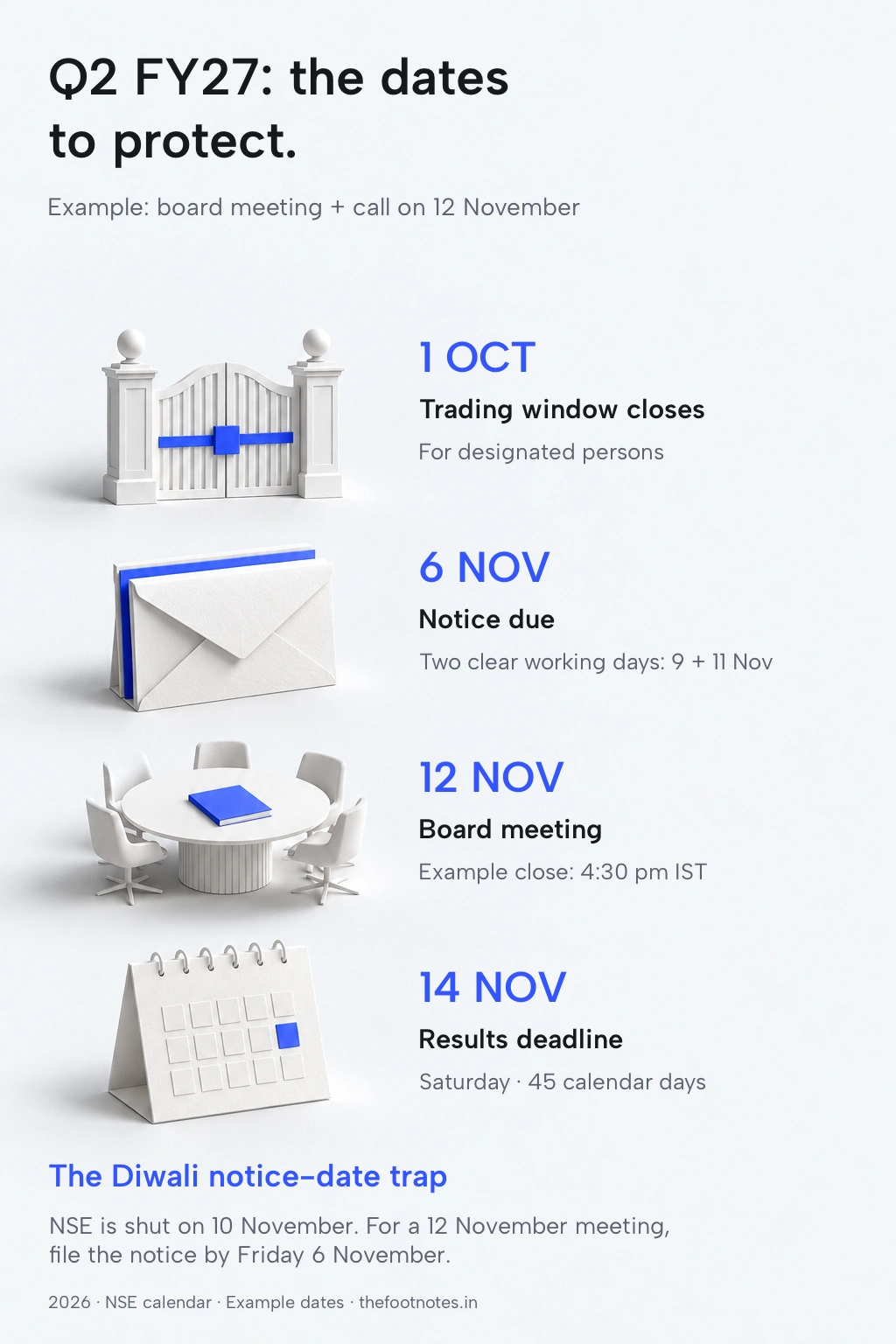
Read the infographic as text
- 1 October. Trading window closes for designated persons. Follow the company's code of conduct.
- 6 November. Latest board-meeting and call notice in this example. The two clear exchange working days are 9 and 11 November; 10 November is an NSE holiday.
- 12 November. Example board meeting closes at 4:30 pm. Earnings call ends at 7:00 pm. All times are IST.
- 14 November. Saturday is the Regulation 33 deadline: 45 calendar days after 30 September. The deadline does not shift to Monday.
Example uses a Thursday 12 November 2026 board meeting and call, and the NSE calendar. Check the applicable exchange calendar. The 6 November notice date is specific to this example.
Take a company whose board meets on Thursday 12 November 2026 and rises at 4:30 pm, with an earnings call from 6:00 to 7:00 pm the same evening. It's a common pattern: two days of slack before the deadline, results out after the market closes.
| Step | Rule | Q2 FY27 date |
|---|---|---|
| Trading window closes | PIT Regulations, Schedule B, clause 4 | Thursday 1 October 2026 |
| Board-meeting and call notice to the exchanges | LODR Regulation 29(1); Schedule III item 15(a) | By Friday 6 November 2026 |
| Board meeting approves results | LODR Regulation 33(3)(a) | Thursday 12 November, 4:30 pm (deadline Saturday 14 November) |
| Outcome filed with the exchanges | LODR Regulation 30(6)(i) and its proviso | By 7:30 pm, 12 November (three-hour window) |
| Audio recording of the call | Schedule III item 15(b)(i) | By 9:15 am, Friday 13 November |
| Newspaper advertisement | LODR Regulation 47(1) | By 4:30 pm, Saturday 14 November |
| Video recording, if any | Schedule III item 15(b)(ii) | By 7:00 pm, Saturday 14 November |
| Trading window reopens | PIT Regulations, Schedule B, clause 4 | 48 hours after filing; first session Monday 16 November |
| Call transcript | Schedule III item 15(b)(iii) | By Thursday 19 November 2026 |
1. The trading window closes on 1 October
The first date in the cycle has nothing to do with the stock exchange filing. Clause 4 of Schedule B to the SEBI (Prohibition of Insider Trading) Regulations, 2015 closes the trading window for designated persons from the end of every quarter until 48 hours after the financial results are declared. For Q2 FY27 the quarter ended on Wednesday 30 September, so the window has been shut since Thursday 1 October 2026.
Enforcement is now automatic. Depositories freeze the PANs of designated persons for the closure period, and SEBI's circular of 21 April 2025 extended the freeze to their immediate relatives, in two phases from July and October 2025. A relative's trade during the closure is now blocked at the depository rather than found afterwards. The freeze only works off the list the company uploads, which makes keeping that list current a compliance task in its own right.
2. The board-meeting notice: two clear working days
Regulation 29(1), as amended with effect from 17 May 2024, requires the company to tell the exchanges about a board meeting to consider financial results "at least two working days in advance, excluding the date of the intimation and date of the meeting". Regulation 29(2) adds that the notice must state the meeting date. Before May 2024 the notice for results was five days.
Two things make the count trickier than it looks. Regulation 2(1)(zn) defines working days as the working days of the stock exchange where the securities are listed, so weekends and exchange holidays drop out. And because both end dates are excluded, two complete working days have to sit between the notice and the meeting.
November 2026 has a holiday in exactly the wrong place. NSE's 2026 holiday list shuts the market on Tuesday 10 November for Diwali Balipratipada. The latest notice date moves like this:
| Board meeting | Two clear working days | Latest notice |
|---|---|---|
| Monday 9 November | Thursday 5, Friday 6 | Wednesday 4 November |
| Thursday 12 November | Monday 9, Wednesday 11 (10 is a holiday) | Friday 6 November |
| Friday 13 November | Wednesday 11, Thursday 12 | Monday 9 November (10 is a holiday) |
| Saturday 14 November | Thursday 12, Friday 13 | Wednesday 11 November |
The Thursday meeting is the one that catches people out. Counting back two days from 12 November without the holiday gives Monday 9 November. The correct answer is the previous Friday.
In practice: A company that reported early hit the same problem in October. Dussehra closed NSE on Tuesday 20 October 2026, so a board meeting on Thursday 22 October needed its notice filed by Friday 16 October.
3. The Regulation 33 deadline: 45 calendar days, no holiday shift
Regulation 33(3)(a) gives 45 days from the end of each of the first three quarters to submit quarterly and year-to-date standalone results, with consolidated results alongside under Regulation 33(3)(b). The audited annual results get 60 days from the year end under Regulation 33(3)(d). For Q2 FY27, 45 days from 30 September is Saturday 14 November 2026.
Unlike Regulation 29, Regulation 33 counts calendar days. There's no rule that moves a deadline falling on a weekend or holiday to the next working day, so 14 November stays 14 November. A company that wants the full 45 days has to meet on the Saturday itself, and some do. Everyone else needs the meeting on or before Friday 13 November. We cover the format, the signatories and the newly-listed-company rule in our Regulation 33 explainer, and what this season's filings need to contain in our Q2 FY27 results guide.
Key number: 45 calendar days from 30 September 2026 is Saturday 14 November. The next three dates are 14 February 2027 (a Sunday), 30 May 2027 (also a Sunday) for the audited annual results, and 14 August 2027.
4. Filing the outcome: 30 minutes, or three hours after the market closes
Once the board approves the results, Regulation 30(6)(i) gives the company 30 minutes from the close of the meeting to tell the exchanges. A proviso added by the LODR Third Amendment Regulations, with effect from 13 December 2024, relaxes that in one case. If the meeting closes after normal trading hours that day but more than three hours before the next trading day's market opens, the company has three hours.
The equity market runs from 9:15 am to 3:30 pm. So:
- A board that rises at 2:00 pm on Thursday 12 November has until 2:30 pm. It closed during market hours.
- A board that rises at 4:30 pm the same day has until 7:30 pm, because the next session opens at 9:15 am on Friday, far more than three hours away.
- A board that meets on Saturday 14 November has three hours whenever it rises, since Saturday isn't a trading day and Monday's open is more than three hours off.
For a meeting held over two days, the second proviso runs the 30-minute or three-hour clock from the close of the day on which the results were taken up. The three hours are a ceiling, not a target: the trading window, the newspaper advertisement and investors' reading of the numbers all start from when the results become public, so most companies still file within minutes.
5. The newspaper advertisement within 48 hours, with a QR code
Regulation 47(1) was rewritten from 13 December 2024. The company must now publish a newspaper advertisement within 48 hours of the end of the board meeting that approved the results, "containing a Quick Response code and the details of the webpage" where the complete results, and any modified audit opinion, can be read. Printing the full results is now optional. Regulation 47(4) keeps the old placement: one English-language national daily and one daily in the language of the region where the registered office sits. Companies listed only on an SME exchange are exempt.
The 48 hours run from the close of the meeting, not from the exchange filing. For our Thursday 12 November meeting closing at 4:30 pm, the advertisement must appear by 4:30 pm on Saturday 14 November, which in practice means the Saturday morning editions. A Saturday 14 November meeting has until Monday 16 November.
6. The trading window reopens 48 hours after the results go public
The same clause that shut the window on 1 October reopens it 48 hours after the results are declared. We read "declared" as the moment the results reach the exchanges and become generally available, so the clock starts at the filing time in step 4, not when the board rises.
If our company files at 5:00 pm on Thursday 12 November, the window reopens at 5:00 pm on Saturday 14 November. The first session in which designated persons and their relatives can actually trade is Monday 16 November. A company that meets on Saturday 14 November and files at 6:00 pm reopens at 6:00 pm on Monday 16 November, and the first full session is Tuesday 17 November. Many codes of conduct set a longer closure than the regulation does, so check yours before telling the board the window is open.
7. The earnings call: notice, recording and transcript
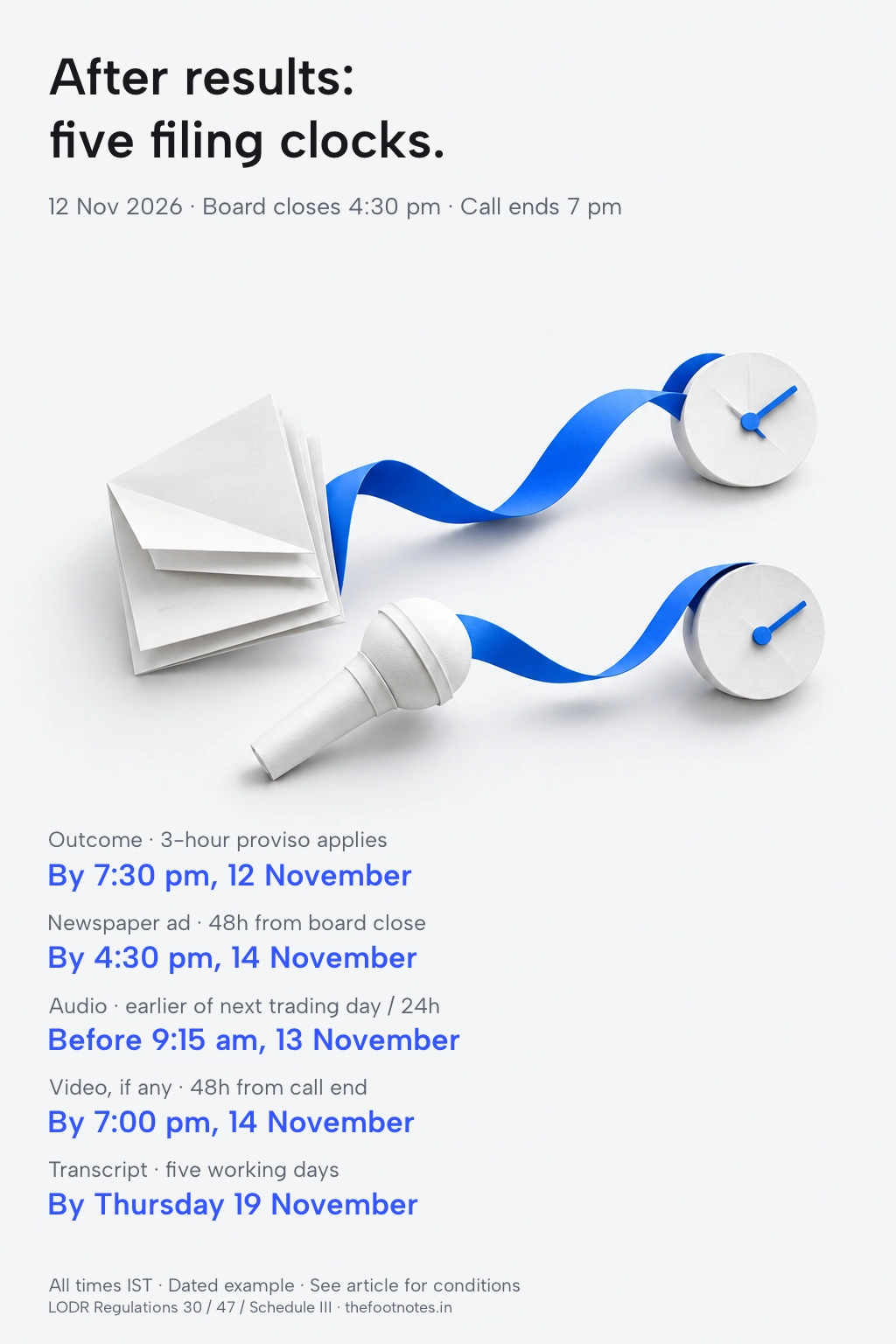
Read the infographic as text
- Outcome: by 7:30 pm, 12 November. Board closes at 4:30 pm on Thursday 12 November 2026. The after-hours three-hour proviso applies in this example; the default is 30 minutes.
- Newspaper ad: by 4:30 pm, 14 November. 48 hours from board close. Include the QR code and webpage details. SME-only listings are exempt from Regulation 47.
- Audio: before 9:15 am, 13 November. Call ends at 7:00 pm on 12 November. Publish promptly, before the next trading day or within 24 hours, whichever is earlier.
- Video, if any: by 7:00 pm, 14 November. 48 hours from the call's end.
- Transcript: by 19 November. Five working days after the call: 13, 16, 17, 18 and 19 November. Publish on the website and file with the exchanges simultaneously.
All times IST. Separate clock: the trading window stays closed until 48 hours after results become public, subject to any longer period under the company code. This is a dated example, not a universal schedule.
The analyst or investor call sits in Schedule III, Part A, Para A, item 15 of LODR, and every part of it has its own clock.
The schedule of the call has to reach the exchanges at least two working days in advance, excluding the date of the notice and the date of the call, under item 15(a)(i). That's the same counting as the board-meeting notice, so for a call on Thursday 12 November the last day is again Friday 6 November. Most companies file both in one letter. The presentation goes to the exchanges before the call starts, under item 15(a)(ii).
After the call, item 15(b) sets three deadlines:
- The audio recording goes on the website promptly, and in any case before the next trading day or within 24 hours of the end of the call, whichever is earlier. For a call ending at 7:00 pm on Thursday 12 November, that's before Friday's 9:15 am open. For a call ending at 7:00 pm on a Saturday, it's 7:00 pm on Sunday.
- Any video recording follows within 48 hours of the end of the call.
- The transcript goes on the website, and filed with the exchanges at the same time, within five working days of the call.
The transcript is where the second November holiday matters. Guru Nanak Jayanti closes NSE on Tuesday 24 November 2026. For a call on Thursday 12 November the five working days are 13, 16, 17, 18 and 19 November, so the transcript is due on Thursday 19 November and the holiday doesn't bite. But a company that holds its call a few days after its results, say on Wednesday 18 November, counts 19, 20, 23, 25 and 26 November and has until Thursday 26 November. Our earnings call transcript explainer goes through these rules in more detail.
Saturday 14 November: the last-day version
For a company using every available day, the sequence compresses to this:
| Step | Date |
|---|---|
| Board-meeting and call notice | By Wednesday 11 November |
| Board meeting | Saturday 14 November (say it rises at 3:00 pm) |
| Outcome filed | By 6:00 pm, Saturday 14 November |
| Audio recording (call ends 5:00 pm) | By 5:00 pm, Sunday 15 November |
| Newspaper advertisement | By 3:00 pm, Monday 16 November |
| Trading window reopens | 6:00 pm, Monday 16 November, if filed at 6:00 pm Saturday |
| Transcript | By Friday 20 November |
The Wednesday 11 November notice is the date to watch. With Tuesday 10 November a holiday and Monday 9 November the only working day between it and the Diwali weekend, a board pack that slips a day can leave the company filing its notice late or meeting after the deadline.
What the calculator does, and what it doesn't
The results deadline calculator takes the quarter, your planned meeting date and closing time, and your call date and time, and returns every date above. It counts working days using NSE's notified 2026 trading holidays, including the 15 January holiday added by circular NSE/CMTR/72260. NSE usually publishes the next year's list in December, so for Q3 FY27 and later the calculator skips weekends but flags that 2027 holidays haven't been notified yet.
It doesn't check your code of conduct's closure period, which can be longer than the regulation's, or the separate timelines for debt-listed entities under Regulation 52. And it treats a holiday on NSE as a holiday for everyone. If your shares are listed only on BSE, check BSE's own holiday list.
As far as we can find, none of these timelines changed in 2026: the LODR amendments of January and July 2026 dealt with other things. The dates above run on the May 2024 and December 2024 texts.
Frequently asked questions
What is the due date for Q2 FY27 quarterly results?
Results for the quarter ended 30 September 2026 are due within 45 days of the quarter end under Regulation 33(3)(a) of the SEBI (Listing Obligations and Disclosure Requirements) Regulations, 2015. That is Saturday 14 November 2026. The period runs in calendar days, so a weekend or exchange holiday at the end does not extend it.
How many days before the board meeting must a listed company inform the stock exchange?
At least two working days in advance, excluding the date of the intimation and the date of the meeting, under Regulation 29(1) as amended with effect from 17 May 2024. Working days are those of the stock exchange, so weekends and exchange holidays don't count. Two full working days must sit between the notice and the meeting.
When does the trading window close and reopen around quarterly results?
Clause 4 of Schedule B to the SEBI (Prohibition of Insider Trading) Regulations, 2015 closes the window from the end of every quarter until 48 hours after the financial results are declared. For Q2 FY27 it closed on 1 October 2026. If a company files its results at 5:00 pm on 12 November, the window reopens at 5:00 pm on 14 November, and the first session designated persons can trade in is Monday 16 November.
Is the 30-minute rule for filing financial results still in force?
Yes, with one exception added in December 2024. If the board meeting closes during market hours, or less than three hours before the next session opens, the outcome is due within 30 minutes. If it closes after market hours and more than three hours before the next session, the company has three hours. For a meeting held over more than one day, the clock runs from the close of the day on which the results were considered.
Do listed companies still have to print their full results in the newspaper?
No. Since 13 December 2024, Regulation 47(1) requires an advertisement within 48 hours of the board meeting that carries a QR code and the details of the webpage where the complete results and any audit qualifications can be read. A company may still print the full results if it wants to. The advertisement goes in one English national daily and one regional-language daily. SME-listed entities are exempt.
When is the earnings call transcript due?
Within five working days of the call, posted on the company's website and filed with the exchanges at the same time, under Schedule III, Part A, Para A, item 15(b)(iii) of SEBI LODR. The audio recording is due earlier: before the next trading day or within 24 hours of the call, whichever comes first. Any video recording is due within 48 hours.
Sources
- SEBI (Listing Obligations and Disclosure Requirements) Regulations, 2015, consolidated and amended up to 22 January 2026 — SEBI
- SEBI circular SEBI/HO/ISD/ISD-PoD-2/P/CIR/2025/55: automated trading window closure extended to immediate relatives of designated persons — SEBI
- Trading holidays for calendar year 2026 (NSE/FAOP/71777) — NSE
- Trading holiday on 15 January 2026 (NSE/CMTR/72260) — NSE
- FAQs on submission of financial results as per Regulation 33 of SEBI LODR Regulations, 2015 — NSE
- SEBI LODR (Third Amendment) Regulations, 2024: key changes — TaxGuru