

SEBI LODR doesn't make a listed company hold an earnings call. Once it holds one, five clocks start: the notice, the presentation, the audio, the video and the transcript.
In this article
 In short
Key takeaways
- Nothing in the SEBI LODR Regulations, 2015 requires a company to hold an earnings call. Item 15 of Para A, Part A, Schedule III and Regulation 46(2)(o) and (oa) attach duties only to calls and group meets it chooses to hold.
- The schedule of a group meet or call must reach the exchange at least two working days in advance, not counting the day of intimation or the day of the meet.
- Since 13 December 2024 the presentation goes to the exchange before the call begins, the audio recording is due by the earlier of the next trading day or 24 hours, and a video recording, if one is made, within 48 hours.
- The transcript is due within five working days of the call, posted on the website and submitted to the exchange simultaneously.
- Audio and video recordings must stay on the website for at least two years and transcripts for at least five, each then preserved under the company's Regulation 9(b) policy.
A listed company doesn't have to hold an earnings call. Nothing in the SEBI Listing Obligations and Disclosure Requirements (LODR) Regulations, 2015 requires one. But once a company holds a post-results call or a group meet with analysts or institutional investors, five deadlines apply, and the transcript is the one most often filed late.
With Q2 FY27 results due by 14 November 2026, most of these calls will happen in the next four weeks. The rules below are taken from the consolidated LODR text last amended on 14 July 2026. Two provisions carry them: item 15 of Para A, Part A, Schedule III, which is an exchange disclosure under Regulation 30, and Regulation 46(2)(o) and (oa), which covers the company website.
Is a listed company required to hold an earnings call?
No. Item 15 and Regulation 46(2)(oa) apply to "post earnings or quarterly calls, by whatever name called, conducted physically or through digital means". They describe what happens when a call takes place. Neither creates a duty to hold one, and no other provision in the LODR text does.
Item 15 sits in Para A, the list of events treated as material without any materiality test. So the filings follow automatically once a call or group meet happens, whatever was said on it.
Explanation I to item 15(a) defines a "meet" as a group meeting or group conference call, physical or digital. One-to-one meetings with a single fund manager fall outside it. That has been the position since the substitution of item 15 with effect from 5 May 2021 (footnote 705 of the consolidated text).
Earnings call deadlines under item 15 and Regulation 46
The current text dates from the SEBI (LODR) (Third Amendment) Regulations, 2024, effective 13 December 2024 (footnotes 706 and 708 to 712 for item 15; footnotes 445 and 448 to 450 for Regulation 46). It split one combined deadline into separate ones for the presentation, the audio and the video.
| Stage | What the text requires | Deadline | Clause |
|---|---|---|---|
| Before the call | Schedule of the meet or call, to the exchange | At least two working days in advance, excluding the date of intimation and the date of the meet | Sch III Para A item 15(a)(i); Reg 46(2)(o)(i) |
| Before the call | Presentation prepared for the meet or call, to the exchange and on the website | Before the event begins | Item 15(a)(ii); Reg 46(2)(o)(ii) |
| After the call | Audio recording, on the website | Promptly, and in any case before the next trading day or within 24 hours of the end of the call, whichever is earlier | Item 15(b)(i); Reg 46(2)(oa)(i) |
| After the call | Video recording, if one is made, on the website | Within 48 hours of the end of the call | Item 15(b)(ii); Reg 46(2)(oa)(ii) |
| After the call | Transcript, on the website with simultaneous submission to the exchange | Within five working days of the end of the call | Item 15(b)(iii); Reg 46(2)(oa)(iii) |
The two-working-day notice period came in with the Second Amendment of 2023, effective 15 July 2023 (footnotes 447 and 707). Explanation II, added in December 2024, makes it optional to name the analysts or investors in the schedule (footnote 711).
The presentation rule is the change teams still miss. Before December 2024, the presentation went on the website with the recording, within the 24-hour window after the call. Now item 15(a)(ii) says it "shall be disclosed to the recognized stock exchanges prior to beginning of such events". Slides that are still being edited at 3:55 PM for a 4:00 PM call are a filing risk.
"Working days" has a definition. Regulation 2(1)(zn) says it means working days of the stock exchange where the company's securities are listed, so exchange holidays don't count in either the notice period or the transcript window.
Late filings carry their own paperwork. The proviso to Regulation 30(6) says disclosures with timelines in Part A of Schedule III must be made within those timelines, and a late disclosure must come with an explanation for the delay.
Key number: five working days for the transcript. The audio recording is due within 24 hours, and the video within 48.
A Q2 FY27 call, date by date
Take a company whose board approves Q2 results on Thursday 29 October 2026 and which holds its call on Friday 30 October from 4:00 PM to 5:00 PM IST. Assuming no exchange holiday falls in the window, the dates work out like this.
| Filing | Last date and time |
|---|---|
| Schedule of the call to the exchange | Tuesday 27 October (Wednesday and Thursday are the two clear working days) |
| Presentation to the exchange and website | Friday 30 October, before 4:00 PM |
| Audio recording on the website | Saturday 31 October, 5:00 PM (24 hours beats the next trading day, Monday) |
| Video recording, if any | Sunday 1 November, 5:00 PM |
| Transcript on the website and to the exchange | Friday 6 November |
A Friday evening call is where the "whichever is earlier" test catches people. The next trading day is Monday, so the 24-hour limit governs and the audio has to go up on a Saturday.
For a midweek call the test usually runs the other way. NSE's 2022 guidance note worked through a Tuesday call at 11:00 AM and treated the recording as due by 9:00 AM on Wednesday, before trading opens, because that comes before the 24 hours run out. The audio wording hasn't changed since that note, so the same reading holds.
Diwali falls in early November this year. Check the exchange holiday list before fixing the transcript date, since a trading holiday inside the five-day window pushes it back by a day.
For the content of the deck itself, see our guide to the quarterly investor presentation.
Where do companies file late?
The most common slip is treating 24 hours as the deadline for everything. It now covers only the audio. The video has 48 hours, and the transcript has five working days. Each needs its own line in the compliance calendar.
The second is the presentation, for the reason above. A deck shared with analysts on the call but uploaded afterwards is late, however quickly it follows.
Some teams also assume a call with nothing price-sensitive in it needs no filing. Item 15 is a Para A event, so the materiality of what was said doesn't matter. The duty comes from the call happening.
Hosting is the fourth. Regulation 46(2)(oa) requires the recordings and transcript to be "made available on the website" of the listed entity. A link to a webcast vendor's page that expires after 30 days doesn't meet a two-year retention rule. Host the files yourself.
The audio and video clauses speak only of the website, while the transcript clause also requires "simultaneous submission to recognized stock exchanges". Many companies send the exchange a short letter with the audio link too. It costs nothing and gives a timestamped record if the 24-hour deadline is ever questioned.
In practice: on the day the board meeting date is fixed, add five lines to the results-season calendar: notice, presentation, audio, video and transcript. Name an owner for each.
What should the UPSI review cover?
Under the Prohibition of Insider Trading Regulations, 2015, a company shouldn't share unpublished price sensitive information (UPSI) on a call. UPSI is information that could move the share price before it's public. NSE's guidance note says that if UPSI does slip out, the company must disclose it promptly.
The transcript window is too late to catch a slip. The audio is due within 24 hours, so the review has to happen the same day. The company secretary or compliance officer should listen live, or read a same-day note from the IR team, and decide before the audio goes up whether anything new was said.
NSE's note also describes a line some companies put in their call notices, saying the discussion will rely on published information and no UPSI is intended to be shared. NSE presents it as best practice. It's sensible but not a legal requirement.
The note's other suggestions for the filing are still useful:
- Attach the transcript itself to the exchange announcement.
- List the management attendees.
- Cover the presentation, the Q&A and any open points.
- Upload a searchable PDF.
How long must recordings and transcripts stay online?
The retention periods changed on 13 December 2024. The proviso to Regulation 46(2)(oa) now reads as follows.
| Document | Minimum period on the company website | After that |
|---|---|---|
| Audio recording and video recording | Two years | Per the company's preservation policy under Regulation 9(b) |
| Transcript | Five years | Preserved in accordance with Regulation 9(b) |
Regulation 9(b) covers documents with a preservation period of not less than eight years after completion of the relevant transactions. So a transcript has to stay on the website for five years and be kept for at least eight under the company's policy.
The old text, quoted in footnote 450, required five years for the presentation and recordings and preservation of transcripts under Regulation 9(a), which is the permanent category. That's where the common advice to keep transcripts "permanently" comes from. Keeping them longer than the minimum does no harm, but the policy should state the current periods rather than the old ones.
Website redesigns are where these files usually get lost. The preservation policy should name the call recordings and transcript folders, and the person who signs off any site migration should check them.
What does this mean for CFOs, company secretaries and IR teams?
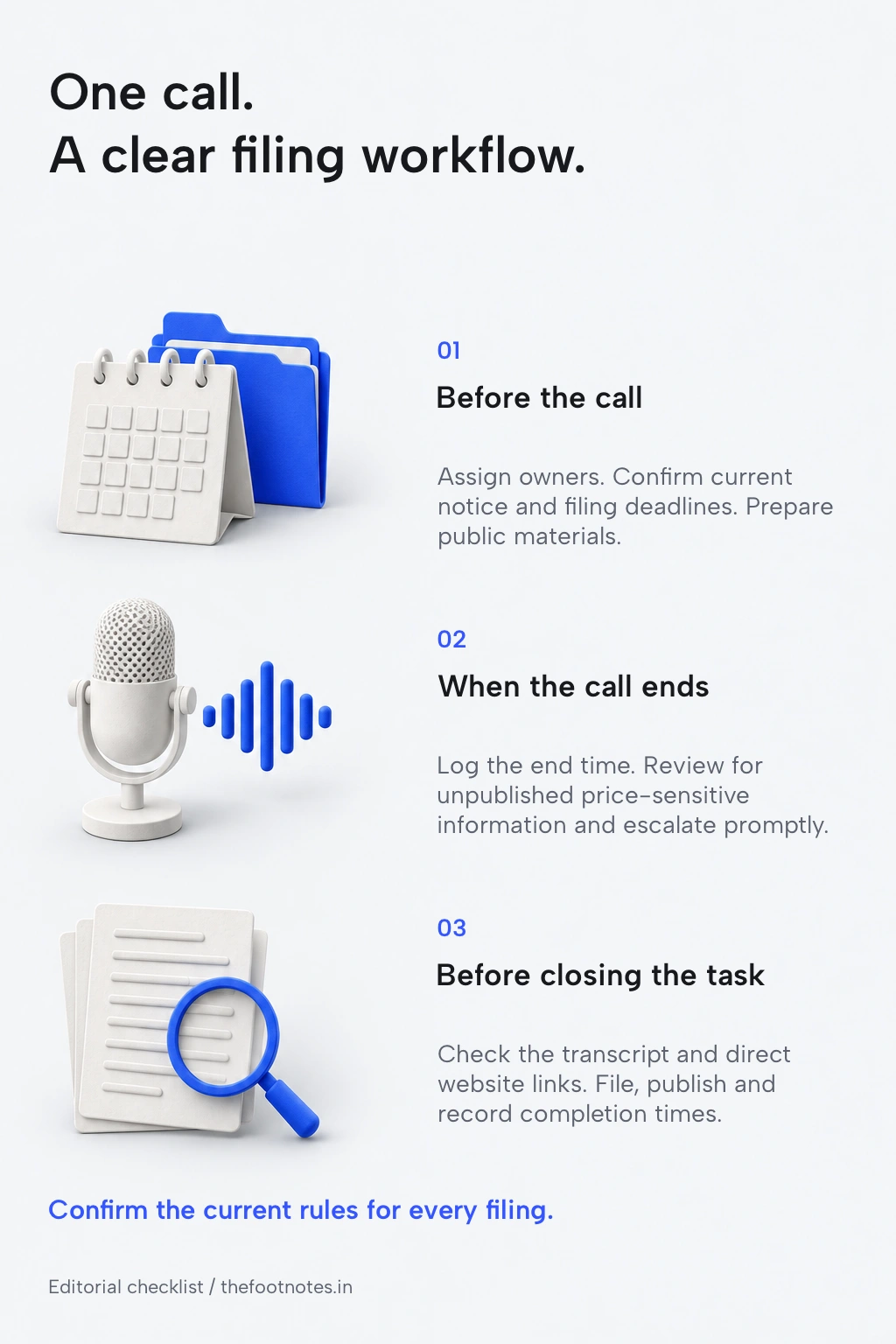
Read the infographic as text
- Before the call. Assign owners. Confirm current notice and filing deadlines. Prepare public materials.
- When the call ends. Log the end time. Review for unpublished price-sensitive information and escalate promptly.
- Before closing the task. Check the transcript and direct website links. File, publish and record completion times.
Editorial workflow, not a statement of statutory deadlines. Verify current LODR requirements for each document.
CFOs
- Decide early in the quarter whether the company will hold a call. That decision creates the filing duties.
- If you decide against one, keep the written results and the investor presentation complete enough that nothing depends on a call. The results themselves still follow Regulation 33.
- Book a transcription vendor who can turn the call around in about three working days. That leaves two for review inside the five-day limit.
Company secretaries
- Send the schedule to the exchange with two clear working days before the call. Count exchange working days only.
- Get the final deck in time to file it before the call begins, and treat any later version as a fresh disclosure.
- Sit in on the call, or review the audio the same day, before it goes on the website.
- Update the Regulation 9 preservation policy to the two-year and five-year website minimums.
IR teams
- Upload the audio by the earlier of the next trading day or 24 hours, and the video within 48 hours if you record it.
- Post the transcript on your own website and file it with the exchange in the same hour.
- Keep a one-page log for each call: end time, upload times, filing times and who cleared the UPSI check.
Before the Q2 calls begin, run one test with last quarter's call. Check that every link on the investor page opens a file hosted on your own domain, and that the two-year-old recordings are still there.
Frequently asked questions
Is an earnings call mandatory for a listed company in India?
No. Nothing in the SEBI LODR Regulations, 2015 requires a listed company to hold one. Item 15 of Para A, Part A, Schedule III and Regulation 46(2)(o) and (oa) apply only to post-earnings or quarterly calls and group meets that a company holds. A company that doesn't hold a call has none of those filings to make.
How far in advance must an earnings call be intimated to the stock exchange?
At least two working days before the meet, excluding both the date of intimation and the date of the meet, under item 15(a)(i) of Para A, Part A, Schedule III. For a call on Friday 30 October 2026, the last day to intimate is Tuesday 27 October, leaving Wednesday and Thursday clear. Naming the analysts or investors in the schedule is optional.
When must the earnings call presentation be filed?
Before the call begins. Item 15(a)(ii) says presentations prepared for analyst or investor meets and post-earnings or quarterly calls must be disclosed to the exchanges prior to the beginning of the event, and Regulation 46(2)(o)(ii) puts the same presentation on the website before the event. This replaced the old rule, under which the presentation went up with the recording after the call.
What are the deadlines for the earnings call recording and transcript?
The audio recording goes on the website before the next trading day or within 24 hours of the end of the call, whichever is earlier. A video recording, if the company makes one, has 48 hours. The transcript is due within five working days of the end of the call, posted on the website and submitted to the exchange at the same time. All three come from item 15(b) of Para A and Regulation 46(2)(oa), in force since 13 December 2024.
How long must earnings call recordings and transcripts stay on the company website?
Audio and video recordings must stay on the website for at least two years and transcripts for at least five years, under the proviso to Regulation 46(2)(oa). After that, both are preserved under the company's document preservation policy in terms of Regulation 9(b), which sets a minimum of eight years. Before 13 December 2024 the rule was five years for recordings and permanent preservation for transcripts, which is why older guides still say "permanently".
Do one-to-one investor meetings have to be disclosed to the exchange?
No. Explanation I to item 15(a) defines a meet as a group meeting or group conference call, held physically or digitally. One-to-one meetings fall outside it, a position in place since 5 May 2021.
Sources
- SEBI (Listing Obligations and Disclosure Requirements) Regulations, 2015, last amended on 14 July 2026 (Regulations 2(1)(zn), 9, 30(6), 46(2)(o) and (oa); Schedule III, Part A, Para A, item 15) — SEBI
- NSE Circular NSE/CML/2022/38: Guidance note on disclosures pertaining to analysts / institutional investors meet and best practices (best-practice guidance; timelines superseded in part from 13 December 2024) — National Stock Exchange of India