


A quarterly investor presentation is a disclosure document under Regulation 30, so every slide has to trace back to something already filed. The slide order that works, and the December 2024 rule that moved the filing to before the call.
In this article
 In short
Key takeaways
- A quarterly investor presentation is a disclosure document under Regulation 30 of the SEBI (Listing Obligations and Disclosure Requirements) Regulations, 2015, so every slide must trace back to something already filed or something the company is ready to tell everyone at once.
- The SEBI LODR (Third Amendment) Regulations, 2024, notified on 12 December 2024, require the deck to be filed with the stock exchanges and hosted on the company website before the analyst or earnings call begins.
- Most of the Third Amendment, including the presentation-sequencing change, took effect on 13 December 2024, the date of gazette publication; only the investor-grievance statement and the corporate governance report format moved to 31 December 2024.
- Audio and video recordings now stay on the website for a minimum of two years and transcripts for five, while Regulation 9 still requires the company to keep securities-law records for at least eight years internally.
- Naming the analysts and institutional investors in the meeting schedule is optional under the new Explanation II; companies may keep naming them, and either choice is compliant.
- A workable slide order runs cover and safe-harbour, logistics annex, quarter highlights, segment performance, balance sheet and cash flow, guidance commentary, management attendee list.
A quarterly investor presentation is the slide deck a listed company publishes alongside its results. It is a disclosure document under Regulation 30 of the SEBI (Listing Obligations and Disclosure Requirements) Regulations, 2015, not a marketing deck. It should carry the quarter's highlights, segment performance, a balance sheet and cash flow summary, guidance commentary and the names of management on the call. Every slide should trace back to something the stock exchanges already have.
The filing order changed in December 2024. The SEBI LODR (Third Amendment) Regulations, 2024 were notified on 12 December 2024. They reversed a practice most investor relations teams had followed for years, which was to file the deck with the exchanges after the call ended. The deck now goes out first.
What should a quarterly investor presentation contain?
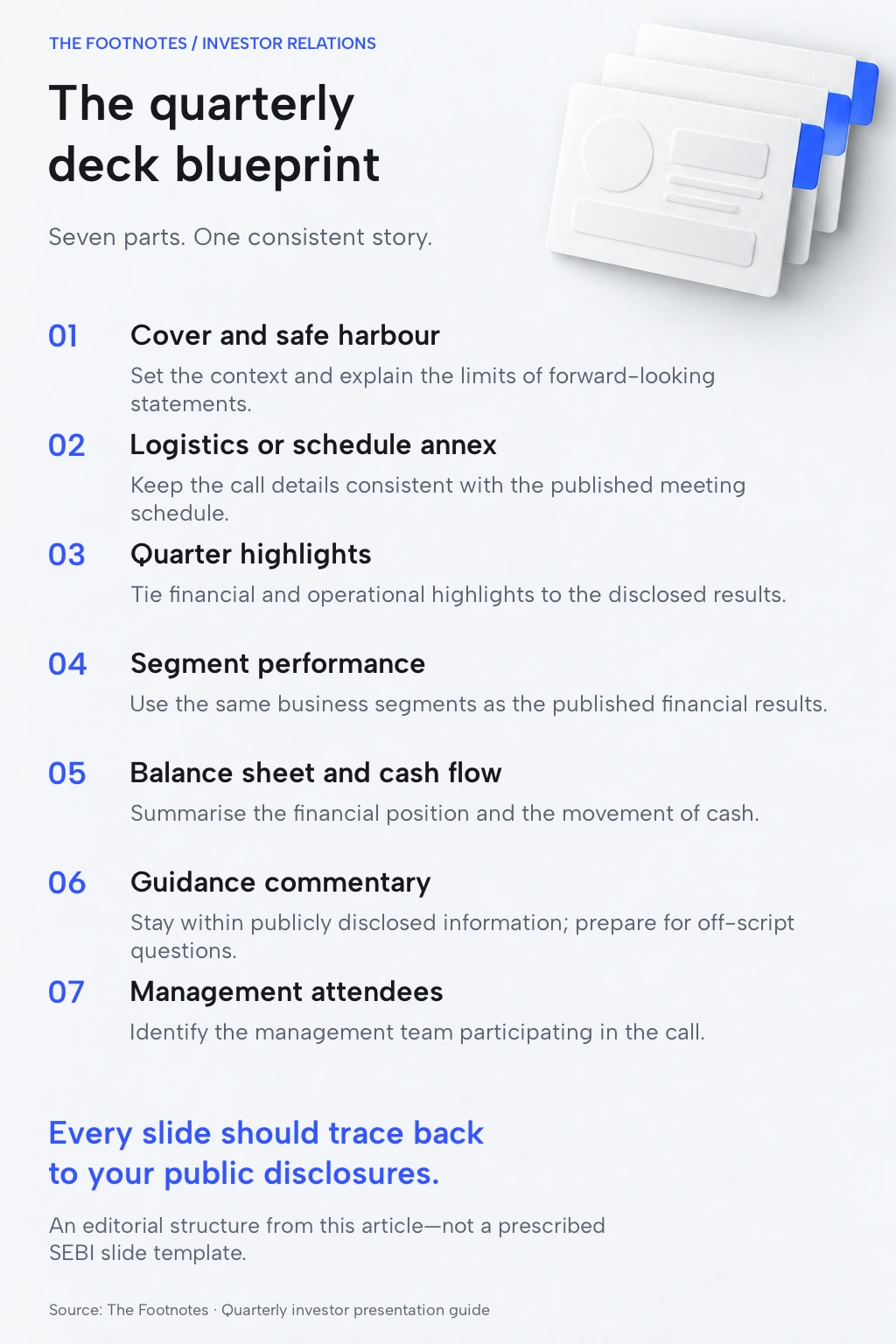
Read the infographic as text
- Cover and safe harbour. Set the context and explain the limits of forward-looking statements.
- Logistics or schedule annex. Keep the call details consistent with the published meeting schedule.
- Quarter highlights. Tie financial and operational highlights to the disclosed results.
- Segment performance. Use the same business segments as the published financial results.
- Balance sheet and cash flow. Summarise the financial position and the movement of cash.
- Guidance commentary. Stay within publicly disclosed information; prepare for off-script questions.
- Management attendees. Identify the management team participating in the call.
This is the article’s recommended structure, not a prescribed SEBI slide template. Every slide should be traceable to the company’s public disclosures.
SEBI prescribes the filing clock, not a slide template. The structure below works because it follows the order in which an analyst reads a quarter, and because every item in it is already public by the time the call starts.
- Cover and safe-harbour slide. State that forward-looking statements are not guarantees, and that no unpublished price sensitive information will be shared.
- Logistics or schedule annex. Keep it consistent with the meeting schedule you already filed.
- Quarter highlights. Financial and operational, tied to the numbers in the board outcome already sent to the exchange.
- Segment or business-line performance. Use the same segments as the published results.
- Balance sheet and cash flow summary.
- Guidance commentary. Word it so it introduces nothing new and price-sensitive mid-call.
- Management attendee list.
None of this is exotic. The discipline is in the sourcing. By the time any investor sees a slide, that slide has already gone to the exchange, so it cannot contain anything the company is not ready to tell the whole market. Our note on the Regulation 33 results format and the 45-day deadline sets out the filing the deck has to sit behind.
What Regulation 30 and Schedule III require
Regulation 30 requires every listed entity to tell the stock exchanges about material events or information. Schedule III Part A lists the events that are deemed material, so no judgement call is needed. The schedule of analyst and institutional investor meetings sits in that deemed-material list, at sub-paragraph 15 of Para A.
Before the 2024 amendment, that sub-paragraph treated the presentation and the audio or video recording of the call as one package. All of it ran on the same post-event clock: before the next trading day or within twenty-four hours from the conclusion of such calls, whichever is earlier.
That bundling is what the Third Amendment undid. Regulation 30 also drives a range of other intimations during the year, from board changes to an unsolicited ESG rating intimation, so secretarial teams tend to know the regulation well and still miss this sequencing point.
File the deck before the call, not after
The amendment inserted a new sub-clause into Schedule III Part A, Para A, sub-paragraph 15. It added a parallel clause to Regulation 46(2)(o), which governs what a listed entity must host on its own website. Both now say much the same thing. Presentations prepared for an analyst or institutional investor meet, or for a post-earnings or quarterly call, must be disclosed to the recognized stock exchanges prior to beginning of such events.
"Prior to beginning" is the operative phrase. The deck can no longer travel with the recording in the post-call package. It has to be filed with the exchange, and hosted on the company website, before the first slide is shown to anyone.
| Requirement | Before Third Amendment 2024 | After Third Amendment 2024 |
|---|---|---|
| Presentation filing with exchange | Bundled with audio/video recording; filed after the call, within 24 hours or by next trading day | Filed before the call or meet begins |
| Presentation on company website | Same post-call timeline as recording | Hosted before the event begins |
| Audio recording | Before next trading day or 24 hours from conclusion, whichever earlier | Unchanged |
| Video recording | No separate website-hosting timeline specified | New: within 48 hours from conclusion |
| Transcript | Within 5 working days of conclusion | Unchanged |
| Names of analysts/institutional investors in the schedule | Required | Now optional (Explanation II) |
The SEBI Expert Committee report on ease of doing business that fed into the amendment is candid about the reason. The committee wanted to close the information gap between the people on the call and everyone else. If the presentation is public before the meeting starts, retail and institutional investors see the same numbers at the same time.
In practice: treat the deck filing as a pre-event gate. Put it first on the call-day checklist.
Almost all of the Third Amendment, including this change, took effect on 13 December 2024, the date of gazette publication. Two unrelated items were deferred to 31 December 2024: the quarterly investor-grievance redressal statement and the corporate governance compliance report format. Some commentary cites 31 December as the effective date for the whole amendment. Treat that with caution. The presentation-sequencing rule has been live since 13 December 2024.
Attendee names: optional, not banned
Practitioners keep asking whether they still have to name the analysts and fund managers they meet. Under the old Explanation to Schedule III, the schedule of the meet had to carry those names. The amendment added a new Explanation II, which says that disclosure of names in the schedule of analysts or institutional investors meet shall be optional for the listed entity.
The Expert Committee's public consultation shows the point was contested. Some respondents wanted the naming requirement kept. SEBI's response was that the regulation exists to equalise information about what was discussed, not to publish a list of who attended. Companies can still name attendees if that fits their investor-relations practice. Nothing in the regulation requires it now.
How long must recordings and transcripts be kept?
This is the part most secretarial teams miss, because two clocks now run side by side. One governs what the public can see on your website. The other governs what your records team must keep internally.
| Record type | Website hosting (public) | Internal preservation (Regulation 9) |
|---|---|---|
| Audio recording | Minimum 2 years | Minimum 8 years |
| Video recording | Minimum 2 years | Minimum 8 years |
| Transcript | Minimum 5 years | Minimum 8 years |
The website window for audio and video recordings fell from five years to a minimum period of two years. After that, the company's own archival policy applies. Transcripts must stay up for five years.
Regulation 9 of the LODR Regulations sits underneath all of this. It requires listed entities to frame a document-preservation policy that classifies records as permanent or kept for not less than eight years after completion of the relevant transactions. SEBI's own FAQ, updated in April 2025, confirms that this applies to securities-law records generally. The Expert Committee's consultation paper is explicit that the eight-year internal floor sits below the shorter public windows for recordings and transcripts.
So taking a recording off the website after two years does not allow you to delete it. The preservation policy has to keep it on file for eight.
SEBI's reason for shortening the website windows was practical. Audio and video files consume storage, and the committee concluded that keeping them public for five years gave investors little once the information had aged.
Sequencing the deck against the board-outcome clock
A results call follows a board meeting that approved the financial results, and that meeting has its own clock under Regulation 30(6). The base rule has not changed. Results and other Schedule III Para A matters must reach the exchange within 30 minutes of the board meeting closing.
The Third Amendment added a proviso for meetings that close outside trading hours. If the meeting closes after normal trading hours and more than three hours before the next trading day's normal hours begin, the entity gets three hours from closure instead of thirty minutes.
This matters for the deck because the presentation cannot front-run the board-outcome disclosure. The sequence runs:
- The board approves the results, and the outcome disclosure goes to the exchange within the 30-minute or three-hour window, whichever applies.
- Only then can the investor deck, built on the same numbers, be finalised and filed with the exchange.
- The deck must reach the exchange and the website before the earnings call begins.
Compress those three steps into one afternoon and the margin for error gets thin. Companies that hold the board meeting and the call on the same day need a tested internal timeline. Otherwise the deck goes out before the board outcome, or the call opens before the deck is filed. The judgement calls that tend to surface in the deck itself, around segment notes and related-party numbers, are covered in our piece on this quarter's Regulation 33 results season.
The three stages in NSE's guidance note
For process, the clearest reference is still NSE's 2022 guidance note on analyst and institutional investor meet disclosures. It frames the obligations in three stages. The filing-timing rule it describes has been overtaken by the 2024 amendment, but the rest of the map holds.
Before the call
NSE recommends that the schedule disclosure carry the meet or call details, the mode of attending, registration details, any disclaimers needed to complete registration, platform requirements, and whether the audience is open or restricted. Under the new regime, this is also the point at which the presentation must already be filed and live on the website. Not drafted. Not pending internal sign-off. Filed.
During the call
The core risk is selective disclosure of unpublished price sensitive information, or UPSI, which is information that could move the share price and has not yet been made public. NSE's note observes that minority shareholders are not privy to what is shared with a select group of investors. That is the asymmetry both the UPSI regime and the pre-filing rule exist to prevent.
The guidance records the common practice of adding a disclaimer confirming that no UPSI will be discussed. Management then has to hold that line through Q&A, where the off-script answer is the real exposure.
After the call
The recording and transcript obligations apply here, and NSE's best-practice list is still useful for deck design:
- Attach the transcript to the same corporate announcement filed with the exchange, rather than a separate one.
- Give the exact web-page link to the recording or transcript, not the homepage.
- Include a list of management attendees on the call.
- Capture the full dialogue, including questions, answers, and any assents or dissents on open points.
- Keep a written confirmation on file that no UPSI was shared or discussed.
- Upload a readable PDF rather than a scanned or compressed file that cannot be searched.
What changes for CFOs, company secretaries and IR teams
For the CFO, the change is timing discipline across the finance close, the board meeting and the investor call. Numbers cannot be finalised for the deck after the board has approved results and the outcome clock has started. The deck has to be built in parallel, ready to file the moment the board outcome goes out.
For the company secretary, this is now a filing-sequence item as much as a content-accuracy one. Three things are worth doing. Build a checklist that forces the presentation filing to happen before the public calendar invite for the call goes live. Update the Regulation 9 preservation policy to state the eight-year internal floor. Keep a log of when each quarter's website hosting clock started and when it lapses.
For investor relations, the deck now has to be drafted and locked earlier in the results cycle. It can no longer be adjusted after seeing how the call goes. IR teams should also settle, as policy, whether to keep naming attendees in the meeting schedule. Some companies will keep the practice for transparency and others will drop it. We'd read the regulation as leaving both routes open.
Run a dry quarter before the next results season
Take last quarter's actual board-meeting and call timings. Map out when the outcome disclosure, the deck filing and the website upload would each have had to happen under the current rules. If that exercise shows a gap of even ten minutes, fix the workflow now, while nothing is riding on it.
Frequently asked questions
When must a listed company file its quarterly investor presentation with the stock exchanges?
Before the call or the analyst meet starts. The SEBI LODR (Third Amendment) Regulations, 2024 changed Schedule III Part A, Para A, sub-paragraph 15 and Regulation 46(2)(o) so that presentations must be disclosed to the exchanges "prior to beginning of such events". The same deck has to be live on the company website by then. The older practice of filing it with the post-call package no longer works.
What should a quarterly investor presentation contain?
A cover and safe-harbour slide, a logistics annex matching the schedule already filed, the quarter's financial and operational highlights tied to the board-outcome numbers, segment or business-line performance, a balance sheet and cash flow summary, guidance commentary worded so it adds nothing price-sensitive, and the list of management on the call. Nothing in the deck should be newer than what the exchange already has.
Do companies still have to name the analysts attending an investor meet?
No. The Third Amendment added Explanation II to Schedule III, which makes naming analysts or institutional investors in the meeting schedule optional. Some respondents to SEBI's consultation wanted the naming kept. SEBI's view was that the rule exists to equalise information about what was discussed, not to publish a roster of who attended. Companies that prefer to keep naming attendees may do so.
How long must recordings and transcripts of the earnings call stay online?
Audio and video recordings must stay on the company website for a minimum of two years, down from five. Transcripts must stay up for five years. Taking a file off the website does not permit deletion. Regulation 9 requires a document-preservation policy that keeps records for not less than eight years after the relevant transactions, so the recording stays in the company's own files.
Can the investor deck be filed before the board outcome goes to the exchange?
No. The board approves the results, the outcome disclosure goes to the exchange within 30 minutes of the meeting closing, and only then can the deck built on those numbers be filed. The deck must still reach the exchange and the website before the call starts. Companies holding the board meeting and the call on the same afternoon need a tested timeline for those three steps.
When does the three-hour window for the board outcome apply?
The base rule under Regulation 30(6) is 30 minutes from the close of the board meeting. The Third Amendment added a proviso: if the meeting closes after normal trading hours and more than three hours before trading starts the next day, the entity gets three hours from closure instead of 30 minutes. The deck sequencing has to be planned around whichever window applies.
Sources
- Detailed analysis of Regulation 30 of SEBI (LODR) Regulations, 2015 — TaxGuru
- SEBI (LODR) (Third Amendment) Regulations, 2024 — TaxGuru
- Highlights of SEBI (LODR) Regulations (Third Amendment) 2024 — TaxGuru
- NSE Guidance Note on disclosures pertaining to analysts, institutional investors meet and best practices — NSE
- FAQs for LODR Regulations — SEBI
- Recommendations of the Expert Committee for facilitating ease of doing business — SEBI