


SEBI wants a monitoring agency on every public issue, however small, and wants that agency to report straight to the stock exchanges when a company stops cooperating. Comments close on 3 November 2026.
In this article
 In short
Key takeaways
- SEBI's consultation paper of 13 October 2026 proposes removing the ₹100 crore threshold, so a monitoring agency would become compulsory for every issuance, excluding the offer-for-sale part.
- Under the proposal, a monitoring agency can file its report directly with the stock exchanges, with a 'Statement of non-cooperation' attached if the company withholds information.
- Stock exchanges may levy ₹50,000 for each instance of non-cooperation and must issue a notice within 30 days of the report's due date.
- The escalation runs on a 30-15-10 day clock: exchange notice in 30 days, promoter notice 15 days later, and a request to depositories to freeze promoters' demat accounts after a further 10 days.
- Not paying the monitoring agency's fee will not, on its own, count as non-cooperation, but agencies may ask for the full monitoring fee in advance.
- Regulation 32 of the LODR Regulations would cover self-reported utilisation statements, while a new Regulation 32A would deal with monitoring agency reports.
SEBI wants an independent agency to watch how every company spends the money it raises from a public issue, however small the issue is. That agency would send its report straight to the stock exchanges. The proposal sits in a consultation paper released on 13 October 2026 by the Securities and Exchange Board of India (SEBI), the market regulator. The same paper sets out fines and a step-by-step escalation route for companies that refuse to cooperate, ending in a freeze on the promoters' demat accounts. A demat account is the electronic account in which shares are held.
For chief financial officers, company secretaries and investor relations teams at IPO-bound and recently listed companies, this is worth reading now, not after it becomes law.
What did SEBI propose on 13 October 2026?
The paper comes from a working group set up to review the SEBI (Listing Obligations and Disclosure Requirements) Regulations, 2015, usually called the LODR Regulations. These rules were published in the Gazette of India on 2 September 2015. They pulled the various listing agreements into one framework and tightened corporate governance and investor protection.
Repeated amendments since then have made parts of the rulebook hard to read consistently. SEBI therefore formed a working group chaired by V S Sundaresan, a former executive director of SEBI, to simplify the language and remove ambiguity. Readers who follow this rulebook closely will recognise the pattern from the 2026 rewrite of Regulations 39 and 40.
The working group's first report covers three areas:
- Chapter I: monitoring and disclosure of how issue proceeds are used
- Chapter II: penal provisions and stock exchange action against non-compliant companies
- Chapter III: clarifications on related-party transactions under LODR
Only Chapter I is open for public comment. Business Standard reported on the same day that the consultation paper covers one chapter of the recommendations, with the other two submitted separately.
The headline change is easy to state. Monitoring becomes compulsory for almost every issue, and the monitoring agency no longer reports only to the company.
Who needs a monitoring agency now that the ₹100 crore threshold goes?
A monitoring agency is an independent body, usually a credit rating agency registered with SEBI, that checks whether a company has spent its issue proceeds on the purposes stated in the offer document.
Today, under Regulation 162A and Regulation 173A of the SEBI (Issue of Capital and Disclosure Requirements) Regulations, 2018, known as the ICDR Regulations, an agency is needed only above a size limit. If the issue size exceeds ₹100 crore, the issuer must appoint a SEBI-registered credit rating agency to monitor the use of proceeds. Issues by banks, public financial institutions and insurance companies are excluded.
The working group wants that threshold removed. It recommends a mandatory monitoring agency for all issuances, whatever the size, excluding the offer-for-sale component. Offer for sale is the part of an issue where existing shareholders sell their shares, so the company receives no money.
In practice, this brings small and mid-sized IPOs, rights issues, preferential allotments and qualified institutional placements into a regime built for larger raises. A qualified institutional placement, or QIP, is a sale of shares directly to large institutional investors.
| Feature | Current rule (ICDR Regulations) | Proposed rule (consultation paper) |
|---|---|---|
| Threshold for mandatory monitoring agency | Issue size above ₹100 crore, excluding offer for sale | No threshold; mandatory for all issuances, excluding offer for sale |
| Who the agency reports to | The issuer company first | Directly to stock exchanges, within prescribed timelines |
| Consequence of non-cooperation | No defined penalty track | ₹50,000 fine per instance, escalating notices, possible demat freeze |
| Where reporting timelines sit | "On a quarterly basis" inside the ICDR Regulations | Moved to LODR, with the standalone ICDR wording removed |
| Non-payment of the agency's fee | Not addressed | Explicitly not treated as non-cooperation |
Key number: ₹50,000. That is the fine a stock exchange can levy for each instance of non-cooperation reported by a monitoring agency in a quarter or half year.
How would monitoring agency reports reach the stock exchanges?
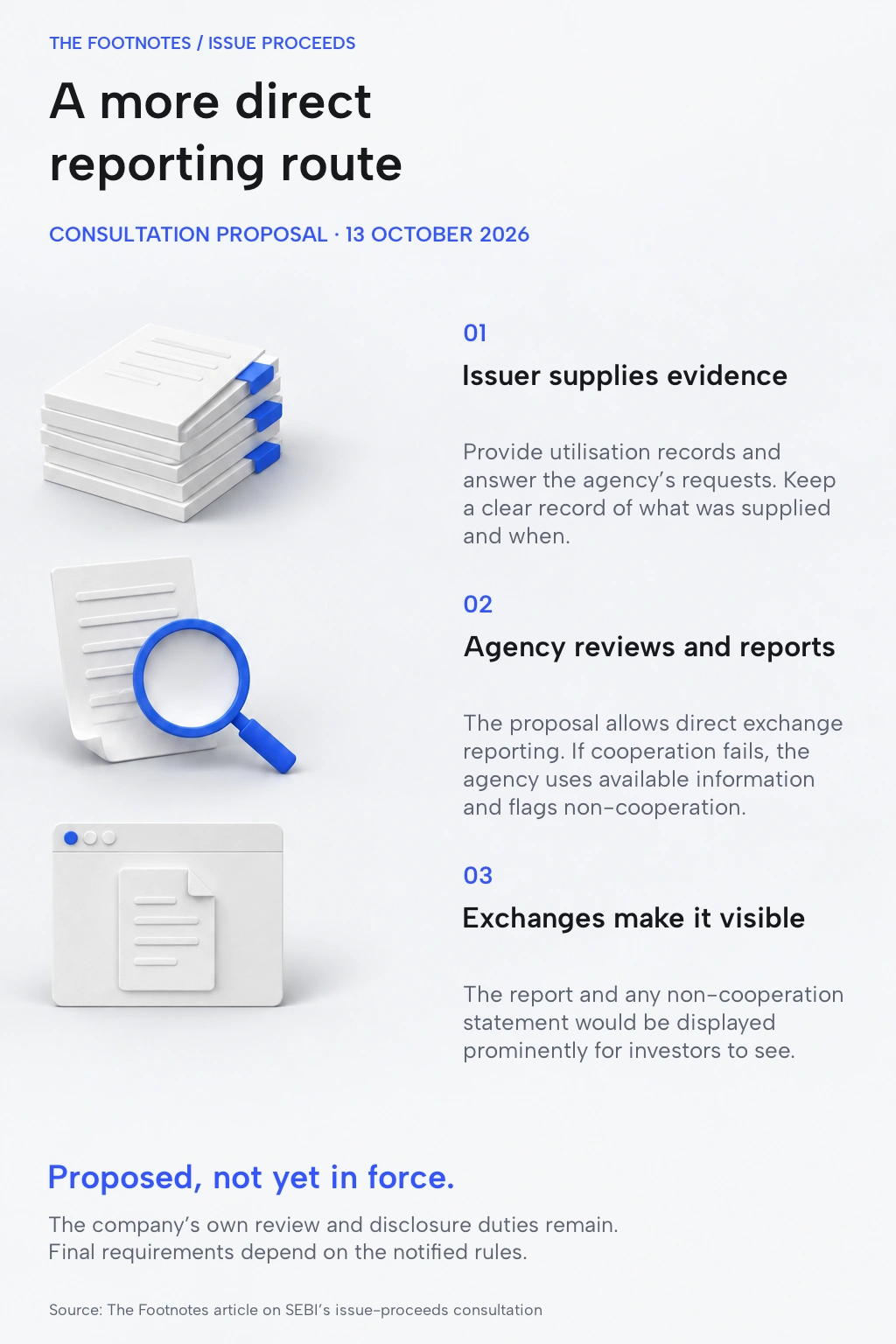
Read the infographic as text
- Issuer supplies evidence. Provide utilisation records and answer the agency’s requests. Keep a clear record of what was supplied and when.
- Agency reviews and reports. The proposal allows direct exchange reporting. If cooperation fails, the agency uses available information and flags non-cooperation.
- Exchanges make it visible. The report and any non-cooperation statement would be displayed prominently for investors to see.
Summary of the proposal described in the article. This does not remove the company’s own review and disclosure duties. Consultation proposal dated 13 October 2026; not an effective rule.
Under the present system the agency reviews the use of proceeds and sends its report to the issuer. The company then uploads it and files it with the exchanges within a set period. The company sits between the agency and the market.
The proposal removes that middle step when things go wrong. The working group recommends letting the monitoring agency file its report directly with the stock exchanges within prescribed timelines. If the company does not cooperate during the review, by withholding information or delaying responses, the agency files on the best information available and attaches a "Statement of non-cooperation".
SEBI has added a safeguard so that a company cannot go quiet for one quarter and quietly catch up the next. Once a listed entity fixes its non-cooperation for a reporting period, the agency must file a complete follow-up report with the exchanges within 15 days of receiving the full information. That report must state clearly that the non-cooperation has been rectified.
Exchanges will not be allowed to bury the information either. They must display the monitoring agency's report, and any statement of non-cooperation, prominently on their websites for investors to see.
The non-cooperation penalty ladder: how the 30-15-10 clock works
This is the part that should concern promoters and finance teams most, because it ends with frozen accounts. Business Standard set out the sequence: exchanges may levy ₹50,000 for each instance of non-cooperation reported in a quarter or half year, and must issue notices within 30 days of the report's due date.
| Day (from report due date) | Action |
|---|---|
| Day 0 | Monitoring agency report due; non-cooperation triggers a ₹50,000 fine per instance |
| By Day 30 | Stock exchange reviews compliance and issues a notice to the listed entity |
| Within 15 days of that notice | Company must pay the fine and enable a complete, rectified report; if not, the exchange notifies the promoters |
| Within 10 days of the promoter notice | If still unresolved, the exchange asks depositories to start freezing the promoters' demat accounts |
The TaxGuru summary of the paper describes the same chain in regulatory language. Exchanges review compliance and issue notices to non-compliant listed entities within 30 days from the due date. After 15 days from that notice, if the complete report is not filed or the fine remains unpaid, exchanges issue notices to the promoters. After a further 10 days, if the position is still not corrected and the fine is still unpaid, exchanges tell the depositories to begin freezing the promoters' demat accounts.
In practice: put the 30-15-10 day clock into the compliance calendar now, so legal and finance teams know which day triggers which exchange action.
One restriction deserves attention. Where non-cooperation has been reported for one or more quarters, the listed entity may neither terminate its agreement with the existing monitoring agency nor appoint a new one. That bar lifts only once it rectifies the position and enables a complete report for that quarter. This closes an obvious loophole: a company cannot sack the agency that is reporting it and hire a friendlier one while the default stands.
What happens if the issuer does not pay the monitoring agency's fee?
A clarification in SEBI's own additional proposals, separate from the working group's recommendations, deals with this. Not paying the agency's invoice will not, on its own, make a company non-cooperative. Instead, monitoring agencies may write clauses into their agreements asking for the entire fee for the monitoring period in advance.
There is a balancing condition for issuers. Where an agency has taken the whole fee up front and the agreement ends before 100% of the proceeds are used, the agency may have to refund a proportionate amount for the remaining monitoring period.
We'd expect monitoring agency contracts drafted after this circular to carry advance-fee clauses as standard, with pro-rata refund terms attached. Negotiating that refund formula before signing is cheaper than arguing about it later.
Where do audit committees and Regulation 32 fit in?
Companies already have a related duty, and the proposal builds on it rather than replacing it. Each quarter, a statement of deviation or variation in the use of issue proceeds must go before the audit committee and the board, and be reviewed there, before it reaches the exchanges. That continues alongside the monitoring agency's own report, which under existing Regulation 162A the board and management must comment on before it is uploaded.
The consultation paper restructures this layer. Regulation 32 of the LODR Regulations would cover the "Statement of utilization including variation(s)", and would apply to listed entities that are exempt from appointing a monitoring agency. A new Regulation 32A would be inserted to deal with monitoring agency report matters.
SEBI is separating two things that have sat in the same regulation: the company's own deviation statement, reviewed by the audit committee, and the independent agency's report, which in a dispute will bypass the company.
Audit committees should not read the direct-reporting proposal as a reduction in their role. This is the part most secretarial teams underestimate. If an agency can go straight to the exchange with a non-cooperation flag, the committee needs to have reviewed and cleared the underlying utilisation data well before the quarterly deadline. Committees that already run a structured question list with their auditors, in the style NFRA recommends for going concern reviews, will find the same discipline useful here.
Housekeeping: aligning the ICDR and LODR Regulations
Several proposals are less dramatic but still need attention from compliance teams. SEBI wants the quarterly reporting timelines taken out of the ICDR Regulations and consolidated under LODR.
The words "on a quarterly basis" would be omitted from these ICDR provisions:
- Regulation 41(2), Main Board IPOs
- Regulation 82(2), rights issues
- Regulation 137(2), further public offers
- Regulation 162A(2), preferential issues
- Regulation 173A(2), qualified institutional placements
- Regulation 262(2), SME IPOs
A related cleanup removes a redundant provision for small and medium enterprise issues. The recommendations include deleting sub-regulation (5) of Regulation 262 of the ICDR Regulations and modifying Regulation 262(6). None of this changes substance on its own. It does mean internal compliance checklists that cite regulation numbers will need updating once the final amendment is notified.
Timeline: what is confirmed and what is not
Everything above is still a proposal. Public comments, with reasons, may be submitted by 3 November 2026 through SEBI's public-comment portal. An email route is available if the web form has technical problems.
No amendment to the LODR or ICDR Regulations has been notified. SEBI has not announced an implementation date or a transition period, beyond a general reference to transitory provisions in the working group's recommendations. Until the amending notification is issued, treat any firm effective date as unconfirmed. The consultation paper does not fix one. The same caution applied to the decisions taken at SEBI's board meeting on 24 September 2026, none of which became law on the day they were approved.
What should CFOs, company secretaries and IR teams do now?
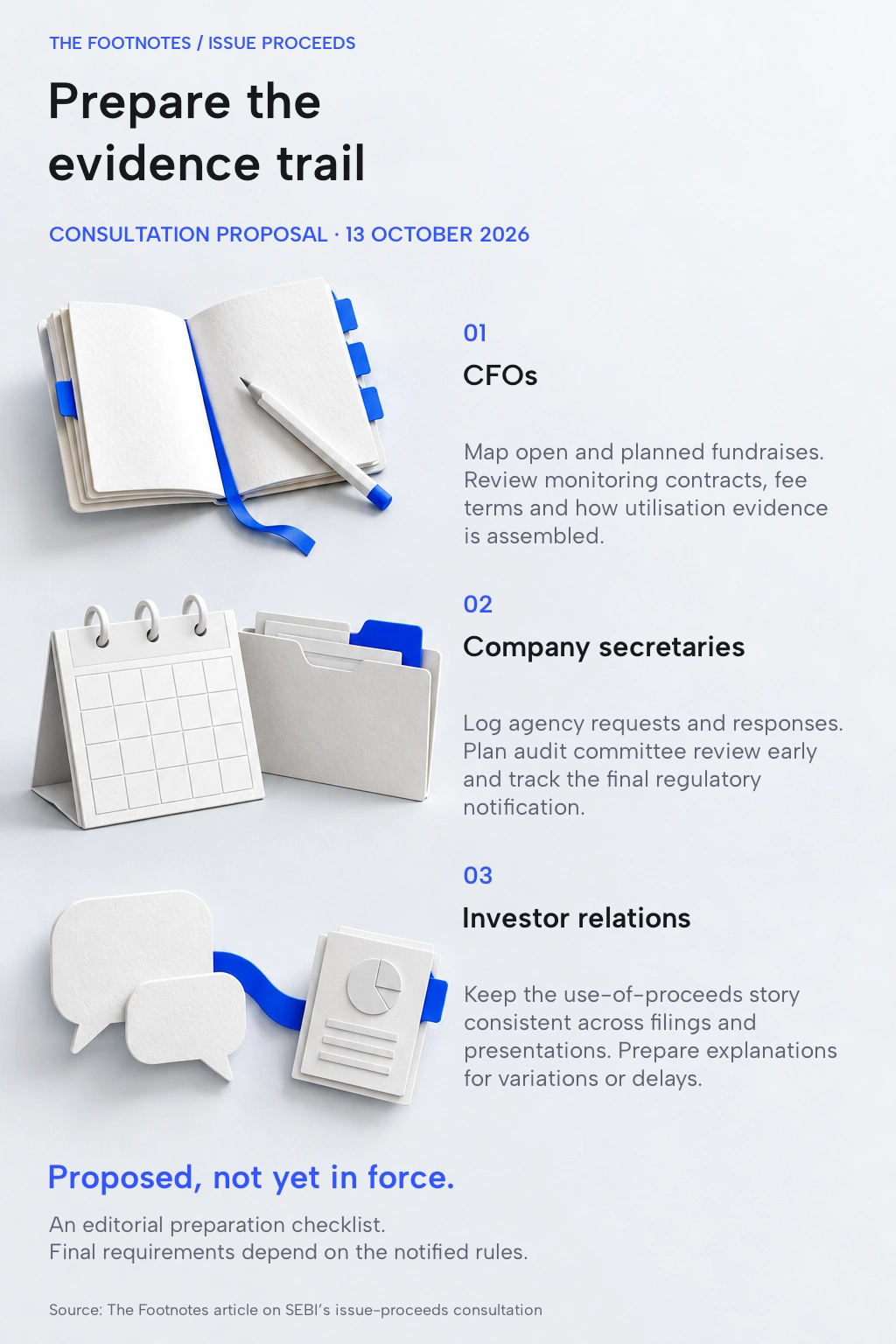
Read the infographic as text
- CFOs. Map open and planned fundraises. Review monitoring contracts, fee terms and how utilisation evidence is assembled.
- Company secretaries. Log agency requests and responses. Plan audit committee review early and track the final regulatory notification.
- Investor relations. Keep the use-of-proceeds story consistent across filings and presentations. Prepare explanations for variations or delays.
Practical preparation drawn from the article, not new duties already in force. The consultation proposal is dated 13 October 2026; implementation depends on the final notification.
CFOs
- Map every open and planned issuance, including IPOs, rights issues, QIPs and preferential allotments, against the proposed no-threshold rule. Small raises that escaped monitoring will not escape it in future.
- Review monitoring agency agreements for fee terms. Advance fee with pro-rata refund is likely to become the market standard.
- Put the 30-15-10 day escalation clock into the treasury and compliance calendar, so one late response does not grow into a promoter-level notice.
Company secretaries
- Tell the audit committee that the Regulation 32 deviation statement and the monitoring agency's report will sit in separate regulations once Regulation 32A is notified.
- Build an internal tracker logging the date every information request from the monitoring agency is answered. "Best available information" reporting turns on whether cooperation can be proved.
- Draft a comment for the 3 November 2026 deadline if any proposal, particularly the demat-freeze route, creates risk out of proportion to your company's size or structure.
Investor relations teams
- Expect monitoring agency reports and non-cooperation statements to sit prominently on exchange websites, visible to analysts in real time rather than buried in a filing.
- Prepare a standard answer for investor questions if a report shows a variation or a delay. The display requirement makes these disclosures far more visible than before.
- Keep the utilisation story consistent across the exchange filing and the quarterly investor presentation, since both will be read against the agency's report.
An agency that can file straight with the exchange changes who controls the story on how your issue money was spent. Companies that wait for the final notification before building systems will be reacting under a live penalty clock. Those that start tracking agency correspondence, fee terms and audit committee review cycles now are only formalising what good governance already asks of them.
Frequently asked questions
Which companies will need to appoint a monitoring agency under SEBI's proposal?
Almost all of them. Today a monitoring agency is required only if the issue size crosses ₹100 crore, under Regulations 162A and 173A of the SEBI ICDR Regulations, 2018. The working group wants that threshold removed, so monitoring would apply to every issuance, excluding the offer-for-sale portion. That pulls in small and mid-sized IPOs, rights issues, preferential allotments and qualified institutional placements that previously escaped it.
What counts as non-cooperation with a monitoring agency?
The paper describes non-cooperation as conduct that stops the agency completing its review, such as withholding information or delaying responses. In that case the agency files its report with the stock exchanges using the best information available, with a 'Statement of non-cooperation' attached. SEBI has clarified separately that simply not paying the agency's fee will not, by itself, be treated as non-cooperation.
Can promoters' demat accounts really be frozen over IPO proceeds reporting?
That is the end point of the proposed ladder. The stock exchange issues a notice within 30 days of the report's due date. If the fine is unpaid and a complete report is not filed within 15 days of that notice, the exchange notifies the promoters. After a further 10 days without rectification, the exchange tells the depositories to start freezing the promoters' demat accounts, meaning their electronic shareholdings.
Can a company replace a monitoring agency that has reported it?
No, not while the default stands. The paper says that where non-cooperation has been reported for one or more quarters, the listed entity may neither terminate the existing agreement nor appoint a new agency until it rectifies the position and enables a complete report for that quarter. This closes the obvious route of swapping in a friendlier agency mid-dispute.
When do SEBI's new IPO proceeds monitoring rules take effect?
No date has been fixed. The consultation paper is open for public comments until 3 November 2026 through SEBI's public-comment portal, with an email route if the web form fails. SEBI has not notified any amendment to the LODR or ICDR Regulations, and has not announced an implementation date or transition period. Treat any firm effective date circulating before the amending notification as unconfirmed.
Does the audit committee still review the statement of deviation?
Yes. The quarterly statement of deviation or variation in the use of issue proceeds still goes before the audit committee and the board before it reaches the exchanges. The paper separates the two streams: Regulation 32 would cover the company's own utilisation statement for entities exempt from appointing an agency, and a new Regulation 32A would cover monitoring agency reports.