


We read the seven FY2025-26 reports in our agency comparison that credit Report Yak, from Jindal Stainless to KRBL. Its strength is a distinctive visual theme built for each client and carried through, plus clean statutory pages. Here's what that looks like, where the reports fall short, and who the work suits.
In this article
 In short
Key takeaways
- Seven FY2025-26 reports in our sample credit Report Yak, all with the line 'Concept, content and design'. They averaged 19.0 out of 35, ranging from 15 (Pfizer) to 24 (Jindal Stainless).
- Format explains most of the score: Report Yak's two integrated reports, Jindal Stainless and Sify, averaged 23.0; its five conventional annual reports averaged 17.4.
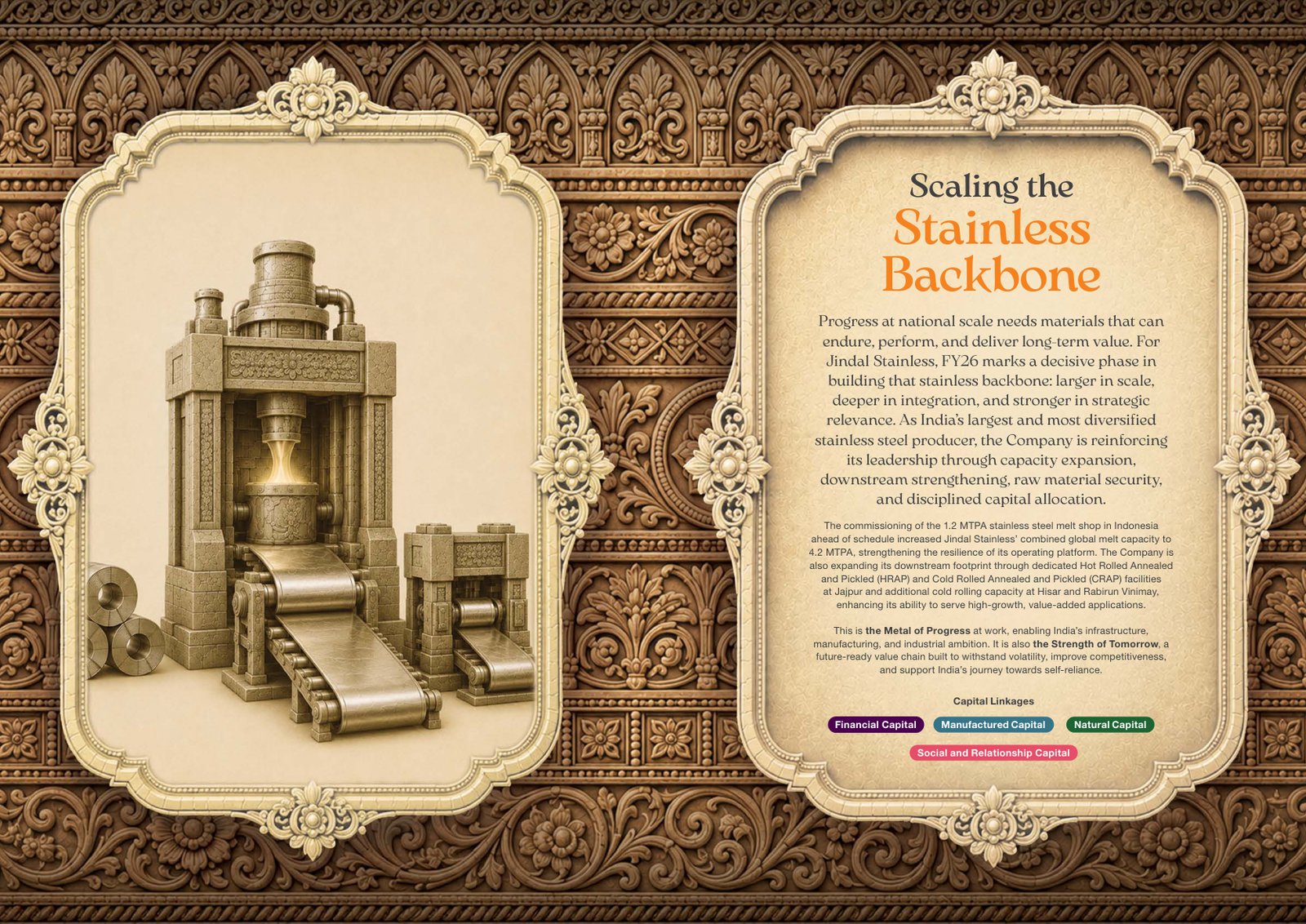
- Its best criterion is design and readability at 3.3 out of 5. Each client gets a theme of its own (carved relief, rice-grain art, paper-cut, a cut-away house) and the theme is carried through, not just put on the cover.
- Its statutory sections were the most consistently clean of the five agencies we compared, and Castrol India's report is one of the few in 35 to say what the board evaluation actually found.
- Jindal Stainless has one of the strongest quantified value creation models outside the two agencies whose clients mostly publish integrated reports.
- The gaps: integrated thinking (2.1) and BRSR and ESG integration (2.6) were the lowest of the five agencies, the digital PDF averaged 2.0, and two front sections leave out a qualified audit opinion.
Report Yak's reports are the easiest of the five agencies in our comparison of 35 FY2025-26 annual reports to recognise from the cover, and that's no accident. Each client gets a visual world of its own. We went back to the seven reports in that study that credit the agency and looked at what it does well, page by page.
All seven carry the same credit, "Concept, content and design", on the back of the report: Jindal Stainless, Sify Technologies, Castrol India, KRBL, Tilaknagar Industries, Amrutanjan Health Care and Pfizer. Two are integrated reports (Jindal Stainless and Sify) and five are conventional annual reports. Castrol's financial year follows the calendar, so its report is for 2025. Report Yak's own website describes it as an annual report design agency in Panaji, Goa, working on annual, integrated, sustainability and ESG reports.
On our seven-point card the reports averaged 19.0 out of 35, with a median of 19 and a range of 15 to 24. That's the lowest average of the five agencies, but read it with the format in mind. The two integrated reports averaged 23.0, the same band as every other agency's integrated reports, while the five conventional reports averaged 17.4. And as with every agency in the study, the credit tells us whom the company chose to name, not what Report Yak was hired to do. We scored the published report.
A theme of its own for every client
Design and readability is Report Yak's highest average, at 3.3 out of 5, and the reason is easy to see. Rather than one house style applied across clients, each report has a theme built for that company and carried from the cover through every section divider.
Jindal Stainless's integrated report, "The Metal of Progress", renders mills, coils and rail lines as carved relief inside ornate frames. Section openers keep the same frame and add the capitals each section links to, so the theme also does some navigational work.
KRBL, the basmati rice company, gets an entire family dinner made of rice grains. Amrutanjan's report uses layered paper-cut landscapes in soft blues and greens (PDF p. 3), and Pfizer's leans on watercolour DNA strands and a "Viggyaan and Vishwas" line. None of them could be swapped for another company's.

Our guide on how to decide an annual report theme argues that a theme should come from the business, not a mood board. These do.
Where the theme carries the numbers
A striking illustration can easily become decoration that sits next to the content. In the better Report Yak spreads the illustration holds the content instead.
Tilaknagar's report is themed "The House We Are Building". Its opening key-facts spread is a cut-away building, with one fact per room: 93 years of legacy, market capitalisation above ₹10,000 crore, 1.32 lakh shareholders, six owned plants. It's a KPI page you actually look at.
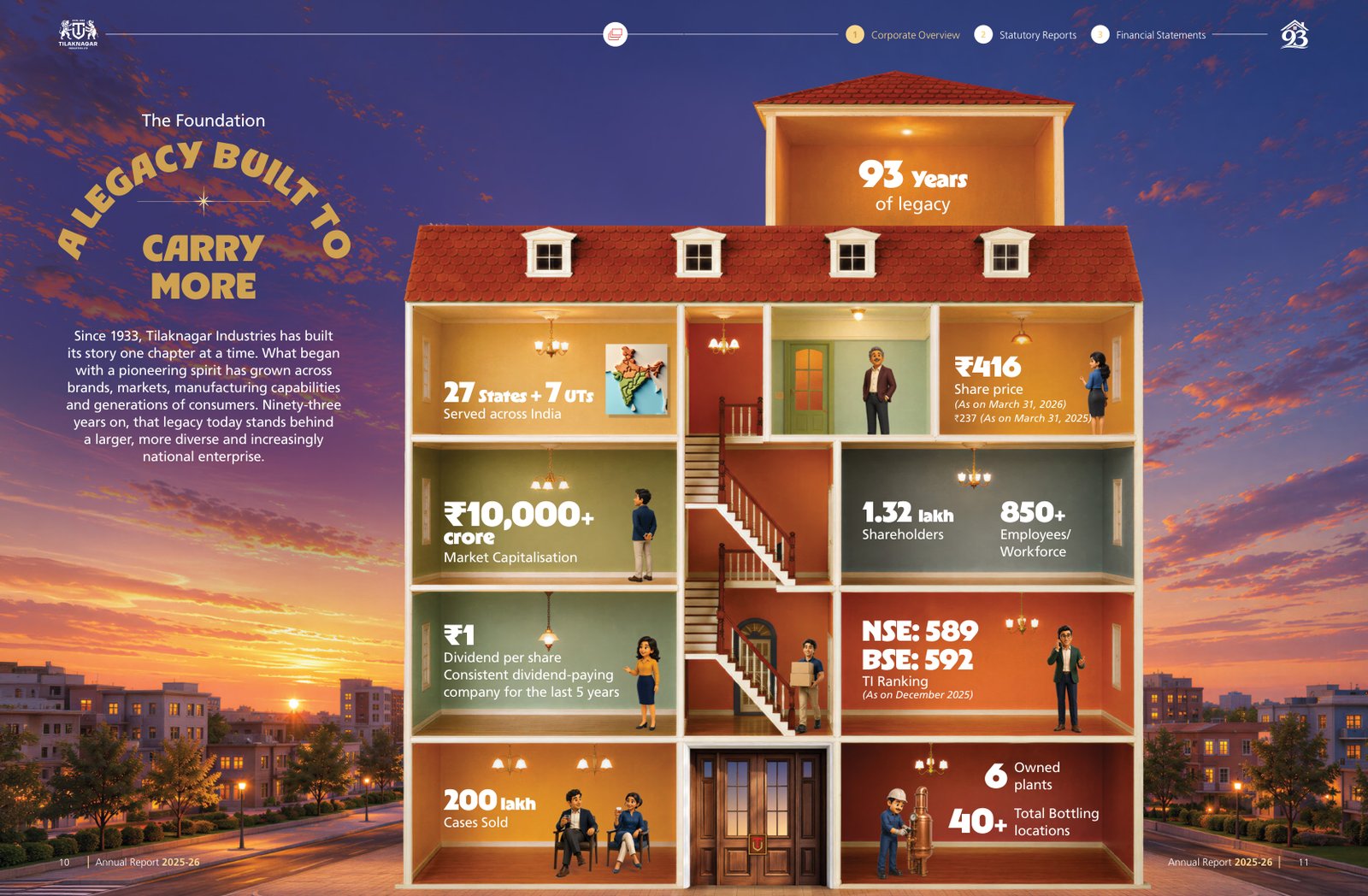
The risk with this approach is that the theme outweighs the substance on the pages where it matters, and we'll come to that below. But as a way of getting readers into the front section, it works.
When the client goes integrated
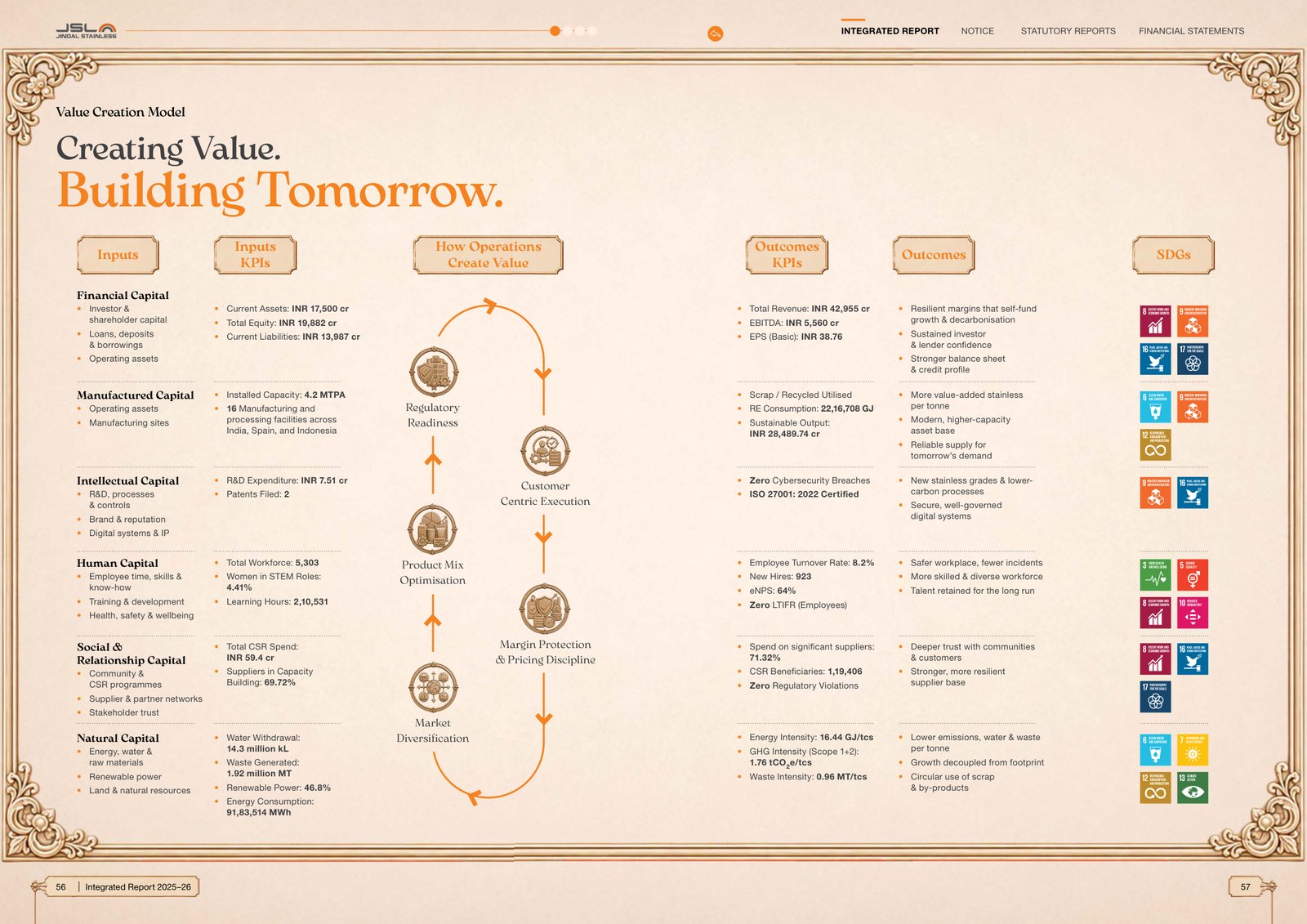
Jindal Stainless is the best-scoring report in the set, at 24, and its value creation model is a big part of why. It's one of the strongest quantified models we found outside the two agencies whose clients mostly publish integrated reports. Every capital has its inputs, input KPIs, outcome KPIs and outcomes, with numbers rather than adjectives: ₹42,955 crore of revenue, 4.2 MTPA of installed capacity, 46.8% renewable power, 2,10,531 learning hours. The carved-relief frame is still there, but it stays out of the way of the table.
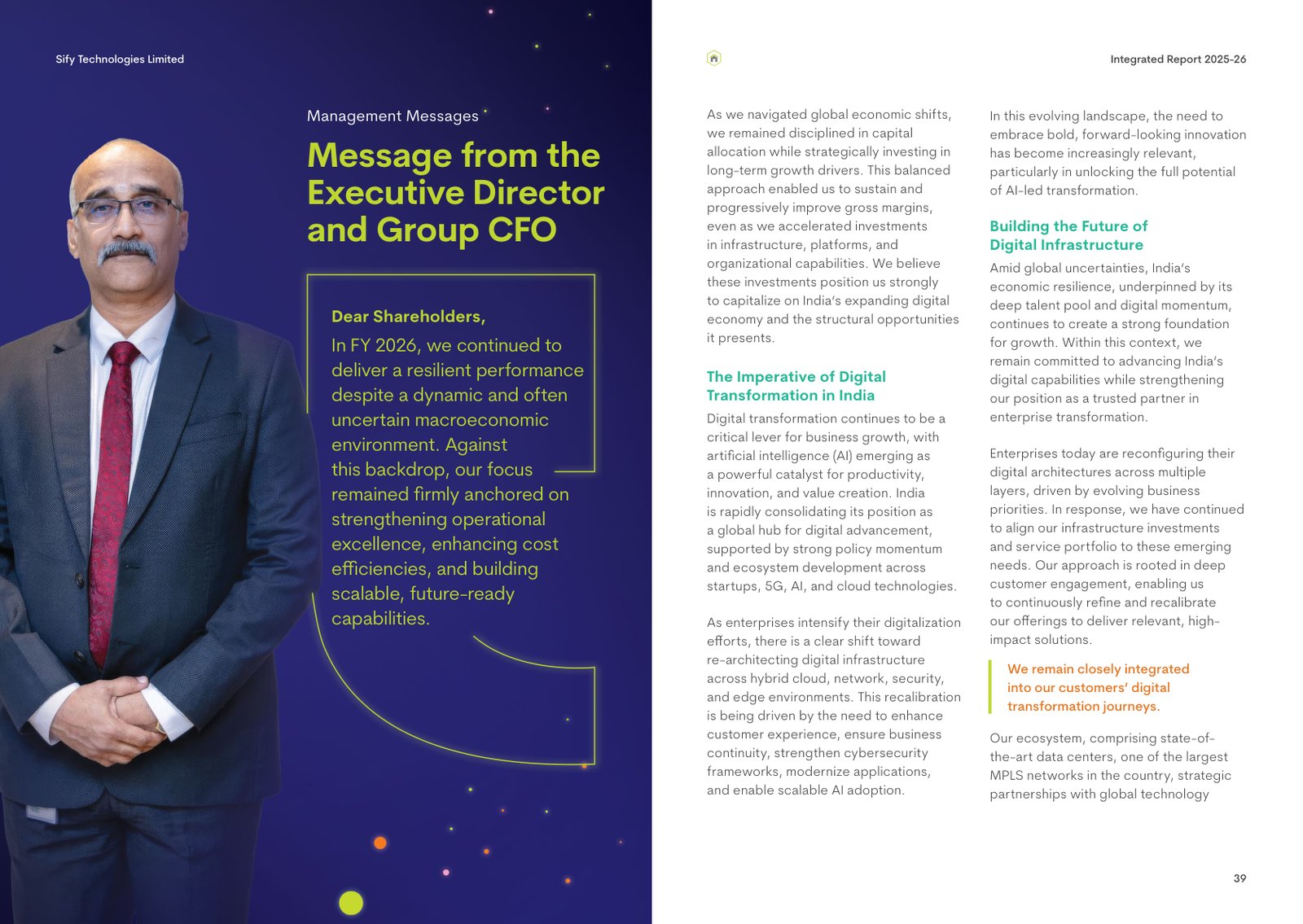
Sify, the other integrated report, scored 22. It has something that's rare across all 35 reports: a message from the CFO. Sify's Executive Director and Group CFO writes about capital allocation, margins and where the company is investing. Among Report Yak's seven, it's the only one, and we found none at all in some agencies' sets.
Strategy and narrative averaged 3.0 out of 5, and financial storytelling 3.0, both close to the middle of the field.
Clean statutory pages
This is the least glamorous strength, and the one that matters most to the company secretary. Report Yak's statutory sections were the most consistently clean of the five agencies in our sample, across clients as different as a lubricants company and a rice brand. We don't know whether the agency typeset every statutory section itself.
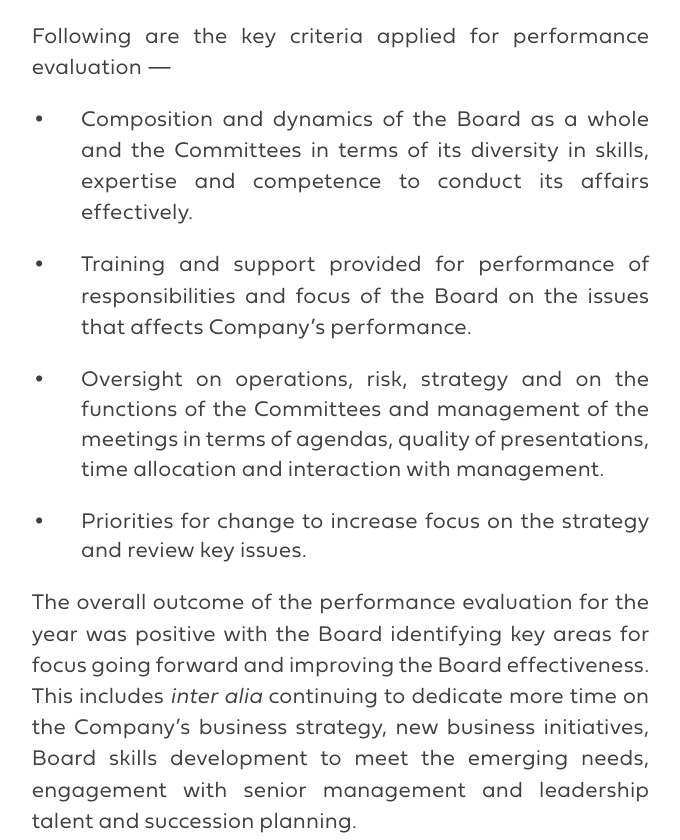
Castrol India's corporate governance report shows the payoff. Governance averaged 3.0 for Report Yak, and most reports in the full sample describe the board evaluation process and stop. Castrol's goes one step further and says what the evaluation found: more time on strategy and new business, board skills, engagement with senior management, and succession planning. We found only five reports in 35 that did.
Castrol is also the only report in Report Yak's set with an online edition. We don't know who built it.
Where it's weaker
Integrated thinking averaged 2.1 out of 5 and BRSR and ESG integration 2.6, the lowest of the five agencies on both. Much of that is the format. Five of the seven reports are conventional annual reports with no value creation model or capitals structure, and the card rewards that structure.
Candour is the bigger issue. Two reports carry a qualified audit opinion that the front section doesn't mention. KRBL's auditors qualified their opinion over an Enforcement Directorate investigation involving the company's Joint Managing Director (PDF p. 48). Tilaknagar's auditors qualified theirs because one plant hadn't been tested for impairment (PDF p. 59). In both reports you'll find it only in the statutory section. A theme-led front section shouldn't leave that out.
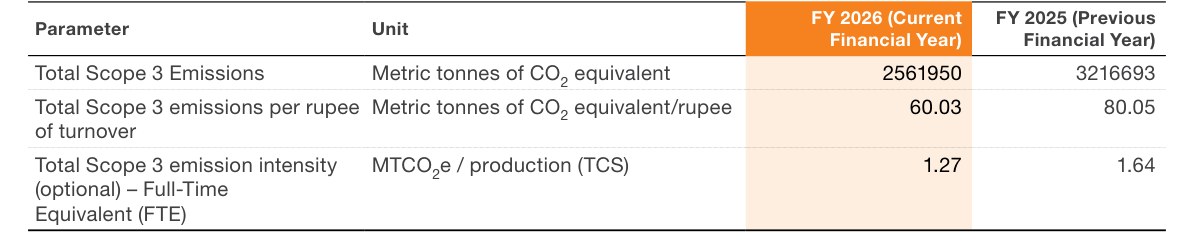
The digital PDF averaged 2.0, joint lowest with K&A. That's a weakness of every agency in the study, but here only Castrol's report had an online edition. And the final cross-check misses things. Jindal Stainless's BRSR gives Scope 3 emissions intensity as 60.03 tonnes of CO2 equivalent per rupee of turnover, which can't be right for that unit. The same report notes reasonable assurance on its BRSR.
Who it suits
Judging only from the work, Report Yak looks like the right fit for a company that wants its report to look unlike anyone else's. Consumer brands and heritage businesses with a story to tell (a rice brand, a balm, a distillery with a 93-year history) get the most from a theme that's built around them. It also suits a company that cares about tidy statutory pages, because that's where the agency is most consistent.
If you're moving to an integrated report, Jindal Stainless shows it can build the structure, but brief for it explicitly: the value creation model, ESG targets against status, and a CFO's review. Our guide to moving from an annual report to an integrated report covers what that involves. Write the digital PDF into the brief too, with bookmarks, single pages and working links, as you would with any agency. And ask for the bad news in the front section in plain words. Our annual report agency scorecard has more questions to ask before you sign.
The seven Report Yak reports
| Company | Format | Credit wording | Score /35 |
|---|---|---|---|
| Jindal Stainless | Integrated report | Concept, content and design | 24 |
| Sify Technologies | Integrated report | Concept, content and design | 22 |
| Castrol India | Annual report | Concept, content and design | 20 |
| KRBL | Annual report | Concept, content and design | 19 |
| Tilaknagar Industries | Annual report | Concept, content and design | 17 |
| Amrutanjan Health Care | Annual report | Concept, content and design | 16 |
| Pfizer | Annual report | Concept, content and design | 15 |
Average score per criterion, out of 5: strategy and narrative 3.0, integrated thinking 2.1, BRSR and ESG integration 2.6, governance 3.0, financial storytelling 3.0, design and readability 3.3, digital version 2.0.
These scores are taken unchanged from our comparison of five annual report agencies, which has the method, the other four agencies and all 35 reports. Page references are to the PDF each company published; in spread-view files, one PDF page holds two printed pages.
If you'd like your company's report rated, send us a direct message on LinkedIn with your company name and your annual report agency.
Frequently asked questions
Which annual reports has Report Yak designed?
In our FY2025-26 sample, seven reports carry a Report Yak credit reading 'Concept, content and design': Jindal Stainless, Sify Technologies, Castrol India, KRBL, Tilaknagar Industries, Amrutanjan Health Care and Pfizer. The agency produces more reports than these; this is the set we scored.
What is Report Yak best at?
On our reading of seven reports, building a distinctive visual theme for each client and carrying it through the front section, plus clean, consistent statutory typesetting. Its themes ranged from carved relief for Jindal Stainless to rice-grain art for KRBL and paper-cut illustration for Amrutanjan.
How did Report Yak score in The Footnotes' agency comparison?
Reports credited to Report Yak averaged 19.0 out of 35 on our seven-criterion card, the lowest of the five agencies compared. But five of its seven reports are conventional annual reports, and its two integrated reports averaged 23.0, in line with the other agencies' integrated reports.
Does a Report Yak credit mean the agency wrote the whole report?
Not necessarily. The credit tells us who the company chose to name, not the scope of the engagement. Finance teams, company secretaries and auditors write and approve much of any annual report, so we scored each published report, not the agency's process.
Where is Report Yak based?
Report Yak's website describes it as an annual report design agency based in Panaji, Goa, covering annual, integrated, sustainability and ESG reports, digital reports and investor presentations.
Sources
- Report Yak: annual report design agency — Report Yak
- Which Annual Report Agency Does What Best? We Scored 35 Indian Reports — The Footnotes