


Most annual report agencies look alike in a pitch: a good portfolio, a confident team, a reasonable quote. Eight questions and a 100-point scorecard to compare them on what actually decides the project: design, content, regulatory depth, timelines, accuracy, the team, confidentiality and commercials.
In this article
 In short
Key takeaways
- A pitch shows an agency at its best. A scorecard forces every agency to answer the same questions, so you can compare them like for like.
- Design, content, regulatory knowledge and timelines carry the most weight, because a failure on any of them is visible to shareholders or misses a statutory deadline.
- Ask for a timeline built backwards from your AGM date and dispatch deadline, and ask how many other reports the team is delivering in the same July to August window.
- The people in the pitch aren't always the people on the project. Ask who will write, design and typeset your report, and for how many years the core team has stayed together.
- Draft annual report content is often UPSI under SEBI's insider trading rules, so the agency's confidentiality agreement, access controls and AI policy belong in the evaluation, not the fine print.
- Delivery and relationship can't be judged from a portfolio. Two reference calls with current clients, asked specific questions, will tell you more than any case study.
Every annual report agency pitch looks good. That's the point of a pitch. The portfolio shows the best three reports of the last five years, the senior team is in the room, and the quote is pitched to win. What the pitch doesn't show is the July night when the auditors restate a number on page 214, or who picks up the phone when they do.
The way round that is to ask every agency on your shortlist the same questions, score the answers the same way, and test the claims you can't see. October to December is when most companies with a 31 March year end brief their agency, so this is the season to do it.
How the scorecard works
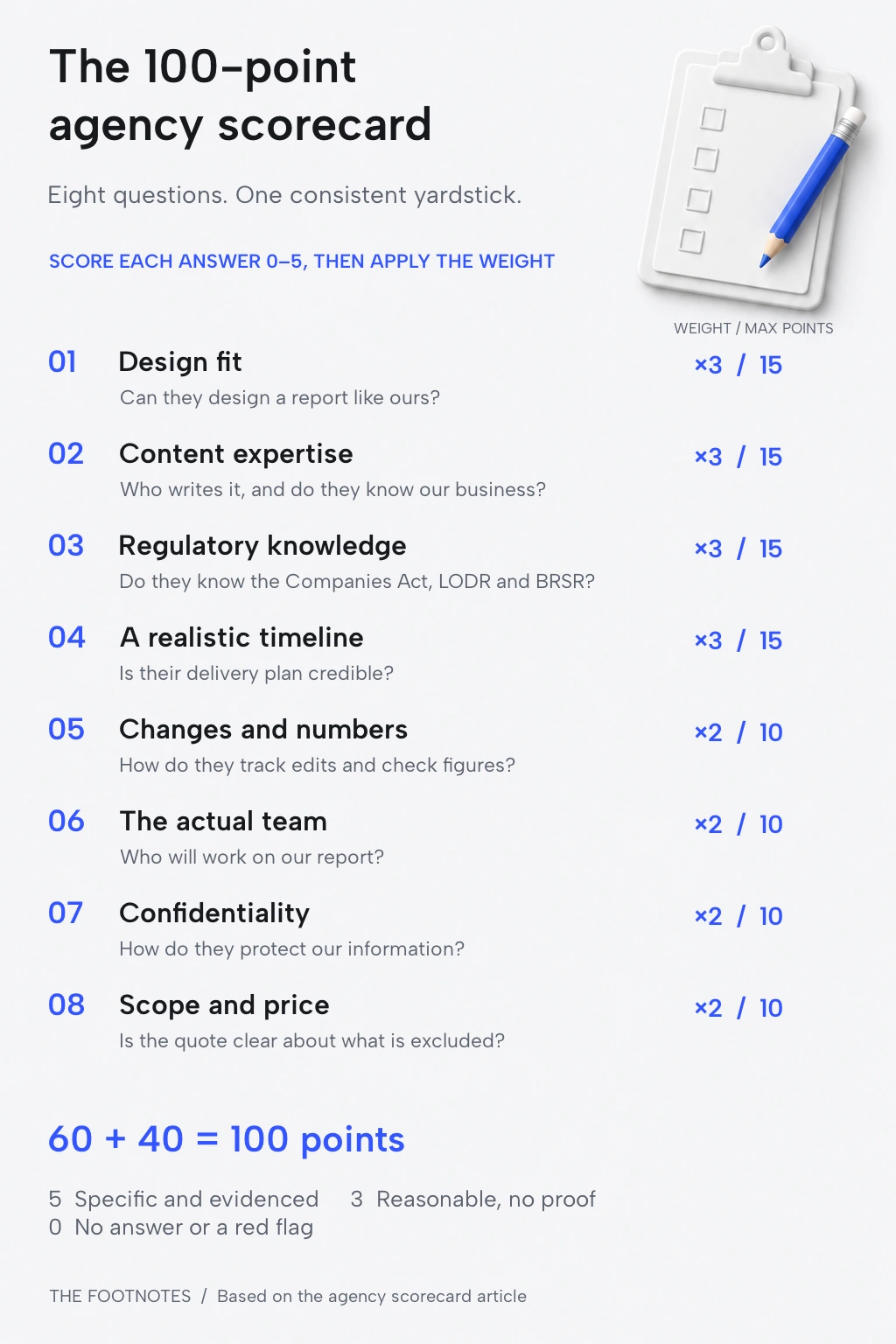
Read the infographic as text
- Design fit. Can they design a report like ours?
- Content expertise. Who writes it, and do they know our business?
- Regulatory knowledge. Do they know the Companies Act, LODR and BRSR?
- A realistic timeline. Is their delivery plan credible?
- Changes and numbers. How do they track edits and check figures?
- The actual team. Who will work on our report?
- Confidentiality. How do they protect our information?
- Scope and price. Is the quote clear about what is excluded?
Score each answer from 0 to 5. Multiply questions 1–4 by 3 (15 points each) and questions 5–8 by 2 (10 points each). Maximum: 100. A 5 is specific and evidenced; 3 is reasonable but unproven; 0 is no answer or a red flag.
Eight questions, each scored from 0 to 5. The first four are weighted by 3, because a failure there is either visible to every shareholder or misses a statutory deadline. The last four are weighted by 2. The maximum is 100.
| # | Question | Weight | Max |
|---|---|---|---|
| 1 | Can they design a report like ours? | ×3 | 15 |
| 2 | Who writes the content, and do they understand our business? | ×3 | 15 |
| 3 | Do they know the Companies Act, LODR and BRSR? | ×3 | 15 |
| 4 | Is their timeline real? | ×3 | 15 |
| 5 | How do they control changes and check numbers? | ×2 | 10 |
| 6 | Who will actually work on our report? | ×2 | 10 |
| 7 | How do they protect confidential information? | ×2 | 10 |
| 8 | Is the quote clear, and what does it leave out? | ×2 | 10 |
| Total | 100 |
Score each answer against the same yardstick: 5 means a specific, evidenced answer that matches your needs, 3 means a reasonable answer with no proof, and 0 means no answer or a red flag. Have at least two people score independently, typically someone from finance or investor relations and the company secretary, and compare notes afterwards.
1. Can they design a report like ours?
A beautiful 120-page sustainability report tells you little about an agency's ability to handle a 700-page integrated report with consolidated financials. Ask for two or three complete reports at a similar page count and in a comparable sector, not a highlights reel of covers and spreads.
Look past the front section. Turn to the Board's report, the corporate governance report and the notes to accounts, and check whether the design system holds up there. Are the tables readable? Do the charts in the front match the numbers in the back? Our annual report reviews show how wide that gap can be even among the largest companies.
Good answer: full reports of similar size, plus an explanation of the design decisions behind them. Red flag: only cover and spread images, or every sample from a different sector and size to yours.
2. Who writes the content, and do they understand our business?
Some agencies write. Some design and typeset what you give them. Both models work, but you need to know which one you're buying. Ask who drafts the chairman's message, the business reviews and the case studies, whether they interview management, and how many rounds of writing the fee covers.
Then test the understanding. A good agency will have read your last report, your investor presentation and a few analyst questions before the pitch, and will tell you what your report failed to answer. If the pitch talks only about look and feel, the content will probably fall back on your team.
Good answer: a named writer or editor, an interview-led process, and a sharp view on what your current report misses. Red flag: "you send us the content and we'll make it look great," when you need more than that.
3. Do they know the Companies Act, LODR and BRSR?
An annual report is a statutory document before it's a brand document. The agency should know what has to be in it under the Companies Act and SEBI LODR, how the MD&A has to be structured, and how the BRSR principle-wise tables and BRSR Core indicators are laid out. It won't own compliance (your company secretary and auditors do), but it shouldn't need to be taught the basics.
A quick test: ask what changed in the last reporting cycle and how they handled it in their clients' reports. An agency that follows regulation will have a ready answer.
Good answer: a specific recent change, and how they built it into the page plan. Red flag: treating the statutory sections as "typesetting only" with no one checking structure.
4. Is their timeline real?
Every agency says it delivers on time. Ask it to prove it with a week-by-week plan built backwards from your AGM date. For a company with a 31 March year end, the AGM must be held by 30 September under Section 96 of the Companies Act, and the top 100 listed entities by market capitalisation must hold it within five months under LODR Regulation 44(5). The report then has to reach shareholders ahead of the meeting. Our annual report deadlines guide sets out the dates.
Then ask the question that matters more: how many other reports is this team delivering in the same July to August window? Most March year-end companies finalise at the same time. An agency with twenty reports going to print in the same three weeks can still deliver, but only if it has staffed for it.
Good answer: a dated plan with your dependencies marked (audited numbers, board approval, auditor sign-off), plus an honest answer on peak-season load. Red flag: a generic "12 to 16 weeks" with no link to your AGM, or a team that's vague about its other commitments.
5. How do they control changes and check numbers?
A large report goes through thousands of changes from finance, the company secretary, auditors, business heads and the board. The risk isn't the number of changes. It's a figure updated on page 40 and missed on page 312.
Ask how they log and track changes, who proofreads against the audited source, how they check that the same number matches everywhere it appears, and what version control they use. Ask what happened the last time a number was wrong in a printed report, and what they changed afterwards. An agency that has never had an error either hasn't done many reports or isn't telling you.
Good answer: a documented change log, a separate proofing step for numbers, and a real example of an error caught or fixed. Red flag: "our designers are very careful."
6. Who will actually work on our report?
The people in the pitch aren't always the people on the project. Ask for the names and roles of the account lead, writer, designer and typesetting lead who will work on your report, and how much of their time it will get. Ask whether any of the work is subcontracted.
Then ask about continuity. A good agency relationship gets better each year, because the team learns your business, your reviewers and your house style. That only happens if the same people come back. Ask how long the core team on their longest-running accounts has stayed together.
This is also where the relationship shows. Do they disagree with you when it matters? Do they explain trade-offs, or just say yes? A pitch that agrees with everything you say is easy to sit through and hard to work with in August.
Good answer: named people, a single day-to-day contact with authority to make decisions, and evidence of multi-year client relationships. Red flag: a senior team at the pitch and "we'll assign a team" afterwards.
7. How do they protect confidential information?
A draft annual report prepared before results are public often contains unpublished price sensitive information (UPSI) under SEBI's Prohibition of Insider Trading Regulations, 2015. Sharing it with an agency for a legitimate purpose is allowed, but the agency must be given notice to keep it confidential, and your company records it in its structured digital database. So the agency's handling of your files is your compliance question too.
Ask who in the agency can access your files, where they're stored, whether freelancers see them, and what their policy is on AI tools. A writer pasting your draft MD&A into a personal chatbot account is a real risk, and our guide to how agencies should use AI covers what a safe setup looks like.
Good answer: a signed confidentiality agreement, named access, per-client file storage and a written AI policy. Red flag: files shared over personal email or messaging apps, or no answer on AI.
8. Is the quote clear, and what does it leave out?
Ask for an itemised quote: research and writing, design, typesetting, the digital edition and printing as separate lines. That's the only way to compare agencies like for like. Our breakdown of what an annual report costs in India shows what each part typically involves.
Then read the exclusions. How many rounds of changes does the fee cover? What does an extra round cost? Are photography, translation and the digital edition included? A low quote with a tight change policy can end up the most expensive one by September.
Good answer: an itemised quote, a written change policy and a clear list of what's extra. Red flag: a single lump sum with no definition of scope.
Test what the pitch can't show
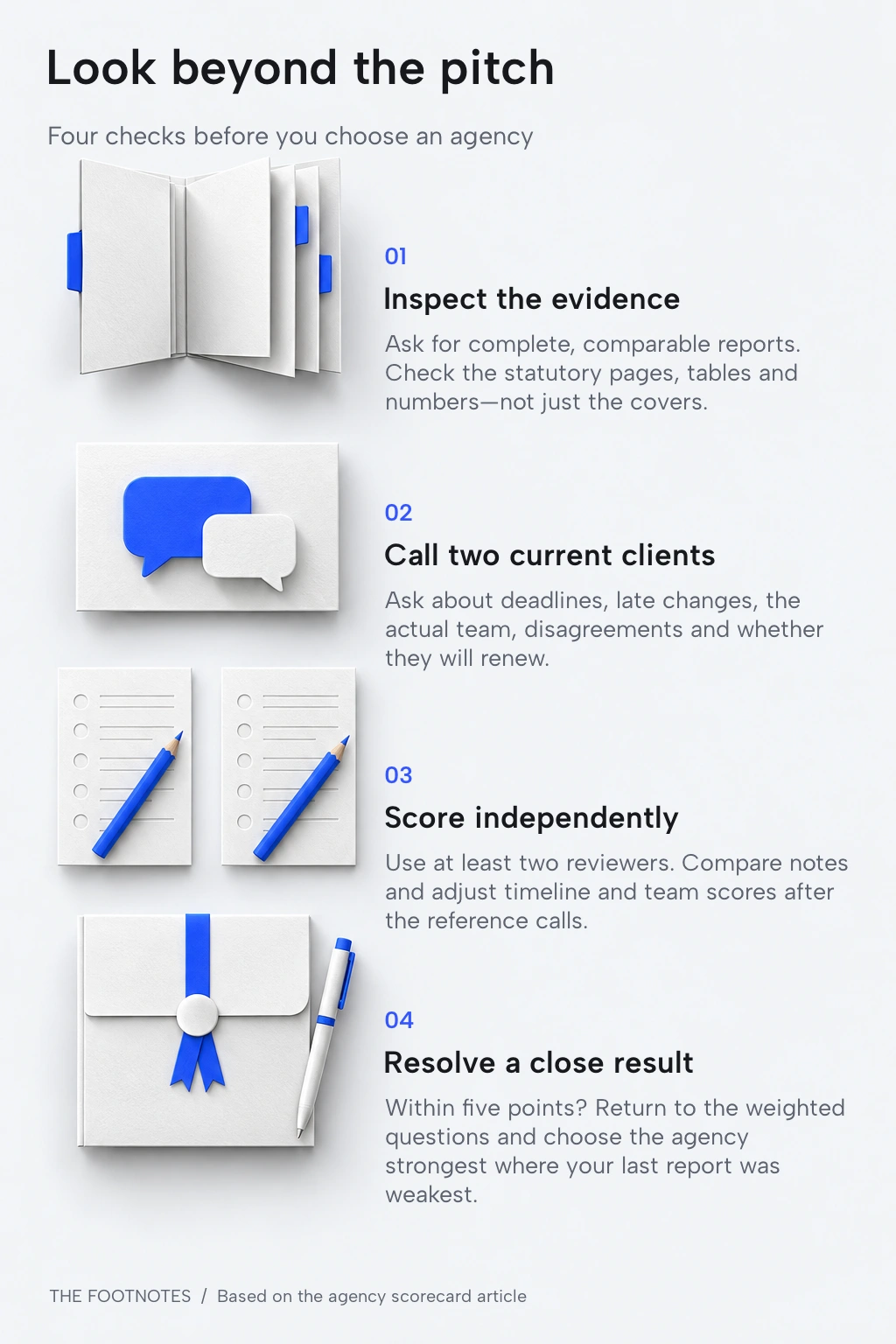
Read the infographic as text
- Inspect the evidence. Ask for complete, comparable reports. Check the statutory pages, tables and numbers—not just the covers.
- Call two current clients. Ask about deadlines, late changes, the actual team, disagreements and whether they will renew.
- Score independently. Use at least two reviewers. Compare notes and adjust timeline and team scores after the reference calls.
- Resolve a close result. Within five points? Return to the weighted questions and choose the agency strongest where your last report was weakest.
Use the same questions and scoring yardstick for every shortlisted agency.
Two things on the scorecard can't be judged from a portfolio: whether the agency delivers on time, and what it's like to work with. You find those out by asking people who already know.
Ask each shortlisted agency for two current clients you can call, ideally of a similar size to you. Then ask those clients specific questions rather than "are you happy?":
- When did you brief them, and did the print-ready file arrive on the agreed date?
- What happened when numbers changed late?
- Did the team you met at the pitch work on your report?
- How did they handle a disagreement?
- Are you renewing next year?
Adjust the scores for questions 4 and 6 after the calls. A reference that hesitates on the deadline question tells you more than any case study.
Put it together
Score the agencies independently, add up the totals, and compare. If two agencies finish within five points of each other, the totals aren't telling you much, so go back to the weighted questions and pick the one that's stronger where your last report was weakest. If your last report was late, weight timelines. If it was dull, weight content.
None of this needs a formal RFP, though a short one helps. What matters is that every agency answers the same questions and the same people score them. Our guide to choosing an annual report agency covers how to scope the project and what fee bands to expect.
The best agency for you isn't the one with the best pitch. It's the one that's still answering your calls, with the same team, at 11 pm in August.
Frequently asked questions
How do I compare annual report agencies?
Ask every shortlisted agency the same eight questions: design at your size and sector, who writes the content, regulatory knowledge, a timeline built back from your AGM, how they control changes and verify numbers, who will be on the team, how they protect confidential information, and an itemised quote with a change policy. Score each answer from 0 to 5, weight the first four by 3 and the last four by 2, and compare totals out of 100. Then check delivery and relationship through reference calls with current clients.
What should I ask an annual report agency before hiring?
Ask for reports they've produced at a similar page count and in your sector, who writes and who only designs, how they handle BRSR and the statutory sections, a week-by-week plan from kick-off to dispatch, how many reports they deliver in the same peak window, how many rounds of changes the fee covers, who your day-to-day contact will be, and how they keep unreleased content confidential, including their policy on AI tools.
How do I check whether an annual report agency delivers on time?
Portfolios don't show it, so ask for two current clients you can call. Ask them when the agency was briefed, whether the print-ready file arrived on the agreed date, what happened when numbers changed late, and whether they plan to renew. Also ask the agency how many other reports its team is producing in July and August, when most March year-end companies are finalising.
Is annual report content confidential when shared with an agency?
Often it's more than confidential. A draft annual report prepared before results are public can contain unpublished price sensitive information under SEBI's Prohibition of Insider Trading Regulations. Sharing it with an agency for a legitimate purpose is allowed, but the agency must be given notice to keep it confidential and the company records it in its structured digital database. So ask how the agency controls access, stores files and uses AI tools.
When should a company start looking for an annual report agency?
For a company with a 31 March year end, October to December is the right window. A full annual report is a four to five month project, and briefing early gets a considered proposal, a team that isn't already committed elsewhere, and time to finish research and design before the audited numbers arrive in April and May.
Sources
- Information Sharing Under SEBI's Insider Trading Rules — Mondaq (S&R Associates)
- Holding AGM by top 100 listed entities by market capitalization — TaxGuru
- BRSR format (Annexure II) — SEBI