


Ind AS 115 asks five questions in a fixed order, from 'is there a contract?' to 'when does the customer get control?'. Each step has an Indian example, and a checklist covers disclosure paragraphs 110 to 129.
In this article
 In short
Key takeaways
- Ind AS 115 applies to accounting periods beginning on or after 1 April 2018 and replaced Ind AS 11 and Ind AS 18.
- The five steps are: identify the contract, identify performance obligations, determine the transaction price, allocate the price, and recognise revenue when control transfers.
- Revenue follows the transfer of control; invoices and cash receipts don't decide the timing.
- ICAI's press release of 20 July 2018 says the percentage of completion method is possible for real estate where paragraph 35 is met, and the test runs contract by contract.
- Disclosure requirements sit in paragraphs 110 to 129, covering disaggregation, contract balances, performance obligations, remaining obligations, judgements, contract costs and practical expedients.
- India's version differs from IFRS 15 in four places: penalties (51AA), excise duty (109AA), a revenue-to-contract-price reconciliation (126AA) and sales with an unconditional right of return (B20AA).
- The Companies (Indian Accounting Standards) Amendment Rules, 2026 (G.S.R. 725(E), 12 August 2026) amend Ind AS 101, 107, 109, 110 and 7. Ind AS 115 is unchanged.
You apply Ind AS 115, the Indian standard on revenue from customer contracts, by asking five questions in order. Is there a contract? What did the company promise? What is the price? How does the price split across the promises? When does the customer get control?
The standard has applied to accounting periods beginning on or after 1 April 2018, and this year's Ind AS amendments leave it untouched. Each step below comes with an Indian example, and a disclosure checklist closes the piece.
Has Ind AS 115 revenue recognition changed recently?
No. The most recent Ind AS amendment, the Companies (Indian Accounting Standards) Amendment Rules, 2026, was notified as G.S.R. 725(E) on 12 August 2026. It amends Ind AS 101, 107, 109, 110 and 7, mostly from 1 April 2026 (KPMG's summary). Ind AS 115 isn't on the list.
The only knock-on is in Ind AS 109. Its revised paragraph 5.1.3 says trade receivables are measured at the amount determined under Ind AS 115. Your revenue accounting doesn't move.
Step 1: How do you identify the contract?
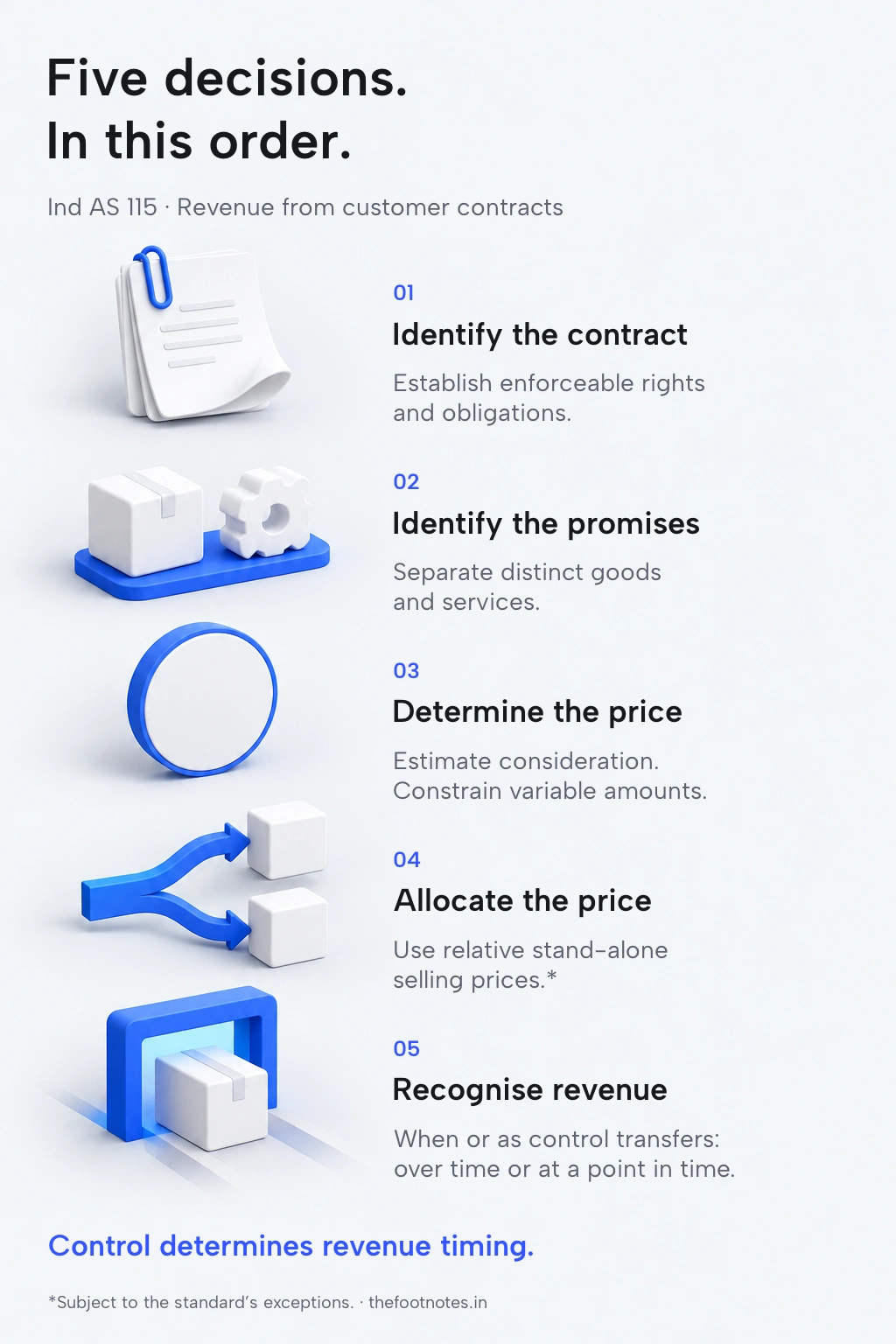
Read the infographic as text
- Identify the contract. Establish enforceable rights and obligations with the customer and check that the contract criteria are met.
- Identify the promises. Identify the distinct goods or services that are separate performance obligations.
- Determine the price. Estimate the consideration expected, including variable amounts subject to the constraint.
- Allocate the price. Allocate to performance obligations using relative stand-alone selling prices, subject to the standard's exceptions.
- Recognise revenue. Recognise when or as control transfers. Assess whether each obligation is satisfied over time or at a point in time.
Revenue follows transfer of control. Invoice dates and cash receipts do not determine revenue timing by themselves. Summary of the five-step model; see the article for examples and conditions.
A contract is an agreement that creates enforceable rights and obligations, and enforceability is a question of law. No contract exists if each party can end a wholly unperformed contract without compensating the other.
Take an IT company that signs a master agreement and several statements of work in the same month. Paragraph 17 requires you to combine contracts entered at or near the same time with the same customer. You combine them if they are negotiated as a package with one commercial objective, or if the price of one depends on another.
Step 2: How do you identify performance obligations?
A performance obligation is a promise to transfer a distinct good or service to the customer. A promise is distinct if two things hold: the customer can benefit from it on its own or with resources it can readily get, and it is separately identifiable from the other promises in the contract.
Telecom bundle. An operator sells a handset with a 24-month plan. The handset and the airtime are normally distinct, so there are two obligations.
IT multi-element contract. A company sells a software licence, implementation work and two years of support. The usual pattern is:
- the licence is recognised when the software is transferred;
- implementation is recognised by percentage of completion;
- support is recognised over 24 months.
That holds only if the licence is distinct. Heavy customisation can merge the licence and the work into one obligation.
Step 3: How do you determine the transaction price?
The transaction price is the amount you expect to be entitled to. It can include fixed and variable parts. Consideration payable to a customer includes cash, and also credits or coupons the customer can set against what it owes you.
Distributor rebates. A paint or FMCG company gives distributors a year-end rebate if they pass a volume target. That is variable consideration. You estimate it at the start and constrain it so that a significant revenue reversal is unlikely, use one estimation method consistently for that uncertainty, and update the estimate at every reporting date.
Penalties are where India departs from IFRS 15. Paragraph 51AA says a penalty is variable consideration only if it is inherent in setting the price. Otherwise the price is treated as fixed and the penalty is accounted for separately, according to the substance of the contract. An EPC contract with liquidated damages for late completion is the typical case to test.
Key number: 1 April 2018. Ind AS 115 applies to accounting periods beginning on or after this date, in place of Ind AS 11 and Ind AS 18.
Step 4: How do you allocate the transaction price?
You allocate the price in proportion to the stand-alone selling prices of each distinct good or service. A stand-alone selling price is the price at which you would sell that item separately.
Handset bundle (illustrative numbers). A handset sells alone for ₹24,000. The plan sells alone for ₹600 a month, or ₹14,400 over 24 months. The customer pays ₹999 a month, ₹23,976 in total, and nothing up front.
- Stand-alone prices add up to ₹38,400. The handset is 62.5% and the plan 37.5%.
- The handset gets ₹14,985 and the plan gets ₹8,991, about ₹375 a month.
- You book ₹14,985 as revenue on delivery against a contract asset, because the cash comes later.
- Each month you recognise about ₹375 of plan revenue and bill ₹999, so the contract asset unwinds.
This ignores GST and any financing effect.
Loyalty points (illustrative numbers). A retailer sells goods for ₹10,000 and awards points with a stand-alone value of ₹400 after expected lapses. The price splits ₹9,615 to the goods and ₹385 to the points. The ₹385 is deferred and recognised as points are redeemed, or once it becomes unlikely they will be.
Step 5: When do you recognise revenue?
You recognise revenue when you satisfy a performance obligation by transferring a good or service. That happens when the customer obtains control. You decide at the start whether control passes over time or at a point in time. Invoices and cash receipts don't decide the timing.
Real estate with construction-linked plans
ICAI's press release of 20 July 2018 quotes paragraph 35. An entity recognises revenue over time if any one of these is met:
- the customer receives and consumes the benefits as the entity performs;
- the entity's work creates or improves an asset the customer controls as it is built; or
- the work creates no asset with an alternative use to the entity, and the entity has an enforceable right to payment for work done to date.
ICAI says paragraphs 35(b) and 35(c) are meant to address real estate. It says recognising revenue as construction progresses is possible, given India's legal system and the facts of each contract.
The test runs contract by contract. A buyer under a registered agreement for a specific flat, paying against construction milestones, may satisfy 35(c). A buyer who can cancel and take a full refund without paying for work done probably doesn't.
On the payment right, compensation on termination must cover a reasonable profit margin, not only the entity's lost profit.
EPC contracts
An engineering, procurement and construction (EPC) contractor building a plant on the customer's land usually satisfies its obligation over time, because the customer controls the asset as it is built (paragraph 35(b)). Progress can be measured by output methods such as milestones, or by input methods. Input methods measure effort against total expected inputs, for example costs incurred or labour hours.
In practice: Write the paragraph 35 analysis once for each project type, with legal advice on enforceability attached. Auditors will ask for it every year.
Principal or agent: how does an e-commerce marketplace report revenue?
The question is whether you control the good or service before it reaches the customer (Appendix B, paragraphs B34 to B38). A principal reports revenue gross; an agent reports only its fee or commission. Paragraph B37 gives three indicators that you're the principal: you're primarily responsible for fulfilment, you carry inventory risk, and you set the price.
A marketplace that connects sellers and buyers, holds no stock and sets no prices looks like an agent. Its revenue is the commission and fees. The same company selling its own inventory, bearing return risk and setting the price looks like a principal.
Many platforms run both models, so assess each stream. Paragraph 119(c) asks you to highlight obligations to arrange for another party to supply goods or services. That is the agent case.
Significant financing components, including real estate advances
You adjust the promised consideration for the time value of money when there is a significant financing benefit to either party. As a practical expedient, you needn't adjust if you expect at the start that payment and transfer will be one year or less apart. You show interest revenue or expense separately from revenue from contracts with customers.
Real estate is where this bites in India. Buyers often pay in stages over a build that lasts years, and where payment runs well ahead of delivery the developer is in effect borrowing from its customers. The one-year expedient only helps if the gap is short when the contract starts.
If you use the paragraph 63 expedient, paragraph 129 requires you to say so.
Contract modifications and changes in price
A modification is a change in scope, price or both. It is a separate contract if it adds distinct goods or services at a price that reflects their stand-alone prices. Otherwise it is part of the existing contract, and the treatment depends on the remaining goods or services:
- if they are distinct, you account for the change prospectively;
- if they aren't, you make a cumulative catch-up adjustment.
Later changes in transaction price are allocated on the same basis as at inception. Amounts for satisfied obligations go to revenue in the period of change.
How does Ind AS 115 differ from earlier standards, IFRS 15 and ASC 606?
IFRS 15 is the international revenue standard, and ASC 606 is the US equivalent. The table compares them with the Indian standards Ind AS 115 replaced.
| Topic | Ind AS 11 and Ind AS 18 | Ind AS 115 | IFRS 15 |
|---|---|---|---|
| Structure | Ind AS 18 for goods, services, interest, dividends and royalties; Ind AS 11 for construction contracts | One five-step model for all customer contracts | Same five-step model |
| Real estate | Agreements for construction of real estate went to Ind AS 11 | Over time only if a paragraph 35 test is met, contract by contract | Same tests |
| Penalties | No specific guidance | Variable consideration only if inherent in the price (paragraph 51AA) | Always variable consideration |
| Disclosure | Limited | Paragraphs 110–129, plus 109AA (excise duty) and 126AA (reconciliation with contracted price) | Paragraphs 110–129 only |
ASC 606, the US standard, was developed jointly with IFRS 15 and uses the same five steps. Ind AS 115 itself had a false start: the MCA's 30 March 2016 amendment pulled it after the IASB deferred IFRS 15, and put Ind AS 11 and Ind AS 18 in its place until 1 April 2018.
India also added paragraph B20AA, which deals with a product transferred to a customer who has an unconditional right to return it. If you sell on that basis, read it before you book the sale.
Does real estate have to use the completed contract method?
No, though the claim still turns up in older commentary. ICAI called the 2018 media reports misleading and said Ind AS 115 does allow the percentage of completion method where the obligation is satisfied over time, citing paragraphs 35 to 37. The test is the contract's terms, not the industry.
Ind AS 115 disclosure checklist (paragraphs 110–129)
- 110–112, objective and detail. Decide the level of detail, and aggregate or disaggregate so useful information isn't buried.
- 113, amounts. Show revenue from contracts with customers apart from other revenue. Show impairment losses on related receivables and contract assets apart from other impairments.
- 109AA, excise duty. Present the excise duty included in revenue separately in the statement of profit and loss.
- 114–115, disaggregation. Break revenue into categories that show how economic factors affect its nature, amount, timing and uncertainty, and show how they link to each reportable segment under Ind AS 108.
- 116–118, contract balances. Give opening and closing receivables, contract assets and contract liabilities. Give revenue recognised from the opening contract liability, and how performance timing relates to payment timing. Paragraph 118 adds an explanation of significant balance changes.
- 119, performance obligations. State when you typically satisfy them, significant payment terms, the nature of the goods or services, returns and refunds, and warranties.
- 120–122, remaining obligations. Give the total price allocated to unsatisfied obligations and when you expect to recognise it, in time bands or in words. A practical expedient covers contracts of one year or less. Explain qualitatively whether you use it.
- 123–126, judgements. Disclose judgements that significantly affect the amount and timing of revenue. For over-time obligations, give the method used and why it is a faithful depiction (paragraph 124). For point-in-time obligations, explain how you judged when control passes (paragraph 125). Paragraph 126 covers methods and inputs for price and allocation.
- 126AA, reconciliation (India only). Reconcile revenue in the statement of profit and loss with the contracted price, showing each adjustment (discounts, rebates, refunds, credits, price concessions, incentives, performance bonuses) by nature and amount.
- 127–128, contract costs. Disclose judgements on costs to obtain or fulfil a contract, the amortisation method, and closing balances of those assets by main category.
- 129, practical expedients. Say so if you use the paragraph 63 financing expedient or the paragraph 94 incremental-cost expedient.
What this means for CFOs, company secretaries and IR teams
CFOs
- Keep a one-page policy memo for each revenue stream that maps it to the five steps.
- Retest paragraph 35 conclusions when contract or termination terms change.
Company secretaries
- Check that board papers use the same revenue policy wording as the notes to accounts.
- Check that segment notes in quarterly results, covered in our note on Q2 FY27 results under Regulation 33, match the revenue disaggregation in the annual accounts.
- Check that the paragraph 126AA reconciliation ties to the discount and rebate figures in board papers.
IR teams
- Reconcile 'order book' in quarterly investor presentations with remaining obligations in the accounts.
Before your next filing, pick one real contract from each revenue stream and walk it through the five steps with your auditor. Any step you can't document in a few lines will probably draw a question.
Frequently asked questions
What are the five steps of Ind AS 115?
The five steps are: identify the contract with the customer, identify the performance obligations in it, determine the transaction price, allocate that price to the obligations, and recognise revenue when the customer obtains control of the good or service. Each step feeds the next, so a weak answer early on carries through to the revenue figure.
Can a real estate developer use the percentage of completion method under Ind AS 115?
Yes, where the obligation is satisfied over time. ICAI's press release of 20 July 2018 says paragraphs 35(b) and 35(c) are meant to address real estate and cites paragraphs 35 to 37. The test runs contract by contract. A buyer who can cancel and take a full refund without paying for work done probably fails it.
Which paragraphs of Ind AS 115 cover disclosure?
Paragraphs 110 to 129. They cover the objective and level of detail, amounts, disaggregation of revenue, contract balances, performance obligations, remaining performance obligations, significant judgements, contract costs and practical expedients. India adds paragraph 126AA, which asks for a reconciliation of revenue with the contracted price.
Is an e-commerce marketplace a principal or an agent under Ind AS 115?
It depends on whether the marketplace controls the good or service before it reaches the customer. A platform that holds no stock and sets no prices looks like an agent and reports only commission and fees. One that sells its own inventory, bears return risk and sets prices looks like a principal. Many platforms run both models, so assess each stream.
Has Ind AS 115 been amended in 2026?
No. The Companies (Indian Accounting Standards) Amendment Rules, 2026, notified as G.S.R. 725(E) on 12 August 2026, amend Ind AS 101, 107, 109, 110 and 7. Ind AS 115 is not among them. The revised paragraph 5.1.3 of Ind AS 109 points to Ind AS 115 for measuring trade receivables, but that is a change to Ind AS 109, not to the revenue standard.
Sources
- Educational Material on Ind AS 115, Revenue from Contracts with Customers (PDF) — ICAI
- First Notes: MCA issues amendments to Ind AS — KPMG India
- ICAI Educational Material on Ind AS 115, Revenue from Contracts with Customers — ICAI
- Implementation of Ind AS 115, Revenue from Contracts with Customers, in context of real estate sector — ICAI