


We looked again at the seven FY2025-26 integrated reports credited to WyattPrism in our 35-report agency comparison: Hindustan Zinc, Dr. Reddy's, Tech Mahindra, Vedanta, Adani Green Energy, HDFC Life and Zydus Lifesciences. Their strengths are value creation models with numbers, ESG targets reported against status, and KPI pages that show the bad years. The weak spots are the digital PDF and candour in the letters.
In this article
 In short
Key takeaways
- We examined the seven FY2025-26 reports credited to WyattPrism in our 35-report agency comparison. All seven are integrated reports, and they averaged 25.1 out of 35, with a range of 21 to 30.
- Integrated thinking (4.1 out of 5) and BRSR and ESG integration (4.3) are the strongest criteria. Value creation models carry numbers for each capital, and ESG targets are reported against status.
- WyattPrism's reports also scored highest of the five agencies on financial storytelling (3.7) and governance (3.4). Tech Mahindra's KPI spread shows five years, weak ones included, and Dr. Reddy's says what its board evaluation found.
- The digital version is the weakest criterion at 2.6. Three of the seven reports have an online edition, led by Hindustan Zinc's.
- Candour is the other gap: Dr. Reddy's leadership letter doesn't mention a 26% fall in net profit, which the MD&A reports.
- Because every report in the sample is integrated, the work tells us most about large companies that already publish, or want to publish, an integrated report.
When we scored 35 FY2025-26 annual reports by the agency credited on the back, the seven credited to WyattPrism came out on top, averaging 25.1 out of 35. An average doesn't tell you much about what an agency's work looks like, though, so we went back to those seven reports to find what they do well and where they fall short.
The seven are Hindustan Zinc, Dr. Reddy's, Tech Mahindra, Vedanta, Adani Green Energy, HDFC Life and Zydus Lifesciences. Six carry the credit "Concept, Content & Design" and HDFC Life's says "Concept & Design". All seven are integrated reports, and that matters: integrated reports scored higher for every agency in our comparison. Against other agencies' integrated reports only, WyattPrism's lead shrinks to well under a point over Stirrup's 24.5.
The usual caveat applies. A credit tells us who the company chose to name, not what the agency was hired to do, and finance teams, company secretaries and auditors write and sign off much of any annual report. We collected nine WyattPrism reports and kept the seven highest-scoring, as we did for every agency with more than seven. Scores below are unchanged from the comparison.
| Criterion (out of 5) | WyattPrism | Highest of the other four |
|---|---|---|
| Strategy and narrative | 3.4 | 3.6 (Stirrup) |
| Integrated thinking and the capitals | 4.1 | 3.4 (Stirrup) |
| BRSR and ESG integration | 4.3 | 3.9 (Stirrup) |
| Governance disclosure | 3.4 | 3.3 (K&A) |
| Financial storytelling | 3.7 | 3.4 (Adsvita) |
| Design and readability | 3.6 | 3.6 (Stirrup) |
| Digital version | 2.6 | 2.9 (Stirrup) |
Value creation models with numbers in them
Most integrated reports in India now have a value creation model. Many are diagrams of arrows with the six capitals written in boxes. The WyattPrism reports in our sample tend to fill the boxes with figures, at both ends.
HDFC Life's model is the clearest example. Inputs are quantified (₹17,696 crore of shareholders' funds, 38,291 employees, 2,71,668 agents), and the outcomes for each capital carry an arrow showing whether they rose or fell against FY2024-25. Several point down: return on equity at 11.5%, new business margin at 24.2%, new business lives covered at 4.6 crore. Each capital's outcomes are also tagged with the risks that bear on them. A model that marks its own declines is more useful to an analyst than one that lists only achievements.
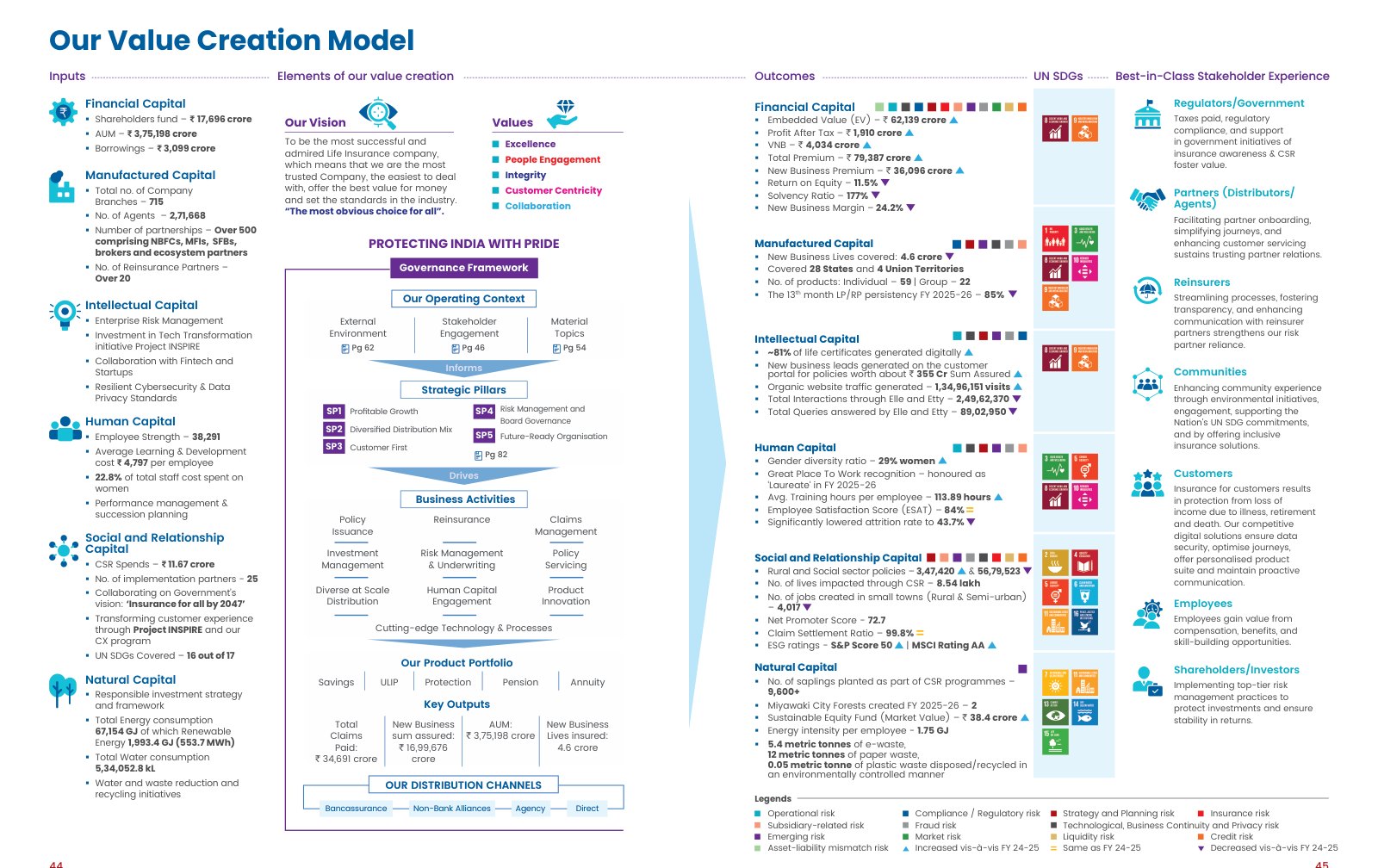
Adani Green Energy (PDF p. 33), Zydus and Tech Mahindra follow the same pattern, with inputs such as equity, debt, operational capacity and headcount stated as numbers rather than adjectives. That consistency across four sectors is the main reason the agency's reports averaged 4.1 on integrated thinking, the widest lead on any criterion in the comparison.
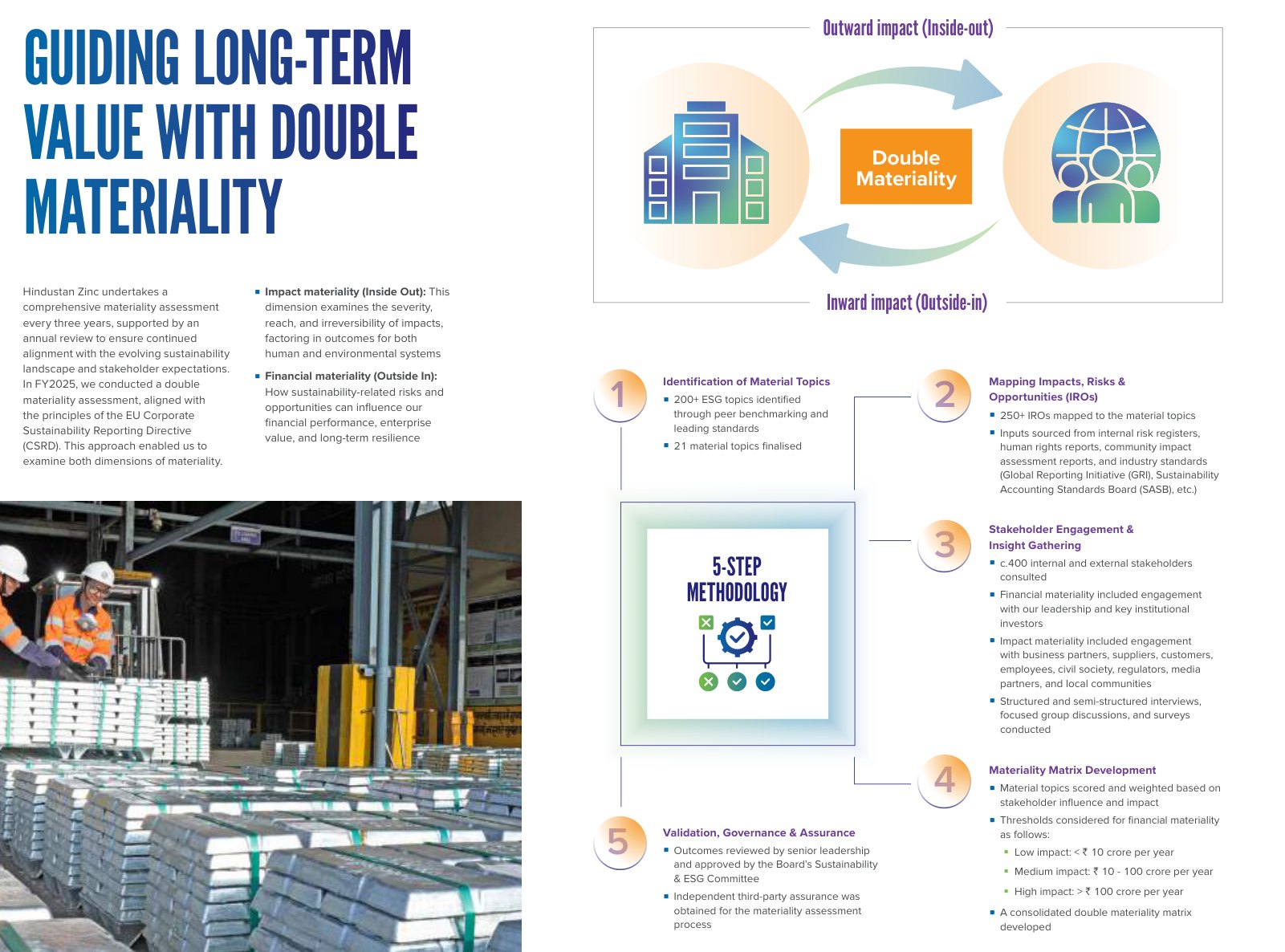
Hindustan Zinc goes a step further. Its materiality section explains a double materiality assessment aligned with the EU's CSRD: around 400 stakeholders consulted, 250-plus impacts, risks and opportunities mapped, 21 material topics, and financial materiality thresholds stated in rupees (under ₹10 crore a year is low impact, over ₹100 crore is high). The process was independently assured. Hindustan Zinc's 30 out of 35 is still the highest score we've given any report.
ESG targets set against what's actually been done
The best-scoring ESG pages in our comparison put the target and the current status side by side, and two of the three examples we singled out were WyattPrism reports. That layout is why the agency averaged 4.3 on BRSR and ESG integration, the highest score for any agency on any criterion.
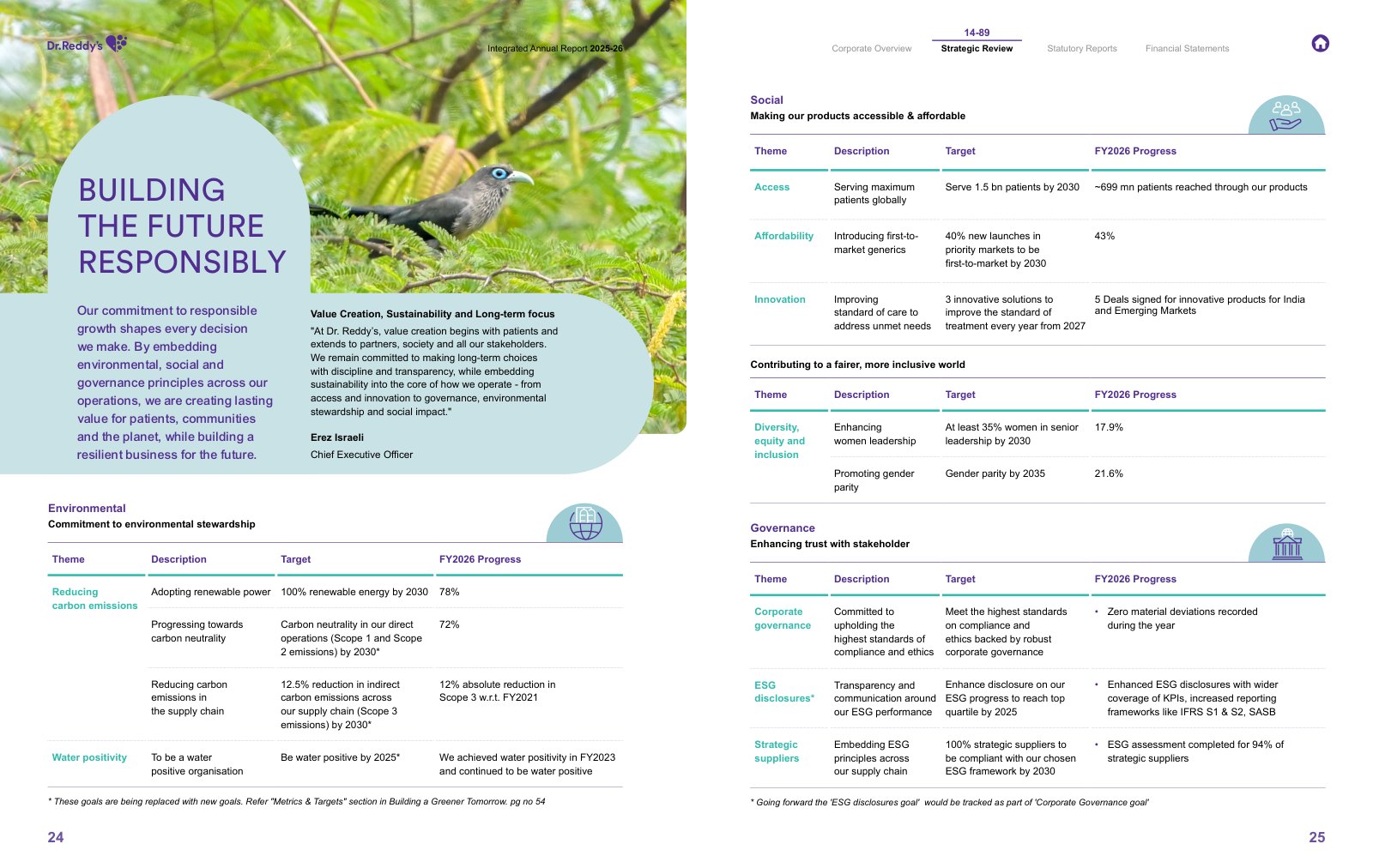
Dr. Reddy's gives a table for each pillar: theme, target, deadline and FY2026 progress. Some are already met (43% of new launches first-to-market against a 2030 target of 40%), others are far off (17.9% women in senior leadership against 35% by 2030, 78% renewable power against 100%). The report doesn't hide the gaps, and it flags goals that are being replaced.
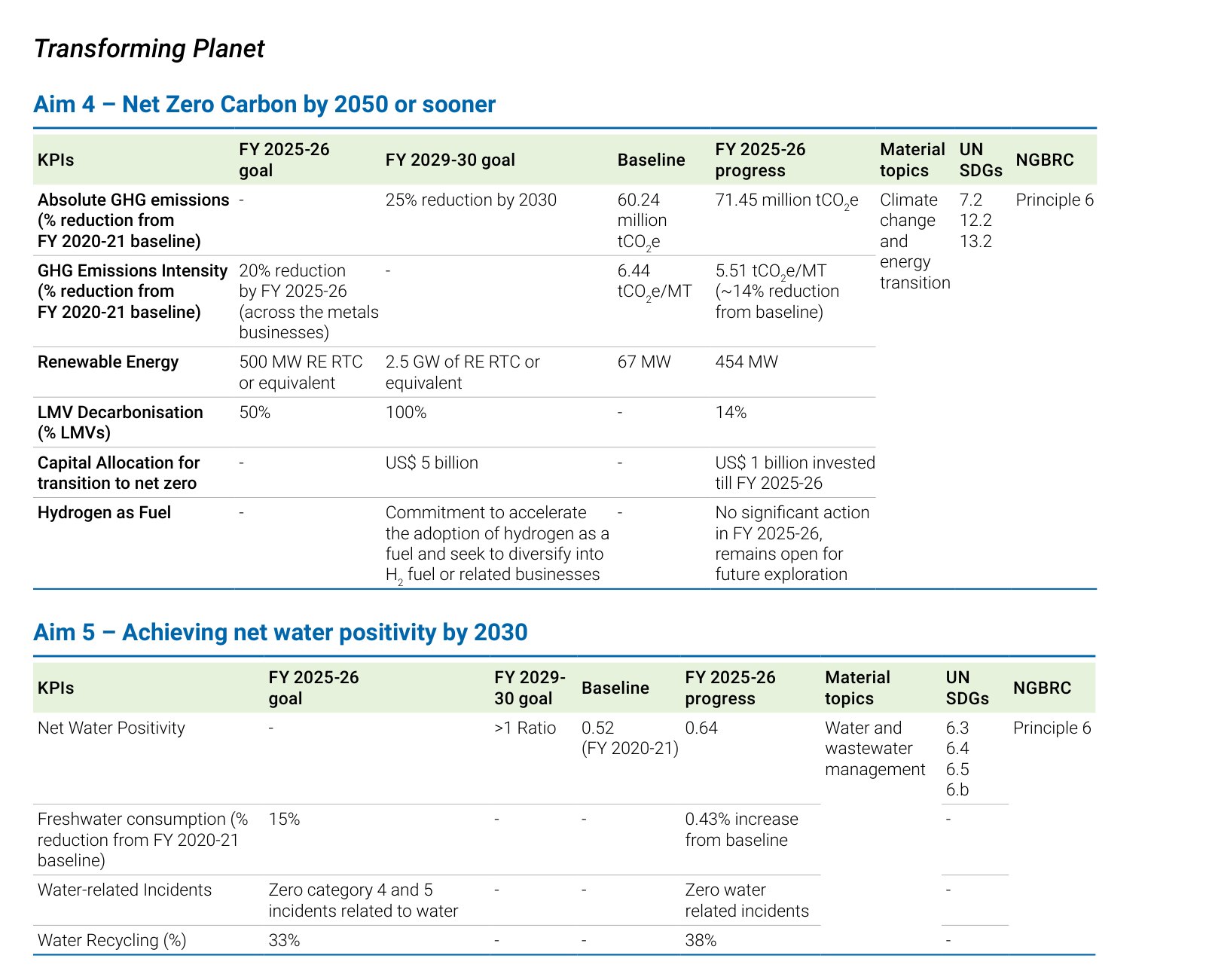
Vedanta's ESG scorecard is blunter still. Against a goal of cutting absolute greenhouse gas emissions 25% by 2030, it reports 71.45 million tonnes of CO2 equivalent against a baseline of 60.24 million. Against a goal of cutting freshwater use 15%, it reports a 0.43% increase. On hydrogen as a fuel, the progress column reads "no significant action". Few Indian reports print their misses this plainly, and it makes the targets they do meet more believable.
KPI pages that keep the bad years in
Financial storytelling averaged 3.7, again the highest of the five agencies. Multi-year KPI pages are standard in Indian reports now. What separates the better ones is whether a dip stays on the chart.
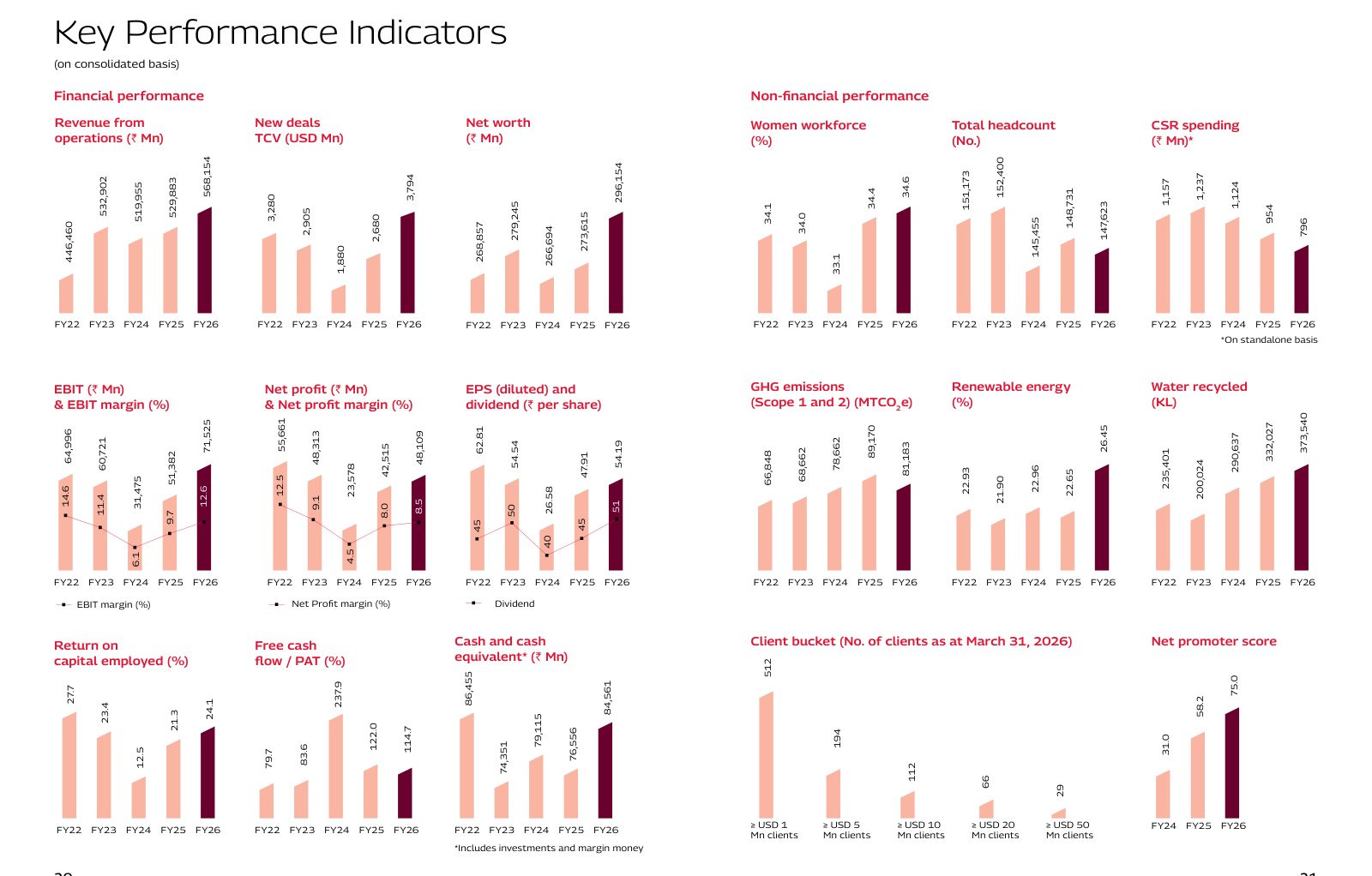
Tech Mahindra's KPI spread shows five years for 17 financial and non-financial measures. FY2024 is plainly a bad year: net profit falls to ₹23,578 million and EBIT margin to 6.1%. CSR spending has fallen for three straight years, from ₹1,237 million to ₹796 million, and it's on the page too. A reader can see the recovery because the trough is shown.
Governance that reports outcomes, not only process
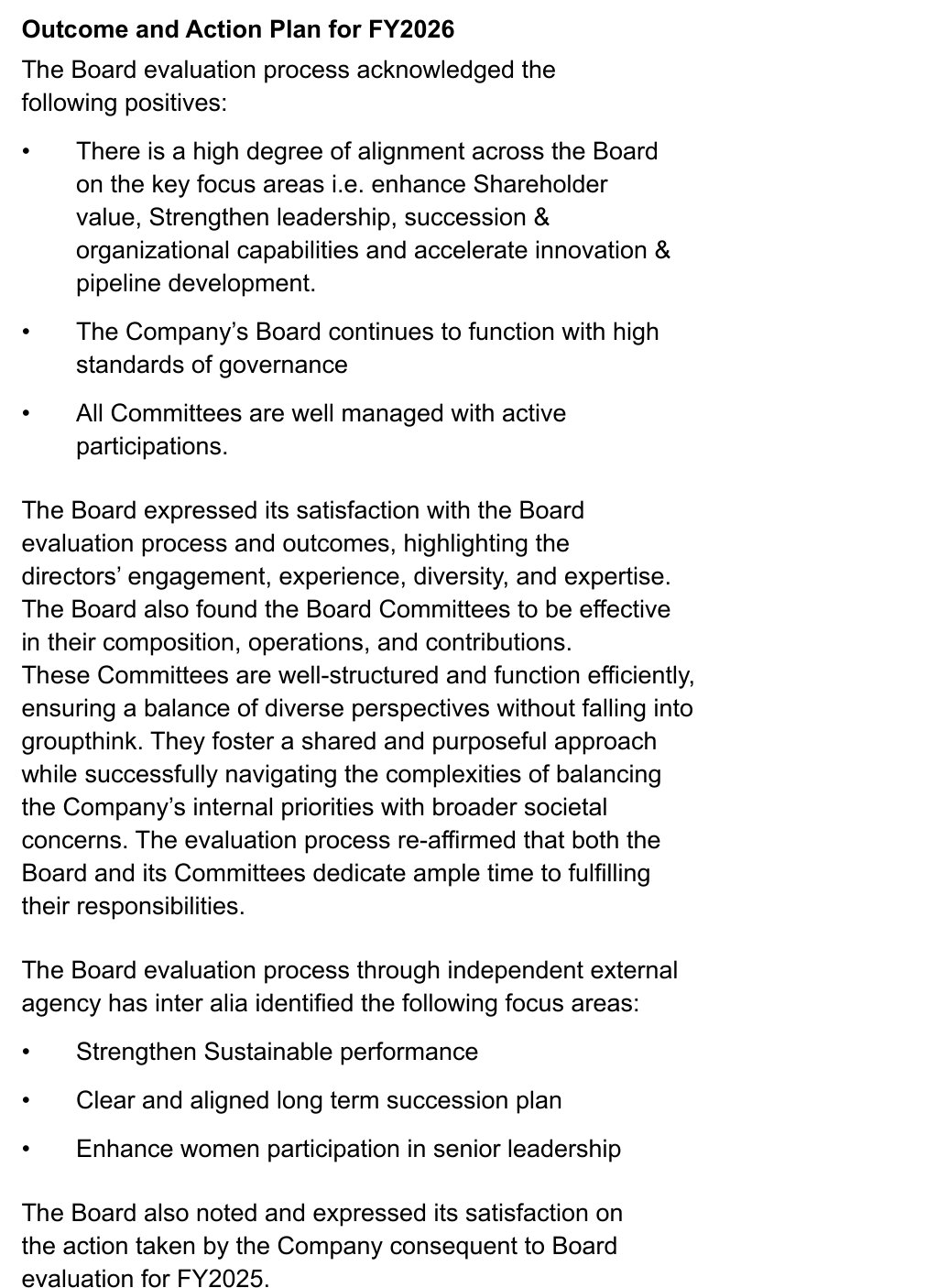
Governance is the flattest criterion in the comparison, and WyattPrism's 3.4 is only a little ahead. The difference shows up in the board evaluation. Most reports describe how the evaluation was done and stop there. Dr. Reddy's is one of only five reports in the whole sample where we found the outcome spelled out: an external agency identified three focus areas (sustainable performance, a clear long-term succession plan and more women in senior leadership), and the board noted the action taken on the previous year's evaluation. The language is still more satisfied than self-critical, but there's something there to hold the board to.
On design, the agency's reports tie with Stirrup's at 3.6. The style is restrained: one visual system, section tabs across the top of most spreads, and layouts that hold up across several hundred pages. It won't win a prize for the most distinctive cover, and it isn't trying to.
Where it's weaker
The digital version is the weakest criterion at 2.6, behind Stirrup's 2.9. That's the same weakness we found at every agency, and we don't know who builds each company's PDF or website, but it still shows. Three of the seven reports have an online edition: Hindustan Zinc, Adani Green Energy and Vedanta. Hindustan Zinc's is the most ambitious in the sample, with a generative AI assistant that answers questions about the report. We found no online edition for Dr. Reddy's, Tech Mahindra, HDFC Life or Zydus.
Candour in the front section is the other gap. Strategy and narrative averaged 3.4, behind Stirrup. Dr. Reddy's leadership letter (PDF p. 4) doesn't mention that net profit fell 26%, which the MD&A states plainly (PDF p. 60). For a report that's so direct about its ESG misses, the silence in the letter stands out.
Special mention: generative AI alongside the report
WyattPrism's digital work runs through RDX Digital, a WyattPrism Communications subsidiary that acts as its in-house team for designing and developing digital reports and AI tools for clients. Beyond the seven reports scored here, that work includes generative AI experiences built alongside digital annual reports. They aren't part of our sample or its scores, but they show where a digital edition can go.
Jubilant Ingrevia's VIA answers questions from the company's FY26 annual report and nothing else. Every figure it gives links to the page it came from, it says when the report doesn't cover a question, and a toggle lets it answer from the FY26 and FY25 reports together. SRF's SRFi works the same way on SRF's FY26 report, with suggested questions and a sources panel that links each answer back into the report. SRF's Audio Intelligence page reads the report aloud, chapter by chapter, in English and Hindi: 17 episodes across the corporate overview, ESG, the capitals and the statutory reports.
Who it suits
Judging only from these seven reports, WyattPrism's work fits large listed companies that already publish an integrated report, or are ready to, and want the integrated parts to carry real numbers: a quantified value creation model, materiality with stated thresholds, and ESG targets reported against status. That's especially relevant for companies in sectors with heavy ESG scrutiny, such as metals and mining, energy, pharmaceuticals and financial services, where the BRSR and the integrated report have to agree.
Our sample can't tell us how the agency handles a conventional annual report, because every report in it is integrated. And any company hiring it, or anyone else, should write the digital edition and a final check of the letters against the MD&A into the brief. The agency describes itself on its website as annual report specialists, with offices in Gurgaon, Mumbai, Kolkata and Bengaluru.
The seven reports
| Company | Credit wording | Score /35 |
|---|---|---|
| Hindustan Zinc | Concept, Content & Design | 30 |
| Dr. Reddy's | Concept, Content & Design | 27 |
| Tech Mahindra | Concept, Content & Design | 25 |
| Vedanta | Concept, Content & Design | 25 |
| Adani Green Energy | Concept, Content & Design | 24 |
| HDFC Life | Concept & Design | 24 |
| Zydus Lifesciences | Concept, Content & Design | 21 |
Average 25.1, median 25, range 21 to 30. Page references are to the PDF each company published; several are spread-view files, where one PDF page holds two printed pages. For the method, the full criterion table and how WyattPrism compares with Adsvita, Kalolwala & Associates, Report Yak and Stirrup, see our comparison of five annual report agencies.
Frequently asked questions
Which annual reports did WyattPrism make for FY2025-26?
Our sample of seven reports credited to WyattPrism includes Hindustan Zinc, Dr. Reddy's Laboratories, Tech Mahindra, Vedanta, Adani Green Energy, HDFC Life and Zydus Lifesciences. Six carry the credit 'Concept, Content & Design' and HDFC Life's carries 'Concept & Design'. The agency will have produced other reports that aren't in our sample.
How did WyattPrism's annual reports score?
The seven averaged 25.1 out of 35 on our seven-criterion card, the highest of the five agencies we compared, with a median of 25 and a range of 21 to 30. Hindustan Zinc scored 30, Dr. Reddy's 27, Tech Mahindra and Vedanta 25 each, Adani Green Energy and HDFC Life 24 each, and Zydus Lifesciences 21. All seven are integrated reports, which helps the score; compared only with other agencies' integrated reports, the lead is smaller.
What is WyattPrism strongest at in annual reports?
On our card, integrated thinking and ESG integration, where its reports averaged 4.1 and 4.3 out of 5. The reports routinely build a value creation model with figures for every capital, and the better ones report ESG targets against current status, including targets the company hasn't met yet.
Where are WyattPrism's annual reports weaker?
The digital version, which averaged 2.6 out of 5, behind Stirrup's 2.9. Four of the seven reports have no online edition that we could find. Leadership letters don't always carry bad news that appears later in the report.
Does the credit mean WyattPrism wrote the whole report?
Not necessarily. The credit shows what the company chose to print, not the scope of the engagement. Finance teams, company secretaries and auditors write and approve much of any annual report, and statutory sections are sometimes typeset elsewhere. Our scores are of the published report.
Sources
- WyattPrism Communications: Annual Report Specialists — WyattPrism Communications
- Hindustan Zinc Integrated Annual Report FY2025-26 (online edition) — Hindustan Zinc Limited
- Business Responsibility and Sustainability Report format (Annexure II) — SEBI